
Table of Contents
As filed with the Securities and Exchange Commission on September 28, 2026
Securities Act File No. 333-
Investment Company Act file No. 811-22554
UNITED STATES
SECURITIES AND EXCHANGE COMMISSION
Washington, D.C. 20549
FORM N-2
| REGISTRATION STATEMENT | ☒ |
UNDER
| THE SECURITIES ACT OF 1933 | ||||
| Pre-Effective Amendment No. | ☐ | |||
| Post-Effective Amendment No. | ☐ |
and
REGISTRATION STATEMENT
UNDER
| THE INVESTMENT COMPANY ACT OF 1940 | ☒ | |||
| Amendment No. 24 | ☒ |
Carlyle Credit Income Fund
(Exact name of registrant as specified in its charter)
One Vanderbilt Avenue, Suite 3400
New York, NY 10017
(212) 813-4900
(Address and telephone number, including area code, of principal executive offices)
Joshua Lefkowitz, Esq.
Carlyle Credit Income Fund
One Vanderbilt Avenue, Suite 3400
New York, NY 10017
(Name and address of agent for service)
WITH COPIES TO:
Rajib Chanda, Esq.
Steven Grigoriou, Esq.
Jonathan H. Pacheco, Esq.
Simpson Thacher & Bartlett LLP
900 G Street, N.W.
Washington DC 20001
(202) 636-5500
Approximate Date of Commencement of Proposed Public Offering: From time to time after the effective date of this Registration Statement.
| ☐ | Check box if the only securities being registered on this Form are being offered pursuant to dividend or interest reinvestment plans. |
Table of Contents
| ☒ | Check box if any securities being registered on this Form will be offered on a delayed or continuous basis in reliance on Rule 415 under the Securities Act of 1933 (“Securities Act”), other than securities offered in connection with a dividend reinvestment plan. |
| ☒ | Check box if this Form is a registration statement pursuant to General Instruction A.2 or a post-effective amendment thereto. |
| ☐ | Check box if this Form is a registration statement pursuant to General Instruction B or a post-effective amendment thereto that will become effective upon filing with the Commission pursuant to Rule 462(e) under the Securities Act. |
| ☐ | Check box if this Form is a post-effective amendment to a registration statement filed pursuant to General Instruction B to register additional securities or additional classes of securities pursuant to Rule 413(b) under the Securities Act. |
It is proposed that this filing will become effective (check appropriate box):
| ☐ | when declared effective pursuant to Section 8(c) of the Securities Act. |
If appropriate, check the following box:
| ☐ | This post-effective amendment designates a new effective date for a previously filed post-effective amendment registration statement. |
| ☐ | This Form is filed to register additional securities for an offering pursuant to Rule 462(b) under the Securities Act, and the Securities Act registration statement number of the earlier effective registration statement for the same offering is: . |
| ☐ | This Form is a post-effective amendment filed pursuant to Rule 462(c) under the Securities Act, and the Securities Act registration statement number of the earlier effective registration statement for the same offering is: . |
| ☐ | This Form is a post-effective amendment filed pursuant to Rule 462(d) under the Securities Act, and the Securities Act registration statement number of the earlier effective registration statement for the same offering is: . |
Check each box that appropriately characterizes the Registrant:
| ☒ | Registered Closed-End Fund (closed-end company that is registered under the Investment Company Act of 1940 (“Investment Company Act”)). |
| ☐ | Business Development Company (closed-end company that intends or has elected to be regulated as a business development company under the Investment Company Act). |
| ☐ | Interval Fund (Registered Closed-End Fund or a Business Development Company that makes periodic repurchase offers under Rule 23c-3 under the Investment Company Act). |
| ☒ | A.2 Qualified (qualified to register securities pursuant to General Instruction A.2 of this Form). |
| ☐ | Well-Known Seasoned Issuer (as defined by Rule 405 under the Securities Act). |
| ☐ | Emerging Growth Company (as defined by Rule 12b-2 under the Securities Exchange Act of 1934 (“Exchange Act”)). |
| ☐ | If an Emerging Growth Company, indicate by check mark if the registrant has elected not to use the extended transition period for complying with any new or revised financial accounting standards provided pursuant to Section 7(a)(2)(B) of Securities Act. |
| ☐ | New Registrant (registered or regulated under the Investment Company Act for less than 12 calendar months preceding this filing). |
The Registrant hereby amends this Registration Statement on such date or dates as may be necessary to delay its effective date until the Registrant shall file a further amendment which specifically states that this Registration Statement shall thereafter become effective in accordance with Section 8(a) of the Securities Act of 1933 or until the Registration Statement shall become effective on such date as the Securities and Exchange Commission, acting pursuant to said Section 8(a), may determine.
Table of Contents
The information in this preliminary prospectus is not complete and may be changed. We may not sell these securities until the Registration Statement filed with the Securities and Exchange Commission is effective. This preliminary prospectus is not an offer to sell these securities and is not soliciting an offer to buy these securities in any jurisdiction where the offer or sale is not permitted.
Subject to Completion, Preliminary Prospectus Dated September 28, 2026
PRELIMINARY PROSPECTUS
$250,000,000
Carlyle Credit Income Fund
Common Shares
Preferred Shares
Subscription Rights
Debt Securities
Carlyle Credit Income Fund (the “Fund”) is a non-diversified, closed-end management investment company that has registered as an investment company under the Investment Company Act of 1940, as amended, or the “1940 Act.”
Investment Objective. The Fund’s primary investment objective is to generate current income, with a secondary objective to generate capital appreciation.
Principal Investment Strategies. We seek to achieve our investment objectives by investing primarily in equity and junior debt tranches of collateralized loan obligations, or “CLOs,” that are collateralized by a portfolio consisting primarily of below investment grade U.S. senior secured loans with a large number of distinct underlying borrowers across various industry sectors. We may also invest in other related securities and instruments or other securities and instruments that the Adviser believes are consistent with our investment objectives, including senior debt tranches of CLOs, loan accumulation facilities (“LAFs”) and securities issued by other securitization vehicles. LAFs are short- to medium-term facilities often provided by the bank that will serve as the placement agent or arranger on a CLO transaction. LAFs typically incur leverage between four and six times equity value prior to a CLO’s pricing. The CLO securities in which we primarily seek to invest are unrated or rated below investment grade and are considered speculative with respect to timely payment of interest and repayment of principal. Unrated and below investment grade securities are also sometimes referred to as “junk” securities. In addition, the CLO equity and junior debt securities in which we invest are highly leveraged (with CLO equity securities typically being leveraged ten times), which magnifies our risk of loss on such investments. See “Risk Factors—Risks Related to Our Investments—We may leverage our portfolio, which would magnify the potential for gain or loss on amounts invested and will increase the risk of investing in us.”
Under normal circumstances, we invest at least 80% of the aggregate of the Fund’s net assets and borrowings for investment purposes in credit and credit-related instruments. For purposes of this policy, the Fund considers credit and credit-related instruments to include, without limitation: (i) equity and debt tranches of CLOs, LAFs and securities issued by other securitization vehicles; (ii) secured and unsecured floating rate and fixed rate loans; (iii) investments in corporate debt obligations, including bonds, notes, debentures, commercial paper and other obligations of corporations to pay interest and repay principal; (iv) debt issued by governments, their agencies, instrumentalities, and central banks; (v) commercial paper and short-term notes; (vi) convertible debt securities; (vii) certificates of deposit, bankers’ acceptances and time deposits; and (viii) other credit-related instruments. The Fund’s investments in derivatives, other investment companies, and other instruments designed to obtain indirect exposure to credit and credit-related instruments will be counted towards its 80% investment policy to the extent such instruments have similar economic characteristics to the investments included within that policy.
Our 80% policy with respect to investments in credit and credit-related instruments is not fundamental and may be changed by our board of trustees without Shareholder approval. Shareholders will be provided with sixty (60) days’ notice in the manner prescribed by the SEC before making any change to this policy.
Table of Contents
Investment Adviser. The investment adviser to the Fund is Carlyle Global Credit Investment Management L.L.C. (“CGCIM” or the “Adviser”). CGCIM is registered as an investment adviser with the U.S. Securities and Exchange Commission (the “SEC”) under the Investment Advisers Act of 1940, as amended (the “Advisers Act”). CGCIM is a wholly owned subsidiary of Carlyle Investment Management L.L.C. (“CIM” and together with CGCIM, “Carlyle”).
Securities Offered. Our shares of beneficial interest (the “common shares”), preferred shares of beneficial interest (“preferred shares”), debt securities or subscription rights to purchase our securities (collectively, the “securities”) may be offered at prices and on terms to be disclosed in one or more supplements to this prospectus. You should read this prospectus and the applicable prospectus supplement carefully before you invest in our securities. The securities may be offered directly to one or more purchasers, or through agents designated from time to time by us, or to or through underwriters or dealers. Each prospectus supplement relating to an offering will identify any agents or underwriters involved in the sale of the securities, and will disclose any applicable purchase price, fee, discount or commissions arrangement between us and our agents or underwriters or among our underwriters or the basis upon which such amount may be calculated. See “Plan of Distribution” in this prospectus. We may not sell any of the securities pursuant to this registration statement through agents, underwriters or dealers without delivery of this prospectus and a prospectus supplement describing the method and terms of the offering of such securities.
Our common shares are traded on the New York Stock Exchange (“NYSE”) under the symbol “CCIF.” Prior to July 27, 2023, the Fund’s common shares traded on NYSE under the symbol “VCIF.” As of September 25, 2026, the last reported sales price of our common shares on the NYSE was $2.42 per share. The net asset value per common share at August 31, 2026 (the last date prior to the date of this prospectus for which we reported net asset value) was $3.23.
As of September 16, 2026, the aggregate market value of our outstanding common shares held by non-affiliates, or the public float, was approximately $40,636,449, which was calculated based on approximately 16,189,820 shares of outstanding common shares held by non-affiliates and on a price per share of $2.51, the closing price of our common shares on September 16, 2026. Pursuant to certain SEC rules, in no event will we sell our securities in a public primary offering with a value exceeding more than one-third of our public float in any 12-month period so long as our public float remains below $75.0 million. We have not offered any securities pursuant to the SEC rules noted above during the 12 calendar months prior to and including the date of this prospectus.
Common shares of closed-end management investment companies that are listed on an exchange frequently trade at a discount to their net asset value (“NAV”). If our common shares trade at a discount to our NAV, it will likely increase the risk of loss for purchasers of our securities.
Investing in our securities involves a high degree of risk, including the risk of a substantial loss of investment. Before purchasing any securities, you should read the discussion of the principal risks of investing in our securities, which are summarized in “Risk Factors” beginning on page 24 of this prospectus.
This prospectus contains important information you should know before investing in our securities. Please read this prospectus and retain it for future reference. We file annual and semi-annual shareholder reports, proxy statements and other information with the Securities and Exchange Commission, or the “SEC.” To obtain this information free of charge or make other inquiries pertaining to us, please visit our website (www.carlylecreditincomefund.com) or call (866) 277-8243 (toll-free). You may also obtain a copy of any information regarding us filed with the SEC from the SEC’s website (www.sec.gov). Information on our website and the SEC’s website is not incorporated into or a part of this prospectus.
Neither the SEC nor any state securities commission has approved or disapproved of these securities or determined that this prospectus is truthful or complete. Any representation to the contrary is a criminal offense.
The date of this prospectus is , 2026
Table of Contents
| Page | ||||
| ii | ||||
| 1 | ||||
| 16 | ||||
| 19 | ||||
| 24 | ||||
| 66 | ||||
| 67 | ||||
| INVESTMENT OBJECTIVE, OPPORTUNITIES AND PRINCIPAL STRATEGIES |
67 | |||
| 75 | ||||
| 76 | ||||
| 80 | ||||
| 89 | ||||
| 91 | ||||
| 94 | ||||
| 95 | ||||
| 98 | ||||
| 99 | ||||
| 103 | ||||
| 105 | ||||
| 118 | ||||
| 120 | ||||
| 130 | ||||
| 132 | ||||
| 134 | ||||
| 138 | ||||
| 139 | ||||
| 140 | ||||
| 141 | ||||
| 142 | ||||
| 143 | ||||
| 144 | ||||
| 151 | ||||
******
We have not authorized any person to provide you with different information from that contained in or incorporated by reference in this prospectus. We are not making an offer to sell these securities in any jurisdiction where the offer or sale is not permitted. You should assume that the information appearing in this prospectus is accurate only as of the date on the front cover of this prospectus. Our business, financial condition and results of operations may have changed since that date. We will notify security holders promptly of any material change to this prospectus during the period in which we are required to deliver the prospectus.
i
Table of Contents
This prospectus is part of a registration statement that we have filed with the SEC using the “shelf” registration process. Under the shelf registration process, we may offer from time to time up to $250,000,000 of our securities on the terms to be determined at the time of the offering, subject to, if applicable, the SEC rules referred to on the cover page of this Registration Statement. We may sell our securities through underwriters or dealers, “at-the-market” to or through a market maker, into an existing trading market or otherwise directly to one or more purchasers or through agents or through a combination of methods of sale. The identities of such underwriters, dealers, market makers or agents, as the case may be, will be described in one or more supplements to this prospectus. The securities may be offered at prices and on terms described in one or more supplements to this prospectus. This prospectus provides you with a general description of the securities that we may offer. Each time we use this prospectus to offer securities, we will provide a prospectus supplement that will contain specific information about the terms of that offering. The prospectus supplement may also add, update or change information contained in this prospectus, and the prospectus and prospectus supplement will together serve as the prospectus. Please carefully read this prospectus and any prospectus supplement, together with any exhibits, before you make an investment decision.
ii
Table of Contents
The following summary highlights some of the information contained in this prospectus. It is not complete and may not contain all the information that is important to a decision to invest in our securities. You should read carefully the more detailed information set forth under “Risk Factors” and the other information included in this prospectus and any applicable prospectus supplement. Except where the context suggests otherwise, the terms:
| • | The “Fund,” “we,” “us,” and “our” refer to Carlyle Credit Income Fund, a Delaware statutory trust; and is registered under the Investment Company Act of 1940, as amended (the “1940 Act”), as a non-diversified, closed-end management investment company. |
| • | The “Adviser” refers to Carlyle Global Credit Investment Management L.L.C. (“CGCIM”); and is an SEC-registered investment adviser. |
| • | The “Administrator” refers to SS&C Technologies, Inc. |
| • | “Risk-adjusted returns” refers to the profile of expected asset returns across a range of potential macroeconomic scenarios, and does not imply that a particular strategy or investment should be considered low-risk. |
Carlyle Credit Income Fund
The Fund is a non-diversified, closed-end management investment company that has registered as an investment company under the 1940 Act. We have elected to be treated, and intend to qualify annually, as a regulated investment company, or “RIC,” under Subchapter M of the Internal Revenue Code of 1986, as amended, or the “Code.” Prior to 2023, the Fund was known as Vertical Capital Income Fund.
The Fund’s primary investment objective is to generate current income, with a secondary objective to generate capital appreciation. We seek to achieve our investment objectives by investing primarily in equity and junior debt tranches of collateralized loan obligations, or “CLOs”, that are collateralized by a portfolio consisting primarily of below investment grade U.S. senior secured loans with a large number of distinct underlying borrowers across various industry sectors. We may also invest in other related securities and instruments or other securities and instruments that the Adviser believes are consistent with our investment objectives, including senior debt tranches of CLOs, loan accumulation facilities (“LAFs”) and securities issued by other securitization vehicles. We may also acquire securities issued by exchange-traded funds (“ETFs”), and may otherwise invest indirectly in securities consistent with our investment objectives, including through a joint venture vehicle in which the Fund shares equal control of the vehicle with another party. The amount that we will invest in other securities and instruments, which may include investments in debt and other securities issued by CLOs collateralized by non-U.S. loans or securities of other collective investment vehicles, will vary from time to time and, as such, may constitute a material part of our portfolio on any given date, all as based on the Adviser’s assessment of prevailing market conditions. From time to time, the Fund may receive rebates of fees paid by the Fund from the CLO issuer in connection with the acquisition of CLO equity.
The CLO securities in which we primarily seek to invest are rated below investment grade or, in the case of CLO equity securities, are unrated, and are considered speculative with respect to timely payment of interest and repayment of principal. Unrated and below investment grade securities are also sometimes referred to as “junk” securities. In addition, the CLO equity and junior debt securities in which we invest are highly leveraged (with CLO equity securities typically being leveraged ten times), which magnifies our risk of loss on such investments. LAFs are short- to medium-term facilities often provided by the bank that will serve as the placement agent or arranger on a CLO transaction. LAFs typically incur leverage between four and six times equity value prior to a CLO’s pricing.
1
Table of Contents
These investment objectives and strategies are not fundamental policies of ours and may be changed by our board of trustees (the “Board”) without prior approval of our Shareholders. See “Regulation as a Closed-End Management Investment Company.”
The Adviser pursues a differentiated strategy within the CLO market focused on:
| • | proactive sourcing and identification of investment opportunities; |
| • | utilization of the Adviser’s methodical investment analysis and due diligence process; |
| • | active involvement at the CLO structuring and formation stage; and |
| • | taking, in many instances, significant stakes in CLO equity and junior debt tranches. |
In conducting its investment activities, the Fund believes that it will benefit from the significant scale and resources of Carlyle and its affiliates.
The Fund will seek to source opportunities through Carlyle’s extensive global relationships and proprietary network and through the deep infrastructure Carlyle has developed in each of the Fund’s credit strategies, including:
| • | Carlyle’s well-established sponsor, bank and lending relationships cultivated over 30+ years, including ~1,000 lending relationships across the firm. |
| • | Scale of capital with approximately $211 billion of assets under management in Carlyle’s Global Credit group and 200+ dedicated credit investment professionals. |
| • | A broad network of dealer, investor, and manager relationships that Carlyle has developed during its 20+-year track record managing CLOs. |
| • | Integrated efforts with cross-platform sourcing capabilities and referrals from both internal and external Carlyle networks. |
| • | Ability to leverage the OneCarlyle platform1 with 775+ origination and underwriting resources and global knowledge base across Global Credit, Global Private Equity, and Carlyle AlpInvest. |
We believe that the Adviser’s (1) direct and often longstanding relationships with CLO collateral managers, CLO primary desks of investment banks, and CLO secondary trading desks of investment banks and broker-dealers, (2) CLO structural expertise and (3) relative scale in the CLO market will enable us to source and execute investments with attractive economics and terms relative to other CLO opportunities.
When we make a significant primary market investment in a particular CLO tranche, we generally expect to be able to influence the CLO’s key terms and conditions. We may acquire a majority position in a CLO tranche directly, or we may benefit from the advantages of a majority position where both we and other accounts managed by the Adviser collectively hold a majority position, subject to any restrictions on our ability to invest alongside such other accounts. See “Conflicts of Interest.”
We seek to construct a portfolio of CLO securities that provides varied exposure across a number of key categories, including:
| • | number of borrowers underlying each CLO; |
| 1 | The OneCarlyle platform consists of Carlyle’s global network of professionals, senior advisors, portfolio company resources, and industry contacts. Within the firm, the platform includes 1,000 Investor Services professionals who are dedicated resources to Carlyle’s limited partners. Additionally, Carlyle’s Global Credit business operates its three business segments, Liquid Credit, Private Credit and Real Assets Credit, in an integrated manner which Carlyle believes provides significant competitive advantages through shared information, resources and investment capabilities. |
2
Table of Contents
| • | industry type of a CLO’s underlying borrowers; |
| • | number and investment style of CLO collateral managers; and |
| • | CLO vintage period. |
The Adviser has a long-term investment horizon and invests primarily with a buy-and-hold mentality. However, on an ongoing basis, the Adviser actively monitors each investment and may sell positions if circumstances change from the time of investment or if the Adviser believes it is in our best interest to do so.
“Names Rule” Policy
In accordance with the requirements of the 1940 Act, we have adopted a policy to invest at least 80% of our assets in the particular type of investments suggested by our name. Accordingly, under normal circumstances, we invest at least 80% of the aggregate of our net assets and borrowings for investment purposes in credit and credit-related instruments. For purposes of this policy, the Fund considers credit and credit-related instruments to include, without limitation: (i) equity and debt tranches of CLOs, LAFs and securities issued by other securitization vehicles; (ii) secured and unsecured floating rate and fixed rate loans; (iii) investments in corporate debt obligations, including bonds, notes, debentures, commercial paper and other obligations of corporations to pay interest and repay principal; (iv) debt issued by governments, their agencies, instrumentalities, and central banks; (v) commercial paper and short-term notes; (vi) convertible debt securities; (vii) certificates of deposit, bankers’ acceptances and time deposits; and (viii) other credit-related instruments. The Fund’s investments in derivatives, other investment companies, and other instruments designed to obtain indirect exposure to credit and credit-related instruments will be counted towards its 80% investment policy to the extent such instruments have similar economic characteristics to the investments included within that policy.
Our 80% policy with respect to investments in credit and credit-related instruments is not fundamental and may be changed by the Board without prior approval of our Shareholders. Shareholders will be provided with sixty (60) days’ notice in the manner prescribed by the SEC before making any change to this policy.
Carlyle Global Credit Investment Management L.L.C.
CGCIM serves as the Fund’s investment adviser. CGCIM is registered as an investment adviser with the SEC under the Advisers Act. CGCIM is a wholly-owned subsidiary of CIM.
Carlyle is a global investment firm with approximately $485 billion of assets under management as of June 30, 2026 across 700+ active investment vehicles. The firm also has a large and diversified investor base with 3,300+ active fund investors located in approximately 88 countries.
Carlyle combines global vision with local insight, relying on a team of 775+ investment professionals operating out of 28 offices in 17 countries to uncover superior opportunities in Africa, Asia, Australia, Europe, Latin America, the Middle East and North America.
Principal Investment Strategies
CLO Overview
Our investment portfolio is comprised primarily of investments in the equity and junior debt tranches of CLOs that are collateralized by a portfolio consisting primarily of below investment grade U.S. senior secured loans with a large number of distinct underlying borrowers across various industry sectors. CLOs are generally backed
3
Table of Contents
by an asset or a pool of assets that serve as collateral. Most CLOs are issued in multiple tranches, offering investors various maturity and credit risk characteristics, often categorized as senior, mezzanine and subordinated/equity according to their degree of risk. Generally, a CLO’s indenture requires that the maturity dates of a CLO’s assets, typically five to eight years from the date of issuance of a senior secured loan, be shorter than the maturity date of the CLO’s liabilities, typically 12 to 13 years from the date of issuance. If there are defaults or the relevant collateral otherwise underperforms, scheduled payments to senior tranches of such securities take precedence over those of junior tranches which are the focus of our investment strategy, and scheduled payments to junior tranches have a priority in right of payment to subordinated/equity tranches. While the vast majority of the portfolio of most CLOs consists of senior secured loans, many CLOs enable the CLO collateral manager to invest up to 10% of the portfolio in assets that are not first lien senior secured loans, including second lien loans, unsecured loans, senior secured bonds and senior unsecured bonds.
CLOs are generally required to hold a portfolio of assets that is highly diversified by underlying borrower and industry and that is subject to a variety of asset concentration limitations. Most CLOs are non-static, revolving structures that generally allow for reinvestment over a specific period of time (the “reinvestment period”) which is typically up to five years. The terms and covenants of a typical CLO structure are, with certain exceptions, based primarily on the cash flow generated by, and the par value (as opposed to the market price or fair value) of, the collateral. These covenants include collateral coverage tests, interest coverage tests and collateral quality tests.
A CLO funds the purchase of a portfolio of primarily senior secured loans via the issuance of CLO equity and debt securities in the form of multiple, primarily floating rate, debt tranches. The CLO debt tranches typically are rated “AAA” (or its equivalent) at the most senior level down to “BB” or “B” (or its equivalent), which is below investment grade, at the junior level by Moody’s Investors Service, Inc., or “Moody’s,” S&P Global Ratings, or “S&P,” and/or Fitch Ratings, Inc., or “Fitch.” The interest rate on the CLO debt tranches is the lowest at the AAA-level and generally increases at each level down the rating scale. The CLO equity tranche is unrated and typically represents approximately 8% to 11% of a CLO’s capital structure. Below investment grade and unrated securities are sometimes referred to as “junk” securities. The diagram below is for illustrative purposes only and highlights a hypothetical structure intended to depict a typical CLO. A minority of CLOs also include a B-rated debt tranche (in which we may invest), and the structure of CLOs in which we invest may otherwise vary from this example. The left column represents the CLO’s assets, which support the liabilities and equity in the right column. The right column shows the various classes of debt and equity issued by the hypothetical CLO in order of seniority
4
Table of Contents
as to rights in payments from the assets. The percentage ranges appearing below the rating of each class represents the percent such class comprises of the overall “capital stack” (i.e., total debt and equity issued by the CLO).
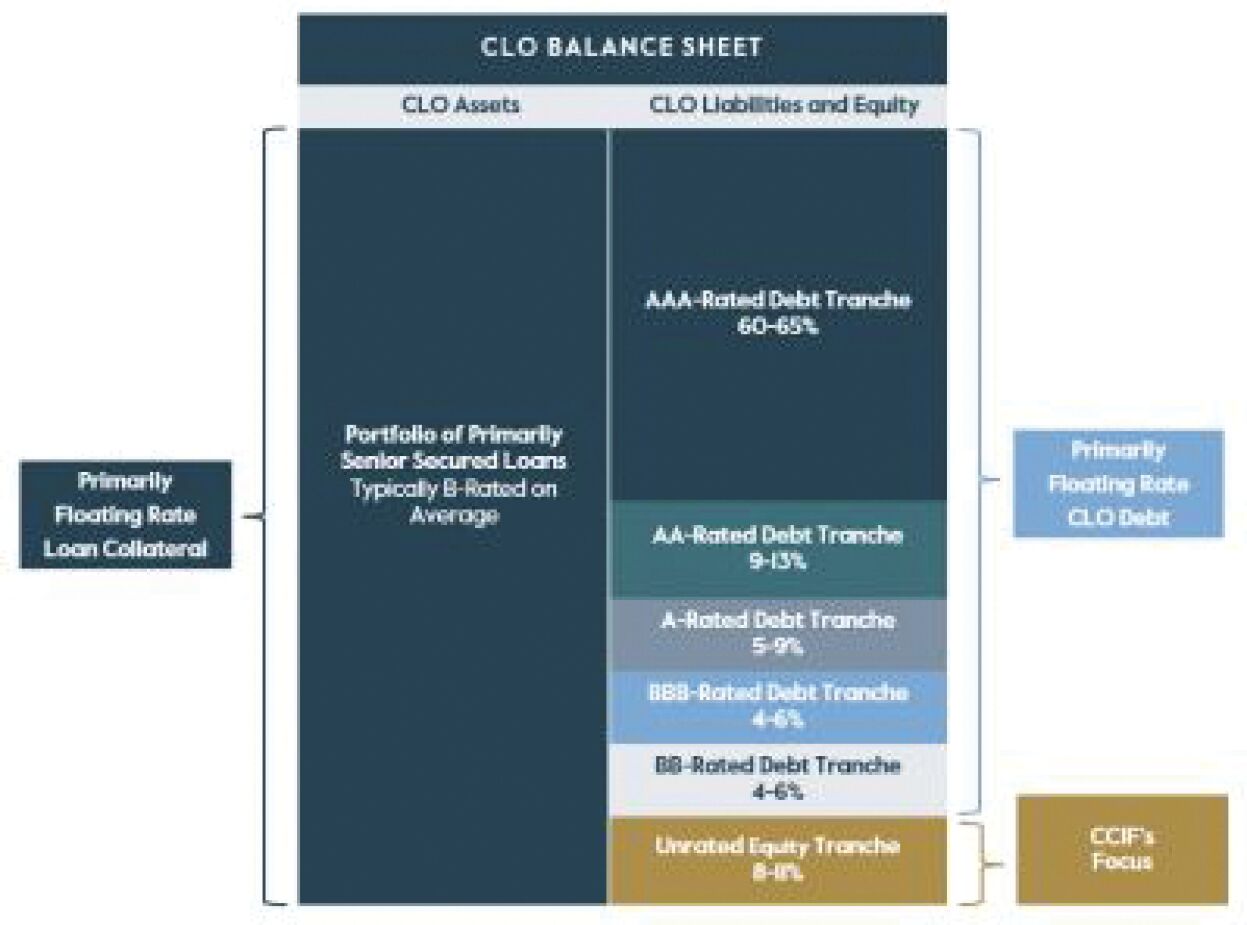
CLOs have two priority-of-payment schedules (commonly called “waterfalls”), which are detailed in a CLO’s indenture and govern how cash generated from a CLO’s underlying collateral is distributed to the CLO’s equity and debt investors. The interest waterfall applies to interest payments received on a CLO’s underlying collateral.
The principal waterfall applies to cash generated from principal on the underlying collateral, primarily through loan repayments and the proceeds from loan sales. Through the interest waterfall, any excess interest-related cash flow available after the required quarterly interest payments to CLO debt investors are made and certain CLO expenses (such as administration and collateral management fees) are paid is then distributed to the CLO’s equity investors each quarter, subject to compliance with certain tests.
A CLO’s indenture typically requires that the maturity dates of a CLO’s assets, typically five to eight years from the date of issuance of a senior secured loan, be shorter than the maturity date of the CLO’s liabilities, typically 12 to 13 years from the date of issuance. However, CLO investors do face reinvestment risk with respect to a CLO’s underlying portfolio. In addition, in most CLO transactions, CLO debt investors are subject to prepayment risk in that the holders of a majority of the equity tranche can direct a call or refinancing of a CLO, which would cause the CLO’s outstanding CLO debt securities to be repaid at par. See “Risk Factors—Risks Related to Our Investments—We and our investments are subject to reinvestment risk.”
Financing and Hedging Strategy
Leverage by the Fund. Subject to prevailing market conditions, the Fund may add financial leverage if, immediately after such borrowing, it would have asset coverage (as defined in the 1940 Act) of 300% or more (for leverage obtained through debt) or 200% or more (for leverage obtained through preferred shares). For example, if the Fund has $100 in Net Assets (as defined below), it may utilize leverage through obtaining debt of up to $50, resulting in $150 in total assets (or 300% asset coverage). In addition, if the Fund has $100 in Net Assets, it may issue $100 in preferred shares, resulting in $200 in total assets (or 200% asset coverage). “Net Assets” means the total assets of the Fund minus the Fund’s liabilities. The Fund may use leverage
5
Table of Contents
opportunistically and may choose to increase or decrease its leverage, or use different types or combinations of leveraging instruments, at any time based on the Fund’s assessment of market conditions and the investment environment. Over the long term, we expect to operate under normal market conditions generally with leverage within a range of 25% to 40% of total assets, although the actual amount of our leverage will vary over time. Certain instruments that create leverage are considered to be senior securities under the 1940 Act.
In the event we fail to meet our applicable asset coverage ratio requirements, we may not be able to incur additional debt and/or issue preferred shares, and could be required by law or otherwise to sell a portion of our investments to repay some debt or redeem preferred shares (if any) when it is disadvantageous to do so, which could have a material adverse effect on our operations, and we may not be able to make certain distributions or pay dividends of an amount necessary to continue to qualify for treatment as a RIC for U.S. federal income tax purposes.
We expect that we will, or that we may need to, raise additional capital in the future to fund our continued growth, and we may do so by entering into a credit facility, issuing preferred shares or debt securities or through other leveraging instruments. Subject to the limitations under the 1940 Act, we may incur additional leverage opportunistically and may choose to increase or decrease our leverage. In addition, we may borrow for temporary, emergency or other purposes as permitted under the 1940 Act, which indebtedness would be in addition to the asset coverage requirements described above. By leveraging our investment portfolio, we may create an opportunity for increased net income and capital appreciation. However, the use of leverage also involves significant risks and expenses, which will be borne entirely by our Shareholders, and our leverage strategy may not be successful. For example, the more leverage is employed, the more likely a substantial change will occur in our NAV. Accordingly, any event that adversely affects the value of an investment would be magnified to the extent leverage is utilized. See “Risk Factors—Risks Related to Our Investments—We may leverage our portfolio, which would magnify the potential for gain or loss on amounts invested and will increase the risk of investing in us.”
Derivative Transactions. We may engage in “Derivative Transactions,” as described below, from time to time. To the extent we engage in Derivative Transactions, we expect to do so to hedge against interest rate, credit, currency and/or other risks, or for other investment or risk management purposes. We may use Derivative Transactions for investment purposes to the extent consistent with our investment objectives if the Adviser deems it appropriate to do so. We may purchase and sell a variety of derivative instruments, including exchange-listed and over-the-counter, or “OTC,” options, futures, options on futures, swaps and similar instruments, various interest rate transactions, such as swaps, caps, floors or collars, and credit transactions and credit default swaps. We also may purchase and sell derivative instruments that combine features of these instruments. Collectively, we refer to these financial management techniques as “Derivative Transactions.” Our use of Derivative Transactions, if any, will generally be deemed to create leverage for us and involves significant risks. No assurance can be given that our strategy and use of derivatives will be successful, and our investment performance could diminish compared with what it would have been if Derivative Transactions were not used. See “Risk Factors—Risks Related to Our Investments—We are subject to risks associated with any hedging or Derivative Transactions in which we participate.”
Temporary Defensive Position. We may take a temporary defensive position and invest all or a substantial portion of our total assets in cash or cash equivalents, government securities or short-term fixed income securities during periods in which we believe that adverse market, economic, political or other conditions make it advisable to maintain a temporary defensive position. As the CLOs and LAFs in which we invest are generally illiquid in nature, we may not be able to dispose of such investments and take a defensive position. To the extent that we invest defensively, we likely will not achieve our investment objectives.
6
Table of Contents
Operating and Regulatory Structure
We are a non-diversified closed-end management investment company that has registered as an investment company under the 1940 Act. As a registered closed-end management investment company, we are required to meet certain regulatory tests. See “Regulation as a Closed-End Management Investment Company.” In addition, we have elected to be treated, and intend to qualify annually, as a RIC under Subchapter M of the Code.
Pursuant to the Investment Advisory Agreement, by and between the Fund and the Adviser, and in consideration of the advisory services provided by the Adviser to the Fund, the Adviser is entitled to a fee consisting of two components—a base management fee (the “Management Fee”) and an incentive fee (the “Incentive Fee”).
The Management Fee is calculated and payable monthly in arrears at the annual rate of 1.75% of the month-end value of the Fund’s Managed Assets. “Managed Assets” means the total assets of the Fund (including any assets attributable to any preferred shares or to indebtedness) minus the Fund’s liabilities other than liabilities relating to indebtedness.
The Incentive Fee is calculated and payable quarterly in arrears based upon the Fund’s “pre-incentive fee net investment income” for the immediately preceding quarter, and is subject to a hurdle rate, expressed as a rate of return on the Fund’s Net Assets equal to 2.00% per quarter (or an annualized hurdle rate of 8.00%), subject to a “catch-up” feature. For this purpose, “pre-incentive fee net investment income” means interest income, dividend income, income generated from original issue discounts, payment-in-kind income, and any other income earned or accrued during the calendar quarter, minus the Fund’s operating expenses (which, for this purpose shall not include any distribution and/or shareholder servicing fees, litigation, any extraordinary expenses or Incentive Fee) for the quarter. For purposes of computing the Fund’s pre-incentive fee net investment income, the calculation methodology will look through total return swaps as if the Fund owned the referenced assets directly. As a result, the Fund’s pre-incentive fee net investment income includes net interest, if any, associated with a derivative or swap (“Net Interest”), which is the difference between (a) the interest income and transaction fees related to the reference assets and (b) all interest and other expenses paid by the Fund to the derivative or swap counterparty. For purposes of the Incentive Fee, Net Assets are calculated for the relevant quarter as the weighted average of the NAV of the Fund as of the first business day of each month therein. The weighted average NAV shall be calculated for each month by multiplying the NAV as of the beginning of the first business day of the month times the number of days in that month, divided by the number of days in the applicable calendar quarter.
The “catch-up” provision is intended to provide the Adviser with an incentive fee of 17.5% on all of the Fund’s pre-incentive fee net investment income when the Fund’s pre-incentive fee net investment income reaches 2.424% of Net Assets in any calendar quarter.
Thus, each calendar quarter the Fund will compare its pre-incentive fee net investment income, expressed as a percentage of the Fund’s Net Assets in respect of the relevant calendar quarter, to a hurdle rate of 2.00%. If the Fund’s pre-incentive fee net investment income is less than the hurdle rate, then the Adviser will not be paid the Incentive Fee in respect of that quarter. If the Fund’s pre-incentive fee net investment income is between 2.00% and 2.424% (the “Catch-up Range”), then the Adviser will be paid the Incentive Fee in respect of that quarter in an amount equal to 100% of the Fund’s pre-incentive fee net investment income within the Catch-up Range (the “Catch-up Amount”). If the Fund’s pre-incentive fee net investment income exceeds 2.424%, then the Adviser will be paid the Incentive Fee in respect of that quarter in an amount equal to the Catch-up Amount plus 17.5% of net investment income above 2.424%. See “Management and Incentive Fees.”
The Adviser is obligated to pay expenses associated with providing the investment services stated in the Investment Advisory Agreement, including compensation of and office space for its officers and employees connected with investment and economic research, trading and investment management of the Fund.
7
Table of Contents
Conflicts of Interest
An affiliated investment fund, account or other similar arrangement currently formed or formed in the future and managed by the Fund’s Adviser or its affiliates may have overlapping investment objectives and strategies with the Fund’s own and, accordingly, may invest in asset classes similar to those targeted by the Fund. This creates potential conflicts in allocating investment opportunities among the Fund and such other investment funds, accounts and similar arrangements, particularly in circumstances where the availability or liquidity of such investment opportunities is limited or where co-investments by the Fund and other funds, accounts or arrangements are not permitted under applicable law, as discussed below.
For example, Carlyle sponsors several investment funds, accounts and other similar arrangements, including, without limitation, structured credit funds as well as closed-end registered investment companies, business development funds (“BDCs”), funds that provide carried interest (i.e., the right to a share of the profits) to investors (“carry funds”), managed accounts and structured credit funds it may sponsor in the future. The SEC has granted exemptive relief that permits the Fund and certain of its affiliates to co-invest in suitable negotiated investments (the “Exemptive Relief”). If Carlyle is presented with investment opportunities that generally fall within the Fund’s investment objective and other board-established criteria and those of other Carlyle funds, accounts or other similar arrangements (including existing and future affiliated BDCs and registered closed-end funds) whether focused on a credit strategy or otherwise, Carlyle allocates such opportunities among the Fund and such other Carlyle funds, accounts or other similar arrangements in a manner consistent with the Exemptive Relief, the Adviser’s allocation policies and procedures and Carlyle’s other allocation policies and procedures, where applicable, as discussed below.
More specifically, investment opportunities in suitable negotiated investments for investment funds, accounts and other similar arrangements (including proprietary accounts) managed by the Adviser, and other funds, accounts or similar arrangements managed by affiliated investment advisers that seek to co-invest with the Fund or other Carlyle BDCs or registered closed-end funds, are allocated in accordance with the Exemptive Relief, the Adviser’s allocation policies and procedures and Carlyle’s other allocation policies and procedures, where applicable. Investment opportunities for all other investment funds, accounts and other similar arrangements not managed by the Adviser are allocated in accordance with their respective investment advisers’ and Carlyle’s other allocation policies and procedures. Such policies and procedures may result in certain investment opportunities that are attractive to the Fund being allocated to other funds that are not managed by the Adviser. Carlyle’s, including the Adviser’s, allocation policies and procedures are designed to allocate investment opportunities fairly and equitably among its clients over time, taking into account a variety of factors which may include the sourcing of the transaction, the nature of the investment focus of each such other Carlyle fund, account or other similar arrangement, each fund’s, account’s or similar arrangement’s desired level of investment, the relative amounts of capital available for investment, the nature and extent of involvement in the transaction on the part of the respective teams of investment professionals, any requirements contained in the limited partnership agreements and other governing agreements of the Carlyle funds, accounts or other similar arrangements and other considerations deemed relevant by Carlyle in good faith, including suitability considerations and reputational matters. The application of these considerations may cause differences in the performance of different Carlyle funds, accounts and similar arrangements that have similar strategies.
The Fund’s executive officers and trustees, other current and future principals of the Adviser and certain members of the Adviser’s investment committee may serve as officers, trustees or principals of other entities and affiliates of the Adviser and funds managed by the Fund’s affiliates that operate in the same or a related line of business as the Fund does. Currently, the Fund’s executive officers, as well as the other principals of the Adviser, manage other funds affiliated with Carlyle, including other existing and future affiliated BDCs and registered closed-end funds, including Carlyle Secured Lending, Inc., Carlyle Credit Solutions, Inc. and Carlyle Tactical Private Credit Fund. In addition, the Adviser’s investment team has responsibilities for sourcing and managing private debt investments for certain other investment funds and accounts. Accordingly, they have obligations to
8
Table of Contents
investors in those entities, the fulfillment of which may not be in the best interests of, or may be adverse to the interests of, the Fund and its Shareholders. Although the professional staff of the Adviser will devote as much time to management of the Fund as appropriate to enable the Adviser to perform its duties in accordance with the Investment Advisory Agreement, the investment professionals of the Adviser may have conflicts in allocating their time and services among the Fund, on the one hand, and investment vehicles managed by Carlyle or one or more of its affiliates on the other hand.
Although the Adviser will endeavor to allocate investment opportunities in a fair and equitable manner in accordance with its allocation policies and procedures, it is possible that, in the future, the Fund may not be given the opportunity to participate in investments made by investment funds managed by the Adviser or an investment manager affiliated with the Adviser, including Carlyle.
In the course of the Fund’s investing activities, it pays management and incentive fees to the Adviser and reimburses the Adviser for certain expenses it incurs in accordance with the Investment Advisory Agreement. Accordingly, a conflict may arise where the Adviser has an incentive to structure transactions to generate the higher management or incentive fees or reimbursements for the Adviser. Investors in the Fund’s common shares invest on a “gross” basis and receive distributions on a “net” basis after expenses, resulting in a lower rate of return than an investor might achieve through direct investments.
During periods of unusual market conditions, the Adviser may deviate from its normal trade allocation practices. For example, this may occur with respect to the management of unlevered and/or long-only investment funds, accounts or similar arrangements that are typically managed on a side-by-side basis with levered and/or long-short investment funds, accounts or similar arrangements.
Summary Risk Factors
The value of our assets, as well as the market price of our securities, will fluctuate. Our investments should be considered risky, and you may lose all or part of your investment in us. Investors should consider their financial situation and needs, other investments, investment goals, investment experience, time horizons, liquidity needs and risk tolerance before investing in our securities. An investment in our securities may be speculative in that it involves a high degree of risk and should not be considered a complete investment program. We are designed primarily as a long-term investment vehicle, and our securities are not an appropriate investment for a short-term trading strategy. We can offer no assurance that returns, if any, on our investments will be commensurate with the risk of investment in us, nor can we provide any assurance that enough appropriate investments that meet our investment criteria will be available.
The following is a summary of certain principal risks of an investment in us. See “Risk Factors” for a more complete discussion of the risks of investing in our securities, including certain risks not summarized below.
| • | CLO-Specific Risks. Investments in CLO securities involve certain risks. CLOs are generally backed by an asset or a pool of assets that serve as collateral. The Fund and other investors in CLO securities ultimately bear the credit risk of the underlying collateral. Most CLOs are issued in multiple tranches, offering investors various maturity and credit risk characteristics, often categorized as senior, mezzanine and subordinated/equity according to their degree of risk. If there are defaults or the relevant collateral otherwise underperforms, scheduled payments to senior tranches of such securities take precedence over those of junior tranches which are the focus of our investment strategy, and scheduled payments to junior tranches have a priority in right of payment to subordinated/equity tranches. CLOs may present risks similar to those of the other types of debt obligations and, in fact, such risks may be of greater significance in the case of CLOs. For example, investments in junior debt and equity securities issued by CLOs, involve risks, including credit risk and market risk. Changes in interest rates and credit quality may cause significant price fluctuations. In addition to the general risks associated with investing in debt securities, CLO securities |
9
Table of Contents
| carry additional risks, including: (1) the possibility that distributions from collateral assets will not be adequate to make interest or other payments; (2) the quality of the collateral may decline in value or default; (3) investments in CLO junior debt and equity tranches will likely be subordinate in right of payment to other senior classes of CLO debt; and (4) the complex structure of a particular security may not be fully understood at the time of investment and may produce disputes with the issuer or unexpected investment results. Changes in the collateral held by a CLO may cause payments on the instruments the Fund holds to be reduced, either temporarily or permanently. |
| • | General Risks of Investing in CLOs and Other Structured Debt Securities. CLOs and other structured finance securities are generally backed by a pool of credit-related assets that serve as collateral. Accordingly, CLO and structured finance securities present risks similar to those of other types of credit investments, including default (credit), interest rate and prepayment risks. In addition, CLOs and other structured finance securities are often governed by a complex series of legal documents and contracts, which increases the risk of dispute over the interpretation and enforceability of such documents relative to other types of investments. |
| • | Subordinated Securities. CLO equity and junior debt securities are subordinated to more senior tranches of CLO debt. CLO equity and junior debt securities are subject to increased risks of default relative to the holders of superior priority interests in the same CLO. In addition, at the time of issuance, CLO equity securities are under-collateralized in that the face amount of the CLO debt and CLO equity of a CLO at inception exceed its total assets. The Fund will typically be in a subordinated or first loss position with respect to realized losses on the underlying assets held by the CLOs in which we are invested. |
| • | High Yield Investment Risk. The CLO equity and junior debt securities are typically rated below investment grade, or in the case of CLO equity securities unrated, and are therefore considered “higher yield” or “junk” securities and are considered speculative with respect to timely payment of interest and repayment of principal. The senior secured loans and other credit-related assets underlying CLOs are also typically higher yield investments. Investing in CLO equity and junior debt securities and other high yield investments involves greater credit and liquidity risk than investment grade obligations, which may adversely impact the Fund’s performance. |
| • | Default Risk. The Fund will be subject to risks associated with defaults on an underlying asset held by a CLO. |
| • | A default and any resulting loss as well as other losses on an underlying asset held by a CLO may reduce the fair value of our corresponding CLO investment. A wide range of factors could adversely affect the ability of the borrower of an underlying asset to make interest or other payments on that asset. To the extent that actual defaults and losses on the collateral of an investment exceed the level of defaults and losses factored into its purchase price, the value of the anticipated return from the investment will be reduced. The more deeply subordinated the tranche of securities in which we invest, the greater the risk of loss upon a default. For example, CLO equity is the most subordinated tranche within a CLO and is therefore subject to the greatest risk of loss resulting from defaults on the CLO’s collateral, whether due to bankruptcy or otherwise. Any defaults and losses in excess of expected default rates and loss model inputs will have a negative impact on the fair value of our investments, will reduce the cash flows that the Fund receives from its investments, adversely affect the fair value of the Fund’s assets and could adversely impact the Fund’s ability to pay dividends. Furthermore, the holders of the junior equity and debt tranches typically have limited rights with respect to decisions made with respect to collateral following an event of default on a CLO. In some cases, the senior most class of notes can elect to liquidate the collateral even if the expected proceeds are not expected to be able to pay in full all classes of notes. The Fund could experience a complete loss of its investment in such a scenario. |
| • | In addition, the collateral of CLOs may require substantial workout negotiations or restructuring in the event of a default or liquidation. Any such workout or restructuring is likely to lead to a substantial reduction in |
10
Table of Contents
| the interest rate of such asset and/or a substantial write-down or write-off of all or a portion the principal of such asset. Any such reduction in interest rates or principal will negatively affect the fair value of the Fund’s portfolio. |
| • | Prepayment Risk. The assets underlying the CLO securities are subject to prepayment by the underlying corporate borrowers. In addition, the CLO securities and related investments are subject to prepayment risk. If the Fund or a CLO collateral manager is unable to reinvest prepaid amounts in a new investment with an expected rate of return at least equal to that of the investment repaid, the Fund’s investment performance will be adversely impacted. |
| • | Non-Diversification Risk. The Fund is a non-diversified investment company under the 1940 Act and expects to hold a narrower range of investments than a diversified fund under the 1940 Act. |
| • | Leverage Risk. The use of leverage, whether directly or indirectly through investments such as CLO equity or junior debt securities that inherently involve leverage, may magnify our risk of loss. CLO equity or junior debt securities are very highly leveraged (with CLO equity securities typically being leveraged ten times), and therefore the CLO securities in which we invest are subject to a higher degree of loss since the use of leverage magnifies losses. |
| • | Credit Risk. If (1) a CLO in which we invest, (2) an underlying asset of any such CLO or (3) any other type of credit investment in our portfolio declines in price or fails to pay interest or principal when due because the issuer or debtor, as the case may be, experiences a decline in its financial status, our income, NAV and/or market price would be adversely impacted. |
| • | Loan Repricing Risk. In the last few years, we have seen a record amount of broadly syndicated loans being repriced at lower spreads. As these broadly syndicated loans are repriced at lower spreads, this negatively impacts CLO equity as it reduces the income CLO equity generates. Such repricing trend has been a principal reason for the decline in the Fund’s income and NAV. If such repricing trend continues, it could continue to adversely impact the Fund’s performance. |
| • | Senior Management Personnel of the Adviser. Since the Fund has no employees, it depends on the investment expertise, skill and network of business contacts of the Adviser. The Adviser evaluates, negotiates, structures, executes, monitors and services the Fund’s investments. The Fund’s future success depends to a significant extent on the continued service and coordination of the Adviser and its senior management team. The departure of any members of the Adviser’s senior management team could have a material adverse effect on the Fund’s ability to achieve its investment objective. |
| • | Conflicts of Interest Risk. The Fund’s executive officers and trustees, other current and future principals of the Adviser and certain members of the Adviser’s investment committee may serve as officers, trustees or principals of other entities and affiliates of the Adviser and funds managed by the Fund’s affiliates that operate in the same or a related line of business as the Fund does. Currently, the Fund’s executive officers, as well as the other principals of the Adviser, manage other funds affiliated with Carlyle, including other existing and future affiliated BDCs and registered closed-end funds, including Carlyle Secured Lending, Inc., Carlyle Credit Solutions, Inc. and Carlyle Tactical Private Credit Fund. In addition, the Adviser’s investment team has responsibilities for sourcing and managing private debt investments for certain other investment funds and accounts. Accordingly, they have obligations to investors in those entities, the fulfillment of which may not be in the best interests of, or may be adverse to the interests of, the Fund and its Shareholders. Although the professional staff of the Adviser will devote as much time to management of the Fund as appropriate to enable the Adviser to perform its duties in accordance with the Investment Advisory Agreement, the investment professionals of the Adviser may have conflicts in allocating their time and services among the Fund, on the one hand, and investment vehicles managed by Carlyle or one or more of its affiliates on the other hand. |
11
Table of Contents
| • | Liquidity Risk. Generally, there is no public market for the CLO investments we target. As such, we may not be able to sell such investments quickly, or at all. If we are able to sell such investments, the prices we receive may not reflect the Adviser’s assessment of their fair value or the amount paid for such investments by us. |
| • | The Adviser’s Incentive Fee Risk. The Investment Advisory Agreement entitles the Adviser to receive incentive compensation on income regardless of any capital losses. In such case, the Fund may be required to pay the Adviser incentive compensation for a fiscal quarter even if there is a decline in the value of the Fund’s portfolio or if the Fund incurs a net loss for that quarter. Any Incentive Fee payable by the Fund that relates to its net investment income may be computed and paid on income that may include interest that has been accrued but not yet received. If an investment defaults on a loan that is structured to provide accrued interest, it is possible that accrued interest previously included in the calculation of the Incentive Fee will become uncollectible. The Adviser is not under any obligation to reimburse the Fund for any part of the Incentive Fee it received that was based on accrued income that the Fund never received as a result of a default by an entity on the obligation that resulted in the accrual of such income, and such circumstances would result in the Fund’s paying an Incentive Fee on income it never received. The Incentive Fee payable by the Fund to the Adviser may create an incentive for it to make investments on the Fund’s behalf that are risky or more speculative than would be the case in the absence of such compensation arrangement. The way in which the Incentive Fee payable to the Adviser is determined may encourage it to use leverage to increase the return on the Fund’s investments. In addition, the fact that the Management Fee is payable based upon the Fund’s Managed Assets, which would include any borrowings for investment purposes, may encourage the Adviser to use leverage to make additional investments. Under certain circumstances, the use of leverage may increase the likelihood of default, which would disfavor Shareholders. Such a practice could result in the Fund’s investing in more speculative securities than would otherwise be in its best interests, which could result in higher investment losses, particularly during cyclical economic downturns. |
| • | Portfolio Fair Value Risk. Under the 1940 Act, the Fund is required to carry its portfolio investments at market value or, if there is no readily available market value, at fair value. There is not a public market for the CLO investments we target. As a result, the Adviser values these securities at least quarterly, or more frequently as may be required from time to time, at fair value. The Adviser, as valuation designee, is responsible for the valuation of the Fund’s portfolio investments and implementing the portfolio. See “Determination of Net Asset Value.” |
| • | Limited Investment Opportunities Risk. The market for CLO securities is more limited than the market for other credit related investments. We can offer no assurances that sufficient investment opportunities for our capital will be available. See “Investment Objective, Opportunities and Principal Strategies.” |
| • | Market Risk. The success of the Fund’s activities will be affected by general economic and market conditions, such as interest rates, availability of credit, credit defaults, inflation rates, economic uncertainty, changes in laws (including laws relating to taxation of the Fund’s investments), trade barriers and tariffs, currency exchange controls, disease outbreaks, pandemics, and national and international political, environmental and socioeconomic circumstances (including wars, terrorist acts or security operations). In addition, the current U.S. political environment and the resulting uncertainties regarding actual and potential shifts in U.S. foreign investment, trade, taxation, economic, environmental and other policies under the current Administration, as well as the impact of geopolitical tension, such as a deterioration in the bilateral relationship between the U.S. and China, an escalation in conflict in the Middle East or between Russia and Ukraine or other systemic issuer or industry-specific economic disruptions, could lead to disruption, instability and volatility in the global markets. Unfavorable economic conditions also would be expected to increase our funding costs, limit our access to the capital markets or result in a decision by lenders not to extend credit to us. |
| • | Inflation Risk. Inflation risk is the risk that the value of certain assets or income from the Fund’s investments will be worth less in the future as inflation decreases the value of money. As inflation increases, the real value of investments and distributions can decline. In addition, during any periods of rising |
12
Table of Contents
| inflation, the dividend rates or borrowing costs associated with the Fund’s use of leverage would likely increase, which would tend to further reduce returns to Shareholders. |
| • | LAFs Risk. We may invest in LAFs, which are short to medium term facilities often provided by the bank that will serve as placement agent or arranger on a CLO transaction and which acquire loans on an interim basis which are expected to form part of the portfolio of a future CLO. Investments in LAFs have risks similar to those applicable to investments in CLOs. Leverage is typically utilized in such a facility and as such the potential risk of loss will be increased for such facilities employing leverage. In the event a planned CLO is not consummated, or the loans are not eligible for purchase by the CLO, the Fund may be responsible for either holding or disposing of the loans. This could expose the Fund primarily to credit and/or mark-to-market losses, and other risks. |
| • | Hedging Risk. Hedging transactions seeking to reduce risks may result in poorer overall performance than if we had not engaged in such hedging transactions, and they may also not properly hedge our risks. |
| • | Foreign Currency Risk. A portion of the Fund’s investments (and the income and gains received by the Fund in respect of such investments) may be denominated in currencies other than the U.S. dollar. However, the books of the Fund will be maintained, and contributions to and distributions from the Fund will generally be made, in U.S. dollars. Accordingly, changes in foreign currency exchange rates and exchange controls may materially adversely affect the value of the investments and the other assets of the Fund. |
| • | Reinvestment Risk. CLOs will typically generate cash from asset repayments and sales that may be reinvested in substitute assets, subject to compliance with applicable investment tests. If the CLO collateral manager causes the CLO to purchase substitute assets at a lower yield than those initially acquired or sale proceeds are maintained temporarily in cash, it would reduce the excess interest-related cash flow, thereby having a negative effect on the fair value of our assets and the market value of our securities. In addition, the reinvestment period for a CLO may terminate early, which would cause the holders of the CLO’s securities to receive principal payments earlier than anticipated. There can be no assurance that we will be able to reinvest such amounts in an alternative investment that provides a comparable return relative to the credit risk assumed. |
| • | Interest Rate Risk. General interest rate fluctuations and changes in credit spreads may have a substantial negative impact on the Fund’s investments and investment opportunities and, accordingly, may have a material adverse effect on the Fund’s rate of return on invested capital, the Fund’s net investment income and the Fund’s NAV. |
| • | Refinancing Risk. If we incur debt financing and subsequently refinance such debt, the replacement debt may be at a higher cost and on less favorable terms and conditions. If we fail to extend, refinance or replace such debt financings prior to their maturity on commercially reasonable terms, our liquidity will be lower than it would have been with the benefit of such financings, which would limit our ability to grow, and holders of our common shares would not benefit from the potential for increased returns on equity that incurring leverage creates. |
| • | Risks Relating to Fund’s RIC Status. Although the Fund intends to qualify to be treated as a RIC under Subchapter M of the Code, no assurance can be given that the Fund will be able to qualify for and maintain RIC status. If the Fund qualifies as a RIC under the Code, the Fund generally will not be subject to corporate-level federal income taxes on its income and capital gains that are timely distributed (or deemed distributed) as dividends for U.S. federal income tax purposes to its shareholders. To qualify as a RIC under the Code and to be relieved of federal taxes on income and gains distributed as dividends for U.S. federal income tax purposes to the Fund’s shareholders, the Fund must, among other things, meet certain source-of-income, asset diversification and distribution requirements. The distribution requirement for a RIC is satisfied if the Fund distributes dividends each tax year for U.S. federal income tax purposes to the Fund’s shareholders of an amount generally at least equal to 90% of the sum of its net ordinary income, net tax-exempt interest income, if any, and net short-term capital gains in excess of net long-term capital losses, if any. |
13
Table of Contents
| • | Derivatives Risk. Derivative instruments in which we may invest may be volatile and involve various risks different from, and in certain cases greater than, the risks presented by other instruments. The primary risks related to Derivative Transactions include counterparty, correlation, liquidity, leverage, volatility, OTC trading, operational and legal risks. In addition, a small investment in derivatives could have a large potential impact on our performance, effecting a form of investment leverage on our portfolio. In certain types of Derivative Transactions, we could lose the entire amount of our investment; in other types of Derivative Transactions the potential loss is theoretically unlimited. |
| • | Counterparty Risk. We may be exposed to counterparty risk, which could make it difficult for us or the CLOs in which we invest to collect on obligations, thereby resulting in potentially significant losses. |
| • | Global Economy Risk. Global economies and financial markets are highly interconnected, and conditions and events in one country, region or financial market may adversely impact issuers in a different country, region or financial market. |
| • | Price Risk. Investors who buy common shares at different times will likely pay different prices. |
| • | Volatility Risk. Volatility risk refers to the magnitude of the movement, but not the direction of the movement, in a financial instrument’s price over a defined time period. Large increases or decreases in a financial instrument’s price over a relative time period typically indicate greater volatility risk, while small increases or decreases in its price typically indicate lower volatility risk. |
| • | Equity Risk. Equity risk relates to the change in value of equity securities as they relate to increases or decreases in the general market. |
| • | Market Disruptions Risk. The U.S. capital markets have experienced extreme volatility and disruption following the spread of COVID-19 in the United States and the conflict between Russia and Ukraine. Disruptions in the capital markets have increased the spread between the yields realized on risk-free and higher risk securities, resulting in illiquidity in parts of the capital markets. These and future market disruptions and/or illiquidity would be expected to have an adverse effect on the Fund’s business, financial condition, results of operations and cash flows. Unfavorable economic conditions also would be expected to increase the Fund’s funding costs, limit the Fund’s access to the capital markets or result in a decision by lenders not to extend credit to the Fund. |
U.S. and global markets recently have experienced increased volatility, including as a result of the recent failures of certain U.S. and non-U.S. banks, which could be harmful to the Fund and issuers in which it invests in. For example, if a bank in which the Fund or issuer has an account fails, any cash or other assets in bank accounts may be temporarily inaccessible or permanently lost by the Fund or issuer. If a bank that provides a subscription line credit facility, asset-based facility, other credit facility and/or other services to the Fund or an issuer fails, the Fund or the issuer could be unable to draw funds under its credit facilities or obtain replacement credit facilities or other services from other lending institutions with similar terms. Even if banks used by the Fund and issuers in which the Fund invests remain solvent, continued volatility in the banking sector could cause or intensify an economic recession, increase the costs of banking services or result in the issuers being unable to obtain or refinance indebtedness at all or on as favorable terms as could otherwise have been obtained. Conditions in the banking sector are evolving, and the scope of any potential impacts to the Fund and issuers, both from market conditions and also potential legislative or regulatory responses, are uncertain. Continued market volatility and uncertainty and/or a downturn in market and economic and financial conditions, as a result of developments in the banking industry or otherwise (including as a result of delayed access to cash or credit facilities), could have an adverse impact on the Fund and issuers in which it invests.
14
Table of Contents
Summary of Certain Aspects of the Delaware Control Share Statute
Because the Fund is organized as a Delaware statutory trust, it is subject to the Control Share Statute. The Control Share Statute provides for a series of voting power thresholds above which shares are considered “control beneficial interests” (referred to here as “control shares”). Voting power is defined by the Control Share Statute as the power to directly or indirectly exercise or direct the exercise of the voting power of fund shares in the election of trustees. Once a threshold is reached, an acquirer has no voting rights under the Delaware Statutory Trust Act (the “DSTA”) or the governing documents of the Fund with respect to shares acquired in excess of that threshold (i.e., the “control shares”) unless approved by shareholders of the Fund or exempted by the Board. Approval by the shareholders requires the affirmative vote of two-thirds of all votes entitled to be cast on the matter, excluding shares held by the acquirer and its associates as well as shares held by certain insiders of the Fund. Further approval by the Fund’s shareholders would be required with respect to additional acquisitions of control shares above the next applicable threshold level. The Board is permitted, but not obligated to, exempt specific acquisitions or classes of acquisitions of control shares, either in advance or retroactively. However, Section 1.9 of the Fund’s By-Laws, provides that the voting restrictions under the Control Share Statute shall not apply to (i) any acquisition of preferred shares that may be issued by the Fund and (ii) any acquisition or proposed acquisition of shares by any company that, in accordance with the 1940 Act or SEC exemptive order or other regulatory relief or guidance, votes the shares held by it in the same proportion as the vote of all other holders of such security or all securities. Shares of the Fund held by an affiliate of CGCIM were exempted from the Control Share Statute by the Board.
The Control Share Statute became automatically applicable to listed closed-end funds organized as Delaware statutory trusts, such as the Fund, upon its effective date of August 1, 2022. The Control Share Statute does not retroactively apply to acquisitions of shares that occurred prior to August 1, 2022. However, such shares will be aggregated with any shares acquired after August 1, 2022 for purposes of determining whether a voting power threshold is exceeded, resulting in the newly acquired shares constituting control shares.
The Control Share Statute may protect the long-term interests of Fund shareholders by limiting the ability of certain investors to use their ownership to attempt to disrupt the Fund’s long-term strategy such as by forcing a liquidity event. However, the Control Share Statute may also serve to entrench the Board and make it less responsive to shareholder requests. The totality of positive or negative effects is difficult to predict as the Control Share Statute has been in effect for a relatively short period of time. See “Description of our Securities-Certain Aspects of the Delaware Control Share Statute.”
Our Corporate Information
The principal office of the Fund is located at One Vanderbilt Avenue, Suite 3400, New York, NY 10017 and its telephone number is (866) 277-8243.
15
Table of Contents
The following table is intended to assist you in understanding the costs and expenses that an investor in our common shares will bear, directly or indirectly, based on the assumptions set forth below. The expenses shown in the table under “Annual Expenses” are estimated amounts based on annualizing estimates for the six-month period ending March 31, 2026. We caution you that some of the percentages indicated in the table below are estimates and may vary. Except where the context suggests otherwise, whenever this table contains a reference to our fees or expenses, we will pay such fees and expenses out of our net assets and, consequently, shareholders will indirectly bear such fees or expenses as investors in the Fund.
| SHAREHOLDER TRANSACTION FEES |
||||
| Sales load |
-%(1) | |||
| Offering expenses borne by the Fund |
-%(2) | |||
| Dividend reinvestment plan expenses |
-%(3) | |||
| Total shareholder transaction fees |
-%(4) | |||
| ANNUAL FUND EXPENSES (as a percentage of net assets attributable to common shares) |
||||
| Management Fee |
3.13%(5) | |||
| Incentive Fee payable under Investment Advisory Agreement (17.5%) |
1.23%(6) | |||
| Interest payments and fees on borrowed funds |
8.73%(7) | |||
| Other Expenses |
3.03%(8) | |||
| Total annual fund expenses |
16.12%(9) | |||
| (1) | In the event that the Fund sells its securities publicly through underwriters or agents the related prospectus supplement will disclose the applicable sales load. |
| (2) | In the event that the Fund sells its securities publicly through underwriters or agents the related prospectus supplement will disclose the estimated amount of total offering expenses (which may include offering expenses borne by third parties on the Fund’s behalf), the offering price and the offering expenses borne by the Fund as a percentage of the offering price. |
| (3) | The expenses of administering the dividend reinvestment plan (the “DRP”) are included in “Other Expenses.” You will pay brokerage charges if you direct your broker or the DRP Plan agent to sell your Common Shares that you acquired pursuant to the DRP. See “Dividend Reinvestment Plan.” |
| (4) | The related prospectus supplement will disclose the offering price and the total Shareholder transaction expenses as a percentage of the offering price. |
| (5) | The Management Fee is calculated and payable monthly in arrears at the annual rate of 1.75% of the month-end value of the Fund’s Managed Assets. “Managed Assets” means the total assets of the Fund (including any assets attributable to any preferred shares or to indebtedness) minus the Fund’s liabilities other than liabilities relating to indebtedness. |
| (6) | The Fund shall pay CGCIM an Incentive Fee calculated and payable quarterly in arrears based upon the Fund’s “pre-incentive fee net investment income” for the immediately preceding quarter, and is subject to a hurdle rate, expressed as a rate of return on the Fund’s net assets, equal to 2.00% per quarter (or an annualized hurdle rate of 8.00%), subject to a “catch-up” feature. For this purpose, “pre-incentive fee net investment income” means interest income, dividend income, income generated from original issue discounts, payment-in-kind income, and any other income earned or accrued during the calendar quarter, minus the Fund’s operating expenses (which, for this purpose shall not include any distribution and/or shareholder servicing fees, litigation, any extraordinary expenses or Incentive Fee) for the quarter. For purposes of computing the Fund’s pre-incentive fee net investment income, the calculation methodology will look through total return swaps as if the Fund owned the referenced assets directly. As a result, the |
16
Table of Contents
| Fund’s pre-incentive fee net investment income includes net interest, if any, associated with a derivative or swap, which is the difference between (a) the interest income and transaction fees related to the reference assets and (b) all interest and other expenses paid by the Fund to the derivative or swap counterparty. Net assets means the total assets of the Fund minus the Fund’s liabilities. For purposes of the Incentive Fee, net assets are calculated for the relevant quarter as the weighted average of the net asset value of the Fund as of the first business day of each month therein. The weighted average net asset value shall be calculated for each month by multiplying the net asset value as of the beginning of the first business day of the month times the number of days in that month, divided by the number of days in the applicable calendar quarter. |
The calculation of the Incentive Fee for each calendar quarter is as follows:
| • | No Incentive Fee is payable to CGCIM if the Fund’s pre-incentive fee net investment income, expressed as a percentage of the Fund’s net assets in respect of the relevant calendar quarter, does not exceed the quarterly hurdle rate of 2.00%; |
| • | 100% of the portion of the Fund’s pre-incentive fee net investment income that exceeds the hurdle rate but is less than or equal to 2.4242% (the “catch-up”) is payable to CGCIM if the Fund’s pre-incentive fee net investment income, expressed as a percentage of the Fund’s net assets in respect of the relevant calendar quarter, exceeds the hurdle rate but is less than or equal to 2.4242% (9.6968% annualized). The “catch-up” provision is intended to provide CGCIM with an incentive fee of 17.5% on all of the Fund’s pre-incentive fee net investment income when the Fund’s pre-incentive fee net investment income reaches 2.4242% of net assets; and |
| • | 17.5% of the portion of the Fund’s pre-incentive fee net investment income that exceeds the “catch-up” is payable to CGCIM if the Fund’s pre-incentive fee net investment income, expressed as a percentage of the Fund’s net assets in respect of the relevant calendar quarter, exceeds 2.4242% (9.6968% annualized). As a result, once the hurdle rate is reached and the catch-up is achieved, 17.5% of all the Fund’s pre-incentive fee net investment income thereafter is allocated to CGCIM. |
| (7) | The Fund may issue preferred shares or debt securities. The above figure assumes an aggregate of $3.5 million of the Fund’s Series B Convertible Preferred Shares with an interest rate of 7.125% per annum, $30.0 million of the Fund’s Series D Term Preferred Shares with an interest rate of 7.375%, and $17.5 million of the Fund’s Series E Convertible Preferred Shares with an interest rate of 7.25%. In the event that the Fund were to issue additional preferred shares or debt securities, the Fund’s borrowing costs, and correspondingly its total annual expenses, including, in the case of such preferred shares, the base management fee as a percentage of the Fund’s net assets attributable to common shares, would increase. |
| (8) | “Other expenses” includes the Fund’s overhead expenses, including payments under the Administration Agreement based on the Fund’s allocable portion of overhead and other expenses incurred by Administrator, and payment of fees in connection with outsourced administrative functions, and are based on estimated amounts for the current fiscal year. “Other expenses” also includes the ongoing administrative expenses to the independent accountants and legal counsel of the Fund, compensation of independent trustees, and cost and expenses relating to rating agencies. |
| (9) | Estimated. |
The following examples illustrate the hypothetical expenses that you would pay on a $1,000 investment assuming annual expenses attributable to common shares remain unchanged and common shares earn a 5% annual return:
| Example - | 1 Year | 3 Years | 5 Years | 10 Years | ||||||||||||
| You would pay the following expenses on a $1,000 investment, assuming a 5% annual return |
$ | 165 | $ | 441 | $ | 657 | $ | 1,012 | ||||||||
17
Table of Contents
The example and the expenses in the tables above should not be considered a representation of the Fund’s future expenses, and actual expenses may be greater or less than those shown. While the example assumes a 5.0% annual return, as required by the SEC, the Fund’s performance will vary and may result in a return greater or less than 5.0%. For a more complete description of the various fees and expenses borne directly and indirectly by the Fund, see “Management and Incentive Fees-Fund Expenses.”
18
Table of Contents
The financial highlights tables are intended to help you understand the Fund’s financial performance. The financial information for the fiscal years ended September 30, 2025, September 30, 2024 and September 30, 2023 have been audited by Ernst & Young LLP, the Fund’s independent registered public accounting firm, whose unqualified report on such financial statements appears in the Fund’s annual report to shareholders for the year ended September 30, 2025, which is incorporated by reference into this prospectus. The information below for the fiscal years ended September 30, 2016 through September 30, 2022 was audited by another independent registered public accounting firm. Information for the Fund’s six-month period ended March 31, 2026 is included in the Fund’s Semi-Annual Report for the period ended March 31, 2026, which is incorporated herein by reference.
The Fund’s financial highlights for fiscal years ended on or before September 30, 2022 relate to the Fund’s previous investment strategy under a different adviser and do not represent the Fund’s current investment strategy, as described in this prospectus. See “Investment Objective, Opportunities and Principal Strategies.”
| Year Ended September 30, 2025 |
Year Ended September 30, | |||||||||||||||||||
| 2024 | 2023 | 2022 | 2021 | |||||||||||||||||
| Per Share Operating Data |
||||||||||||||||||||
| Net asset value, beginning of period |
$ | 7.64 | $ | 8.42 | $ | 10.39 | $ | 11.69 | $ | 12.05 | ||||||||||
| Income (loss) from investment operations: |
||||||||||||||||||||
| Net investment income |
0.81 | 1.19 | 0.05 | 0.50 | 0.42 | |||||||||||||||
| Net realized and unrealized gain (loss) |
(1.13 | ) | (0.74 | ) | (1.20 | ) | (0.80 | ) | 0.33 | |||||||||||
|
|
|
|
|
|
|
|
|
|
|
|||||||||||
| Total from investment operations |
(0.32 | ) | 0.45 | (1.15 | ) | (0.30 | ) | 0.75 | ||||||||||||
| Dividends to shareholders from: |
||||||||||||||||||||
| Net investment income |
(0.55 | ) | (0.03 | ) | (0.43 | ) | (0.73 | ) | (0.89 | ) | ||||||||||
| Net realized gains |
— | — | — | (0.18 | ) | (0.22 | ) | |||||||||||||
| Return of capital |
(0.71 | ) | (1.20 | ) | (0.40 | ) | (0.09 | ) | — | |||||||||||
|
|
|
|
|
|
|
|
|
|
|
|||||||||||
| Total dividends |
(1.26 | ) | (1.23 | ) | (0.82 | ) | (1.00 | ) | (1.11 | ) | ||||||||||
|
|
|
|
|
|
|
|
|
|
|
|||||||||||
| Effect of shares issued |
$ | 0.07 | $ | — | $ | — | $ | — | $ | — | ||||||||||
| Net asset value, end of period |
$ | 6.13 | $ | 7.64 | $ | 8.42 | $ | 10.39 | $ | 11.69 | ||||||||||
|
|
|
|
|
|
|
|
|
|
|
|||||||||||
| Per share market value at beginning of period |
$ | 8.23 | $ | 8.18 | $ | 8.92 | $ | 10.49 | $ | 9.93 | ||||||||||
|
|
|
|
|
|
|
|
|
|
|
|||||||||||
| Per share market value at end of period |
$ | 5.82 | $ | 8.23 | $ | 8.18 | $ | 8.92 | $ | 10.49 | ||||||||||
|
|
|
|
|
|
|
|
|
|
|
|||||||||||
| Total Return based on Net Asset Value |
(3.74 | )% | 6.07 | % | (11.75 | )% | (2.77 | )% | 6.52 | % | ||||||||||
| Total Return based on Market Value |
(15.09 | )% | 17.21 | % | 0.39 | % | (5.95 | )% | 17.59 | % | ||||||||||
| Ratios/Supplemental Data |
||||||||||||||||||||
| Net assets, end of period (in thousands) |
$ | 129,914 | $ | 117,613 | $ | 98,751 | $ | 107,829 | $ | 121,324 | ||||||||||
| Ratio of gross expenses to average net assets |
13.85 | % | 12.92 | % | 7.42 | % | 3.27 | % | 3.05 | % | ||||||||||
| Ratio of net expenses to average net assets |
13.85 | % | 12.92 | % | 6.72 | % | 3.09 | % | 2.88 | % | ||||||||||
| Ratio of net expenses before incentive fees to average net assets |
11.36 | % | 9.72 | % | N/A | N/A | N/A | |||||||||||||
| Ratio of net investment income to average net assets |
11.72 | % | 15.10 | % | 0.56 | % | 4.53 | % | 3.56 | % | ||||||||||
| Portfolio turnover rate |
28.91 | % | 17.69 | % | 100.91 | % | 28.39 | % | 14.73 | % | ||||||||||
| Asset coverage of preferred shares and credit facility |
258 | % | 285 | % | N/A | N/A | N/A | |||||||||||||
| Loan Outstanding, End of Year/Period (in thousands) |
$ | 6,750 | N/A | N/A | $ | 7,455 | $ | 1,923 | ||||||||||||
| Asset Coverage Ratio for Loan Outstanding |
3143 | % | N/A | N/A | 1546 | % | 6409 | % | ||||||||||||
| Asset Coverage, per $1,000 Principal Amount of Loan Outstanding |
$ | 31,434 | N/A | N/A | $ | 15,463 | $ | 64,090 | ||||||||||||
| Weighted Average Loans Outstanding (in thousands) |
$ | 7,542 | N/A | $ | 3,732 | $ | 8,051 | $ | 10,788 | |||||||||||
| Weighted Average Interest Rate on Loans Outstanding |
7.45 | % | N/A | 7.94 | % | 4.50 | % | 3.75 | % | |||||||||||
19
Table of Contents
| (1) | Per share amounts are calculated based on the average shares outstanding during the period. |
| (2) | Net realized and unrealized gain (loss) includes adjustments to reconcile change in net asset value (“NAV”) per share. The amount may not agree with the change in the aggregate net realized and unrealized gain (loss) due to the timing of the issuance of the Fund’s common shares in relation to fluctuating market values for the portfolio. |
| (3) | Management monitors available taxable earnings to determine if a tax return of capital may occur for the period. To the extent the Fund’s taxable earnings fall below the total amount of the Fund’s distributions for that fiscal year, a portion of those distributions may be deemed a tax return of capital to the Fund’s shareholders. The ultimate tax character of the Fund’s earnings cannot be determined until tax returns are prepared after the end of the fiscal year. |
| (4) | Total returns are historical in nature and assume changes in share price, reinvestment of dividends and capital gains distributions, if any, and excludes the effect of sales charges. Had the Adviser not waived expenses, total returns would have been lower. Returns do not reflect the deduction of taxes that a shareholder would pay on fund distributions or the redemption of fund shares. |
| (5) | Annualized for periods less than one full year. For years ended September 2021, 2022, and 2023 the Fund waived certain expenses in connection with an expense limitation agreement. For the year ended September 30, 2025, there were no expenses waived. See Note 4. Related Party Transactions, for further information. |
| (6) | Effective at the close of business on July 14, 2023, CGCIM replaced Oakline Advisors as the Fund’s new investment adviser and the Fund’s investment strategy was changed to invest primarily in debt and equity tranches issued by collateralized loan obligations. Prior to the close of business on July 14, 2023, the investment strategy was to invest primarily in mortgage notes secured by residential real estate. |
| (7) | On July 11, 2025, the Fund entered into a revolving credit and security agreement (the “Credit Facility”). The weighted average loans outstanding and weighted average interest rate on loans outstanding are calculated from August 13, 2025 (initial date the Fund borrowed under the Credit Facility) through September 30, 2025. The obligations under the Credit Facility are secured by a first priority lien on substantially all of the Fund’s portfolio investments (see Note 6, Borrowings). A revolving line of credit agreement between the Fund and Nexbank was terminated on July 5, 2023. |
20
Table of Contents
The table below sets forth financial data for one share of beneficial interest outstanding throughout each year presented.
| Year Ended September 30, 2020 |
Year Ended September 30, 2019 |
Year Ended September 30, 2018 |
Year Ended September 30, 2017 |
Year Ended September 30, 2016 |
||||||||||||||||
| Net Asset Value, Beginning of Year |
$ | 12.71 | $ | 12.23 | $ | 12.34 | $ | 12.49 | $ | 11.53 | ||||||||||
|
|
|
|
|
|
|
|
|
|
|
|||||||||||
| From Operations: |
||||||||||||||||||||
| Net investment income (a) |
0.36 | 0.30 | 0.43 | 0.39 | 0.36 | |||||||||||||||
| Net gain (loss) from investments (both realized and unrealized) |
(0.50 | ) | 0.72 | 0.06 | (0.04 | ) (b) | 1.33 | |||||||||||||
|
|
|
|
|
|
|
|
|
|
|
|||||||||||
| Total from operations |
(0.14 | ) | 1.02 | 0.49 | 0.35 | 1.69 | ||||||||||||||
|
|
|
|
|
|
|
|
|
|
|
|||||||||||
| Distributions to shareholders from: |
||||||||||||||||||||
| Net investment income |
(0.33 | ) | (0.34 | ) | (0.39 | ) | (0.40 | ) | (0.38 | ) | ||||||||||
| Net realized gains |
(0.19 | ) | (0.20 | ) | (0.21 | ) | (0.10 | ) | (0.35 | ) | ||||||||||
|
|
|
|
|
|
|
|
|
|
|
|||||||||||
| Total distributions |
(0.52 | ) | (0.54 | ) | (0.60 | ) | (0.50 | ) | (0.73 | ) | ||||||||||
|
|
|
|
|
|
|
|
|
|
|
|||||||||||
| Net Asset Value, End of Year |
$ | 12.05 | $ | 12.71 | $ | 12.23 | $ | 12.34 | $ | 12.49 | ||||||||||
|
|
|
|
|
|
|
|
|
|
|
|||||||||||
| Market Price, End of Year |
$ | 9.93 | $ | 10.68 | N/A | N/A | N/A | |||||||||||||
|
|
|
|
|
|
|
|
|
|
|
|||||||||||
| Total Return-NAV (c) |
(1.09 | )% | 8.62 | % | 4.03 | % | 2.81 | % | 15.10 | % | ||||||||||
| Total Return-Market Price (c) |
(2.99 | )% | (8.73 | )% | NA | NA | NA | |||||||||||||
| Ratios/Supplemental Data |
||||||||||||||||||||
| Net assets, end of Year (in 000’s) |
$ | 125,034 | $ | 131,945 | $ | 137,659 | $ | 160,630 | $ | 182,008 | ||||||||||
| Ratio of gross expenses to average net assets (d) |
3.06 | % | 3.87 | % (f) | 3.03 | % (e) | 2.74 | % (e) | 2.95 | % (e) | ||||||||||
| Ratio of net expenses to average net assets (d) |
2.73 | % | 3.34 | % (f) | 2.09 | % (e) | 2.04 | % (e) | 2.26 | % (e) | ||||||||||
| Ratio of net investment income to average net assets (d) |
2.95 | % | 2.43 | % (f) | 3.52 | % (e) | 3.24 | % (e) | 2.98 | % (e) | ||||||||||
| Portfolio turnover rate |
20.13 | % | 7.12 | % | 5.11 | % | 17.69 | % | 13.72 | % | ||||||||||
| Loan Outstanding, End of Period (000s) |
$ | 13,000 | $ | 2,355 | $ | 6,664 | $ | — | $ | — | ||||||||||
| Asset Coverage Ratio for Loan Outstanding (g) |
1062 | % | 5702 | % | 2167 | % | 0 | % | 0 | % | ||||||||||
| Asset Coverage, per $1,000 Principal Amount of Loan Outstanding (g) |
$ | 10,618 | $ | 53,778 | $ | 20,680 | $ | — | $ | — | ||||||||||
| Weighted Average Loans Outstanding (000s) (h) |
$ | 9,796 | $ | 7,500 | $ | 4,500 | $ | 14,368 | $ | 12,330 | ||||||||||
| Weighted Average Interest Rate on Loans Outstanding |
3.79 | % | 5.14 | % | 4.69 | % | 3.88 | % | 3.41 | % | ||||||||||
| (a) | Per share amounts are calculated using the annual average shares method, which more appropriately presents the per share data for the period. |
| (b) | The amount of net gain (loss) on investments (both realized and unrealized) per share does not accord with the amounts reported in the Statement of Operations due to timing of purchases and redemptions of Fund shares. |
| (c) | Total returns are historical in nature and assume changes in share price, reinvestment of dividends and capital gains distributions, if any, and excludes the effect of sales charges. Had the Adviser not waived expenses, total returns would have been lower. |
21
Table of Contents
| (d) | Ratio includes 0.48%, 0.46%, 0.24%, 0.14% and 0.20% for the years ended September 30, 2020, 2019, 2018, 2017, and 2016, respectively, that attributed to interest expenses and fees. |
| (e) | Ratio includes 0.01%, 0.05%, 0.21% and 0.21% for the years ended September 30, 2018, 2017, 2016 and the year ended 2015, respectively, that attributed to advisory transition expenses. |
| (f) | Ratio includes 0.77% for the year ended September 30, 2019 that attributed to reorganization (NYSE listing) expenses and contested proxy expenses. |
| (g) | Represents value of net assets plus the loan outstanding at the end of the period divided by the loan outstanding at the end of the period. |
| (h) | Based on monthly weighted average. |
Senior Securities
The following table sets forth information about the Fund’s outstanding senior securities as of the semi-annual period ended March 31, 2026 and each of the Fund’s last two fiscal years. The Fund did not have any senior securities outstanding during the eight fiscal years prior. The information in this table for the period ended March 31, 2026 is unaudited. The information in this table for the other fiscal periods has been audited by Ernst & Young LLP.
| Class and Period Ended | Total Amount Outstanding Exclusive of Treasury Securities (1) |
Asset Coverage Per Unit (2) |
Involuntary Liquidating Preference Per Unit (3) |
Average Market Value Per Unit (4) |
||||||||||||
| March 31, 2026 |
||||||||||||||||
| Credit Facility |
$ | 8,000,000 | $ | 16,233.31 | $ | — | N/A | |||||||||
| 7.125% Series B Convertible Preferred Shares |
$ | 3,517,000 | $ | 2,200.49 | $ | 1,000.00 | N/A | |||||||||
| 7.375% Series D Term Preferred Shares |
$ | 30,000,000 | $ | 55.01 | $ | 25.00 | $ | 25.17 | ||||||||
| 7.25% Series E Convertible Preferred Shares |
$ | 17,500,000 | $ | 2,200.49 | $ | 1,000.00 | N/A | |||||||||
| September 30, 2025 |
$ | 17,500,000 | $ | 2,200.49 | $ | 1,000.00 | N/A | |||||||||
| Credit Facility |
$ | 6,750,000 | $ | 31,434.17 | $ | — | N/A | |||||||||
| 8.75% Series A Term Preferred Shares |
$ | 52,000,000 | $ | 64.48 | $ | 25.00 | $ | 25.74 | ||||||||
| 7.125% Series B Convertible Preferred Shares |
$ | 3,517,000 | $ | 2,579.17 | $ | 1,000.00 | N/A | |||||||||
| 7.50% Series C Convertible Preferred Shares |
$ | 20,000,000 | $ | 2,579.17 | $ | 1,000.00 | N/A | |||||||||
| September 30, 2024 |
||||||||||||||||
| 8.75% Series A Term Preferred Shares |
$ | 52,000,000 | $ | 71.29 | $ | 25.00 | $ | 25.60 | ||||||||
| 7.125% Series B Convertible Preferred Shares |
$ | 11,517,000 | $ | 2,851.68 | $ | 1,000.00 | N/A | |||||||||
| September 30, 2023 |
$ | — | $ | — | $ | — | $ | — | ||||||||
| September 30, 2022 |
$ | — | $ | — | $ | — | $ | — | ||||||||
| September 30, 2021 |
$ | — | $ | — | $ | — | $ | — | ||||||||
| September 30, 2020 |
$ | — | $ | — | $ | — | $ | — | ||||||||
| September 30, 2019 |
$ | — | $ | — | $ | — | $ | — | ||||||||
| September 30, 2018 |
$ | — | $ | — | $ | — | $ | — | ||||||||
| September 30, 2017 |
$ | — | $ | — | $ | — | $ | — | ||||||||
| September 30, 2016 |
$ | — | $ | — | $ | — | $ | — | ||||||||
| (1) | Total amount of each class of senior securities outstanding at principal value at the end of the period presented. |
| (2) | Asset coverage per unit is the ratio of the carrying value of the Fund’s total assets, less all liabilities and indebtedness not represented by senior securities, to the aggregate amount of the outstanding senior securities as calculated in accordance with Section 18(h) of the 1940 Act. The asset coverage per unit figure is expressed in terms of dollar amounts per share of outstanding Preferred Shares (based on a per share liquidation preference of $25 in the case of the 8.75% Series A Term Preferred Shares and 7.375% Series D |
22
Table of Contents
| Term Preferred Shares, and $1,000 in the case of the 7.125% Series B Convertible Preferred Shares, 7.50% Series C Convertible Preferred Shares and the 7.25% Series E Convertible Preferred Shares). With respect to the Credit Facility, the asset coverage ratio is multiplied by $1,000 to determine the asset coverage per unit. |
| (3) | The amount to which such class of senior security would be entitled upon our involuntary liquidation in preference to any security junior to it. |
| (4) | The average market value per unit is calculated by taking the average of the closing price of the 8.75% Series A Term Preferred Shares (NYSE: CCIA) and the 7.375% Series D Term Preferred Shares (NYSE: CCID) for each day during the year for which they were listed on the NYSE. Not applicable for the 7.125% Series B Convertible Preferred Shares, the 7.50% Series C Convertible Preferred Shares, the 7.25% Series E Convertible Preferred Shares, and the Credit Facility as they do not have market quoted levels. |
23
Table of Contents
Investors should carefully consider the risk factors described below, before deciding on whether to make an investment in the Fund. The risks set out below are not the only risks the Fund faces. Additional risks and uncertainties not currently known to the Fund or that the Fund currently deems to be immaterial also may materially adversely affect the Fund’s business, financial condition and/or operating results. If any of the following events occur, the Fund’s business, financial condition and results of operations could be materially adversely affected. In such case, the NAV of the Fund’s common shares could decline, and investors may lose all or part of their investment.
Investors should be aware that in light of the current uncertainty, volatility and distress in economies, financial markets, and labor and health conditions over the world, the risks below are heightened significantly compared to normal conditions. The fact that a particular risk below is not specifically identified as being heightened under current conditions does not mean that the risk is not greater than under normal conditions.
Risks Related to Our Investments
Our investments in CLO securities and other structured finance securities involve certain risks.
Investments in CLO securities involve certain risks. CLOs and other structured finance securities are generally backed by an asset or a pool of credit-related assets that serve as collateral. The Fund and other investors in CLO securities ultimately bear the credit risk of the underlying collateral. Most CLOs are issued in multiple tranches, offering investors various maturity and credit risk characteristics, often categorized as senior, mezzanine and subordinated/equity according to their degree of risk. If there are defaults or the relevant collateral otherwise underperforms, scheduled payments to senior tranches of such securities take precedence over those of junior tranches which are the focus of our investment strategy, and scheduled payments to junior tranches have a priority in right of payment to subordinated/equity tranches. CLOs may present risks similar to those of the other types of credit investments, including default (credit), interest rate and prepayment risks and, in fact, such risks may be of greater significance in the case of CLOs. For example, investments in junior debt and equity securities issued by CLOs, involve risks, including credit risk and market risk. Changes in interest rates and credit quality may cause significant price fluctuations. In addition to the general risks associated with investing in debt securities, CLO securities carry additional risks, including: (1) the possibility that distributions from collateral assets will not be adequate to make interest or other payments; (2) the quality of the collateral may decline in value or default; (3) investments in CLO junior debt and equity tranches will likely be subordinate in right of payment to other senior classes of CLO debt; and (4) the complex structure of a particular security may not be fully understood at the time of investment and may produce disputes with the issuer or unexpected investment results. Changes in the collateral held by a CLO may cause payments on the instruments the Fund holds to be reduced, either temporarily or permanently.
In addition, CLOs and other structured finance securities are often governed by a complex series of legal documents and contracts, which increases the risk of dispute over the interpretation and enforceability of such documents relative to other types of investments.
Investing in senior secured loans indirectly through CLO securities involves particular risks.
We obtain exposure to underlying senior secured loans through our investments in CLOs, but may obtain such exposure directly or indirectly through other means from time to time. Such loans may become nonperforming or impaired for a variety of reasons. Nonperforming or impaired loans may require substantial workout negotiations or restructuring that may entail a substantial reduction in the interest rate and/or a substantial write-down of the principal of the loan. In addition, because of the unique and customized nature of a loan agreement and the private syndication of a loan, certain loans may not be purchased or sold as easily as publicly traded securities, and, historically, the trading volume in the loan market has been small relative to other markets. Loans may
24
Table of Contents
encounter trading delays due to their unique and customized nature, and transfers may require the consent of an agent bank and/or borrower. Risks associated with senior secured loans include the fact that prepayments generally may occur at any time without premium or penalty.
In addition, the portfolios of certain CLOs in which we invest may contain middle market loans. Loans to middle market companies may carry more inherent risks than loans to larger, publicly traded entities. These companies generally have more limited access to capital and higher funding costs, may be in a weaker financial position, may need more capital to expand or compete, and may be unable to obtain financing from public capital markets or from traditional sources, such as commercial banks. Middle market companies typically have narrower product lines and smaller market shares than large companies. Therefore, they tend to be more vulnerable to competitors’ actions and market conditions, as well as general economic downturns. These companies may also experience substantial variations in operating results. The success of a middle market business may also depend on the management talents and efforts of one or two persons or a small group of persons. The death, disability or resignation of one or more of these persons could have a material adverse impact on the obligor. Accordingly, loans made to middle market companies may involve higher risks than loans made to companies that have greater financial resources or are otherwise able to access traditional credit sources. Middle market loans are less liquid and have a smaller trading market than the market for broadly syndicated loans and may have default rates or recovery rates that differ (and may be better or worse) than has been the case for broadly syndicated loans or investment grade securities. There can be no assurance as to the levels of defaults and/or recoveries that may be experienced with respect to middle market loans in any CLO in which we may invest. As a consequence of the foregoing factors, the securities issued by CLOs that primarily invest in middle market loans (or hold significant portions thereof) are generally considered to be a riskier investment than securities issued by CLOs that primarily invest in broadly syndicated loans.
Covenant-lite loans may comprise a significant portion of the senior secured loans underlying the CLOs in which we invest. Over the past decade, the senior secured loan market has evolved from one in which covenant-lite loans represented a minority of the market to one in which such loans represent a significant majority of the market. Generally, covenant-lite loans provide borrower companies more freedom to negatively impact lenders because their covenants are incurrence-based, which means they are only tested and can only be breached following an affirmative action of the borrower, rather than by a deterioration in the borrower’s financial condition. Accordingly, to the extent that the CLOs that we invest in hold covenant-lite loans, our CLOs may have fewer rights against a borrower and may have a greater risk of loss on such investments as compared to investments in or exposure to loans with financial maintenance covenants.
Our investments in the primary CLO market involve certain additional risks.
Between the pricing date and the effective date of a CLO, the CLO collateral manager will generally expect to purchase additional collateral obligations for the CLO. During this period, the price and availability of these collateral obligations may be adversely affected by a number of market factors, including price volatility and availability of investments suitable for the CLO, which could hamper the ability of the collateral manager to acquire a portfolio of collateral obligations that will satisfy specified concentration limitations and allow the CLO to reach the target initial par amount of collateral prior to the effective date. An inability or delay in reaching the target initial par amount of collateral may adversely affect the timing and amount of interest or principal payments received by the holders of the CLO debt securities and distributions on the CLO equity securities and could result in early redemptions which may cause CLO equity and debt investors to receive less than face value of their investment.
Our portfolio of investments may lack diversification among CLO securities which may subject us to a risk of significant loss if one or more of these CLO securities experience a high level of defaults on collateral.
Our portfolio may hold investments in a limited number of CLO securities. Beyond the asset diversification requirements associated with our qualification as a RIC under the Code, we do not have fixed guidelines for
25
Table of Contents
diversification, we do not have any limitations on the ability to invest in any one CLO, and our investments may be concentrated in relatively few CLO securities. As our portfolio may be less diversified than the portfolios of some larger funds, we are more susceptible to risk of loss if one or more of the CLOs in which we are invested experiences a high level of defaults on its collateral. Similarly, the aggregate returns we realize may be significantly adversely affected if a small number of investments perform poorly or if we need to write down the value of any one investment. We may also invest in multiple CLOs managed by the same CLO collateral manager, thereby increasing our risk of loss in the event the CLO collateral manager were to fail, experience the loss of key portfolio management employees or sell its business.
Failure to maintain a broad range of underlying obligors across the CLOs in which we invest would make us more vulnerable to defaults.
We may be subject to concentration risk since CLO portfolios tend to have a certain amount of overlap across underlying obligors. This trend is generally exacerbated when demand for bank loans by CLO issuers outpaces supply. Market analysts have noted that the overlap of obligor names among CLO issuers has increased recently and is particularly evident across CLOs of the same year of origination, as well as with CLOs managed by the same asset manager. To the extent we invest in CLOs which have a high percentage of overlap, this may increase the likelihood of defaults on our CLO investments occurring together.
Our portfolio is focused on CLO securities, and the CLO securities in which we invest may hold loans that are concentrated in a limited number of industries.
Our portfolio is focused on securities issued by CLOs and related investments, and the CLOs in which we invest may hold loans that are concentrated in a limited number of industries. As a result, a downturn in the CLO industry or in any particular industry that the CLOs in which we invest are concentrated could significantly impact the aggregate returns we realize.
Failure by a CLO in which we are invested to satisfy certain tests will harm our operating results.
The failure by a CLO in which we invest to satisfy financial covenants, including with respect to adequate collateralization and/or interest coverage tests, would lead to a reduction in its payments to us. In the event that a CLO fails certain tests, holders of CLO senior debt would be entitled to additional payments that would, in turn, reduce the payments we, as holder of junior debt or equity tranches, would otherwise be entitled to receive. Separately, we may incur expenses to the extent necessary to seek recovery upon default or to negotiate new terms, which may include the waiver of certain financial covenants, with a defaulting CLO or any other investment we may make. If any of these occur, it could materially and adversely affect our operating results and cash flows.
Negative loan ratings migration may also place pressure on the performance of certain of our investments.
Per the terms of a CLO’s indenture, assets rated “CCC+” or lower or their equivalent in excess of applicable limits typically do not receive full par credit for purposes of calculation of the CLO’s overcollateralization tests. As a result, if an asset’s credit rating were to decrease and descend to a lower credit level, also known as a negative rating migration, it could cause a CLO to be out of compliance with its overcollateralization tests. This could cause a diversion of cash flows away from the CLO equity and junior debt tranches in favor of the more senior CLO debt tranches until the relevant overcollateralization test breaches are cured. This could have a negative impact on our NAV and cash flows.
Our investments in CLOs and other investment vehicles result in additional expenses to us.
We invest in CLO securities and may invest, to the extent permitted by law, in the securities and other instruments of other investment companies, including private funds, and, to the extent we so invest, will bear our
26
Table of Contents
ratable share of a CLO’s or any such investment vehicle’s expenses, including management and performance fees. In addition to the management and performance fees borne by our investments in CLOs we also remain obligated to pay management and incentive fees to the Adviser with respect to the assets invested in the securities and other instruments of other investment vehicles, including CLOs. With respect to each of these investments, each holder of our common shares bears his or her share of the management and incentive fee of the Adviser as well as indirectly bearing the management and performance fees charged by the underlying advisor and other expenses of any investment vehicles in which we invest.
In the course of our investing activities, we pay management and incentive fees to the Adviser and reimburse the Adviser for certain expenses it incurs. As a result, investors in our securities invest on a “gross” basis and receive distributions on a “net” basis after expenses, potentially resulting in a lower rate of return than an investor might achieve through direct investments.
Our investments in CLO securities may be less transparent to us and our Shareholders than direct investments in the collateral.
We invest primarily in equity and junior debt tranches of CLOs and other related investments. Generally, there may be less information available to us regarding the collateral held by such CLOs than if we had invested directly in the debt of the underlying obligors. As a result, our Shareholders do not know the details of the collateral of the CLOs in which we invest or receive the reports issued with respect to such CLO. In addition, none of the information contained in certain monthly reports nor any other financial information furnished to us as a noteholder in a CLO is audited and reported upon, nor is an opinion expressed, by an independent public accountant. Our CLO investments are also subject to the risk of leverage associated with the debt issued by such CLOs and the repayment priority of senior debt holders in such CLOs.
CLO investments involve complex documentation and accounting considerations.
CLOs and other structured finance securities in which we invest are often governed by a complex series of legal documents and contracts. As a result, the risk of dispute over interpretation or enforceability of the documentation may be higher relative to other types of investments.
The accounting and tax implications of the CLO investments that we make are complicated. In particular, reported earnings from CLO equity securities are recorded under U.S. generally accepted accounting principles, or “GAAP,” based upon an effective yield calculation. Current taxable earnings on certain of these investments, however, will generally not be determinable until after the end of the fiscal year of each individual CLO that ends within our fiscal year, even though the investments are generating cash flow throughout the fiscal year. The tax treatment of certain of these investments may result in higher distributable earnings in the early years and a capital loss at maturity, while for reporting purposes the totality of cash flows are reflected in a constant yield to maturity.
We are dependent on the collateral managers of the CLOs in which we invest, and those CLOs are generally not registered under the 1940 Act.
We rely on CLO collateral managers to administer and review the portfolios of collateral they manage. The actions of the CLO collateral managers may significantly affect the return on our investments; however, we, as investors of the CLO, typically do not have any direct contractual relationship with the collateral managers of the CLOs in which we invest. The ability of each CLO collateral manager to identify and report on issues affecting its securitization portfolio on a timely basis could also affect the return on our investments, as we may not be provided with information on a timely basis in order to take appropriate measures to manage our risks. We will also rely on CLO collateral managers to act in the best interests of a CLO it manages; however, such CLO collateral managers are subject to fiduciary duties owed to other classes of notes besides those in which we invest; therefore, there can be no assurance that the collateral managers will always act in the best interest of the
27
Table of Contents
class or classes of notes in which we are invested. If any CLO collateral manager were to act in a manner that was not in the best interest of the CLOs (e.g., gross negligence, with reckless disregard or in bad faith), this could adversely impact the overall performance of our investments. Furthermore, since the underlying CLO issuer often provides an indemnity to its CLO collateral manager, we may not be incentivized to pursue actions against the collateral manager since any such action, if successful, may ultimately be borne by the underlying CLO issuer and payable from its assets, which could create losses to us as investors in the CLO. In addition, to the extent we invest in CLO equity, liabilities incurred by the CLO manager to third parties may be borne by us to the extent the CLO is required to indemnify its collateral manager for such liabilities.
In addition, the CLOs in which we invest are generally not registered as investment companies under the 1940 Act. As investors in these CLOs, we are not afforded the protections that shareholders in an investment company registered under the 1940 Act would have.
The collateral managers of the CLOs in which we invest may not continue to manage such CLOs.
Given that we invest in CLO securities issued by CLOs which are managed by unaffiliated collateral managers, we are dependent on the skill and expertise of such managers. We believe our Adviser’s ability to analyze and diligence potential CLO managers differentiates our approach to investing in CLO securities. However, we cannot assure you that, for any CLO we invest in, the collateral manager in place when we invest in such CLO securities will continue to manage such CLO through the life of our investment. Collateral managers are subject to removal or replacement by other holders of CLO securities without our consent, and may also voluntarily resign as collateral manager or assign their role as collateral manager to another entity. There can be no assurance that any removal, replacement, resignation or assignment of any particular CLO manager’s role will not adversely affect the returns on the CLO securities in which we invest.
Our investments in CLO securities may be subject to special anti-deferral provisions that could result in us incurring tax or recognizing income prior to receiving cash distributions related to such income.
Some of the CLOs in which we invest may constitute “passive foreign investment companies,” or “PFICs.” If we acquire interests in PFICs that are treated as equity for U.S. federal income tax purposes (including equity tranche investments and certain debt tranche investments in CLOs that are PFICs), we may be subject to federal income tax on a portion of any “excess distribution” or gain from the disposition of such investments even if such income is distributed as a taxable dividend by us to our Shareholders. Certain elections may be available to mitigate or eliminate such tax on excess distributions or gains, but such elections (if available) may require us to recognize income in any year in excess of our distributions from PFICs and our proceeds from dispositions of our investments in PFICs, and such income would nevertheless be subject to the distribution requirement necessary to maintain our tax treatment as a RIC. For instance, if we were to invest in a PFIC and elected to treat the PFIC as a qualified electing fund, or a “QEF,” under the Code, we would be required to include in income each year our share of the PFIC’s ordinary earnings and net capital gains for such year regardless of whether we receive any distributions from the PFIC. Treasury Regulations generally treat our income inclusion with respect to a PFIC with respect to which we have made a QEF election as qualifying income for purposes of determining our ability to be subject to tax as a RIC if either (i) there is a current distribution out of the earnings and profits of the PFIC that are attributable to such income inclusion or (ii) such inclusion is derived with respect to our business of investing in stock, securities, or currencies. Even if we are eligible to make a QEF election, we may choose not to do so with respect to our holdings in issuers that could be treated as PFICs in order to ensure our continued tax treatment as a RIC and/or maximize our after-tax return from these investments. As an alternative to a QEF election, we may be able to elect mark-to-market treatment for any equity investments in a PFIC. See “U.S. Federal Income Tax Matters—Taxation of the Fund.”
If we hold 10% or more (by vote or value) of the interests treated as equity for U.S. federal income tax purposes in a foreign corporation that is treated as a controlled foreign corporation, or “CFC” (including equity tranche investments and certain debt tranche investments in a CLO treated as a CFC), we may be treated as receiving a
28
Table of Contents
deemed distribution (taxable as ordinary income) each tax year from such foreign corporation in an amount equal to our pro rata share of the corporation’s “subpart F income” and “net CFC tested income” (formerly known as “global intangible low-taxed income”) for the tax year (including both ordinary earnings and capital gains). If we are required to include such deemed distributions from a CFC in our income, such income will be subject to the distribution requirement necessary to maintain our tax treatment as a RIC regardless of whether or not the CFC makes an actual distribution during such tax year. Treasury Regulations generally treat our income inclusion with respect to a CFC as qualifying income for purposes of determining our ability to be subject to tax as a RIC if either (i) there is a current distribution out of the earnings and profits of the CFC that are attributable to such income inclusion or (ii) such inclusion is derived with respect to our business of investing in stock, securities, or currencies. We may limit and/or manage our holdings in issuers that could be treated as CFCs in order to ensure our continued tax treatment as a RIC and/or maximize our after-tax return from these investments.
Because income from CLO securities will be subject to the distribution requirement necessary to maintain our tax treatment as a RIC, if we are required to include amounts from CLO securities in income prior to receiving the cash distributions representing such income, we may have to sell some of our investments at times and/or at prices we would not consider advantageous, raise additional debt or equity capital or forgo new investment opportunities for this purpose. If we are not able to obtain cash from other sources, we may fail to qualify for RIC tax treatment and thus become subject to corporate-level income tax.
If a CLO in which we invest is treated as engaged in a U.S. trade or business for U.S. federal income tax purposes, such CLO could be subject to U.S. federal income tax on a net basis, which could affect our operating results and cash flows.
Each CLO in which we invest will generally operate pursuant to investment guidelines intended to ensure the CLO is not treated as engaged in a U.S. trade or business for U.S. federal income tax purposes. Each CLO will generally receive an opinion of counsel, subject to certain assumptions (including compliance with the investment guidelines) and limitations, that the CLO will not be engaged in a U.S. trade or business for U.S. federal income tax purposes. If a CLO fails to comply with the investment guidelines or the Internal Revenue Service, or the “IRS,” otherwise successfully asserts that the CLO should be treated as engaged in a U.S. trade or business for U.S. federal income tax purposes, such CLO could be subject to U.S. federal income tax on a net basis, which could reduce the amount available to distribute to junior debt and equity holders in such CLO, including the Fund.
If a CLO in which we invest fails to comply with certain U.S. tax reporting requirements, such CLO may be subject to withholding requirements that could materially and adversely affect our operating results and cash flows.
The U.S. Foreign Account Tax Compliance Act provisions of the Code (commonly referred to as “FATCA”) impose a withholding tax of 30% on certain U.S. source periodic payments, including interest and dividends, to certain non-U.S. entities, including certain non-U.S. financial institutions and investment funds, unless such non-U.S. entity complies with certain reporting requirements regarding its U.S. account holders and its U.S. owners. Most CLOs in which we invest will be treated as non-U.S. financial entities for this purpose, and therefore will be required to comply with these reporting requirements to avoid the 30% withholding. If a CLO in which we invest fails to properly comply with these reporting requirements, certain payments to such CLO may be subject to the 30% withholding tax, which could reduce the amount available to distribute to equity and junior debt holders in such CLO, and therefore materially and adversely affect the fair value of the CLO’s securities and our operating results and cash flows.
Increased competition in the market or a decrease in new CLO issuances may result in increased price volatility or a shortage of investment opportunities.
In recent years there has been a marked increase in the number of, and flow of capital into, investment vehicles established to pursue investments in CLO securities whereas the size of this market is relatively limited. While
29
Table of Contents
we cannot determine the precise effect of such competition, such increase may result in greater competition for investment opportunities, which may result in an increase in the price of such investments relative to the risk taken on by holders of such investments. Such competition may also result under certain circumstances in increased price volatility or decreased liquidity with respect to certain positions.
In addition, the volume of new CLO issuances and CLO refinancings varies over time as a result of a variety of factors including new regulations, changes in interest rates, and other market forces. As a result of increased competition and uncertainty regarding the volume of new CLO issuances and CLO refinancings, we can offer no assurances that we will deploy all of our capital in a timely manner or at all. Prospective investors should understand that we may compete with other investment vehicles, as well as investment and commercial banking firms, which have substantially greater resources, in terms of financial wherewithal and research staffs, than may be available to us.
We and our investments are subject to interest rate risk.
Since we may incur leverage (including through issuance of preferred shares and/or debt securities) to make investments, our net investment income depends, in part, upon the difference between the rate at which we borrow funds and the rate at which we invest those funds.
In a rising interest rate environment, any additional leverage that we incur may bear a higher interest rate than our current leverage. There may not, however, be a corresponding increase in our investment income. Any reduction in the level of rate of return on new investments relative to the rate of return on our current investments, and any reduction in the rate of return on our current investments, could adversely impact our net investment income, reducing our ability to service the interest obligations on, and to repay the principal of, our indebtedness, as well as our capacity to pay distributions to our Shareholders. See “—Benchmark Floor Risk.”
The fair value of certain of our investments may be significantly affected by changes in interest rates. Although senior secured loans are generally floating rate instruments, our investments in senior secured loans through investments in junior equity and debt tranches of CLOs are sensitive to interest rate levels and volatility. For example, because CLO debt securities are floating rate securities, a reduction in interest rates would generally result in a reduction in the coupon payment and cash flow we receive on our CLO debt investments. Further, there may be some difference between the timing of interest rate resets on the assets and liabilities of a CLO. Such a mismatch in timing could have a negative effect on the amount of funds distributed to CLO equity investors. In addition, CLOs may not be able to enter into hedge agreements, even if it may otherwise be in the best interests of the CLO to hedge such interest rate risk. Furthermore, in the event of a significant rising interest rate environment and/or economic downturn, loan defaults may increase and result in credit losses that may adversely affect our cash flow, fair value of our assets and operating results. In the event that our interest expense were to increase relative to income, or sufficient financing became unavailable, our return on investments and cash available for distribution to Shareholders or to make other payments on our securities would be reduced. In addition, future investments in different types of instruments may carry a greater exposure to interest rate risk.
Benchmark Floor Risk. Because CLOs generally issue debt on a floating rate basis, an increase in the relevant Benchmark will increase the financing costs of CLOs. Many of the senior secured loans held by these CLOs have Benchmark floors such that, when the relevant Benchmark is below the stated Benchmark floor, the stated Benchmark floor (rather than the Benchmark itself) is used to determine the interest payable under the loans. Therefore, if the relevant Benchmark increases but stays below the average Benchmark floor rate of the senior secured loans held by a CLO, there would not be a corresponding increase in the investment income of such CLOs. The combination of increased financing costs without a corresponding increase in investment income in such a scenario could result in the CLO not having adequate cash to make interest or other payments on the securities which we hold.
Interest Rate Environment. The senior secured loans underlying the CLOs in which we invest typically have floating interest rates. A rising interest rate environment may increase loan defaults, resulting in losses for the
30
Table of Contents
CLOs in which we invest. In addition, fluctuating interest rates may lead to higher prepayment rates, as corporate borrowers look to avoid escalating interest payments or refinance floating rate loans. See “—Risks Related to Our Investments—Our investments are subject to prepayment risk.” Further, a general rise in interest rates will increase the financing costs of the CLOs. However, since many of the senior secured loans within these CLOs have Benchmark floors, if the Benchmark is below the applicable Benchmark floor, there may not be corresponding increases in investment income which could result in the CLO not having adequate cash to make interest or other payments on the securities which we hold.
For detailed discussions of the risks associated with a fluctuating interest rate environment, see “- Risks Related to Our Investments—We and our investments are subject to interest rate risk” and “—Risks Related to Our Investments—We and our investments are subject to risks associated with investing in high-yield and unrated, or “junk,” securities.”
Our investments are subject to inflation risk.
Inflation risk is the risk that the value of certain assets or income from the Fund’s investments will be worth less in the future as inflation decreases the value of money. As inflation increases, the real value of investments and distributions can decline. In addition, during any periods of rising inflation, the dividend rates or borrowing costs associated with the Fund’s use of leverage would likely increase, which would tend to further reduce returns to Shareholders.
Our investments are subject to credit risk.
Credit risk relates to the ability of the borrower under an instrument to make interest and principal payments as they become due. If (1) a CLO in which we invest, (2) an underlying asset of any such CLO or (3) any other type of credit investment in our portfolio declines in price or fails to pay interest or principal when due because the issuer or debtor, as the case may be, experiences a decline in its financial status either or both our income and NAV may be adversely impacted. Non-payment would result in a reduction of our income, a reduction in the value of the applicable CLO security or other credit investment experiencing non-payment and, potentially, a decrease in our NAV. With respect to our investments in CLO securities and credit investments that are secured, there can be no assurance that liquidation of collateral would satisfy the issuer’s obligation in the event of non-payment of scheduled dividend, interest or principal or that such collateral could be readily liquidated. In the event of bankruptcy of an issuer, we could experience delays or limitations with respect to its ability to realize the benefits of any collateral securing a CLO security or credit investment. To the extent that the credit rating assigned to a security in our portfolio is downgraded, the market price and liquidity of such security may be adversely affected. In addition, if a CLO in which we invest triggers an event of default as a result of failing to make payments when due or for other reasons, the CLO would be subject to the possibility of liquidation, which could result in full loss of value to the CLO equity and junior debt investors. CLO equity tranches are the most likely tranche to suffer a loss of all of their value in these circumstances. Heightened inflationary pressures could increase the risk of default by the Fund’s underlying obligors.
Our investments are subject to loan repricing risk.
In the last few years, we have seen a record amount of broadly syndicated loans being repriced at lower spreads. As these broadly syndicated loans are repriced at lower spreads, this negatively impacts CLO equity as it reduces the income CLO equity generates. Such repricing trend has been a principal reason for the decline in the Fund’s income and NAV. If such repricing trend continues, it could continue to adversely impact the Fund’s performance.
Our investments are subject to prepayment risk.
The assets underlying the CLO securities are subject to prepayment by the underlying corporate borrowers. In addition, the CLO securities and related investments are subject to prepayment risk. If the Fund or a CLO
31
Table of Contents
collateral manager is unable to reinvest prepaid amounts in a new investment with an expected rate of return at least equal to that of the investment repaid, the Fund’s investment performance will be adversely impacted.
Although the Adviser’s valuations and projections take into account certain expected levels of prepayments, the collateral of a CLO may be prepaid more quickly than expected. Prepayment rates are influenced by changes in interest rates and a variety of factors beyond our control and consequently cannot be accurately predicted. Early prepayments give rise to increased reinvestment risk, as a CLO collateral manager might realize excess cash from prepayments earlier than expected. If a CLO collateral manager is unable to reinvest such cash in a new investment with an expected rate of return at least equal to that of the investment repaid, this may reduce our net income and the fair value of that asset.
In addition, in most CLO transactions, CLO debt investors, such as us, are subject to prepayment risk in that the holders of a majority of the equity tranche can direct a call or refinancing of a CLO, which would cause such CLO’s outstanding CLO debt securities to be repaid at par. Such prepayments of CLO debt securities held by us also give rise to reinvestment risk if we are unable to reinvest such cash in a new investment with an expected rate of return at least equal to that of the investment repaid.
Our investments are subject to volatility risk.
Volatility risk refers to the magnitude of the movement, but not the direction of the movement, in a financial instrument’s price over a defined time period. Large increases or decreases in a financial instrument’s price over a relative time period typically indicate greater volatility risk, while small increases or decreases in its price typically indicate lower volatility risk.
Our investments are subject to equity risk.
Equity risk relates to the change in value of equity securities as they relate to increases or decreases in the general market.
We may leverage our portfolio, which would magnify the potential for gain or loss on amounts invested and will increase the risk of investing in us.
The use of leverage, whether directly or indirectly through investments such as CLO equity or junior debt securities that inherently involve leverage, may magnify our risk of loss. CLO equity or junior debt securities are very highly leveraged (with CLO equity securities typically being leveraged ten times), and therefore the CLO securities in which we invest are subject to a higher degree of loss since the use of leverage magnifies losses.
We may incur leverage, directly or indirectly, through one or more special purpose vehicles (“SPVs”) (entities primarily engaged in investment activities in securities or other assets that are wholly owned by the Fund), indebtedness for borrowed money, as well as leverage in the form of Derivative Transactions, preferred shares, debt securities and other structures and instruments, in significant amounts and on terms that the Adviser and the Board deem appropriate, subject to applicable limitations under the 1940 Act. Such leverage may be used for the acquisition and financing of our investments, to pay fees and expenses and for other purposes. Such leverage may be secured and/or unsecured. Any such leverage does not include leverage embedded or inherent in the CLO structures in which we invest or in derivative instruments in which we may invest. Accordingly, there is a layering of leverage in our overall structure. If the Fund elects to incur leverage through an SPV, any such vehicle will comply with all applicable statutory and regulatory requirements regarding affiliated transactions and custody under the 1940 Act. Additionally, the Fund will comply with all applicable 1940 Act provisions governing capital structure, leverage and investment policies on an aggregate basis with any potential use of an SPV. To the extent the Fund forms an SPV in the future, the Fund intends that the custodian of the SPV would be the Fund’s custodian.
32
Table of Contents
The more leverage we employ, the more likely a substantial change will occur in our NAV. Accordingly, any event that adversely affects the value of an investment would be magnified to the extent leverage is utilized. For instance, any decrease in our income would cause net income to decline more sharply than it would have had we not borrowed. Such a decline could also negatively affect our ability to make distributions and other payments to our security holders. Leverage is generally considered a speculative investment technique. Our ability to service any debt that we incur will depend largely on our financial performance and will be subject to prevailing economic conditions and competitive pressures. The cumulative effect of the use of leverage with respect to any investments in a market that moves adversely to such investments could result in a substantial loss that would be greater than if our investments were not leveraged. Currently, the Fund does not intend to create or acquire primary control of any entity that primarily engages in investment activities in securities or other assets other than entities wholly owned by the Fund.
As a registered closed-end management investment company, we are required to meet certain asset coverage requirements, as defined under the 1940 Act, with respect to any senior securities. With respect to senior securities representing indebtedness (i.e., borrowings or deemed borrowings, including any notes), other than temporary borrowings as defined under the 1940 Act, we are required under current law to have an asset coverage of at least 300%, as measured at the time of borrowing and calculated as the ratio of our total assets (less all liabilities and indebtedness not represented by senior securities) over the aggregate amount of our outstanding senior securities representing indebtedness. With respect to senior securities that are stock (i.e., our preferred shares), we are required under current law to have an asset coverage of at least 200%, as measured at the time of the issuance of any such preferred shares and calculated as the ratio of our total assets (less all liabilities and indebtedness not represented by senior securities) over the aggregate amount of our outstanding senior securities representing indebtedness plus the aggregate liquidation preference of any outstanding preferred shares. If legislation were passed that modifies this section of the 1940 Act and increases the amount of senior securities that we may incur, we may increase our leverage to the extent then permitted by the 1940 Act and the risks associated with an investment in us may increase.
If our asset coverage declines below 300% (or 200%, as applicable), we would not be able to incur additional debt or issue additional preferred shares, and could be required by law to sell a portion of our investments to repay some debt or redeem preferred shares when it is disadvantageous to do so, which could have a material adverse effect on our operations, and we may not be able to make certain distributions or pay dividends of an amount necessary to continue to be subject to tax as a RIC. The amount of leverage that we employ will depend on the Adviser’s and the Board’s assessment of market and other factors at the time of any proposed borrowing. We cannot assure you that we will be able to obtain credit at all or on terms acceptable to us.
In addition, any debt facility into which we may enter would likely impose financial and operating covenants that restrict our business activities, including limitations that could hinder our ability to finance additional loans and investments or to make the distributions required to maintain our ability to be subject to tax as a RIC under Subchapter M of the Code.
The following table is furnished in response to requirements of the SEC. It is designed to illustrate the effects of the Fund’s leverage due to senior securities on corresponding share total return, assuming investment portfolio total returns (consisting of income and changes in the value of investments held in the Fund’s portfolio) of -10%, -5%, 0%, 5% and 10%. These assumed investment portfolio returns are hypothetical figures and are not necessarily indicative of the investment portfolio returns expected to be experienced by the Fund. Your actual returns may be greater or less than those appearing below.
The following table assumes the Fund’s continued use of Preferred Shares represents 39.28% of the Fund’s Managed Assets, its Credit Facility represents 6.16% of the Fund’s Managed Assets as of March 31, 2026, and the Fund bears expenses relating to such Preferred Shares and borrowings at annualized average interest rates of 7.40% and 6.96%, respectively (based on dividend rates for such Preferred Shares and interest rates for such borrowings as of March 31, 2026). The table below also assumes the annual return that the Fund’s portfolio must
33
Table of Contents
experience (net of expenses not related to Preferred Shares and the Credit Facility) in order to cover the costs of such leverage would be 3.34%. These figures are estimates based on current market conditions and are used for illustration purposes only. Actual expenses associated with Preferred Shares and borrowings used by the Fund may vary frequently and may be significantly higher or lower than the rate used for the example below.
| Assumed Return on Portfolio (Net of Expenses) |
(10.00 | )% | (5.00 | )% | 0.00 | % | 5.00 | % | 10.00 | % | ||||||||||
|
|
|
|
|
|
|
|
|
|
|
|||||||||||
| Corresponding Share Total Return |
(24.44 | )% | (15.28 | )% | (6.12 | )% | 3.05 | % | 12.21 | % |
Our investments may be highly subordinated and subject to leveraged securities risk.
Our portfolio includes equity and junior debt investments in CLOs, which involve a number of significant risks. CLO equity and junior debt securities are subordinated to more senior tranches of CLO debt. CLO equity and junior debt securities are subject to increased risks of default relative to the holders of superior priority interests in the same CLO. In addition, at the time of issuance, CLO equity securities are under-collateralized in that the face amount of the CLO debt and CLO equity of a CLO at inception exceed its total assets. The Fund will typically be in a subordinated or first loss position with respect to realized losses on the underlying assets held by the CLOs in which we are invested.
We and our investments are subject to risks associated with investing in risky and unrated, or “junk,” securities.
The CLO equity and junior debt securities in which we invest are typically rated below investment grade, or in the case of CLO equity securities unrated, and are therefore considered “higher yield” or “junk” securities and are considered speculative with respect to timely payment of interest and repayment of principal. The senior secured loans and other credit-related assets underlying CLOs are also typically higher yield investments. Investing in CLO equity and junior debt securities and other high yield investments involves greater credit and liquidity risk than investment grade obligations, which may adversely impact the Fund’s performance.
We invest primarily in securities that are rated below investment grade or, in the case of CLO equity securities, are not rated by a nationally recognized statistical rating organization. The primary assets underlying our CLO security investments are senior secured loans, although these transactions may allow for limited exposure to other asset classes including unsecured loans, risky bonds, emerging market loans or bonds and structured finance securities with underlying exposure to CBO and CDO tranches, residential mortgage-backed securities, commercial mortgage-backed securities, trust preferred securities and other types of securitizations. CLOs generally invest in lower-rated debt securities that are typically rated below Baa/BBB by Moody’s, S&P or Fitch. In addition, we may obtain direct exposure to such financial assets/instruments. Securities that are not rated or are rated lower than Baa by Moody’s or lower than BBB by S&P or Fitch are sometimes referred to as “high yield” or “junk.” Junk debt securities have greater credit and liquidity risk than investment grade obligations. Junk debt securities are generally unsecured and may be subordinated to certain other obligations of the issuer thereof. The lower rating of junk debt securities and below investment grade loans reflects a greater possibility that adverse changes in the financial condition of an issuer or in general economic conditions or both may impair the ability of the issuer thereof to make payments of principal or interest.
Risks of junk debt securities may include:
| (1) | limited liquidity and secondary market support; |
| (2) | substantial marketplace volatility resulting from changes in prevailing interest rates; |
| (3) | subordination to the prior claims of banks and other senior lenders; |
| (4) | the operation of mandatory sinking fund or call/redemption provisions during periods of declining interest rates that could cause the CLO issuer to reinvest premature redemption proceeds in lower-yielding debt obligations; |
34
Table of Contents
| (5) | the possibility that earnings of the junk debt security issuer may be insufficient to meet its debt service; |
| (6) | the declining creditworthiness and potential for insolvency of the issuer of such junk debt securities during periods of rising interest rates and/or economic downturn; and |
| (7) | greater susceptibility to losses and real or perceived adverse economic and competitive industry conditions than higher grade securities. |
An economic downturn or an increase in interest rates could severely disrupt the market for high-yield debt securities and adversely affect the value of outstanding junk debt securities and the ability of the issuers thereof to repay principal and interest.
Issuers of junk debt securities may be highly leveraged and may not have available to them more traditional methods of financing. The risk associated with acquiring (directly or indirectly) the securities of such issuers generally is greater than is the case with highly rated securities. For example, during an economic downturn or a sustained period of rising interest rates, issuers of junk debt securities may be more likely to experience financial stress, especially if such issuers are highly leveraged. During such periods, timely service of debt obligations also may be adversely affected by specific issuer developments, or the issuer’s inability to meet specific projected business forecasts or the unavailability of additional financing. The risk of loss due to default by the issuer is significantly greater for the holders of junk debt securities because such securities may be unsecured and may be subordinated to obligations owed to other creditors of the issuer of such securities. In addition, the CLO issuer may incur additional expenses to the extent it (or any investment manager) is required to seek recovery upon a default on a high yield bond (or any other debt obligation) or participate in the restructuring of such obligation.
A portion of the loans held by CLOs in which we invest may consist of second lien loans. Second lien loans are secured by liens on the collateral securing the loan that are subordinated to the liens of at least one other class of obligations of the related obligor, and thus, the ability of the CLO issuer to exercise remedies after a second lien loan becomes a defaulted obligation is subordinated to, and limited by, the rights of the senior creditors holding such other classes of obligations. In many circumstances, the CLO issuer may be prevented from foreclosing on the collateral securing a second lien loan until the related first lien loan is paid in full. Moreover, any amounts that might be realized as a result of collection efforts or in connection with a bankruptcy or insolvency proceeding involving a second lien loan must generally be turned over to the first lien secured lender until the first lien secured lender has realized the full value of its own claims. In addition, certain of the second lien loans contain provisions requiring the CLO issuer’s interest in the collateral to be released in certain circumstances. These lien and payment obligation subordination provisions may materially and adversely affect the ability of the CLO issuer to realize value from second lien loans and adversely affect the fair value of and income from our investment in the CLO’s securities.
We are subject to risks associated with loan assignments and participations.
We, or the CLOs in which we invest, may acquire interests in loans either directly (by way of assignment, or “Assignments”) or indirectly (by way of participation, or “Participations”). The purchaser by an Assignment of a loan obligation typically succeeds to all the rights and obligations of the selling institution and becomes a lender under the loan or credit agreement with respect to the debt obligation. In contrast, Participations acquired by us or the CLOs in which we invest in a portion of a debt obligation held by a selling institution, or the “Selling Institution,” typically result in a contractual relationship only with such Selling Institution, not with the obligor. We or the CLOs in which we invest would have the right to receive payments of principal, interest and any fees to which we (or the CLOs in which we invest) are entitled under the Participation only from the Selling Institution and only upon receipt by the Selling Institution of such payments from the obligor. In purchasing a Participation, we or the CLOs in which we invest generally will have no right to enforce compliance by the obligor with the terms of the loan or credit agreement or other instrument evidencing such debt obligation, nor any rights of setoff against the obligor, and we or the CLOs in which we invest may not directly benefit from the collateral supporting the debt obligation in which it has purchased the Participation. As a result, we or the CLOs in which we invest would assume the credit risk of both the obligor and the Selling Institution. In the event of the
35
Table of Contents
insolvency of the Selling Institution, we or the CLOs in which we invest will be treated as a general creditor of the Selling Institution in respect of the Participation and may not benefit from any setoff between the Selling Institution and the obligor.
The holder of a Participation in a debt obligation may not have the right to vote to waive enforcement of any default by an obligor. Selling Institutions commonly reserve the right to administer the debt obligations sold by them as they see fit and to amend the documentation evidencing such debt obligations in all respects. However, most participation agreements with respect to senior secured loans provide that the Selling Institution may not vote in favor of any amendment, modification or waiver that (1) forgives principal, interest or fees, (2) reduces principal, interest or fees that are payable, (3) postpones any payment of principal (whether a scheduled payment or a mandatory prepayment), interest or fees or (4) releases any material guarantee or security without the consent of the participant (at least to the extent the participant would be affected by any such amendment, modification or waiver).
A Selling Institution voting in connection with a potential waiver of a default by an obligor may have interests different from ours, and the Selling Institution might not consider our interests in connection with its vote. In addition, many participation agreements with respect to senior secured loans that provide voting rights to the participant further provide that, if the participant does not vote in favor of amendments, modifications or waivers, the Selling Institution may repurchase such Participation at par.
The lack of liquidity in our investments may adversely affect our business.
Generally, there is no public market for the CLO investments we target. As such, we may not be able to sell such investments quickly, or at all. If we are able to sell such investments, the prices we receive may not reflect the Adviser’s assessment of their fair value or the amount paid for such investments by us.
Prices of risky investments have at times experienced significant and rapid decline when a substantial number of holders (or a few holders of a significantly large “block” of the securities) decided to sell. In addition, we (or the CLOs in which we invest) may have difficulty disposing of certain risky investments because there may be a thin trading market for such securities. To the extent that a secondary trading market for non-investment grade risky investments does exist, it would not be as liquid as the secondary market for highly rated investments. Reduced secondary market liquidity would have an adverse impact on the fair value of the securities and on our direct or indirect ability to dispose of particular securities in response to a specific economic event such as deterioration in the creditworthiness of the issuer of such securities.
As secondary market trading volumes increase, new loans frequently contain standardized documentation to facilitate loan trading that may improve market liquidity. There can be no assurance, however, that future levels of supply and demand in loan trading will provide an adequate degree of liquidity or that the current level of liquidity will continue. Because holders of such loans are offered confidential information relating to the borrower, the unique and customized nature of the loan agreement, and the private syndication of the loan, loans are not purchased or sold as easily as publicly traded securities are purchased or sold. Although a secondary market may exist, risks similar to those described above in connection with an investment in risky debt investments are also applicable to investments in lower rated loans.
The securities issued by CLOs generally offer less liquidity than other investment grade or risky corporate debt, and are subject to certain transfer restrictions that impose certain financial and other eligibility requirements on prospective transferees. Other investments that we may purchase in privately negotiated transactions may also be illiquid or subject to legal restrictions on their transfer. As a result of this illiquidity, our ability to sell certain investments quickly, or at all, in response to changes in economic and other conditions and to receive a fair price when selling such investments may be limited, which could prevent us from making sales to mitigate losses on such investments. In addition, CLOs are subject to the possibility of liquidation upon an event of default, which could result in full loss of value to the CLO equity and junior debt investors. CLO equity tranches are the most likely tranche to suffer a loss of all of their value in these circumstances.
36
Table of Contents
We may be exposed to counterparty risk.
We may be exposed to counterparty risk, which could make it difficult for us or the CLOs in which we invest to collect on the obligations represented by investments and result in significant losses.
We may hold investments that would expose us to the credit risk of our counterparties or the counterparties of the CLOs in which it invests. In the event of a bankruptcy or insolvency of such a counterparty, we or a CLO in which such an investment is held could suffer significant losses, including the loss of that part of our or the CLO’s portfolio financed through such a transaction, declines in the value of our investment, including declines that may occur during an applicable stay period, the inability to realize any gains on our investment during such period and fees and expenses incurred in enforcing our rights.
In addition, with respect to certain swaps, neither a CLO nor we usually has a contractual relationship with the entities, referred to as “Reference Entities” whose payment obligations are the subject of the relevant swap agreement or security. Therefore, neither the CLOs nor we generally have a right to directly enforce compliance by the Reference Entity with the terms of this kind of underlying obligation, any rights of set-off against the Reference Entity or any voting rights with respect to the underlying obligation. Neither the CLOs nor we will directly benefit from the collateral supporting the underlying obligation and will not have the benefit of the remedies that would normally be available to a holder of such underlying obligation.
We are subject to risks associated with defaults on an underlying asset held by a CLO.
The Fund will be subject to risks associated with defaults on an underlying asset held by a CLO. A default and any resulting loss as well as other losses on an underlying asset held by a CLO may reduce the fair value of our corresponding CLO investment. A wide range of factors could adversely affect the ability of the borrower of an underlying asset to make interest or other payments on that asset. To the extent that actual defaults and losses on the collateral of an investment exceed the level of defaults and losses factored into its purchase price, the value of the anticipated return from the investment will be reduced. The more deeply subordinated the tranche of securities in which we invest, the greater the risk of loss upon a default. For example, CLO equity is the most subordinated tranche within a CLO and is therefore subject to the greatest risk of loss resulting from defaults on the CLO’s collateral, whether due to bankruptcy or otherwise. Any defaults and losses in excess of expected default rates and loss model inputs will have a negative impact on the fair value of our investments, will reduce the cash flows that the Fund receives from its investments, adversely affect the fair value of the Fund’s assets and could adversely impact the Fund’s ability to pay dividends. Furthermore, the holders of the junior equity and debt tranches typically have limited rights with respect to decisions made with respect to collateral following an event of default on a CLO. In some cases, the senior most class of notes can elect to liquidate the collateral even if the expected proceeds are not expected to be able to pay in full all classes of notes. The Fund could experience a complete loss of its investment in such a scenario.
In addition, the collateral of CLOs may require substantial workout negotiations or restructuring in the event of a default or liquidation. Any such workout or restructuring is likely to lead to a substantial reduction in the interest rate of such asset and/or a substantial write-down or write-off of all or a portion the principal of such asset. Any such reduction in interest rates or principal will negatively affect the fair value of our portfolio.
We are subject to risks associated with loan accumulation facilities.
We may invest capital in LAFs, which are short- to medium-term facilities often provided by the bank that will serve as placement agent or arranger on a CLO transaction and which acquire loans on an interim basis which are expected to form part of the portfolio of a future CLO. Investments in LAFs have risks similar to those applicable to investments in CLOs. Leverage is typically utilized in such a facility and as such the potential risk of loss will be increased for such facilities employing leverage. In the event a planned CLO is not consummated, or the loans are not eligible for purchase by the CLO, the Fund may be responsible for either holding or disposing of the loans. This could expose the Fund primarily to credit and/or mark-to-market losses, and other risks.
37
Table of Contents
Furthermore, we likely will have no consent rights in respect of the loans to be acquired in such a facility and in the event we do have any consent rights, they will be limited. In the event a planned CLO is not consummated, or the loans are not eligible for purchase by the CLO, we may be responsible for either holding or disposing of the loans. This could expose us primarily to credit and/or mark-to-market losses, and other risks. LAFs typically incur leverage from four to six times prior to a CLO’s closing and as such the potential risk of loss will be increased for such facilities that employ leverage.
We are subject to risks associated with the bankruptcy or insolvency of an issuer or borrower of a loan that we hold or of an underlying asset held by a CLO in which we invest.
In the event of a bankruptcy or insolvency of an issuer or borrower of a loan that we hold or of an underlying asset held by a CLO or other vehicle in which we invest, a court or other governmental entity may determine that our claims or those of the relevant CLO are not valid or not entitled to the treatment we expected when making our initial investment decision.
Various laws enacted for the protection of debtors may apply to the underlying assets in our investment portfolio. The information in this and the following paragraph represents a brief summary of certain points only, is not intended to be an extensive summary of the relevant issues and is applicable with respect to U.S. issuers and borrowers only. The following is not intended to be a summary of all relevant risks. Similar avoidance provisions to those described below are sometimes available with respect to non-U.S. issuers or borrowers, and there is no assurance that this will be the case which may result in a much greater risk of partial or total loss of value in that underlying asset.
If a court in a lawsuit brought by an unpaid creditor or representative of creditors of an issuer or borrower of underlying assets, such as a trustee in bankruptcy, were to find that such issuer or borrower did not receive fair consideration or reasonably equivalent value for incurring the indebtedness constituting such underlying assets and, after giving effect to such indebtedness, the issuer or borrower (1) was insolvent; (2) was engaged in a business for which the remaining assets of such issuer or borrower constituted unreasonably small capital; or (3) intended to incur, or believed that it would incur, debts beyond our ability to pay such debts as they mature, such court could decide to invalidate, in whole or in part, the indebtedness constituting the underlying assets as a fraudulent conveyance, to subordinate such indebtedness to existing or future creditors of the issuer or borrower or to recover amounts previously paid by the issuer or borrower in satisfaction of such indebtedness. In addition, in the event of the insolvency of an issuer or borrower of underlying assets, payments made on such underlying assets could be subject to avoidance as a “preference” if made within a certain period of time (which may be as long as one year under U.S. Federal bankruptcy law or even longer under state laws) before insolvency.
Our underlying assets may be subject to various laws for the protection of debtors in other jurisdictions, including the jurisdiction of incorporation of the issuer or borrower of such underlying assets and, if different, the jurisdiction from which it conducts business and in which it holds assets, any of which may adversely affect such issuer’s or borrower’s ability to make, or a creditor’s ability to enforce, payment in full, on a timely basis or at all. These insolvency considerations will differ depending on the jurisdiction in which an issuer or borrower or the related underlying assets are located and may differ depending on the legal status of the issuer or borrower.
We are subject to risks associated with any hedging or Derivative Transactions in which we participate.
We may in the future purchase and sell a variety of derivative instruments. To the extent we engage in Derivative Transactions, we expect to do so to hedge against interest rate, credit, currency and/or other risks or for other investment or risk management purposes. We may use Derivative Transactions for investment purposes to the extent consistent with our investment objectives if the Adviser deems it appropriate to do so. Derivative Transactions may be volatile and involve various risks different from, and in certain cases, greater than the risks presented by other instruments. The primary risks related to Derivative Transactions include counterparty, correlation, illiquidity, leverage, volatility and over-the-counter, or “OTC,” trading, operational and legal risks. A small investment in derivatives could have a large potential impact on our performance, effecting a form of
38
Table of Contents
investment leverage on our portfolio. In certain types of Derivative Transactions we could lose the entire amount of our investment. In other types of Derivative Transactions, the potential loss is theoretically unlimited.
The following is a more detailed discussion of primary risk considerations related to the use of Derivative Transactions that investors should understand before investing in our securities.
Counterparty risk. Counterparty risk is the risk that a counterparty in a Derivative Transaction will be unable to honor its financial obligation to us, or the risk that the reference entity in a credit default swap or similar derivative will not be able to honor its financial obligations. Certain participants in the derivatives market, including larger financial institutions, have experienced significant financial hardship and deteriorating credit conditions. If our counterparty to a Derivative Transaction experiences a loss of capital, or is perceived to lack adequate capital or access to capital, it may experience margin calls or other regulatory requirements to increase equity. Under such circumstances, the risk that a counterparty will be unable to honor its obligations may increase substantially. If a counterparty becomes bankrupt, we may experience significant delays in obtaining recovery (if at all) under the derivative contract in bankruptcy or other reorganization proceeding; if our claim is unsecured, we will be treated as a general creditor of such prime broker or counterparty and will not have any claim with respect to the underlying security. We may obtain only a limited recovery or may obtain no recovery in such circumstances. The counterparty risk for cleared derivatives is generally lower than for uncleared OTC derivatives since generally a clearing organization becomes substituted for each counterparty to a cleared derivative and, in effect, guarantees the parties’ performance under the contract as each party to a trade looks only to the clearing house for performance of financial obligations. However, there can be no assurance that the clearing house, or its members, will satisfy its obligations to us.
Correlation risk. When used for hedging purposes, an imperfect or variable degree of correlation between price movements of the derivative instrument and the underlying investment sought to be hedged may prevent us from achieving the intended hedging effect or expose us to the risk of loss. The imperfect correlation between the value of a derivative and our underlying assets may result in losses on the Derivative Transaction that are greater than the gain in the value of the underlying assets in our portfolio.
The Adviser may not hedge against a particular risk because it does not regard the probability of the risk occurring to be sufficiently high as to justify the cost of the hedge, or because it does not foresee the occurrence of the risk. These factors may have a significant negative effect on the fair value of our assets and the market value of our securities.
Liquidity risk. Derivative Transactions, especially when traded in large amounts, may not be liquid in all circumstances, so that in volatile markets we would not be able to close out a position without incurring a loss. Although both OTC and exchange-traded derivatives markets may experience a lack of liquidity, OTC non-standardized derivative transactions are generally less liquid than exchange-traded instruments. The illiquidity of the derivatives markets may be due to various factors, including congestion, disorderly markets, limitations on deliverable supplies, the participation of speculators, government regulation and intervention, and technical and operational or system failures. In addition, daily limits on price fluctuations and speculative position limits on exchanges on which we may conduct transactions in derivative instruments may prevent prompt liquidation of positions, subjecting us to the potential of greater losses. As a result, we may need to liquidate other investments to meet margin and settlement payment obligations.
Leverage risk. Trading in Derivative Transactions can result in significant leverage and risk of loss. Thus, the leverage offered by trading in derivative instruments will magnify the gains and losses we experience and could cause our NAV to be subject to wider fluctuations than would be the case if we did not use the leverage feature in derivative instruments.
Volatility risk. The prices of many derivative instruments, including many options and swaps, are highly volatile. Price movements of options contracts and payments pursuant to swap agreements are influenced by, among other things, interest rates, changing supply and demand relationships, trade, fiscal, monetary and exchange control
39
Table of Contents
programs and policies of governments, and national and international political and economic events and policies. The value of options and swap agreements also depends upon the price of the securities or currencies underlying them.
OTC trading. Derivative Transactions that may be purchased or sold may include instruments not traded on an organized market. The risk of non-performance by the counterparty to such Derivative Transaction may be greater and the ease with which we can dispose of or enter into closing transactions with respect to such an instrument may be less than in the case of an exchange traded instrument. In addition, significant disparities may exist between “bid” and “ask” prices for certain derivative instruments that are not traded on an exchange. Such instruments are often valued subjectively and may result in mispricings or improper valuations. Improper valuations can result in increased cash payment requirements to counterparties or a loss of value, or both. In contrast, cleared derivative transactions benefit from daily mark-to-market pricing and settlement, and segregation and minimum capital requirements applicable to intermediaries. Derivatives are also subject to operational and legal risks. Operational risk generally refers to risk related to potential operational issues, including documentation issues, settlement issues, system failures, inadequate controls, and human errors. Legal risk generally refers to insufficient documentation, insufficient capacity or authority of counterparty, or legality or enforceability of a contract. Transactions entered into directly between two counterparties generally do not benefit from such protections; however, certain uncleared derivative transactions are subject to minimum margin requirements which may require us and our counterparties to exchange collateral based on daily marked-to-market pricing. OTC trading generally exposes us to the risk that a counterparty will not settle a transaction in accordance with its terms and conditions because of a dispute over the terms of the contract (whether or not bona fide) or because of a credit or liquidity problem, thus causing us to suffer a loss. Such “counterparty risk” is accentuated for contracts with longer maturities where events may intervene to prevent settlement, or where we have concentrated our transactions with a single or small group of counterparties.
We may be subject to risks associated with investments in ETFs.
We may invest in securities of ETFs and may otherwise invest indirectly in securities consistent with our investment objectives, including through a joint venture vehicle in which the Fund shares equal control of the vehicle with another party, subject to statutory limitations prescribed by the 1940 Act. These limitations include in certain circumstances a prohibition on us acquiring more than 3% of the voting shares of any other investment company, and a prohibition on investing more than 5% of our total assets in securities of any one investment company or more than 10% of our total assets in securities of all investment companies. Subject to applicable law and/or pursuant to an exemptive order obtained from the SEC or under an exemptive rule adopted by the SEC, we may invest in certain other investment companies (including ETFs and money market funds) and business development companies beyond these statutory limits or otherwise provided that certain conditions are met. We will indirectly bear our proportionate share of any management fees and other expenses paid by such other investment companies, in addition to the fees and expenses that we regularly bear. We may only invest in other investment companies to the extent that the asset class exposure in such investment companies is consistent with the permissible asset class exposure for us had we invested directly in securities, and the portfolios of such investment companies are subject to similar risks as we are.
Investors will bear indirectly the fees and expenses of the CLO equity securities in which we invest.
Investors will bear indirectly the fees and expenses (including management fees and other operating expenses) of the CLO equity securities in which we invest. CLO collateral manager fees are charged on the total assets of a CLO but are assumed to be paid from the residual cash flows after interest payments to the CLO senior debt tranches. Therefore, these CLO collateral manager fees (which generally range from 0.30% to 0.50% of a CLO’s total assets) are effectively much higher when allocated only to the CLO equity tranche. The calculation does not include any other operating expense ratios of the CLOs, as these amounts are not routinely reported to Shareholders on a basis consistent with this methodology; however, it is estimated that additional operating expenses of 0.30% to 0.70% could be incurred. In addition, CLO collateral managers may earn fees based on a
40
Table of Contents
percentage of the CLO’s equity cash flows after the CLO equity has earned a cash-on-cash return of its capital and achieved a specified “hurdle” rate.
We and our investments are subject to reinvestment risk.
As part of the ordinary management of its portfolio, a CLO will typically generate cash from asset repayments and sales and reinvest those proceeds in substitute assets, subject to compliance with its investment tests and certain other conditions. The earnings with respect to such substitute assets will depend on the quality of reinvestment opportunities available at the time. If the CLO collateral manager causes the CLO to purchase substitute assets at a lower yield than those initially acquired (for example, during periods of loan compression or need to satisfy the CLO’s covenants) or sale proceeds are maintained temporarily in cash, it would reduce the excess interest-related cash flow that the CLO collateral manager is able to achieve. The investment tests may incentivize a CLO collateral manager to cause the CLO to buy riskier assets than it otherwise would, which could result in additional losses. These factors could reduce our return on investment and may have a negative effect on the fair value of our assets and the market value of our securities. In addition, the reinvestment period for a CLO may terminate early, which would cause the holders of the CLO’s securities to receive principal payments earlier than anticipated. In addition, in most CLO transactions, CLO debt investors are subject to the risk that the holders of a majority of the equity tranche, who can direct a call or refinancing of a CLO, causing such CLO’s outstanding CLO debt securities to be repaid at par earlier than expected. There can be no assurance that we will be able to reinvest such amounts in an alternative investment that provides a comparable return relative to the credit risk assumed.
We and our investments are subject to risks associated with non-U.S. investing.
While we invest primarily in CLOs that hold underlying U.S. assets, these CLOs may be organized outside the United States. We may also invest in CLOs that hold collateral that are non-U.S. assets or otherwise invest in securities of non-U.S. issuers to the extent consistent with our investment strategies and objectives.
Investing in foreign entities may expose us to additional risks not typically associated with investing in U.S. issuers. These risks include changes in exchange control regulations, political and social instability, restrictions on the types or amounts of investment, expropriation, imposition of foreign taxes, less liquid markets and less available information than is generally the case in the U.S., higher transaction costs, less government supervision of exchanges, brokers and issuers, less developed bankruptcy laws, difficulty in enforcing contractual obligations, lack of uniform accounting and auditing standards, currency fluctuations and greater price volatility. Further, we, and the CLOs in which we invest, may have difficulty enforcing creditor’s rights in foreign jurisdictions.
In addition, international trade tensions may arise from time to time which could result in trade tariffs, embargoes or other restrictions or limitations on trade. The imposition of any actions on trade could trigger a significant reduction in international trade, supply chain disruptions, an oversupply of certain manufactured goods, substantial price reductions of goods and possible failure of individual companies or industries, which could have a negative impact on the value of the CLO securities that we hold.
Foreign markets also have different clearance and settlement procedures, and in certain markets there have been times when settlements have failed to keep pace with the volume of securities transactions, making it difficult to conduct such transactions. Delays in settlement could result in periods when our assets are uninvested. Our inability to make intended investments due to settlement problems or the risk of intermediary counterparty failures could cause it to miss investment opportunities. The inability to dispose of an investment due to settlement problems could result either in losses to the funds due to subsequent declines in the value of such investment or, if we have entered into a contract to sell the security, could result in possible liability to the purchaser. Transaction costs of buying and selling foreign securities also are generally higher than those involved in domestic transactions. Furthermore, foreign financial markets have, for the most part, substantially less volume than U.S. markets, and securities of many foreign companies are less liquid and their prices more volatile than securities of comparable domestic companies.
41
Table of Contents
The economies of individual non-U.S. countries may also differ favorably or unfavorably from the U.S. economy in such respects as growth of gross domestic product, rate of inflation, volatility of currency exchange rates, depreciation, capital reinvestment, resources self-sufficiency and balance of payments position.
A portion of our investments may be denominated in foreign currencies.
A portion of the Fund’s investments (and the income and gains received by the Fund in respect of such investments) may be denominated in currencies other than the U.S. dollar. However, the books of the Fund will be maintained, and contributions to and distributions from the Fund will generally be made, in U.S. dollars. Accordingly, changes in foreign currency exchange rates and exchange controls may materially adversely affect the value of the investments and the other assets of the Fund.
Any unrealized losses we experience on our portfolio may be an indication of future realized losses, which could reduce our income available for distribution or to make payments on our other obligations.
As a registered closed-end management investment company, we are required to carry our investments at market value or, if no market value is ascertainable, at the fair value as determined in good faith by the Adviser. Decreases in the market values or fair values of our investments are recorded as unrealized depreciation. Any unrealized losses in our portfolio could be an indication of an issuer’s inability to meet its repayment obligations to us with respect to the affected investments. This could result in realized losses in the future and ultimately in reductions of our income available for distribution or to make payments on our other obligations in future periods.
If our distributions exceed our taxable income and capital gains realized during a taxable year, all or a portion of the distributions made in the same taxable year may be recharacterized as a return of capital.
If our distributions exceed our taxable income and capital gains realized during a taxable year, all or a portion of the distributions made in the same taxable year may be recharacterized as a return of capital to our Shareholders. A return of capital distribution will generally not be taxable to our Shareholders. However, a return of capital distribution will reduce a Shareholder’s cost basis in our common shares on which the distribution was received, thereby potentially resulting in a higher reported capital gain or lower reported capital loss when those common shares are sold or otherwise disposed of.
A portion of our income and fees may not be qualifying income for purposes of the income source requirement.
Some of the income and fees that we may recognize will not be qualifying income for purposes of the income source requirement applicable to RICs. In order to ensure that such income and fees do not disqualify us as a RIC for a failure to satisfy such requirement, we may need to recognize such income and fees indirectly through one or more entities classified as corporations for U.S. federal income tax purposes. Such corporations will be subject to U.S. corporate income tax on their earnings, which ultimately will reduce our return on such income and fees.
Risks Relating to an Investment in Our Securities
Common shares of closed-end management investment companies frequently trade at discounts to their respective NAVs, and we cannot assure you that the market price of our common shares will not decline below our NAV per common share.
Common shares of closed-end management investment companies frequently trade at discounts to their respective NAVs and our common shares may also be discounted in the market. This characteristic of closed-end management investment companies is separate and distinct from the risk that our NAV per common share may decline. We cannot predict whether our common shares will trade above, at or below our NAV per common share. The risk of loss associated with this characteristic of closed-end management investment companies may
42
Table of Contents
be greater for investors expecting to sell common shares purchased in an offering soon after such offering. In addition, if our common shares trades below our NAV per common share, we will generally not be able to sell additional common shares to the public at market price except (1) in connection with a rights offering to our existing Shareholders, (2) with the consent of the majority of the holders of our common shares, (3) upon the conversion of a convertible security in accordance with its terms or (4) under such circumstances as the SEC may permit.
The price of our common shares may be volatile and may decrease substantially.
The trading price of our common shares may fluctuate substantially. The price of our common shares that will prevail in the market may be higher or lower than the price you paid to purchase our common shares, depending on many factors, some of which are beyond our control and may not be directly related to our operating performance. These factors include the following:
| • | price and volume fluctuations in the overall stock market from time to time; |
| • | investor demand for our common shares; |
| • | significant volatility in the market price and trading volume of securities of registered closed-end management investment companies or other companies in our sector, which are not necessarily related to the operating performance of these companies; |
| • | changes in regulatory policies or tax guidelines with respect to RICs or registered closed-end management investment companies; |
| • | failure to qualify as a RIC, or the loss of RIC status; |
| • | any shortfall in revenue or net income or any increase in losses from levels expected by investors or securities analysts; |
| • | changes, or perceived changes, in the value of our portfolio investments; |
| • | departures of any members of the Senior Investment Team; |
| • | operating performance of companies comparable to us; or |
| • | general economic conditions and trends and other external factors. |
We and the Adviser could be the target of litigation.
We or the Adviser could become the target of securities class action litigation or other similar claims if our common share price fluctuates significantly or for other reasons. The outcome of any such proceedings could materially adversely affect our business, financial condition, and/or operating results and could continue without resolution for long periods of time. Any litigation or other similar claims could consume substantial amounts of our management’s time and attention, and that time and attention and the devotion of associated resources could, at times, be disproportionate to the amounts at stake. Litigation and other claims are subject to inherent uncertainties, and a material adverse impact on our financial statements could occur for the period in which the effect of an unfavorable final outcome in litigation or other similar claims becomes probable and reasonably estimable. In addition, we could incur expenses associated with defending ourselves against litigation and other similar claims, and these expenses could be material to our earnings in future periods.
Sales in the public market of substantial amounts of our common shares may have an adverse effect on the market price of our common shares.
Sales of substantial amounts of our common shares or the availability of such common shares for sale, whether or not actually sold, could adversely affect the prevailing market price of our common shares. If this occurs and continues, it could impair our ability to raise additional capital through the sale of equity securities should we desire to do so. For a discussion of the adverse effect that the concentration of beneficial ownership may have on
43
Table of Contents
the market price of our common shares, see “—Risks Related to Our Business and Structure—Significant Shareholders may control the outcome of matters submitted to our Shareholders or adversely impact the market price of our securities.”
Our Shareholders will experience dilution in their ownership percentage if they do not participate in our dividend reinvestment plan.
All distributions declared in cash payable to Shareholders that are participants in our dividend reinvestment plan are automatically reinvested in our common shares. As a result, our Shareholders that do not participate in our dividend reinvestment plan will experience dilution in their ownership percentage of our common shares over time.
Your interest in us may be diluted if you do not fully exercise your subscription rights in any rights offering.
In the event we issue subscription rights to purchase our common shares to existing Shareholders, Shareholders who do not fully exercise their rights should expect that they will, at the completion of the offer, own a smaller proportional interest in us than would otherwise be the case if they fully exercised their rights. We cannot state precisely the amount of any such dilution in common share ownership because we do not know at this time what proportion of the common shares will be purchased as a result of the offer.
In addition, if the subscription price is less than our net asset value per common share, then our Shareholders would experience an immediate dilution of the aggregate net asset value of their common shares as a result of the offer. The amount of any decrease in net asset value is not predictable because it is not known at this time what the subscription price and net asset value per common share will be on the expiration date of the rights offering or what proportion of the common shares will be purchased as a result of the offer. Such dilution could be substantial.
The impact of tax law changes on us, our securityholders and our investments is uncertain.
Changes in tax laws, regulations or administrative interpretations thereof could adversely affect us, our securityholders and the entities in which we invest. You are urged to consult with your tax advisor with respect to the impact of any such legislation or other regulatory or administrative developments and proposals and their potential effect on your investment in us.
Future issuances of preferred shares or debt securities may cause the NAV and market value of our common shares to be more volatile.
Any future issuances of preferred shares or debt securities or other indebtedness, may cause the NAV and market value of our common shares to become more volatile. If the dividend rate on the preferred shares or interest rate payable on our indebtedness were to approach the net rate of return on our investment portfolio, the benefit of leverage to the common Shareholders would be reduced. If the dividend rate on the preferred shares or interest rate payable on our indebtedness were to exceed the net rate of return on our portfolio, the leverage would result in a lower rate of return to the common Shareholders than if we had not issued preferred shares or incurred any indebtedness. Any decline in the NAV of our investments would be borne entirely by the common Shareholders. Therefore, if the market value of our portfolio were to decline, the leverage would result in a greater decrease in NAV to the common Shareholders than if we were not leveraged through the issuance of preferred shares and debt securities. This greater NAV decrease would also tend to cause a greater decline in the market price for our common shares. We might be in danger of failing to maintain the required asset coverage of the preferred shares or indebtedness or of losing our ratings, if any, on the preferred shares or indebtedness or, in an extreme case, our current investment income might not be sufficient to meet the dividend requirements on the preferred shares or interest payments on our indebtedness. In order to counteract such an event, we might need to liquidate investments in order to fund a redemption of some or all of the preferred shares or debt. In addition, we would
44
Table of Contents
pay (and the common Shareholders would bear) all costs and expenses relating to the issuance and ongoing maintenance of the preferred shares or indebtedness, including higher advisory fees if our total return exceeds the dividend rate on the preferred shares.
Increases in market yields would result in a decline in the price of any future issuances of preferred shares or debt securities.
The prices of fixed income investments vary inversely with changes in market yields. If the market yields on securities comparable to any future issuance by the Fund of preferred shares or debt securities increase, it would result in a decline in the secondary market price of the Fund’s preferred shares or debt securities.
Future issuances of debt securities may be unsecured and therefore effectively subordinated to any secured indebtedness we may incur in the future.
Future issuances of debt securities may not be secured by any of our assets or any of the assets of our subsidiaries. As a result, those debt securities will be subordinated to any secured indebtedness we or our subsidiaries may incur in the future (or any indebtedness that is initially unsecured to which we subsequently grant security) to the extent of the value of the assets securing such indebtedness. In any liquidation, dissolution, bankruptcy or other similar proceeding, the holders of any of our future secured indebtedness and the secured indebtedness of our subsidiaries may assert rights against the assets pledged to secure that indebtedness in order to receive full payment of their indebtedness before the assets may be used to pay other creditors, including the holders of our debt securities.
An active trading market for future issuances of debt securities may not exist, which could adversely affect the market price of those debt securities or a holder’s ability to sell them.
Future debt securities may be listed on the NYSE. However, we cannot provide any assurances that an active trading market for those debt securities will exist in the future or that you will be able to sell our debt securities. Even if an active trading market does exist, our debt securities may trade at a discount from their initial offering price depending on prevailing interest rates, the market for similar securities, our credit ratings, if any, general economic conditions, our financial condition, performance and prospects and other factors. To the extent an active trading market does not exist, the liquidity and trading price for our debt securities may be harmed. Accordingly, holders may be required to bear the financial risk of an investment in our debt securities for an indefinite period of time.
A downgrade, suspension or withdrawal of any future credit rating assigned by a rating agency to us or any future issuances of preferred shares or debt securities, if any, or change in the debt markets could cause the liquidity or market value of our preferred shares or debt securities to decline significantly.
Any credit rating is an assessment by rating agencies of our ability to pay our debts when due. Consequently, real or anticipated changes in any credit ratings will generally affect the market value of any issuances of preferred shares or debt securities. These credit ratings may not reflect the potential impact of risks relating to the structure or marketing of our preferred shares and debt securities. Credit ratings are not a recommendation to buy, sell or hold any security, and may be revised or withdrawn at any time by the issuing organization in its sole discretion. Neither we nor any underwriter undertakes any obligations to obtain or maintain any credit ratings or to advise holders of our preferred shares or debt securities of any changes in any credit ratings. There can be no assurance that any credit ratings will be assigned to us or remain for any given period of time or that such credit ratings will not be lowered or withdrawn entirely by the rating agencies if, in their judgment, future circumstances relating to the basis of the credit rating, such as adverse changes in the Fund, so warrant. The conditions of the financial markets and prevailing interest rates have fluctuated in the past and are likely to fluctuate in the future, which could have an adverse effect on the market prices of our preferred shares and debt securities.
45
Table of Contents
The indenture that will govern our debt securities will contain limited protection for holders of our debt securities.
The indenture that will govern future issuances of our debt securities will offer limited protection to holders of our debt securities. The terms of the indenture do not restrict our or any of our subsidiaries’ ability to engage in, or otherwise be a party to, a variety of corporate transactions, circumstances or events that could have an adverse impact on your investment in our debt securities. In particular, the terms of the indenture do not place any restrictions on our or our subsidiaries’ ability to:
| • | issue securities or otherwise incur additional indebtedness or other obligations, including (1) any indebtedness or other obligations that would be equal in right of payment to our debt securities, (2) any indebtedness or other obligations that would be secured and therefore rank effectively senior in right of payment to our debt securities to the extent of the values of the assets securing such debt, (3) indebtedness of ours that is guaranteed by one or more of our subsidiaries and which therefore would rank structurally senior to our debt securities and (4) securities, indebtedness or obligations issued or incurred by our subsidiaries that would be senior to our equity interests in our subsidiaries and therefore rank structurally senior to our debt securities with respect to the assets of our subsidiaries, in each case other than an incurrence of indebtedness or other obligation that would cause a violation of Section 18(a)(1)(A) of the 1940 Act or any successor provisions; |
| • | pay distributions or dividends on, or purchase or redeem or make any payments in respect of, capital stock or other securities ranking junior in right of payment to our debt securities, other than a distribution, dividend or purchase that would cause a violation of Section 18(a)(1)(B) of the 1940 Act or any successor provisions; |
| • | sell assets (other than certain limited restrictions on our ability to consolidate, merge or sell all or substantially all of our assets); |
| • | enter into transactions with affiliates; |
| • | create liens (including liens on the shares of our subsidiaries) or enter into sale and leaseback transactions; |
| • | make investments; or |
| • | create restrictions on the payment of dividends or other amounts to us from our subsidiaries. |
Furthermore, the terms of the indenture do not protect holders of our debt securities in the event that we experience changes (including significant adverse changes) in our financial condition, results of operations or credit ratings, as they do not require that we or our subsidiaries adhere to any financial tests or ratios or specified levels of net worth, revenues, income, cash flow or liquidity, except as required under the 1940 Act.
Our ability to recapitalize, incur additional debt and take a number of other actions that are not limited by the terms of our debt securities may have important consequences for you as a holder of our debt securities, including making it more difficult for us to satisfy our obligations with respect to our debt securities or negatively affecting the trading value of our debt securities.
Other debt we issue or incur in the future could contain more protections for its holders than the indenture and our debt securities, including additional covenants and events of default. The issuance or incurrence of any such debt with incremental protections could affect the market for and trading levels and prices of our debt securities.
Any optional redemption provision may materially adversely affect the return on our debt securities.
Our debt securities may be redeemable in whole or in part at any time or from time to time at our sole option as set forth in the applicable indenture or otherwise. We may choose to redeem any of our debt securities at times when prevailing interest rates are lower than the interest rate paid on the applicable debt securities. In this circumstance, holders may not be able to reinvest the redemption proceeds in a comparable security at an effective interest rate as high as that of the debt securities being redeemed.
46
Table of Contents
If we default on our obligations to pay our other indebtedness, we may not be able to make payments on our debt securities.
Any future indebtedness or under other indebtedness to which we may be a party that is not waived by the required lenders or holders, and the remedies sought by the holders of such indebtedness could make us unable to pay principal, premium, if any, and interest on our debt securities and substantially decrease the market value of our debt securities. If we are unable to generate sufficient cash flow and are otherwise unable to obtain funds necessary to meet required payments of principal, premium, if any, and interest on our indebtedness, or if we otherwise fail to comply with the various covenants, including financial and operating covenants, in the instruments governing any future indebtedness, we could be in default under the terms of the agreements governing such indebtedness. In the event of such default, the holders of such indebtedness could elect to declare all the funds borrowed thereunder to be due and payable, together with accrued and unpaid interest, the lenders of the debt we may incur in the future could elect to terminate their commitments, cease making further loans and institute foreclosure proceedings against our assets, and we could be forced into bankruptcy or liquidation. If our operating performance declines, we may in the future need to seek to obtain waivers from the required lenders or holders of any debt that we may incur in the future to avoid being in default. If we breach our covenants under our debt and seek a waiver, we may not be able to obtain a waiver from the required lenders or holders of the debt. If this occurs, we would be in default and our lenders or debt holders could exercise their rights as described above, and we could be forced into bankruptcy or liquidation. If we are unable to repay debt, lenders having secured obligations could proceed against the collateral securing the debt. Because any future debt will likely have customary cross-default provisions, if the indebtedness thereunder or under any future credit facility is accelerated, we may be unable to repay or finance the amounts due. See “Description of our Debt Securities.”
FATCA withholding may apply to payments to certain foreign entities.
Payments made under our securities to a foreign financial institution, or “FFI,” or non-financial foreign entity, or “NFFE” (including such an institution or entity acting as an intermediary), may be subject to a U.S. withholding tax of 30% under FATCA. This withholding tax may apply to certain payments of interest on our debt securities or dividends on our shares unless the FFI or NFFE complies with certain information reporting, withholding, identification, certification and related requirements imposed by FATCA. Depending upon the status of a holder and the status of an intermediary through which any of our debt securities or shares are held, the holder could be subject to this 30% withholding tax in respect of any interest paid on our debt securities or dividends on our shares. You should consult your own tax advisors regarding FATCA and how it may affect your investment in our securities.
Risks Relating to Our Business and Structure
Our investment portfolio is recorded at fair value in accordance with the 1940 Act. As a result, there will be uncertainty as to the value of our portfolio investments.
Under the 1940 Act, we are required to carry our portfolio investments at market value or, if there is no readily available market value, at fair value as determined by the Adviser in accordance with written valuation policies and procedures, subject to oversight by the Board, in accordance with Rule 2a-5 under the 1940 Act. Typically, there is no public market for the type of investments we target. As a result, we value these securities at least quarterly based on relevant information compiled by the Adviser and third-party pricing services (when available), and with the oversight of the Board.
The determination of fair value and, consequently, the amount of unrealized gains and losses in our portfolio, are to a certain degree subjective and dependent on a valuation process approved and overseen by the Board. Certain factors that may be considered in determining the fair value of our investments include non-binding indicative bids and the number of trades (and the size and timing of each trade) in an investment. Valuation of certain investments is also based, in part, upon third party valuation models which take into account various market inputs. Investors should be aware that the models, information and/or underlying assumptions utilized by the Adviser or such models will not always correctly capture the fair value of an asset. Because such valuations, and
47
Table of Contents
particularly valuations of securities that are not publicly traded like those we hold, are inherently uncertain, they may fluctuate over short periods of time and may be based on estimates. The Adviser’s determinations of fair value may differ materially from the values that would have been used if an active public market for these securities existed. The Adviser’s determinations of the fair value of our investments have a material impact on our net earnings through the recording of unrealized appreciation or depreciation of investments and may cause our NAV on a given date to understate or overstate, possibly materially, the value that we may ultimately realize on one or more of our investments. See “Determination of Net Asset Value.”
Our financial condition and results of operations depend on the Adviser’s ability to effectively manage and deploy capital.
Our ability to achieve our investment objectives depends on the Adviser’s ability to effectively manage and deploy capital, which depends, in turn, on the Adviser’s ability to identify, evaluate and monitor, and our ability to acquire, investments that meet our investment criteria.
Accomplishing our investment objectives on a cost-effective basis is largely a function of the Adviser’s handling of the investment process, its ability to provide competent, attentive and efficient services and our access to investments offering acceptable terms, either in the primary or secondary markets. Even if we are able to grow and build upon our investment operations, any failure to manage our growth effectively could have a material adverse effect on our business, financial condition, results of operations and prospects. The results of our operations will depend on many factors, including the availability of opportunities for investment, readily accessible short and long-term funding alternatives in the financial markets and economic conditions. Furthermore, if we cannot successfully operate our business or implement our investment policies and strategies as described in this prospectus, it could adversely impact our ability to pay dividends or make distributions. In addition, because the trading methods employed by the Adviser on our behalf are proprietary, Shareholders will not be able to determine details of such methods or whether they are being followed.
We are reliant on CGCIM continuing to serve as the Adviser.
Since the Fund has no employees, it depends on the investment expertise, skill and network of business contacts of the Adviser. The Adviser evaluates, negotiates, structures, executes, monitors and services the Fund’s investments. The Fund’s future success depends to a significant extent on the continued service and coordination of the Adviser and its senior management team. The departure of any members of the Adviser’s senior management team could have a material adverse effect on the Fund’s ability to achieve its investment objective.
The Fund’s ability to achieve its investment objective depends on the Adviser’s ability to identify, analyze, invest in, finance and monitor companies that meet the Fund’s investment criteria. The Adviser’s capabilities in managing the investment process, providing competent, attentive and efficient services to the Fund, and facilitating access to financing on acceptable terms depend on the employment of investment professionals in an adequate number and of adequate sophistication to match the corresponding flow of transactions. To achieve the Fund’s investment objective, the Adviser may need to hire, train, supervise and manage new investment professionals to participate in the Fund’s investment selection and monitoring process. The Adviser may not be able to find investment professionals in a timely manner or at all. Failure to support the Fund’s investment process could have a material adverse effect on the Fund’s business, financial condition and results of operations.
In addition, the Investment Advisory Agreement has termination provisions that allow the parties to terminate the agreements without penalty. The Investment Advisory Agreement may be terminated at any time, without penalty, by the Adviser upon 60 days’ notice to the Fund. If the Investment Advisory Agreement is terminated, it may adversely affect the quality of the Fund’s investment opportunities. In addition, in the event the Investment Advisory Agreement is terminated, it may be difficult for the Fund to replace the Adviser. Furthermore, the termination of the Investment Advisory Agreement may adversely impact the terms of the Fund’s or its subsidiaries’ financing facilities or any financing facility into which the Fund or its subsidiaries may enter in the future, which could have a material adverse effect on the Fund’s business and financial condition.
48
Table of Contents
We are reliant on key personnel at CGCIM.
The Adviser depends on the diligence, skill and network of business contacts of certain professionals. The Adviser also depends, to a significant extent, on access to other investment professionals and the information and deal flow generated by these investment professionals in the course of their investment and portfolio management activities. The Fund’s success depends on the continued service of such personnel. The investment professionals associated with the Adviser are actively involved in other investment activities not concerning the Fund and will not be able to devote all of their time to the Fund’s business and affairs. The departure of any of the senior managers of the Adviser, or of a significant number of the investment professionals or partners of the Adviser’s affiliates, could have a material adverse effect on the Fund’s ability to achieve its investment objective. Individuals not currently associated with the Adviser may become associated with the Fund and the performance of the Fund may also depend on the experience and expertise of such individuals. In addition, there is no assurance that the Adviser will remain the Fund’s investment adviser or that the Adviser will continue to have access to the investment professionals and partners of its affiliates and the information and deal flow generated by the investment professionals of its affiliates.
We expect to rely on Carlyle’s existing relationships to a significant extent.
The Fund expects that Carlyle will depend on its existing relationships with private equity sponsors, investment banks and commercial banks, and the Fund expects to rely to a significant extent upon these relationships for purposes of potential investment opportunities. If Carlyle fails to maintain its existing relationships or develop new relationships with other sources or sponsors of investment opportunities, the Fund may not be able to expand its investment portfolio. In addition, individuals with whom Carlyle has relationships are not obligated to provide the Fund with investment opportunities and, therefore, there is no assurance that such relationships will generate investment opportunities for the Fund.
The highly competitive market in which we operate may limit our investment opportunities.
The market for CLO securities is more limited than the market for other credit related investments. We can offer no assurances that sufficient investment opportunities for our capital be available.
The Fund competes for investments with other closed-end funds and investment funds, as well as traditional financial services companies such as commercial banks and other sources of funding. Moreover, alternative investment vehicles, such as hedge funds, have begun to invest in areas in which they have not traditionally invested. As a result of these new entrants, competition for investment opportunities may intensify. Many of the Fund’s competitors are substantially larger and may have considerably greater financial, technical and marketing resources than the Fund. For example, some competitors may have a lower cost of capital and access to funding sources that are not available to the Fund. In addition, some of the Fund’s competitors may have higher risk tolerances or different risk assessments than it has. These characteristics could allow the Fund’s competitors to consider a wider variety of investments, establish more relationships and pay more competitive prices for investments than it is able to do. The Fund may lose investment opportunities if it does not match its competitors’ pricing. If the Fund is forced to match its competitors’ pricing, it may not be able to achieve acceptable returns on its investments or may bear substantial risk of capital loss. A significant increase in the number and/or the size of the Fund’s competitors could force it to accept less attractive investment terms. Furthermore, many of the Fund’s competitors have greater experience operating under, or are not subject to, the regulatory restrictions that the 1940 Act imposes on it as a closed-end fund.
The risk of our investments may not be commensurate with the returns.
No assurance can be given that the returns on the Fund’s investments will be commensurate with the risk of investment in the Fund.
49
Table of Contents
The Adviser, senior management and employees have certain conflicts of interest.
The Adviser is an entity in which the Fund’s Interested Trustees, officers and members of the investment committee of the Adviser may have indirect ownership and economic interests. Certain of the Fund’s Trustees and officers and members of the investment committee of the Adviser also serve as officers or principals of other investment managers affiliated with the Adviser that currently, and may in the future, manage investment funds with investment objectives similar to the Fund’s investment objective. In addition, certain of the Fund’s officers and Trustees and the members of the investment committee of the Adviser serve or may serve as officers, trustees or principals of entities that operate in the same or related line of business as the Fund does or of investment funds managed by the Fund’s affiliates. Accordingly, the Fund may not be made aware of and/or given the opportunity to participate in certain investments made by investment funds managed by advisers affiliated with the Adviser. However, the Adviser intends to allocate investment opportunities in a fair and equitable manner in accordance with the Adviser’s investment allocation policy, consistent with each fund’s or separate account’s investment objective and strategies and legal and regulatory requirements.
There may be conflicts of interest related to obligations that the Adviser has with respect to the allocation of investment opportunities.
The Adviser has adopted allocation procedures that are intended to treat each fund they advise in a manner that, over a period of time, is fair and equitable. The Adviser and its affiliates currently provide investment advisory and administration services and may provide in the future similar services to other entities (collectively, “Advised Funds”). Certain existing Advised Funds have, and future Advised Funds may have, investment objectives similar to those of the Fund, and such Advised Funds will invest in asset classes similar to those targeted by the Fund. Certain other existing Advised Funds do not, and future Advised Funds may not, have similar investment objectives, but such funds may from time to time invest in asset classes similar to those targeted by the Fund. The Adviser will endeavor to allocate investment opportunities in a fair and equitable manner, and in any event consistent with any fiduciary duties owed to the Fund and other clients and in an effort to avoid favoring one client over another and taking into account all relevant facts and circumstances, including (without limitation): (i) differences with respect to available capital, size of client, and remaining life of a client; (ii) differences with respect to investment objectives or current investment strategies, including regarding: (a) current and total return requirements, (b) emphasizing or limiting exposure to the security or type of security in question, (c) diversification, including industry or company exposure, currency and jurisdiction, or (d) rating agency ratings; (iii) differences in risk profile at the time an opportunity becomes available; (iv) the potential transaction and other costs of allocating an opportunity among various clients; (v) potential conflicts of interest, including whether a client has an existing investment in the security in question or the issuer of such security; (vi) the nature of the security or the transaction, including minimum investment amounts and the source of the opportunity; (vii) current and anticipated market and general economic conditions; (viii) existing positions in a borrower/loan/security; and (ix) prior positions in a borrower/loan/security. Nevertheless, it is possible that the Fund may not be given the opportunity to participate in certain investments made by investment funds managed by investment managers affiliated with the Adviser.
In the event investment opportunities are allocated among the Fund and the other Advised Funds, the Fund may not be able to structure its investment portfolio in the manner desired. Furthermore, the Fund and the other Advised Funds may make investments in securities where the prevailing trading activity may make impossible the receipt of the same price or execution on the entire volume of securities purchased or sold by the Fund and the other Advised Funds. When this occurs, the various prices may be averaged, and the Fund will be charged or credited with the average price. Thus, the effect of the aggregation may operate on some occasions to the disadvantage of the Fund. In addition, under certain circumstances, the Fund may not be charged the same commission or commission equivalent rates in connection with a bunched or aggregated order.
It is likely that the other Advised Funds may make investments in the same or similar securities at different times and on different terms than the Fund. The Fund and the other Advised Funds may make investments at different levels of a borrower’s capital structure or otherwise in different classes of a borrower’s securities, to the extent
50
Table of Contents
permitted by applicable law. Such investments may inherently give rise to conflicts of interest or perceived conflicts of interest between or among the various classes of securities that may be held by such entities. Conflicts may also arise because portfolio decisions regarding the Fund may benefit the other Advised Funds. For example, the sale of a long position or establishment of a short position by the Fund may impair the price of the same security sold short by (and therefore benefit) one or more Advised Funds, and the purchase of a security or covering of a short position in a security by the Fund may increase the price of the same security held by (and therefore benefit) one or more Advised Funds.
Applicable law, including the 1940 Act, may at times prevent the Fund from being able to participate in investments that it otherwise would participate in, and may require the Fund to dispose of investments at a time when it otherwise would not dispose of such investment, in each case, in order to comply with applicable law.
The 1940 Act contains prohibitions and restrictions relating to certain transactions between registered investment companies and certain affiliates (including any investment advisers or sub-advisers), principal underwriters and certain affiliates of those affiliates or underwriters. Because the Fund is a registered investment company, the Fund is not generally permitted to make loans to companies controlled by the Adviser or other funds managed by the Adviser or its affiliates, including Carlyle. The Fund is also not permitted to make any co-investments with Carlyle or its affiliates (including any fund managed by Carlyle or its affiliates) without exemptive relief from the SEC, subject to certain exceptions. The SEC has granted exemptive relief that permits the Fund and certain present and future funds advised by Carlyle-controlled investment advisers to co-invest in suitable negotiated investments. Co-investments made under the exemptive relief are subject to compliance with the conditions and other requirements contained in the exemptive relief, which could limit the Fund’s ability to participate in a co-investment transaction.
The Adviser, its affiliates and their clients may pursue or enforce rights with respect to a borrower in which the Fund has invested, and those activities may have an adverse effect on the Fund. As a result, prices, availability, liquidity and terms of the Fund’s investments may be negatively impacted by the activities of the Adviser and its affiliates or their clients, and transactions for the Fund may be impaired or effected at prices or terms that may be less favorable than would otherwise have been the case.
The Adviser may have a conflict of interest in deciding whether to cause the Fund to incur leverage or to invest in more speculative investments or financial instruments, thereby potentially increasing the management and incentive fee payable by the Fund and, accordingly, the fees received by the Adviser. Certain other Advised Funds pay the Adviser or its affiliates greater performance-based compensation, which could create an incentive for the Adviser or an affiliate to favor such investment fund or account over the Fund.
Certain personnel of the Adviser and their management may face conflicts in their time management and commitments.
The Fund’s executive officers and trustees, other current and future principals of the Adviser and certain members of the Adviser’s investment committee may serve as officers, trustees or principals of other entities and affiliates of the Adviser and funds managed by the Fund’s affiliates that operate in the same or a related line of business as the Fund does. Currently, the Fund’s executive officers, as well as the other principals of the Adviser, manage other funds affiliated with Carlyle, including other existing and future affiliated BDCs and registered closed-end funds, including Carlyle Secured Lending, Inc., Carlyle Credit Solutions, Inc. and Carlyle Tactical Private Credit Fund. In addition, the Adviser’s investment team has responsibilities for sourcing and managing private debt investments for certain other investment funds and accounts. Accordingly, they have obligations to investors in those entities, the fulfillment of which may not be in the best interests of, or may be adverse to the interests of, the Fund and its Shareholders. Although the professional staff of the Adviser will devote as much time to management of the Fund as appropriate to enable the Adviser to perform its duties in accordance with the Investment Advisory Agreement, the investment professionals of the Adviser may have conflicts in allocating their time and services among the Fund, on the one hand, and investment vehicles managed by Carlyle or one or more of its affiliates on the other hand.
51
Table of Contents
The Adviser and the Administrator each has the right to resign following a required notice period, and we may not be able to find a suitable replacement within that time, resulting in a disruption in our operations that could adversely affect our financial condition, business and results of operations.
The Adviser has the right, under the Investment Advisory Agreement, to resign at any time upon 60 days’ written notice, whether we have found a replacement or not. The Administrator has the right, under the Administration Agreement, to terminate the Administration Agreement upon 180 days’ written notice prior to the initial term expiration or renewal date. If the Adviser or the Administrator resigns, we may not be able to find a new investment adviser or hire internal management, or find a new administrator, as the case may be, with similar expertise and ability to provide the same or equivalent services on acceptable terms within the notice period, or at all. If we are unable to do so quickly, our operations are likely to experience a disruption, our financial condition, business and results of operations, as well as our ability to make distributions to our Shareholders and other payments to securityholders, are likely to be adversely affected and the market price of our securities may decline. In addition, the coordination of our internal management and investment activities is likely to suffer if we are unable to identify and reach an agreement with a single institution or group of executives having the expertise possessed by the Adviser and the Administrator and their affiliates. Even if we are able to retain comparable management and administration, whether internal or external, the integration of such management and their lack of familiarity with our investment objectives and operations would likely result in additional costs and time delays that may adversely affect our financial condition, business and results of operations.
Our success will depend on the ability of the Adviser to attract and retain qualified personnel in a competitive environment.
Our growth will require that the Adviser attract and retain new investment and administrative personnel in a competitive market. The Adviser’s ability to attract and retain personnel with the requisite credentials, experience and skills will depend on several factors including its ability to offer competitive compensation, benefits and professional growth opportunities. Many of the entities, including investment funds (such as private equity funds, mezzanine funds and business development companies) and traditional financial services companies, with which the Adviser will compete for experienced personnel have greater resources than the Adviser has.
Our incentive fee structure may incentivize the Adviser to pursue speculative investments, use leverage when it may be unwise to do so, or refrain from de-levering when it would otherwise be appropriate to do so.
The Investment Advisory Agreement entitles the Adviser to receive incentive compensation on income regardless of any capital losses. In such case, the Fund may be required to pay the Adviser incentive compensation for a fiscal quarter even if there is a decline in the value of the Fund’s portfolio or if the Fund incurs a net loss for that quarter. Any Incentive Fee payable by the Fund that relates to its net investment income may be computed and paid on income that may include interest that has been accrued but not yet received. If an investment defaults on a loan that is structured to provide accrued interest, it is possible that accrued interest previously included in the calculation of the Incentive Fee will become uncollectible.
The Adviser is not under any obligation to reimburse the Fund for any part of the Incentive Fee it received that was based on accrued income that the Fund never received as a result of a default by an entity on the obligation that resulted in the accrual of such income, and such circumstances would result in the Fund’s paying an Incentive Fee on income it never received. The Incentive Fee payable by the Fund to the Adviser may create an incentive for it to make investments on the Fund’s behalf that are risky or more speculative than would be the case in the absence of such compensation arrangement. The way in which the Incentive Fee payable to the Adviser is determined may encourage it to use leverage to increase the return on the Fund’s investments. In addition, the fact that the Management Fee is payable based upon the Fund’s Managed Assets, which would include any borrowings for investment purposes, may encourage the Adviser to use leverage to make additional investments. Under certain circumstances, the use of leverage may increase the likelihood of default, which would disfavor Shareholders. Such a practice could result in the Fund’s investing in more speculative securities than would otherwise be in its best interests, which could result in higher investment losses, particularly during cyclical economic downturns.
52
Table of Contents
Additionally, the incentive fee payable by us to the Adviser may create an incentive for the Adviser to pursue investments on our behalf that are riskier or more speculative than would be the case in the absence of such compensation arrangement. Such a practice could result in our investing in more speculative securities than would otherwise be the case, which could result in higher investment losses, particularly during economic downturns. The incentive fee payable to the Adviser is based on our Pre-Incentive Fee Net Investment Income, as calculated in accordance with our Investment Advisory Agreement. This may encourage the Adviser to use leverage to increase the return on our investments, even when it may not be appropriate to do so, and to refrain from de-levering when it would otherwise be appropriate to do so. Under certain circumstances, the use of leverage may increase the likelihood of default, which would impair the value of our securities. See “—Risks Related to Our Investments—We may leverage our portfolio, which would magnify the potential for gain or loss on amounts invested and will increase the risk of investing in us.”
We may be obligated to pay the Adviser incentive compensation even if we incur a loss or with respect to investment income that we have accrued but not received.
The Adviser is entitled to incentive compensation for each fiscal quarter based, in part, on our Pre-Incentive Fee Net Investment Income, if any, for the immediately preceding calendar quarter above a performance threshold for that quarter. Accordingly, since the performance threshold is based on a percentage of our NAV, decreases in our NAV make it easier to achieve the performance threshold. Our Pre-Incentive Fee Net Investment Income for incentive compensation purposes excludes realized and unrealized capital losses or depreciation that we may incur in the fiscal quarter, even if such capital losses or depreciation result in a net loss on our statement of operations for that quarter. Thus, we may be required to pay the Adviser incentive compensation for a fiscal quarter even if there is a decline in the value of our portfolio or we incur a net loss for that quarter. In addition, we accrue an incentive fee on accrued income that we have not yet received in cash. However, the portion of the incentive fee that is attributable to such income will be paid to the Adviser, without interest, only if and to the extent we actually receive such income in cash.
The Adviser’s liability is limited under the Investment Advisory Agreement, and we have agreed to indemnify the Adviser against certain liabilities, which may lead the Adviser to act in a riskier manner on our behalf than it would when acting for its own account.
Under the Investment Advisory Agreement, the Adviser does not assume any responsibility to us other than to render the services called for under the agreement, and it is not responsible for any action of the Board in following or declining to follow the Adviser’s advice or recommendations. The Adviser maintains a contractual and fiduciary relationship with us. Under the terms of the Investment Advisory Agreement, the Adviser, its officers, managers, members, agents, employees and other affiliates are not liable to us for acts or omissions performed in accordance with and pursuant to the Investment Advisory Agreement, except those resulting from acts constituting willful misfeasance, bad faith, gross negligence or reckless disregard of the Adviser’s duties under the Investment Advisory Agreement. In addition, we have agreed to indemnify the Adviser and each of its officers, managers, members, agents, employees and other affiliates from and against all damages, liabilities, costs and expenses (including reasonable legal fees and other amounts reasonably paid in settlement) incurred by such persons arising out of or based on performance by the Adviser of its obligations under the Investment Advisory Agreement, except where attributable to willful misfeasance, bad faith, gross negligence or reckless disregard of the Adviser’s duties under the Investment Advisory Agreement. These protections may lead the Adviser to act in a riskier manner when acting on our behalf than it would when acting for its own account.
The Adviser may not be able to achieve the same or similar returns as those achieved by other portfolios managed by the Senior Investment Team.
Although the Senior Investment Team manages other investment portfolios, including accounts using investment objectives, investment strategies and investment policies similar to ours, we cannot assure you that we will be able to achieve the results realized by such portfolios.
53
Table of Contents
We may experience fluctuations in our NAV and quarterly operating results.
We could experience fluctuations in our NAV from month to month and in our quarterly operating results due to a number of factors, including the timing of distributions to our Shareholders, fluctuations in the value of the CLO securities that we hold, our ability or inability to make investments that meet our investment criteria, the interest and other income earned on our investments, the level of our expenses (including the interest or dividend rate payable on the debt securities or preferred shares we issue), variations in and the timing of the recognition of realized and unrealized gains or losses, the degree to which we encounter competition in our markets and general economic conditions. As a result of these factors, our NAV and results for any period should not be relied upon as being indicative of our NAV and results in future periods.
The Board may change our operating policies and strategies without Shareholder approval, the effects of which may be adverse.
The Board has the authority to modify or waive our current operating policies, investment criteria and strategies, other than those that we have deemed to be fundamental, without prior Shareholder approval. We cannot predict the effect any changes to our current operating policies, investment criteria and strategies would have on our business, NAV, operating results and value of our securities. However, the effects of any such changes could adversely impact our ability to pay dividends and cause you to lose all or part of your investment.
Our management’s estimates of certain metrics relating to our financial performance for a period are subject to revision based on our actual results for such period.
Our management makes and publishes unaudited estimates of certain metrics indicative of our financial performance, including the NAV per common share and the range of NAV per common share on a monthly basis, and the range of the net investment income and realized gain/loss per common share on a quarterly basis. While any such estimate will be made in good faith based on our most recently available records as of the date of the estimate, such estimates are subject to financial closing procedures, the Adviser’s final determination of the fair value of our applicable investments as of the end of the applicable quarter and other developments arising between the time such estimate is made and the time that we finalize our quarterly financial results and may differ materially from the results reported in the audited financial statements and/or the unaudited financial statements included in filings we make with the SEC. As a result, investors are cautioned not to place undue reliance on any management estimates presented in this prospectus or any related amendment to this prospectus or related prospectus supplement and should view such information in the context of our full quarterly or annual results when such results are available.
We will be subject to corporate-level income tax if we are unable to maintain our RIC status for U.S. federal income tax purposes.
We can offer no assurance that we will be able to maintain our RIC status. To obtain and maintain RIC tax treatment under the Code, we must meet certain annual distribution, income source and asset diversification requirements.
The annual distribution requirement for a RIC will be satisfied if we distribute dividends to our shareholders each tax year of an amount generally at least equal to 90% of the sum of our net ordinary income, net tax-exempt interest income, if any, and realized net short-term capital gains in excess of realized net long-term capital losses, if any. Because we use debt financing, we are subject to certain asset coverage requirements under the 1940 Act and may be subject to financial covenants that could, under certain circumstances, restrict us from making distributions necessary to satisfy the distribution requirement. If we are unable to obtain cash from other sources, we could fail to qualify for RIC tax treatment and thus become subject to corporate-level income tax.
The income source requirement will be satisfied if we obtain at least 90% of our income for each tax year from dividends, interest, gains from the sale of our securities or similar sources.
54
Table of Contents
The asset diversification requirement will be satisfied if we meet certain asset composition requirements at the end of each quarter of our tax year. Failure to meet those requirements may result in our having to dispose of certain investments quickly in order to prevent the loss of RIC status. Because most of our investments are expected to be in CLO securities for which there will likely be no active public market, any such dispositions could be made at disadvantageous prices and could result in substantial losses.
If we fail to qualify for RIC tax treatment for any reason and remain or become subject to corporate income tax, the resulting corporate taxes could substantially reduce our net assets and the amount of income available for distributions, and the amount of any such distributions, to our Shareholders and the holders of our other securities.
We may have difficulty paying our required distributions if we recognize income before or without receiving cash representing such income.
For federal income tax purposes, we will include in income certain amounts that we have not yet received in cash, such as original issue discount, or “OID,” or market discount, which may arise if we acquire a debt security at a significant discount to par, or payment-in-kind interest, which represents contractual interest added to the principal amount of a debt security and due at the maturity of the debt security. We also may be required to include in income certain other amounts that we have not yet, and may not ever, receive in cash. Our investments in debt securities that pay payment-in-kind interest may represent a higher credit risk than debt securities for which interest must be paid in full in cash on a regular basis. For example, even if the accounting conditions for income accrual are met, the issuer of the security could still default when our actual collection is scheduled to occur upon maturity of the obligation.
Since, in certain cases, we may recognize income before or without receiving cash representing such income, we may have difficulty meeting the annual distribution requirement necessary to maintain RIC tax treatment under the Code. In addition, since our incentive fee is payable on our income recognized, rather than cash received, we may be required to pay advisory fees on income before or without receiving cash representing such income. Accordingly, we may have to sell some of our investments at times and/or at prices we would not consider advantageous, raise additional debt or equity capital or forgo new investment opportunities for this purpose. If we are not able to obtain cash from other sources, we may fail to qualify for RIC tax treatment and thus become subject to corporate-level income tax.
Our cash distributions to Shareholders may change and a portion of our distributions to Shareholders may be a return of capital.
The amount of our cash distributions may increase or decrease at the discretion of the Board, based upon its assessment of the amount of cash available to us for this purpose and other factors. Unless we are able to generate sufficient cash through the successful implementation of our investment strategy, we may not be able to sustain a given level of distributions and may need to reduce the level of our cash distributions in the future. Further, to the extent that the portion of the cash generated from our investments that is recorded as interest income for financial reporting purposes is less than the amount of our distributions, all or a portion of one or more of our future distributions, if declared, may comprise a return of capital. A return of capital distribution will generally not be taxable to our Shareholders. However, a return of capital distribution will reduce a Shareholder’s cost basis in our common shares on which the distribution was received, thereby potentially resulting in a higher reported capital gain or lower reported capital loss when those common shares are sold or otherwise disposed of. Accordingly, Shareholders should not assume that the sole source of any of our distributions is net investment income. Any reduction in the amount of our distributions would reduce the amount of cash received by our Shareholders and could have a material adverse effect on the market price of our common shares. See “—Risks Related to Our Investments—Our investments are subject to prepayment risk” and “—Any unrealized losses we experience on our portfolio may be an indication of future realized losses, which could reduce our income available for distribution or to make payments on our other obligations.”
55
Table of Contents
Our Shareholders may receive our common shares as distributions, which could result in adverse tax consequences to them.
In order to satisfy certain annual distribution requirements to maintain RIC tax treatment under Subchapter M of the Code, we may declare a large portion of a distribution in our common shares instead of in cash even if a Shareholder has opted out of participation in the DRP. We do not intend to declare any portion of our distributions in our common shares. If, however, we do make such a declaration, as long as at least 20% of such distribution is paid in cash and certain requirements are met, the entire distribution will be treated as a dividend for U.S. federal income tax purposes. As a result, a Shareholder generally would be subject to tax on the distribution in the same manner as a cash distribution, even though most of the distribution was paid in our common shares.
We incur significant costs as a result of being a publicly traded company.
As a publicly traded company, we incur legal, accounting and other expenses, including costs associated with the periodic reporting requirements applicable to a company whose securities are registered under the Exchange Act as well as additional corporate governance requirements, including requirements under the Sarbanes-Oxley Act of 2002 and other rules implemented by the SEC.
Because we expect to distribute substantially all of our ordinary income and net realized capital gains to our shareholders, we may need additional capital to finance the acquisition of new investments and such capital may not be available on favorable terms, or at all.
In order to maintain our RIC tax treatment, we are required to distribute at least 90% of the sum of our net ordinary income, net tax-exempt interest income, if any, and realized net short-term capital gains in excess of realized net long-term capital losses, if any. As a result, these earnings will not be available to fund new investments, and we will need additional capital to fund growth in our investment portfolio. If we fail to obtain additional capital, we could be forced to curtail or cease new investment activities, which could adversely affect our business, operations and results. Even if available, if we are not able to obtain such capital on favorable terms, it could adversely affect our net investment income.
A disruption or downturn in the capital markets and the credit markets could impair our ability to raise capital and negatively affect our business.
We may be materially affected by market, economic and political conditions globally and in the jurisdictions and sectors in which we invest or operate, including conditions affecting interest rates and the availability of credit. Unexpected volatility, illiquidity, governmental action, currency devaluation or other events in the global markets in which we directly or indirectly hold positions could impair our ability to carry out our business and could cause us to incur substantial losses. These factors are outside our control and could adversely affect the liquidity and value of our investments, and may reduce our ability to make attractive new investments.
Global financial markets experienced considerable declines in the valuations of equity and debt securities, an acute contraction in the availability of credit and the failure of a number of leading financial institutions at times in recent history. As a result, certain government bodies and central banks worldwide, including the U.S. Treasury Department and the U.S. Federal Reserve, undertook unprecedented intervention programs, the effects of which remain partially uncertain. Although certain financial markets have improved, to the extent economic conditions experienced during the past decade recur, they may adversely impact our investments. Signs of deteriorating sovereign debt conditions in Europe and elsewhere and uncertainty regarding the U.S. economy more generally could lead to further disruption in the global markets. Trends and historical events do not imply, forecast or predict future events, and past performance is not necessarily indicative of future results. There can be no assurance that the assumptions made or the beliefs and expectations currently held by the Adviser will prove correct, and actual events and circumstances may vary significantly.
56
Table of Contents
We may be subject to risk arising from a default by one of several large institutions that are dependent on one another to meet their liquidity or operational needs, so that a default by one institution may cause a series of defaults by the other institutions. This is sometimes referred to as “systemic risk” and may adversely affect financial intermediaries with which we interact in the conduct of our business.
We also may be subject to risk arising from a broad sell off or other shift in the credit markets, which may adversely impact our income and NAV. In addition, if the value of our assets declines substantially, we may fail to maintain the minimum asset coverage imposed upon us by the 1940 Act. Any such failure would affect our ability to issue preferred shares, debt securities and other senior securities, including borrowings, and may affect our ability to pay distributions on our capital stock, which could materially impair our business operations. Our liquidity could be impaired further by an inability to access the capital markets or to obtain additional debt financing. For example, we cannot be certain that we would be able to obtain debt financing on commercially reasonable terms, if at all. In previous market cycles, many lenders and institutional investors have previously reduced or ceased lending to borrowers. In the event of such type of market turmoil and tightening of credit, increased market volatility and widespread reduction of business activity could occur, thereby limiting our investment opportunities. Moreover, we are unable to predict when economic and market conditions may be favorable in future periods. Even if market conditions are broadly favorable over the long term, adverse conditions in particular sectors of the financial markets could adversely impact our business.
If we are unable to refinance and/or obtain debt capital or issue preferred shares, the Fund’s operations could be materially adversely affected.
We may obtain debt financing or issue preferred shares in order to obtain funds to make additional investments and grow our portfolio of investments. Such debt capital may take the form of a term credit facility with a fixed maturity date or other fixed term instruments, and we may be unable to extend, refinance or replace such debt financings prior to their maturity. If we are unable to issue preferred shares or refinance and/or obtain additional debt capital on commercially reasonable terms, our liquidity will be lower than it would have been with the benefit of such financings, which would limit our ability to grow our business. Any such limitations on our ability to grow and take advantage of leverage may decrease our earnings, if any, and distributions to Shareholders, which in turn may lower the trading price of our securities. In addition, in such event, we may need to liquidate certain of our investments, which may be difficult to sell if required, meaning that we may realize significantly less than the value at which we have recorded our investments. Furthermore, to the extent we are not able to raise capital and are at or near our targeted leverage ratios, we may receive smaller allocations, if any, on new investment opportunities under the Adviser’s allocation policy.
Debt capital that is available to us in the future, if any, including upon the refinancing of then-existing debt prior to its maturity, may be at a higher cost and on less favorable terms and conditions than costs and other terms and conditions at which we can currently obtain debt capital. In addition, if we are unable to repay amounts outstanding under any such debt financings and are declared in default or are unable to renew or refinance these debt financings, we may not be able to make new investments or operate our business in the normal course. These situations may arise due to circumstances that we may be unable to control, such as lack of access to the credit markets, a severe decline in the value of the U.S. dollar, an economic downturn or an operational problem that affects third parties or us, and could materially damage our business.
We may be more susceptible than a diversified fund to being adversely affected by any single corporate, economic, political or regulatory occurrence.
The Fund is a non-diversified investment company under the 1940 Act and expects to hold a narrower range of investments than a diversified fund under the 1940 Act. Since the Fund will only participate in a limited number of investments, and since the Fund’s investments generally will involve a high degree of risk, poor performance by a few investments could severely affect the total returns to investors, which may be exacerbated by the use of leverage. See “—Risks Related to Our Investments—We may leverage our portfolio, which would magnify the potential for gain or loss on amounts invested and will increase the risk of investing in us.”
57
Table of Contents
In addition, the Fund cannot provide assurance as to the degree of diversification of the Fund’s investments. To the extent the Fund concentrates investments in a particular asset, investors will be subject to concentration levels higher than currently targeted for the Fund, which concentration would result in the Fund being more susceptible to fluctuations in value resulting from adverse economic, business or market conditions. In particular, because our portfolio of investments may lack diversification among CLO securities and related investments, we are susceptible to a risk of significant loss if one or more of these CLO securities and related investments experience a high level of defaults on the collateral that they hold. Moreover, there is no guarantee that all of the Fund’s investments will perform well or provide a return capital. Therefore, if certain Investments perform unfavorably, for the Fund to achieve above-average returns, one or a few of its Investments must perform exceptionally well. There are no assurances that this will be the case.
Regulations governing our operation as a registered closed-end management investment company affect our ability to raise additional capital and the way in which we do so. The raising of debt capital or issuance of preferred shares may expose us to risks, including the typical risks associated with leverage.
Under the provisions of the 1940 Act, we are permitted, as a registered closed-end management investment company, to issue senior securities (including debt securities, preferred shares and/or borrowings from banks or other financial institutions); provided we meet certain asset coverage requirements (i.e., 300% for senior securities representing indebtedness and 200% in the case of the issuance of preferred shares under current law). See “—Risks Related to Our Investments—We may leverage our portfolio, which would magnify the potential for gain or loss on amounts invested and will increase the risk of investing in us” for details concerning how asset coverage is calculated. If the value of our assets declines, we may be unable to satisfy this test. If that happens, we may be required to sell a portion of our investments and, depending on the nature of our leverage, repay a portion of our indebtedness (including by redeeming a portion of any series of preferred shares or debt that may be outstanding) at a time when such sales or redemptions may be disadvantageous. Also, any amounts that we use to service or repay our indebtedness would not be available for distributions to our Shareholders.
We are not generally able to issue and sell our common shares at a price below the then current NAV per common share (exclusive of any distributing commission or discount). We may, however, sell our common shares at a price below the then current NAV per share (1) in connection with a rights offering to our existing Shareholders, (2) with the consent of the majority of our Shareholders, (3) upon the conversion of a convertible security in accordance with its terms or (4) under such circumstances as the SEC may permit.
Significant Shareholders may control the outcome of matters submitted to our Shareholders or adversely impact the market price or liquidity of our securities.
To the extent any Shareholder, individually or acting together with other Shareholders, controls a significant number of our voting securities (as defined in the 1940 Act) or any class of voting securities, they may have the ability to control the outcome of matters submitted to our Shareholders for approval, including the election of trustees and any merger, consolidation or sale of all or substantially all of our assets, and may cause actions to be taken that you may not agree with or that are not in your interests or those of other investors.
This concentration of beneficial ownership also might harm the market price of our securities by:
| • | delaying, deferring or preventing a change in corporate control; |
| • | impeding a merger, consolidation, takeover or other business combination involving us; or |
| • | discouraging a potential acquirer from making a tender offer or otherwise attempting to obtain control of us. |
The Fund is subject to the Control Share Statute, which may restrict the voting rights of certain Shareholders.
Because the Fund is organized as a Delaware statutory trust, it is subject to the Control Share Statute. With certain exceptions, the Control Share Statute provides that a holder of “control shares” of a Delaware statutory
58
Table of Contents
trust acquired in a “control share acquisition” has no voting rights with respect to those shares except to the extent approved by a vote of two-thirds of the votes entitled to be cast on the matter, unless otherwise exempted by the Board. The Control Share Statute became automatically applicable to the Fund as of August 1, 2022. The Control Share Statute does not retroactively apply to acquisitions of shares that occurred prior to August 1, 2022. However, such shares will be aggregated with any shares acquired after August 1, 2022 for purposes of determining whether a voting power threshold is exceeded, resulting in the newly acquired shares constituting control shares. Shares of the Fund that are held by an affiliate of CGCIM were exempted from the provisions of the Control Share Statute by the Board. See “Description of our Securities—Certain Aspects of the Delaware Control Share Statute.”
We are subject to the risk of legislative and regulatory changes impacting our business or the markets in which we invest.
Legal and regulatory changes could occur and may adversely affect the Fund and its ability to pursue its investment strategies and/or increase the costs of implementing such strategies. New or revised laws or regulations that could adversely affect the Fund may be imposed by the CFTC, the SEC, the U.S. Federal Reserve and the other Central Banks, other banking regulators, other governmental regulatory authorities, or self-regulatory organizations that supervise the financial markets. In particular, these agencies are empowered to promulgate a variety of new rules pursuant to recently enacted financial reform legislation in the United States and the countries which they operate in. The Fund also may be adversely affected by changes in the enforcement or interpretation of existing statutes and rules by these governmental regulatory authorities or self-regulatory organizations. Such changes, or uncertainty regarding any such changes, could adversely affect the strategies and plans set forth in this prospectus and may result in the Fund’s investment focus shifting from the areas of expertise of the investment team to other types of investments in which the investment team may have less expertise or little or no experience. Thus, any such changes, if they occur, could have a material adverse effect on the Fund’s results of operations and the value of an investment in the Fund.
Derivative Investments. The derivative investments in which we may invest are subject to comprehensive statutes, regulations and margin requirements. In particular, certain provisions of the Dodd-Frank Wall Street Reform and Consumer Protection Act, or the “Dodd-Frank Act,” requires certain standardized derivatives to be executed on a regulated market and cleared through a central counterparty, which may result in increased margin requirements and costs for us. The Dodd-Frank Act also established minimum margin requirements on certain uncleared derivatives which may result in us and our counterparties posting higher margin amounts for uncleared derivatives. In addition, we have claimed an exclusion from the definition of the term “commodity pool operator” pursuant to CFTC No-Action Letter 12-38 issued by the staff of the CFTC Division of Swap Dealer and Intermediary Oversight. For us to continue to qualify for this exclusion, (i) the aggregate initial margin and premiums required to establish our positions in derivative instruments subject to the jurisdiction of the U.S. Commodity Exchange Act, as amended, or the “CEA,” and (other than positions entered into for hedging purposes) may not exceed five percent of our liquidation value, (ii) the net notional value of our aggregate investments in CEA-regulated derivative instruments (other than positions entered into for hedging purposes) may not exceed 100% of our liquidation value, or (iii) we must meet an alternative test appropriate for a “fund of funds” as set forth in CFTC No-Action Letter 12-38. In the event we fail to qualify for the exclusion and the Adviser is required to register as a “commodity pool operator” in connection with serving as our investment adviser and becomes subject to additional disclosure, recordkeeping and reporting requirements, our expenses may increase. The Adviser has claimed an exclusion from the definition of the term “commodity pool operator” under the CEA pursuant to CFTC Regulation 4.5 under the CEA promulgated by the CFTC with respect to us, and we currently intend to operate in a manner that would permit the Adviser to continue to claim such exclusion.
Under SEC Rule 18f-4, related to the use of derivatives, short sales, reverse repurchase agreements and certain other transactions by registered investment companies, we are permitted to enter into derivatives and other transactions that create future payment or delivery obligations, including short sales, notwithstanding the senior
59
Table of Contents
security provisions of the 1940 Act if we comply with certain value-at-risk leverage limits and derivatives risk management program and board oversight and reporting requirements or comply with a “limited derivatives users” exception. We have elected to rely on the limited derivatives users exception. We may change this election and comply with the other provisions of Rule 18f-4 related to derivatives transactions at any time and without notice. To satisfy the limited derivatives users exception, we have adopted and implemented written policies and procedures reasonably designed to manage our derivatives risk and limit our derivatives exposure in accordance with Rule 18f-4. Rule 18f-4 also permits us to enter into reverse repurchase agreements or similar financing transactions notwithstanding the senior security provisions of the 1940 Act if we aggregate the amount of indebtedness associated with our reverse repurchase agreements or similar financing transactions with the aggregate amount of any other senior securities representing indebtedness when calculating our asset coverage ratios as discussed above or treat all such transactions as derivatives transactions for all purposes under Rule 18f-4. In addition, we are permitted to invest in a security on a when-issued or forward-settling basis, or with a non-standard settlement cycle, and the transaction will be deemed not to involve a senior security under the 1940 Act, provided that (i) we intend to physically settle the transaction and (ii) the transaction will settle within 35 days of its trade date (the “Delayed-Settlement Securities Provision”). We may otherwise engage in such transactions that do not meet the conditions of the Delayed-Settlement Securities Provision so long as we treat any such transaction as a “derivatives transaction” for purposes of compliance with the rule. Furthermore, we are permitted to enter into an unfunded commitment agreement, and such unfunded commitment agreement will not be subject to the asset coverage requirements under the 1940 Act, if we reasonably believe, at the time we enter into such agreement, that we will have sufficient cash and cash equivalents to meet our obligations with respect to all such agreements as they come due. We cannot predict the effects of these requirements. The Adviser intends to monitor developments and seek to manage our assets in a manner consistent with achieving our investment objective, but there can be no assurance that it will be successful in doing so.
Loan Securitizations. Section 619 of the Dodd-Frank Act, commonly referred to as the “Volcker Rule,” generally prohibits, subject to certain exemptions, covered banking entities from engaging in proprietary trading or sponsoring, or acquiring or retaining an ownership interest in, a hedge fund or private equity fund, or “covered funds,” (which have been broadly defined in a way which could include many CLOs). Given the limitations on banking entities investing in CLOs that are covered funds, the Volcker Rule may adversely affect the market value or liquidity of any or all of the investments held by us. Although the Volcker Rule and the implementing rules exempt “loan securitizations” from the definition of covered fund, not all CLOs will qualify for this exemption.
In June 2020, the five federal agencies responsible for implementing the Volcker Rule adopted amendments to the Volcker Rule’s implementing regulations, including changes relevant to the treatment of securitizations (the “Volcker Changes”). Among other things, the Volcker Changes ease certain aspects of the “loan securitization” exclusion, and create additional exclusions from the “covered fund” definition, and narrow the definition of “ownership interest” to exclude certain “senior debt interests.” Also, under the Volcker Changes, a debt interest would no longer be considered an “ownership interest” solely because the holder has the right to remove or replace the manager following a cause-related default. The Volcker Changes were effective October 1, 2020.
U.S. Risk Retention. In 2014, pursuant to the Dodd-Frank Act, U.S. federal regulators adopted joint final rules (the “U.S. Risk Retention Rules”) implementing certain credit risk retention requirements which generally require the “securitizer” of an asset-backed security to retain an exposure to certain credit risk in the securitization for a certain period of time. However, in 2018, a federal court of appeals interpreting the credit risk retention requirements in the Dodd-Frank Act held that open market CLO collateral managers are not securitizers subject to the U.S. Risk Retention Rules. Therefore, CLO collateral managers of open market CLOs are not required to hold retained interests in those CLOs, and they may dispose of any retained interest they may hold at any time. This could reduce the alignment of interests between managers and noteholders, including the Fund, potentially influencing management decisions in ways that are adverse to the Fund.
EU/UK Risk Retention. Regulators in the European Union (EU) and the United Kingdom (UK) have imposed significant securitization-related regulations (collectively, the “Securitization Regulations”).
60
Table of Contents
Pursuant to the Securitization Regulations, sponsors of CLOs issued in the EU or UK (collectively, “European CLOs”) are required to retain a material net economic interest in such securitizations (“risk retention”), and such sponsors are also subject to various disclosure-related obligations. To the extent that the Securitization Regulations relating to CLO sponsors or managers (including risk retention requirements) are made less stringent or rescinded, the sponsors or managers of European CLOs may have reduced incentives to prioritize the interests of CLO investors, which may increase the risk of poor performance or default because of less careful construction or management of the underlying loan portfolios; this could also limit investor confidence in such CLOs. To the extent that the Securitization Regulations relating to sponsors or managers are made more stringent, sponsors could be dissuaded from sponsoring new European CLOs, which could limit the available supply of such CLOs. Pursuant to the Securitization Regulations, EU-based or UK-based investors purchasing certain securitizations (including CLOs) are required, prior to purchasing interests in such securitizations, to carry out due diligence assessments relating to the credit risks and other material risks of such interests (including verifying that such securitizations comply with risk retention), and such investors are also subject to various monitoring obligations related to the ongoing performance and risks of such interests. To the extent that the Securitization Regulations relating to EU-based or UK-based investors are made more stringent, such investors may be dissuaded from investing in (or maintaining their investments in) CLOs, which could adversely affect the price and liquidity of such CLOs.
European CLOs are generally structured in compliance with the Securitization Regulations so that prospective investors subject to the Securitization Regulations can invest in compliance with such requirements. To the extent the Fund invests in CLO securities that have not been structured to comply with the Securitization Regulations, the price and liquidity of such securities may be adversely affected.
Japanese Risk Retention. The Japanese Financial Services Agency (the “JFSA”) published a risk retention rule as part of the regulatory capital regulation of certain categories of Japanese investors seeking to invest in securitization transactions (the “JRR Rule”). The JRR Rule mandates an “indirect” compliance requirement, meaning that certain categories of Japanese investors will be required to apply higher risk weighting to securitization exposures they hold unless the relevant originator commits to hold a retention interest equal to at least 5% of the exposure of the total underlying assets in the transaction (the “Japanese Retention Requirement”) or such investors determine that the underlying assets were not “inappropriately originated.” The Japanese investors to which the JRR Rule applies include banks, bank holding companies, credit unions (shinyo kinko), credit cooperatives (shinyo kumiai), labor credit unions (rodo kinko), agricultural credit cooperatives (nogyo kyodo kumiai), ultimate parent companies of large securities companies and certain other financial institutions regulated in Japan (such investors, “Japanese Affected Investors”). Such Japanese Affected Investors may be subject to punitive capital requirements and/or other regulatory penalties with respect to investments in securitizations that fail to comply with the Japanese Retention Requirement.
The JRR Rule became effective on March 31, 2019. At this time, there are a number of unresolved questions and no established line of authority, precedent or market practice that provides definitive guidance with respect to the JRR Rule, and no assurances can be made as to the content, impact or interpretation of the JRR Rule. In particular, the basis for the determination of whether an asset is “inappropriately originated” remains unclear and, therefore, unless the JFSA provides further specific clarification, it is possible that CLO securities we have purchased may contain assets deemed to be “inappropriately originated” and, as a result, may not be exempt from the Japanese Retention Requirement. The JRR Rule or other similar requirements may deter Japanese Affected Investors from purchasing CLO securities, which may limit the liquidity of CLO securities and, in turn, adversely affect the price of such CLO securities in the secondary market. Whether and to what extent the JFSA may provide further clarification or interpretation as to the JRR Rule is unknown.
Private Funds Rule. The SEC has adopted new and amended rules under the 1940 Act that significantly reformed the scope of reporting, disclosure and other obligations imposed on investment advisers to private funds. These requirements may increase the cost of doing business for the Fund (and thereby decrease the value of a shareholder’s interest in the Fund over time) and/or adversely affect the issuers in which the Fund invests.
61
Table of Contents
The SEC staff could modify its position on certain non-traditional investments, including investments in CLO securities.
The staff of the SEC from time to time has undertaken a broad review of the potential risks associated with different asset management activities, focusing on, among other things, liquidity risk and leverage risk. The staff of the Division of Investment Management of the SEC has, in correspondence with registered management investment companies, previously raised questions about the level of, and special risks associated with, investments in CLO securities. While it is not possible to predict what conclusions, if any, the staff may reach in these areas, or what recommendations, if any, the staff might make to the SEC, the imposition of limitations on investments by registered management investment companies in CLO securities could adversely impact our ability to implement our investment strategy and/or our ability to raise capital through public offerings, or could cause us to take certain actions that may result in an adverse impact on our Shareholders, our financial condition and/or our results of operations. We are unable at this time to assess the likelihood or timing of any such regulatory development.
General Risk Factors
Market disruptions may negatively impact the Fund’s operations and performance.
The U.S. capital markets have experienced extreme volatility and disruption following the spread of COVID-19 in the United States and the conflict between Russia and Ukraine. Disruptions in the capital markets have increased the spread between the yields realized on risk-free and higher risk securities, resulting in illiquidity in parts of the capital markets. These and future market disruptions and/or illiquidity would be expected to have an adverse effect on the Fund’s business, financial condition, results of operations and cash flows. Unfavorable economic conditions also would be expected to increase the Fund’s funding costs, limit the Fund’s access to the capital markets or result in a decision by lenders not to extend credit to the Fund. U.S. and global markets recently have experienced increased volatility, including as a result of the recent failures of certain U.S. and non-U.S. banks, which could be harmful to the Fund and issuer in it invests. For example, if a bank in which the Fund or issuer has an account fails, any cash or other assets in bank accounts may be temporarily inaccessible or permanently lost by the Fund or issuer. If a bank that provides a subscription line credit facility, asset-based facility, other credit facility and/or other services to the Fund or an issuer fails, the Fund or the issuer could be unable to draw funds under its credit facilities or obtain replacement credit facilities or other services from other lending institutions with similar terms. Even if banks used by the Fund and issuers in which the Fund invests remain solvent, continued volatility in the banking sector could cause or intensify an economic recession, increase the costs of banking services or result in the issuers being unable to obtain or refinance indebtedness at all or on as favorable terms as could otherwise have been obtained. Conditions in the banking sector are evolving, and the scope of any potential impacts to the Fund and issuers, both from market conditions and also potential legislative or regulatory responses, are uncertain. Continued market volatility and uncertainty and/or a downturn in market and economic and financial conditions, as a result of developments in the banking industry or otherwise (including as a result of delayed access to cash or credit facilities), could have an adverse impact on the Fund and issuers in which it invests.
We are subject to risks associated with terrorism.
Terrorist attacks have caused instability in the world financial markets and may generate global economic instability. The continued threat of terrorism and the impact of military or other action could affect the Fund’s financial results.
Social unrest may adversely impact the Fund.
Events concerning discrimination, race relations and inequality have in the recent past led to protests, demonstrations, marches and other forms of political and social unrest on a local, regional, national and international level as well as rioting in some instances. Such unrest, which has ranged from peaceful to in some
62
Table of Contents
instances, violent, has resulted in curfews, the deployment of the national guard and other local and national interference, and social unrest could lead to increased political and social volatility and uncertainty. While the overall effect of such unrest remains unknown, investors should note that this type of volatility and uncertainty could materially and adversely impact the securities and other assets in which the Fund invests.
We are subject to risks related to changes in law.
Government counterparties or agencies may have the discretion to change or increase regulation of an investment’s operations or implement laws or regulations affecting the investment’s operations, separate from any contractual rights it may have. An investment also could be materially and adversely affected as a result of statutory or regulatory changes or judicial or administrative interpretations of existing laws and regulations that impose more comprehensive or stringent requirements. Governments have considerable discretion in implementing regulations and tax reform, including, for example, the possible imposition or increase of taxes on income earned by an investment or gains recognized by the Fund on its investment, that could impact the Fund’s return on investment with respect to such investment.
We are subject to risks related to force majeure events.
Our investments may be affected by force majeure events (i.e., events beyond the control of the party claiming that the event has occurred, including, without limitation, acts of God, fire, flood, earthquakes, outbreaks of an infectious disease, pandemic or any other serious public health concern, war, trade war, cyber security breaches, terrorism and labor strikes). Some force majeure events may adversely affect the ability of a party, such as a CLO manager or a service provider to the Fund, to perform its obligations until it is able to remedy the force majeure event. In addition, the cost to a the Fund of repairing or replacing damaged assets resulting from such force majeure event could be considerable. Certain force majeure events, such as war or an outbreak of an infectious disease, could have a broader negative impact on the world economy and international business activity generally.
We are subject to risks related to cybersecurity and other disruptions to information systems.
Cybersecurity incidents and cyber-attacks have been occurring globally at a more frequent and severe level and will likely continue to increase in frequency in the future. The Adviser faces various security threats on a regular basis, including ongoing cyber security threats to and attacks on its information technology infrastructure that are intended to gain access to its proprietary information, destroy data or disable, degrade or sabotage its systems. These security threats could originate from a wide variety of sources, including unknown third parties outside of the Adviser. Although the Adviser is not currently aware that it has been subject to cyber-attacks or other cyber incidents which, individually or in the aggregate, have materially affected its operations or financial condition, there can be no assurance that the various procedures and controls utilized to mitigate these threats will be sufficient to prevent disruptions to its systems.
The Adviser’s and issuers’ information and technology systems may be vulnerable to damage or interruption from computer viruses, network failures, computer and telecommunication failures, infiltration by unauthorized persons and security breaches, usage errors by their respective professionals, power outages and catastrophic events such as fires, tornadoes, floods, hurricanes and earthquakes.
In addition, the Fund will heavily rely on the Adviser’s and third parties’ financial, accounting, information and other data processing systems. Any failure or interruption of those systems, including as a result of the termination of an agreement with any third- party service providers, could cause delays or other problems in its activities. If any of these systems do not operate properly or are disabled for any reason or if there is any unauthorized disclosure of data, whether as a result of tampering, a breach of its network security systems, a cyber-incident or attack or otherwise, the Fund and/or the Adviser could suffer substantial financial loss, increased costs, a disruption of its businesses, liability to its investors, regulatory intervention or reputational
63
Table of Contents
damage. In addition, the Adviser operates in a business that is highly dependent on information systems and technology. The information systems and technology that the Adviser relies on may not continue to be able to accommodate their growth, and the cost of maintaining such systems may increase from its current level. Such a failure to accommodate growth, or an increase in costs related to such information systems, could have a material adverse effect on the Fund and/or the Adviser.
A cybersecurity incident could have numerous material adverse effects, including on the operations, liquidity and financial condition of the Fund. Cyber threats and/or incidents could cause financial costs from the theft of Fund assets (including proprietary information and intellectual property) as well as numerous unforeseen costs including, but not limited to: litigation costs, preventative and protective costs, remediation costs and costs associated with reputational damage, any one of which, could be materially adverse to the Fund. There can be no guarantee that the Fund will be able to prevent or mitigate such incidents. If systems and measures to manage risks relating to these types of events, are compromised, become inoperable for extended periods of time or cease to function properly, the Adviser, the Fund and/or an issuer may have to make a significant investment to fix or replace them. The failure of these systems and/or of disaster recovery plans for any reason could cause significant interruptions in the Adviser’s, the Fund’s and/or an issuer’s operations and result in a failure to maintain the security, confidentiality or privacy of sensitive data, including personal information relating to investors (and the beneficial owners of investors).
In addition, the Fund or the Adviser may not be in a position to verify the risks or reliability of third parties with which the Fund’s and the Adviser’s operations interface with and/or depend on third parties, including the Fund’s administrator and other service providers. The Fund may suffer adverse consequences from actions, errors or failure to act by such third parties, and will have obligations, including indemnity obligations, and limited recourse against them.
Artificial intelligence and other machine learning techniques could increase competitive, operational, legal and regulatory risks to the Fund’s business in ways that the Fund cannot predict.
The use of artificial intelligence (“AI”) by the Fund and others, and the overall adoption of AI throughout society, may exacerbate or create new and unpredictable competitive, operational, legal and regulatory risks to the Fund’s business. There is substantial uncertainty about the extent to which AI will result in dramatic changes throughout the world, and the Fund may not be able to anticipate, prevent, mitigate or remediate all of the potential risks, challenges or impacts of such changes. These changes could potentially disrupt, among other things, the Fund’s business model, investment strategies and operational processes. Some of the Fund’s competitors may be more successful than the Fund in the development and implementation of new technologies, including services and platforms based on AI, to improve their operations. If the Fund is unable to adequately advance its capabilities in these areas, or do so at a slower pace than others in its industry, the Fund may be at a competitive disadvantage.
If the data the Fund, or third parties whose services the Fund relies on, use in connection with the possible development or deployment of AI is incomplete, inadequate or biased in some way, the performance of the Fund’s business could suffer. In addition, recent technological advances in AI both present opportunities and pose risks to the Fund. Data in technology that uses AI may contain a degree of inaccuracy and error, which could result in flawed algorithms in various models used in the Fund’s business. The volume and reliance on data and algorithms also make AI more susceptible to cybersecurity threats, including data poisoning and the compromise of underlying models, training data or other intellectual property. The personnel provided to the Fund by the Adviser, and/or its third-party service providers could, without being known to the Fund, improperly utilize AI and machine learning-technology while carrying out their responsibilities. This could reduce the effectiveness of AI technologies and adversely impact the Fund and its operations to the extent that it relies on the AI’s work product.
There is also a risk that AI may be misused or misappropriated by the Fund’s third party service providers. For example, a user may input confidential information, including material non-public information, into AI
64
Table of Contents
applications, resulting in the information becoming a part of a dataset that is accessible by third-party technology applications and users, including the Fund’s competitors. Further, the Fund may not be able to control how third-party AI that it chooses to use is developed or maintained, or how data the Fund inputs is used or disclosed. The misuse or misappropriation of the Fund’s data could have an adverse impact on its reputation and could subject it to legal and regulatory investigations or actions or create competitive risk.
In addition, the use of AI by the Fund or others may require compliance with legal or regulatory frameworks that are not fully developed or tested, and the Fund may face litigation and regulatory actions related to its use of AI. There has been increased scrutiny, including from global regulators, regarding the use of “big data,” diligence of data sets and oversight of data vendors. The Fund’s ability to use data to gain insights into and manage its business may be limited in the future by regulatory scrutiny and legal developments.
65
Table of Contents
Unless otherwise specified in the applicable prospectus supplement, we intend to use the proceeds from the sale of our securities pursuant to this prospectus to acquire investments in accordance with our investment objectives and strategies described in this prospectus, to make distributions to our Shareholders and for general working capital purposes.
We currently anticipate that it will generally take no more than three months after the completion of any offering of securities to invest substantially all of the net proceeds of the offering in our targeted investments. We cannot assure you we will achieve our targeted investment pace, which may negatively impact our returns. Until appropriate investments or other uses can be found, we will invest in temporary investments, such as cash, cash equivalents, U.S. government securities and other high-quality debt investments that mature in one year or less, which we expect will have returns substantially lower than the returns that we anticipate earning from investments in CLO securities and related investments. Investors should expect, therefore, that before we have fully invested the proceeds of the offering in accordance with our investment objectives and strategies, assets invested in these instruments would earn interest income at a modest rate, which may not exceed our expenses during this period. To the extent that the net proceeds from an offering have not been fully invested in accordance with our investment objectives and strategies prior to the next payment of a distribution to our Shareholders, a portion of the proceeds may be used to pay such distribution and may represent a return of capital.
66
Table of Contents
The Fund is a non-diversified, closed-end management investment company that is registered under the 1940 Act. Our common shares are currently traded on the NYSE under the symbol “CCIF.” Between May 29, 2019 and July 27, 2023, the Fund’s common shares traded on NYSE under the symbol “VCIF.” The Fund was organized as a Delaware statutory trust on April 8, 2011. The principal office of the Fund is located at One Vanderbilt Avenue, Suite 3400, New York, NY 10017 and its telephone number is (866) 277-8243.
The Fund’s primary investment objective is to generate current income, with a secondary objective to generate capital appreciation. The Fund seeks to achieve its investment objective by investing primarily in equity and junior debt tranches of collateralized loan obligations, that are collateralized by a portfolio consisting primarily of below investment grade U.S. senior secured loans with a large number of distinct underlying borrowers across various industry sectors.
For a further discussion of the Fund’s principal investment strategies, see “Investment Objective, Opportunities and Principal Strategies.” There can be no assurance that the Fund will achieve its investment objective.
The Fund’s investment adviser is CGCIM. See “The Adviser.” Responsibility for monitoring and overseeing the Fund’s investment program, management and operation is vested in the individuals who serve on the Board.
INVESTMENT OBJECTIVE, OPPORTUNITIES AND PRINCIPAL STRATEGIES
Investment Objective
The Fund’s primary investment objective is to generate current income, with a secondary objective to generate capital appreciation.
Investment Opportunities and Strategies
“Names Rule” Policy
In accordance with the requirements of the 1940 Act, we have adopted a policy to invest at least 80% of our assets in the particular type of investments suggested by our name. Under normal circumstances, we invest at least 80% of the aggregate of our net assets and borrowings for investment purposes in credit and credit-related instruments. For purposes of this policy, the Fund considers credit and credit-related instruments to include, without limitation: (i) equity and debt tranches of CLOs, LAFs and securities issued by other securitization vehicles; (ii) secured and unsecured floating rate and fixed rate loans; (iii) investments in corporate debt obligations, including bonds, notes, debentures, commercial paper and other obligations of corporations to pay interest and repay principal; (iv) debt issued by governments, their agencies, instrumentalities, and central banks; (v) commercial paper and short-term notes; (vi) convertible debt securities; (vii) certificates of deposit, bankers’ acceptances and time deposits; and (viii) other credit-related instruments. The Fund’s investments in derivatives, other investment companies, and other instruments designed to obtain indirect exposure to credit and credit-related instruments will be counted towards its 80% investment policy to the extent such instruments have similar economic characteristics to the investments included within that policy.
Additional Information on the Structural Advantages of CLOs
CLOs are generally required to hold a portfolio of assets that is highly diversified by underlying borrower and industry and that is subject to a variety of asset concentration limitations. The terms and covenants of a typical CLO structure are, with certain exceptions, based primarily on the cash flow generated by, and the par value (as opposed to the market price or fair value) of, the collateral. These covenants include collateral coverage tests, interest coverage tests and collateral quality tests.
67
Table of Contents
CLOs have two priority-of-payment schedules (commonly called “waterfalls”), which are detailed in a CLO’s indenture and govern how cash generated from a CLO’s underlying collateral is distributed to the CLO’s equity and debt investors. The interest waterfall applies to interest payments received on a CLO’s underlying collateral. The principal waterfall applies to cash generated from principal on the underlying collateral, primarily through loan repayments and the proceeds from loan sales. Through the interest waterfall, any excess interest-related cash flow available after the required quarterly interest payments to CLO debt investors are made and certain CLO expenses (such as administration and management fees) are paid is then distributed to the CLO’s equity investors each quarter, subject to compliance with certain tests.
The Adviser believes that excess interest-related cash flow is an important driver of CLO equity returns. In addition, relative to certain other high-yielding credit investments such as mezzanine or subordinated debt, CLO equity is expected to have a shorter payback period with higher front-end loaded quarterly cash flows during the early years of a CLO’s life if there is no disruption in the interest waterfall due to a failure to remain in compliance with certain tests.
Most CLOs are non-static, revolving structures that generally allow for reinvestment over a reinvestment period, which is typically up to five years. Specifically, a CLO’s collateral manager normally has broad latitude, within a specified set of asset eligibility and diversity criteria, to manage and modify a CLO’s portfolio over time. We believe that skilled CLO collateral managers can add significant value to both CLO equity and debt investors through a combination of their credit expertise and a strong understanding of how to manage effectively within the rules-based structure of a CLO.
After the CLO’s reinvestment period has ended, in accordance with the CLO’s principal waterfall, cash generated from principal payments or other proceeds are generally distributed to repay CLO debt investors in order of seniority. That is, the AAA tranche investors are repaid first, the AA tranche investors second and so on, with any remaining principal being distributed to the equity tranche investors. In certain instances, principal may be reinvested after the end of the reinvestment period.
CLOs contain a variety of structural features and covenants that are designed to enhance the credit protection of CLO debt investors, including overcollateralization tests and interest coverage tests. The overcollateralization tests and interest coverage tests require CLOs to maintain certain levels of overcollateralization (measured as par value of assets to liabilities subject to certain adjustments) and interest coverage, respectively. If a CLO breaches an overcollateralization test or interest coverage test, excess interest-related cash flow that would otherwise be available for distribution to the CLO equity tranche investors is diverted to prepay CLO debt investors in order of seniority until such time as the covenant breach is cured. If the covenant breach is not or cannot be cured, the CLO equity investors (and potentially other debt tranche investors) may experience a deferral of cash flow, a partial or total loss of their investment and/or the CLO may eventually experience an event of default. For this reason, CLO equity investors are often referred to as being in a first loss position. The Adviser will have no control over whether or not the CLO is able to satisfy its relevant interest coverage tests or overcollateralization tests.
CLOs also typically have interest diversion tests, which also act to ensure that CLOs maintain adequate overcollateralization. If a CLO breaches an interest diversion test, excess interest-related cash flow that would otherwise be available for distribution to the CLO equity tranche investors is diverted to acquire new loan collateral until the test is satisfied. Such diversion would lead to payments to the equity investors being delayed and/or reduced.
Cash flow CLOs do not have mark-to-market triggers and, with limited exceptions (such as the proportion of assets rated “CCC+” or lower (or their equivalent) by which such assets exceed a specified concentration limit, discounted purchases and defaulted assets), CLO covenants are generally calculated using the par value of collateral, not the market value or purchase price. As a result, a decrease in the market price of a CLO’s performing collateral portfolio does not generally result in a requirement for the CLO collateral manager to sell assets (i.e., no forced sales) or for CLO equity investors to contribute additional capital (i.e., no margin calls).
68
Table of Contents
Overview of Senior Secured Loans
Senior secured loans have the most senior position in a borrower’s capital structure or share the senior position with other senior debt securities of the borrower. This capital structure position generally gives holders of senior secured loans a priority claim on some or all of the borrower’s assets in the event of default and therefore the lenders will be paid before certain other creditors of the borrower. Broadly syndicated senior secured loans are typically originated and structured by banks on behalf of corporate borrowers with proceeds often used for leveraged buyout transactions, mergers and acquisitions, stock repurchases, recapitalizations, refinancings, financing capital expenditures, and internal growth. Broadly syndicated senior secured loans are typically acquired through both primary bank syndications and in the secondary market, and distributed by the arranging bank to a diverse group of investors primarily consisting of CLOs, loan and high-yield bond registered funds, loan separate accounts, banks, insurance companies, finance companies and hedge funds. Senior secured loans are floating rate instruments, typically making quarterly interest payments based on a spread over SOFR. We believe that senior secured loans represent an attractive and stable base of collateral for CLOs. In most cases, a senior secured loan will be secured by specific collateral of the issuer. Historically, many of these investments have traded at or near par (i.e., 100% of face value), although they more recently have traded at greater discounts on the current market environment.
Senior secured loans generally are negotiated between a borrower and several financial institution lenders represented by one or more lenders acting as agent of all the lenders. The agent is responsible for negotiating the loan agreement that establishes the terms and conditions of the senior secured loan and the rights of the borrower and the lenders. Senior secured loans also have contractual terms designed to protect lenders. These covenants may include mandatory prepayment out of excess cash flows, restrictions on dividend payments, the maintenance of minimum financial ratios, limits on indebtedness and financial tests. Breach of these covenants generally is an event of default and, if not waived by the lenders, may give lenders the right to accelerate principal and interest payments. Other senior secured loans may be issued with less restrictive covenants which are often referred to as “covenant-lite” transactions. In a “covenant-lite” loan, the covenants that require the borrower to “maintain” certain financial ratios are eliminated altogether, and the lenders are left to rely only on covenants that restrict a company from “incurring” or actively engaging certain action. But a covenant that only restricts a company from incurring new debt cannot be violated simply by a deteriorating financial condition, the company has to take affirmative action to breach it. The impact of these covenant-lite transactions may be to retard the speed with which lenders will be able to take control over troubled deals. We generally acquire senior secured loans of borrowers that, among other things, in the Adviser’s judgment, can make timely payments on their senior secured loans and that satisfy other credit standards established by the Adviser.
When we purchase first and second lien senior floating rate loans and other floating rate debt securities, coupon rates are floating, not fixed and are tied to a benchmark lending rate. The interest rates of these floating rate debt securities vary periodically based upon a benchmark indicator of prevailing interest rates.
When we purchase an Assignment, we succeed to all the rights and obligations under the loan agreement of the assigning lender and becomes a lender under the loan agreement with the same rights and obligations as the assigning lender. These rights include the ability to vote along with the other lenders on such matters as enforcing the terms of the loan agreement (e.g., declaring defaults, initiating collection action, etc.). Taking such actions typically requires a vote of the lenders holding at least a majority of the investment in the loan, and may require a vote by lenders holding two-thirds or more of the investment in the loan. Because we typically do not hold a majority of the investment in any loan, we will not be able by ourselves to control decisions that require a vote by the lenders.
While we believe that senior secured loans and CLO securities have certain attractive fundamental attributes, such securities are subject to a number of risks as discussed in the “Risk Factors” section of this prospectus. Among our primary targeted investments, the risks associated with CLO equity are generally greater than those associated with CLO debt. In addition, many of the statistics and data noted in this prospectus relate to historical periods when market conditions were, in some cases, materially different than they are as of the date of this
69
Table of Contents
prospectus. As with other asset classes, market conditions and dynamics for senior secured loans and CLO securities evolve over time. For example, over the past decade, the senior secured loan market has evolved from one in which covenant-lite loans represented a minority of the market to one in which such loans represent a significant majority of the market.
Access to Carlyle’s Transaction Flow and Expertise
In conducting its investment activities, the Fund believes that it will benefit from the significant scale and resources of Carlyle and its affiliates. The Fund is served by an origination, capital markets, underwriting and portfolio management team comprised of experienced investment professionals. The Fund’s investment team utilizes a rigorous, systematic, and consistent investment process, refined over Carlyle’s history investing in private markets across multiple cycles, designed to achieve enhanced risk-adjusted returns.
The Fund’s investment team will leverage Carlyle’s industry-dedicated research analysts to assess the relative attractiveness of investment opportunities across industries. The investment team will develop proprietary screening tools that seek to identify potential credit instruments.
The Fund will seek to source opportunities through Carlyle’s extensive global relationships and proprietary network and through the deep infrastructure Carlyle has developed in each of the Fund’s credit strategies, including:
| • | Carlyle’s well-established sponsor, bank and lending relationships cultivated over 30+ years, including ~1,000 lending relationships across the firm. |
| • | Scale of capital with approximately $211 billion of assets under management in Carlyle’s Global Credit group and 200+ dedicated credit investment professionals. |
| • | A broad network of dealer, investor, and manager relationships that Carlyle has developed during its 20+-year track record managing CLOs. |
| • | Carlyle’s ongoing active dialogue with corporate private equity professionals for access to highly structured preferred or convertible securities that have an expected shorter duration than traditional private equity. |
| • | Integrated efforts with cross-platform sourcing capabilities and referrals from both internal and external Carlyle networks. |
| • | Ability to leverage the OneCarlyle platform2 with 775+ origination and underwriting resources and global knowledge base across Global Credit, Global Private Equity, and Carlyle AlpInvest. |
| • | The Fund may also benefit from opportunities sourced by Carlyle investment vehicles that fall outside the scope of their respective investment mandates. |
Portfolio Composition
The Fund’s portfolio will consist of some combination of the following types of investments:
Collateralized Loan Obligations.
Our investment portfolio is comprised primarily of investments in the equity and junior debt tranches of CLOs that are collateralized by a portfolio consisting primarily of below investment grade U.S. senior secured loans
| 2 | The OneCarlyle platform consists of Carlyle’s global network of professionals, senior advisors, portfolio company resources, and industry contacts. Within the firm, the platform includes 1,000 Investor Services professionals who are dedicated resources to Carlyle’s limited partners. Additionally, Carlyle’s Global Credit business operates its three business segments, Liquid Credit, Private Credit and Real Assets Credit, in an integrated manner which Carlyle believes provides significant competitive advantages through shared information, resources and investment capabilities. |
70
Table of Contents
with a large number of distinct underlying borrowers across various industry sectors. CLOs are generally backed by an asset or a pool of assets that serve as collateral. Most CLOs are issued in multiple tranches, offering investors various maturity and credit risk characteristics, often categorized as senior, mezzanine and subordinated/equity according to their degree of risk. If there are defaults or the relevant collateral otherwise underperforms, scheduled payments to senior tranches of such securities take precedence over those of junior tranches which are the focus of our investment strategy, and scheduled payments to junior tranches have a priority in right of payment to subordinated/equity tranches. While the vast majority of the portfolio of most CLOs consists of senior secured loans, many CLOs enable the CLO collateral manager to invest up to 10% of the portfolio in assets that are not first lien senior secured loans, including second lien loans, unsecured loans, senior secured bonds and senior unsecured bonds.
CLOs are generally required to hold a portfolio of assets that is highly diversified by underlying borrower and industry and that is subject to a variety of asset concentration limitations. Most CLOs are non-static, revolving structures that generally allow for reinvestment over a specific period of time which is typically up to five years. The terms and covenants of a typical CLO structure are, with certain exceptions, based primarily on the cash flow generated by, and the par value (as opposed to the market price or fair value) of, the collateral. These covenants include collateral coverage tests, interest coverage tests and collateral quality tests.
A CLO funds the purchase of a portfolio of primarily senior secured loans via the issuance of CLO equity and debt securities in the form of multiple, primarily floating rate, debt tranches. The CLO debt tranches typically are rated “AAA” (or its equivalent) at the most senior level down to “BB” or “B” (or its equivalent), which is below investment grade, at the junior level by Moody’s Investors Service, Inc., or “Moody’s,” S&P Global Ratings, or “S&P,” and/or Fitch Ratings, Inc., or “Fitch.” The interest rate on the CLO debt tranches is the lowest at the AAA-level and generally increases at each level down the rating scale. The CLO equity tranche is unrated and typically represents approximately 8% to 11% of a CLO’s capital structure. Below investment grade and unrated securities are sometimes referred to as “junk” securities. The diagram below is for illustrative purposes only and highlights a hypothetical structure intended to depict a typical CLO. A minority of CLOs also include a B-rated debt tranche (in which we may invest), and the structure of CLOs in which we invest may otherwise vary from this example. The left column represents the CLO’s assets, which support the liabilities and equity in the right column. The right column shows the various classes of debt and equity issued by the hypothetical CLO in order of seniority as to rights in payments from the assets. The percentage ranges appearing below the rating of each class represents the percent such class comprises of the overall “capital stack” (i.e., total debt and equity issued by the CLO).
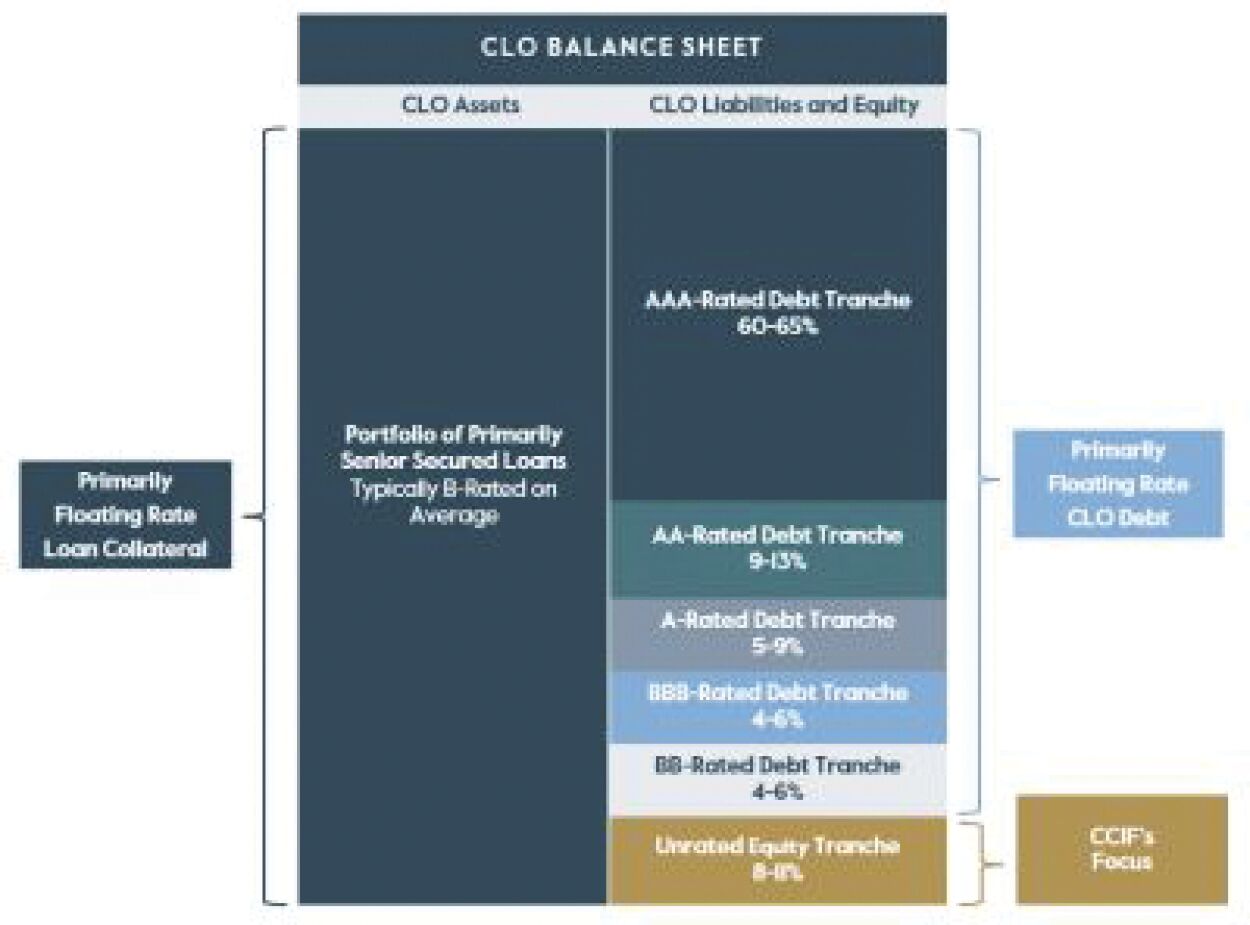
71
Table of Contents
CLOs have two priority-of-payment schedules (commonly called “waterfalls”), which are detailed in a CLO’s indenture and govern how cash generated from a CLO’s underlying collateral is distributed to the CLO’s equity and debt investors. The interest waterfall applies to interest payments received on a CLO’s underlying collateral. The principal waterfall applies to cash generated from principal on the underlying collateral, primarily through loan repayments and the proceeds from loan sales. Through the interest waterfall, any excess interest-related cash flow available after the required quarterly interest payments to CLO debt investors are made and certain CLO expenses (such as administration and collateral management fees) are paid is then distributed to the CLO’s equity investors each quarter, subject to compliance with certain tests.
A CLO’s indenture typically requires that the maturity dates of a CLO’s assets, typically five to eight years from the date of issuance of a senior secured loan, be shorter than the maturity date of the CLO’s liabilities, typically 12 to 13 years from the date of issuance. However, CLO investors do face reinvestment risk with respect to a CLO’s underlying portfolio. In addition, in most CLO transactions, CLO debt investors are subject to prepayment risk in that the holders of a majority of the equity tranche can direct a call or refinancing of a CLO, which would cause the CLO’s outstanding CLO debt securities to be repaid at par.
Loan Accumulation Facilities. LAFs are short- to medium-term facilities often provided by the bank that will serve as the placement agent or arranger on a CLO transaction. LAFs typically incur leverage between four and six times equity value prior to a CLO’s pricing.
Collateralized Bond Obligations. A CBO is a trust which is often backed by a diversified pool of high risk, below investment grade fixed income securities. The collateral can be from many different types of fixed income securities, such as high yield debt, residential privately issued mortgage-related securities, commercial privately issued mortgage related securities, trust preferred securities and emerging market debt. The pool of high yield securities underlying CBOs is typically separated into tranches representing different degrees of credit quality. The higher quality tranches have greater degrees of protection and pay lower interest rates, whereas the lower tranches, with greater risk, pay higher interest rates.
Investment Process
The investment process involves a rigorous, bottom-up fundamental approach to credit analysis and security selection, driving investment decisions. Carlyle has invested significantly in building out a comprehensive CLO investment process with significant depth across all key pillars under a proprietary investment process, CREST. CREST comprises five key areas: CLO Manager Diligence, Relative Value and Risk Adjusted Returns, Evaluation of CLO Documentation, Systematic Approach to Structure, and Tracking Underlying Collateral:
CLO Manager Diligence: Carlyle thoroughly analyzes each CLO manager prior to investing in a CLO. The team’s extensive due diligence process incorporates a multi-step process including (1) quantitative manager ranking system based on 96 unique factors across multiple vintages and (2) manager deep dive presentation allowing the team to fully understand each CLO manager’s investment style, track record, and potential style drift prior to investing in a CLO.
Relative Value and Risk Adjusted Returns: Carlyle leverages firmwide portfolio company data and automated trackers in conjunction with investment decisions. These automated trackers include opportunities within secondary and primary CLO markets across both the U.S. and Europe. The Carlyle team leverages these extensive and proprietary databases to create relative value trackers that allows the team to better assess what profile within a CLO debt tranche provides the best risk adjusted returns.
Evaluation of CLO Documentation: Carlyle also assesses the legal structure of each investment, focusing on factors that could drive economic outcomes. Carlyle’s CLO Documentation professional seeks to understand and evaluate restrictions on manager behavior as well as document integrity. This legal assessment includes documentation review across more than 50 topics identified through 20+ years of reviewing and negotiating CLO documents across CLO investments and issuance.
72
Table of Contents
Systematic Approach to Structure: As one of the largest global CLO managers, we believe Carlyle has the expertise to develop and manage complex CLO structures.3 Prior to assessing a new CLO investment, Carlyle conducts a thorough review of existing CLO structures, as well as current market best practices. Each deal will be evaluated on its projected returns and ability to withstand losses in the underlying leveraged loan collateral. Carlyle will also review the cash flow waterfall, test triggers, reinvestment conditions, and optional redemption mechanics in conjunction with Carlyle’s individual credit views to stress test portfolios. These assumptions are updated regularly to reflect current market conditions and Carlyle’s latest views on macroeconomic trends.
Tracking Underlying Collateral: Carlyle conducts a detailed analysis of the underlying loan portfolios for third-party CLO tranche positions based on the credit-level views from the team of ~30 industry-focused credit research analysts, ultimately categorizing each underlying loan depending on the industry expert’s view of overall risk. The team can gain in-depth, real-time market insights into the underlying collateral of each CLO position that it evaluates, enhancing the investment advisory team’s ability to dynamically monitor risk. The team also customizes default scenarios and cashflow projections based on the credit research analysts’ views of the underlying loan portfolios.
Carlyle believes it can leverage its dedicated team of credit research analysts and robust credit underwriting to build CLO portfolios that provide a competitive advantage. The team effectuates the investment process through 15 separate and highly automated processes, templates, and systems that are outlined in Figure 2 below.
Figure 1: CREST: Carlyle’s Proprietary Investment Process Focused on 5 Areas
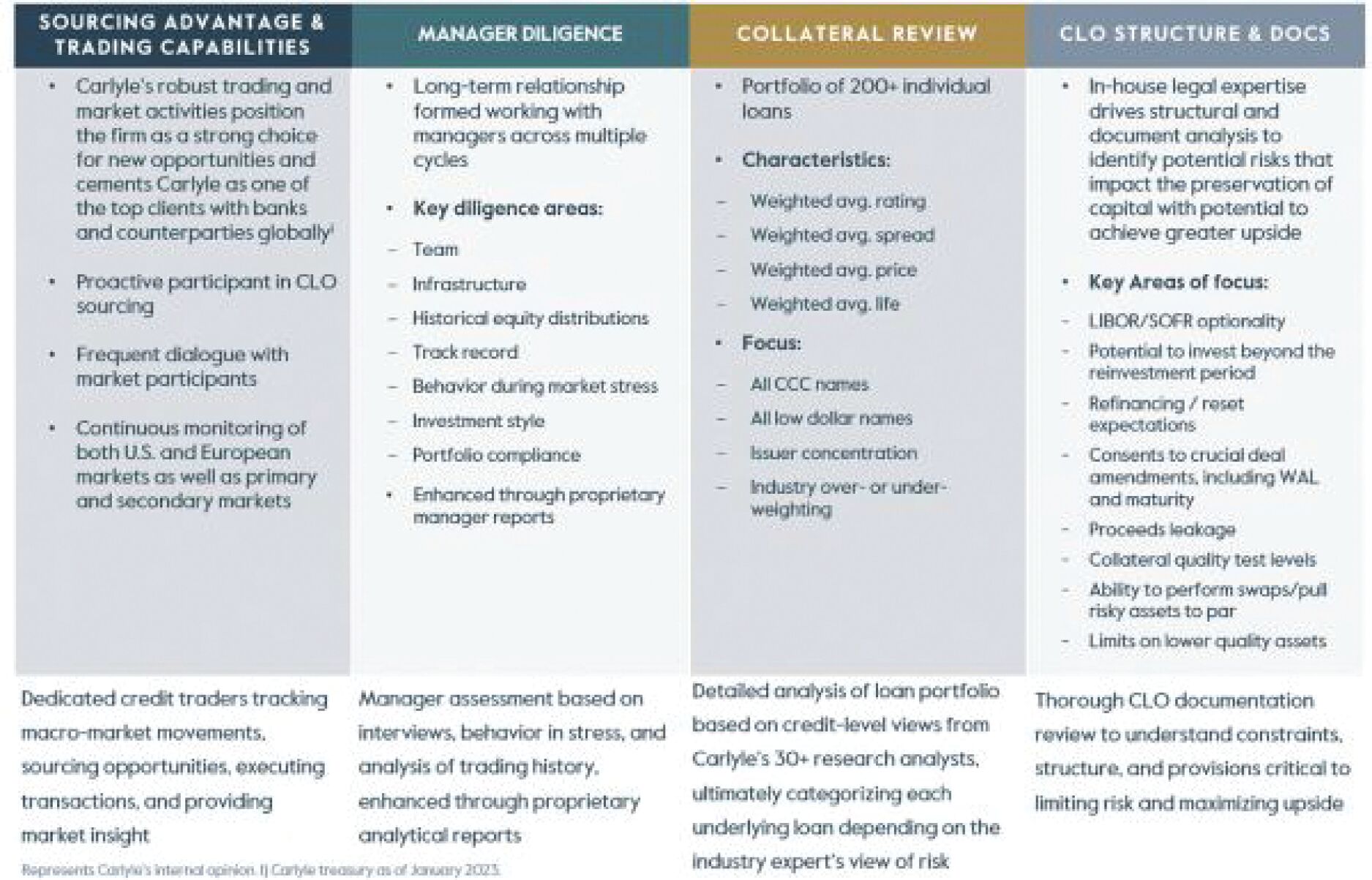
| 3 | Source: Creditflux as of June 30, 2026. Only includes closed CLOs. |
73
Table of Contents
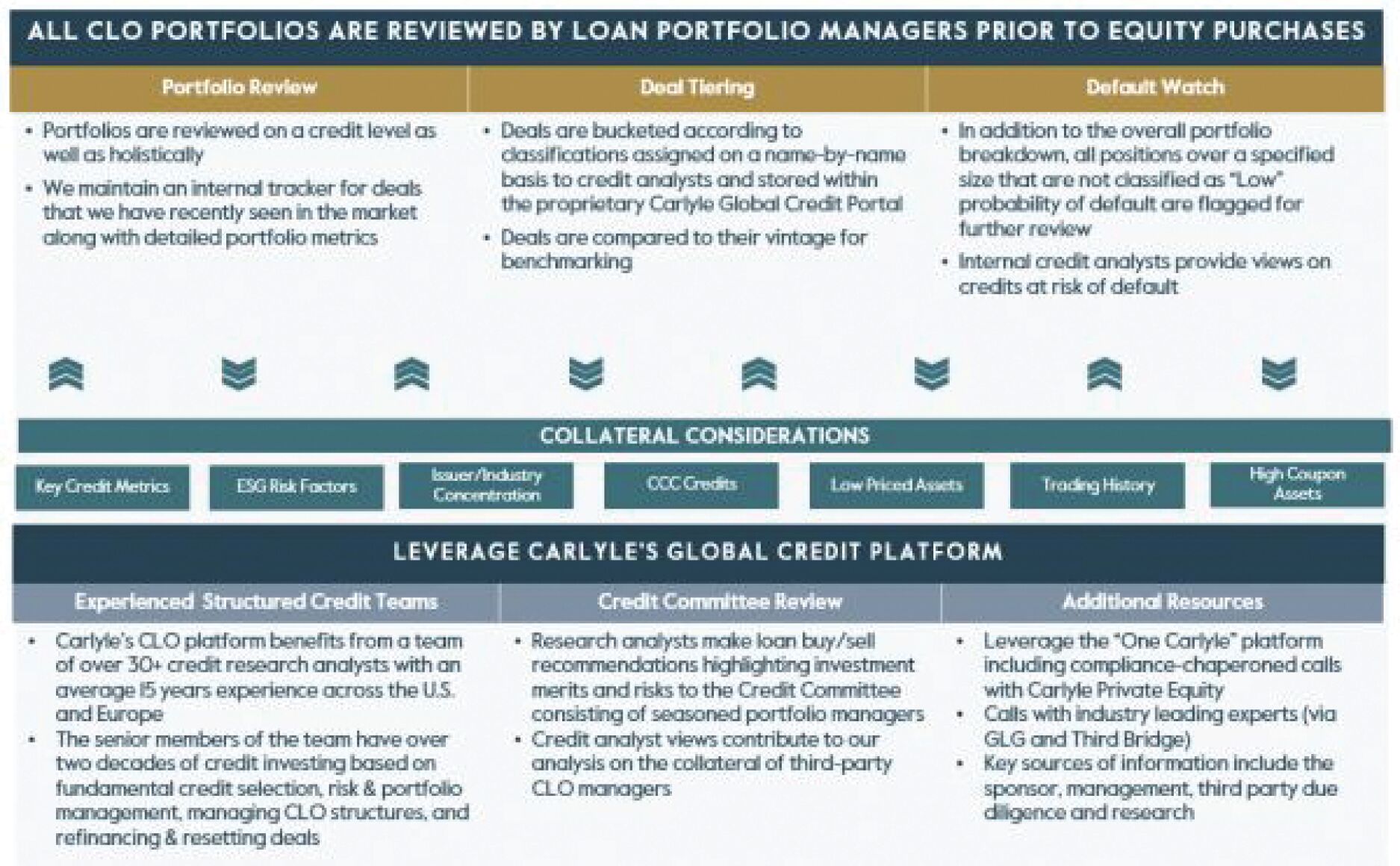
\
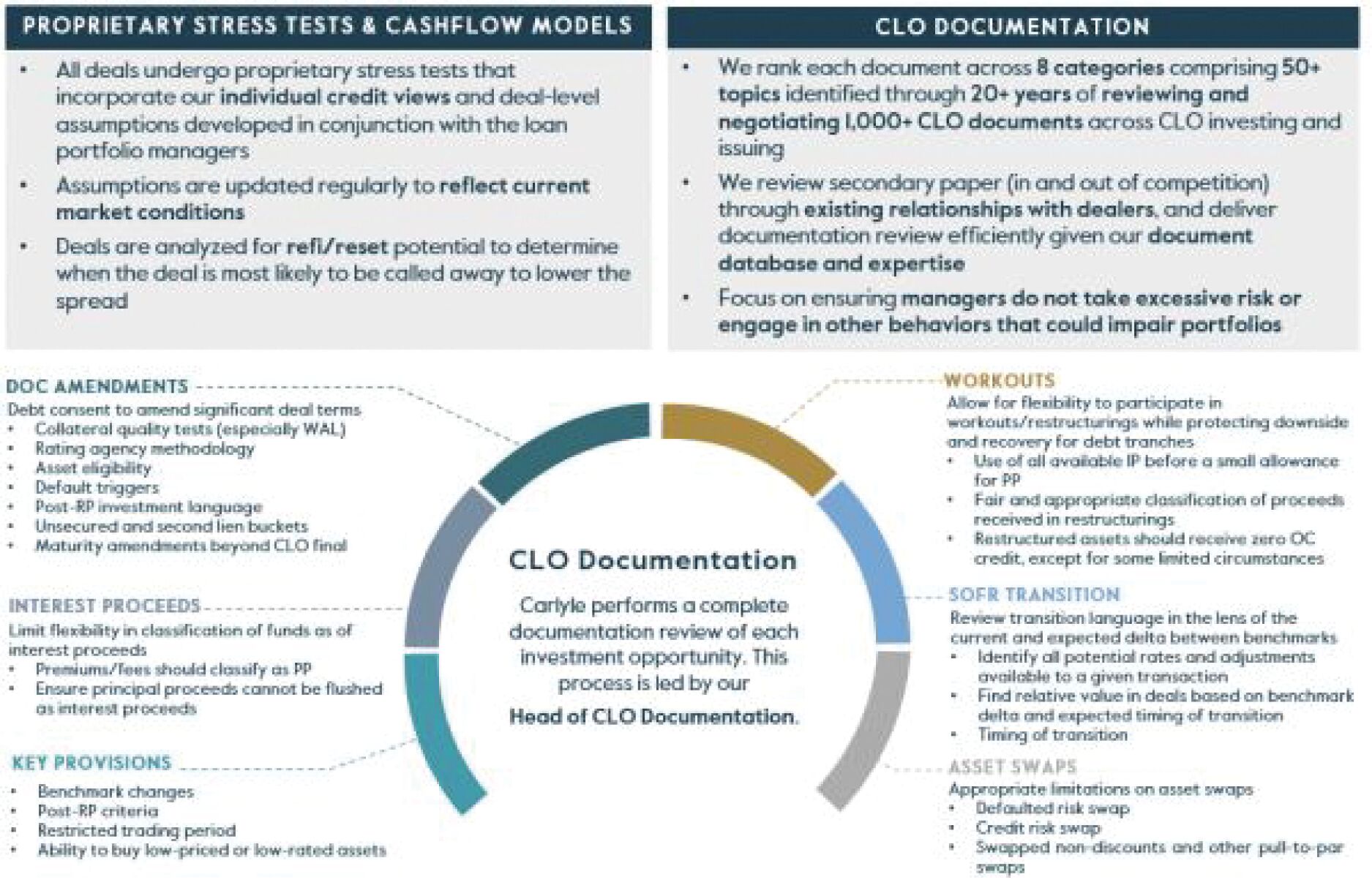
74
Table of Contents
CGCIM serves as the Fund’s investment adviser. CGCIM is registered as an investment adviser with the SEC under the Advisers Act. CGCIM is a wholly owned subsidiary of CIM.
Carlyle is a global investment firm with approximately $485 billion of assets under management as of June 30, 2026 across 700+ active investment vehicles. The firm also has a large and diversified investor base with 3,300+ active fund investors located in approximately 88 countries.
Carlyle combines global vision with local insight, relying on a team of 775+ investment professionals operating out of 28 offices in 17 countries to uncover superior opportunities in Africa, Asia, Australia, Europe, Latin America, the Middle East and North America.
75
Table of Contents
Pursuant to the investment advisory agreement, and in consideration of the advisory services provided by the Adviser to the Fund, the Adviser is entitled to a fee consisting of two components—the Management Fee and the Incentive Fee.
Management Fee
The Management Fee is calculated and payable monthly in arrears at the annual rate of 1.75% of the month-end value of the Fund’s Managed Assets. “Managed Assets” means the total assets of the Fund (including any assets attributable to any preferred shares or to indebtedness) minus the Fund’s liabilities other than liabilities relating to indebtedness.
Incentive Fee
The Incentive Fee is calculated and payable quarterly in arrears based upon the Fund’s “pre-incentive fee net investment income” for the immediately preceding quarter, and is subject to a hurdle rate, expressed as a rate of return on the Fund’s net assets, equal to 2.00% per quarter (or an annualized hurdle rate of 8.00%), subject to a “catch-up” feature. For this purpose, “pre-incentive fee net investment income” means interest income, dividend income, income generated from original issue discounts, payment-in-kind income, and any other income earned or accrued during the calendar quarter, minus the Fund’s operating expenses (which, for this purpose shall not include any distribution and/or shareholder servicing fees, litigation, any extraordinary expenses or Incentive Fee) for the quarter. For purposes of computing the Fund’s pre-incentive fee net investment income, the calculation methodology will look through total return swaps as if the Fund owned the referenced assets directly. As a result, the Fund’s pre-incentive fee net investment income includes net interest, if any, associated with a derivative or swap, which is the difference between (a) the interest income and transaction fees related to the reference assets and (b) all interest and other expenses paid by the Fund to the derivative or swap counterparty. Net assets means the total assets of the Fund minus the Fund’s liabilities. For purposes of the Incentive Fee, net assets are calculated for the relevant quarter as the weighted average of the net asset value of the Fund as of the first business day of each month therein. The weighted average net asset value shall be calculated for each month by multiplying the net asset value as of the beginning of the first business day of the month times the number of days in that month, divided by the number of days in the applicable calendar quarter.
The calculation of the Incentive Fee for each calendar quarter is as follows:
| • | No Incentive Fee is payable to CGCIM if the Fund’s pre-incentive fee net investment income, expressed as a percentage of the Fund’s net assets in respect of the relevant calendar quarter, does not exceed the quarterly hurdle rate of 2.00%; |
| • | 100% of the portion of the Fund’s pre-incentive fee net investment income that exceeds the hurdle rate but is less than or equal to 2.4242% (the “catch-up”) is payable to CGCIM if the Fund’s pre-incentive fee net investment income, expressed as a percentage of the Fund’s net assets in respect of the relevant calendar quarter, exceeds the hurdle rate but is less than or equal to 2.4242% (9.6968% annualized). The “catch-up” provision is intended to provide CGCIM with an incentive fee of 17.5% on all of the Fund’s pre-incentive fee net investment income when the Fund’s pre-incentive fee net investment income reaches 2.4242% of net assets; and |
| • | 17.5% of the portion of the Fund’s pre-incentive fee net investment income that exceeds the “catch-up” is payable to CGCIM if the Fund’s pre-incentive fee net investment income, expressed as a percentage of the Fund’s net assets in respect of the relevant calendar quarter, exceeds 2.4242% (9.6968% annualized). As a result, once the hurdle rate is reached and the catch-up is achieved, 17.5% of all the Fund’s pre-incentive fee net investment income thereafter is allocated to CGCIM. |
76
Table of Contents
The following is a graphical representation of the calculation of the Incentive Fee:
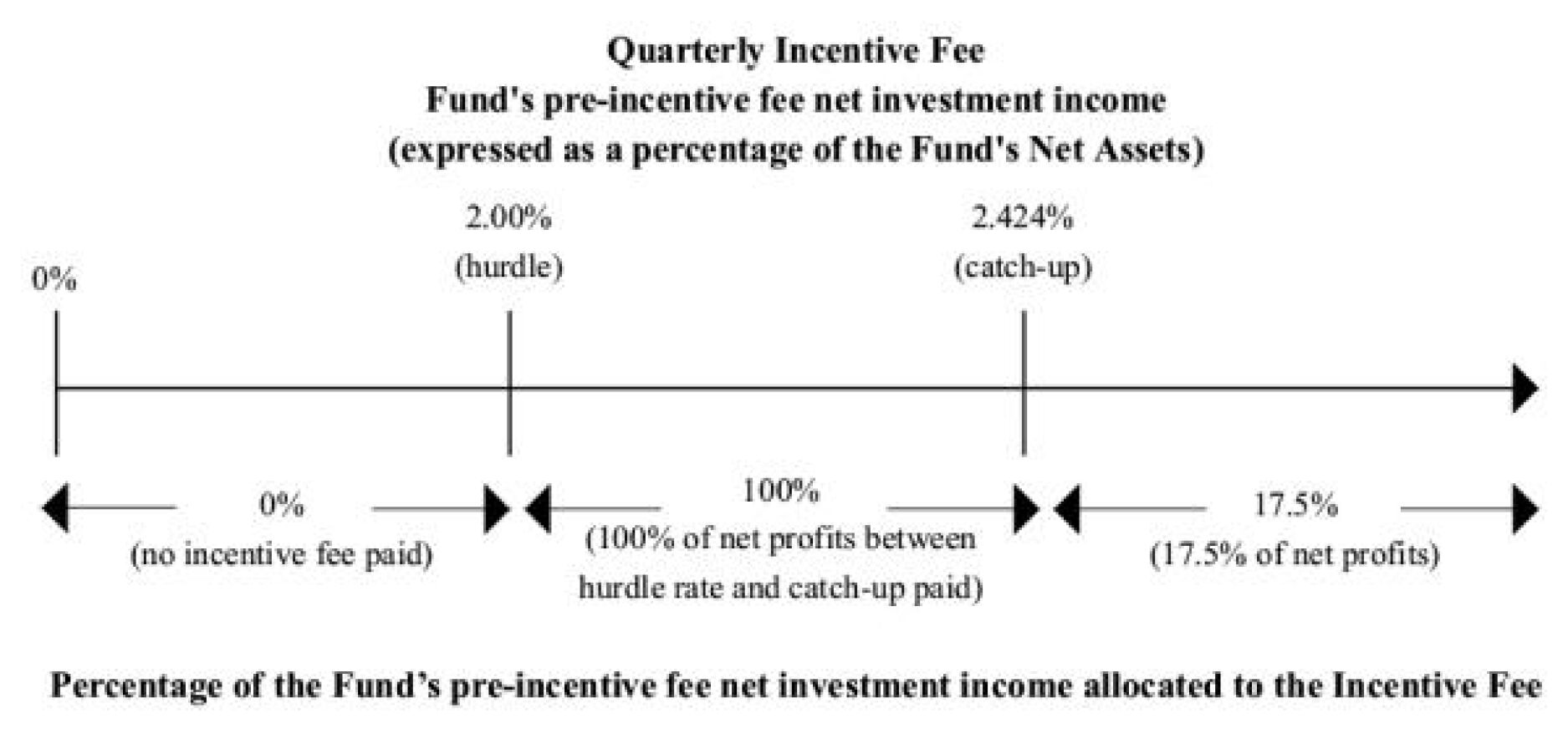
These calculations will be appropriately prorated for any period of less than three months.
Example of the Incentive Fee:
Example—Incentive Fee on pre-incentive fee net investment income for each calendar quarter
| Scenarios expressed as a percentage of average Net Assets | Scenario 1 | Scenario 2 | Scenario 3 | |||||||||
| Pre-incentive fee net investment income |
0.550 | % | 2.350 | % | 3.000 | % | ||||||
| Catch up incentive fee (maximum of 0.424%) |
— | (0.350 | %) | (0.424 | %) | |||||||
| Split incentive fee (17.5% above 2.424%) |
— | — | (0.101 | %) | ||||||||
| Net Investment income |
0.550 | % | 2.000 | % | 2.475 | % | ||||||
Scenario 1—Incentive Fee on Income
Pre-incentive fee net investment income does not exceed the 2.00% hurdle rate; therefore there is no catch up or split incentive fee on pre-incentive fee net investment income.
Scenario 2—Incentive Fee on Income
Pre-incentive fee net investment income falls between the 2.00% hurdle rate and the catch up of 2.424%; therefore the incentive fee on pre-incentive fee net investment income is 100% of the pre-incentive fee above the 2.00% hurdle return.
Scenario 3—Incentive Fee on Income
Pre-incentive fee net investment income exceeds the 2.00% hurdle and the 2.424% catch up provision. Therefore the catch up provision is fully satisfied by the 0.424% of pre-incentive fee net investment income above the 2.00% hurdle rate and there is a 17.5% incentive fee on pre-incentive fee net investment income above the 2.424% “catch up.” This provides a 0.525% incentive fee, which represents 17.5% of pre-incentive fee net investment income.
Approval of the Investment Advisory Agreement
The Investment Advisory Agreement was most recently approved on May 18, 2026 by the Board, including a majority of the Independent Trustees of the Fund, for a one-year term ending on July 14, 2027. The Board
77
Table of Contents
weighed a number of factors in reaching its decision to approve the Investment Advisory Agreement, including, without limitation, the history, reputation, and resources of CGCIM, prior performance results achieved by CGCIM, and quality of services to be provided by CGCIM. The Board considered CGCIM’s expertise in managing collateralized loan obligation securities. A discussion regarding the basis for the Board’s approval of the Investment Advisory Agreement is available in the Fund’s Annual Report on Form N-CSR for the year ended September 30, 2025, which is incorporated herein by reference.
Fund Expenses
The Adviser bears all of its own costs incurred in providing investment advisory services to the Fund. As described below, however, the Fund bears all other expenses incurred in the business and operation of the Fund.
Expenses borne directly by the Fund include:
| • | corporate, organizational and offering costs relating to offerings of the Fund’s securities; |
| • | the cost of calculating the NAV of shares, including the cost of any third-party pricing or valuation services; |
| • | the cost of effecting sales and repurchases of shares and other securities; |
| • | the Management Fee and Incentive Fee; |
| • | distribution and/or shareholder servicing fees; |
| • | investment related expenses (e.g., expenses that, in the Adviser’s discretion, are related to the investment of the Fund’s assets, whether or not such investments are consummated), including, as applicable, brokerage commissions, borrowing charges on securities sold short, clearing and settlement charges, recordkeeping, interest expense, line of credit fees, dividends on securities sold but not yet purchased, margin fees, investment related travel and lodging expenses and research-related expenses; |
| • | professional fees relating to investments, including expenses of consultants, investment bankers, attorneys, accountants and other experts; |
| • | transfer agent, sub-transfer agent and custodial fees; |
| • | fees and expenses associated with marketing and distribution efforts; |
| • | federal and any state registration or notification fees; |
| • | federal, state and local taxes; |
| • | fees and expenses incident to qualifying and listing of the Fund’s common shares on any exchange; |
| • | fees and expenses of Trustees not also serving in an executive officer capacity for the Fund or the Adviser; |
| • | the costs of preparing, printing and mailing reports and other communications, including repurchase offer correspondence or similar materials, to Shareholders; |
| • | fidelity bond, Trustees and officers errors and omissions liability insurance and other insurance premiums; |
| • | legal expenses (including those expenses associated with preparing the Fund’s public filings, attending and preparing for Board meetings, as applicable, and generally serving as counsel to the Fund or the Independent Trustees of the Fund); |
| • | external accounting expenses (including fees and disbursements and expenses related to the annual audit of the Fund and the preparation of the Fund’s tax information); |
| • | any costs and expenses associated with or related to due diligence performed with respect to the Fund’s offering of its shares, including but not limited to, costs associated with or related to due diligence activities |
78
Table of Contents
| performed by, on behalf of, or for the benefit of broker-dealers, registered investment advisors and third-party due diligence providers; |
| • | any and all fees, costs and expenses incurred in implementing or maintaining third-party or proprietary software tools, programs or technology for the benefit of the Fund; |
| • | costs associated with reporting and compliance obligations under the 1940 Act and applicable federal and state securities laws, including compliance with The Sarbanes-Oxley Act of 2002; |
| • | the compensation of the Fund’s Chief Compliance Officer and the salary of any compliance personnel of the Adviser and its affiliates who provide compliance-related services to the Fund, provided such salary expenses are properly allocated between the Fund and other affiliates, as applicable, and any costs associated with the monitoring, testing and revision of the Fund’s compliance policies and procedures required by Rule 38a-1 under the 1940 Act; |
| • | all other expenses incurred by the Fund in connection with administering the Fund’s business, including expenses by SS&C for performing administrative services for the Fund, subject to the terms of the Administration Agreement; and |
| • | any expenses incurred outside of the ordinary course of business, including, without limitation, costs incurred in connection with any claim, litigation, arbitration, mediation, government investigation or similar proceeding and indemnification expenses as provided for in the Fund’s organizational documents. |
Except as otherwise described in this prospectus, the Adviser will be reimbursed by the Fund, as applicable, for any of the above expenses that it pays on behalf of the Fund.
The Adviser is obligated to pay expenses associated with providing the investment services stated in the Investment Advisory Agreement, including compensation of and office space for its officers and employees connected with investment and economic research, trading and investment management of the Fund.
79
Table of Contents
Trustees
Pursuant to the Amended and Restated Declaration of Trust (“Declaration of Trust”) and Amended and Restated By-laws (the “By-laws”), the Fund’s business and affairs are managed under the direction of the Board, which has overall responsibility for monitoring and overseeing the Fund’s management and operations. The Board consists of five members, three of whom are considered Independent Trustees. The Trustees are subject to removal or replacement in accordance with Delaware law and the Declaration of Trust. The Trustees serving on the Board were elected by the Shareholders of the Fund.
The Board, including a majority of the Independent Trustees, oversees and monitors the Fund’s management and operations. The Board reviews on an annual basis the Investment Advisory Agreement to determine, among other things, whether the fees payable under such agreement are reasonable in light of the services provided.
Board of Trustees and Officers
Information regarding the members of the Board is set forth below. The Trustees have been divided into two groups-Interested Trustees and Independent Trustees. As set forth in the Fund’s declaration of trust, each Trustee’s term of office shall continue until his or her death, resignation or removal.
Independent Trustees
| Name, address(1) and year of birth |
Position to be Held with the Fund |
Term of Office and Length of Time Served |
Principal Occupation(s) During Past 5 Years |
Number of Portfolios in Fund Complex(2) to be Overseen by Trustee |
Other Directorships Held by Nominee Trustee in Past Five Years | |||||
| Mark Garbin (1951) | Trustee | Class I Board member until 2028 annual shareholder meeting—since July 2023 | Managing Principal, Coherent Capital Management LLC (since 2008) | 2 | Independent Trustee of Two Roads Shared Trust (since 2012), Forethought Variable Insurance Trust (since 2013), Northern Lights Fund Trust (since 2013), Northern Lights Variable Trust (since 2013), iCapital KKR Private Markets Fund (since 2014), Independent Director of OHA CLO Enhanced Equity II Genpar LLP (since 2021), and Independent Trustee, Carlyle Tactical Private Credit Fund (since 2018). |
80
Table of Contents
| Name, address(1) and year of birth |
Position to be Held with the Fund |
Term of Office and Length of Time Served |
Principal Occupation(s) During Past 5 Years |
Number of Portfolios in Fund Complex(2) to be Overseen by Trustee |
Other Directorships Held by Nominee Trustee in Past Five Years | |||||
| Sanjeev Handa (1961) | Trustee | Class III Board member until 2027 annual shareholder meeting—since July 2023 | Managing Member, Old Orchard Lane, LLC (since 2014); Adjunct Professor, Fairfield University (since 2020) | 2 | Independent Director of OHA CLO Enhanced Equity II Genpar LLP (since 2021); Audit Committee Chair and Independent Trustee of Total Fund Solution (since 2023); Audit Committee Chair and Independent Trustee of Carlyle Credit Income Fund (since 2023); Independent Director of OHA CLO Enhanced Equity III Genpar LLP (since 2024); Advisory Board Member of White Oak Partners (2021-2025); Independent Director of Alti Private Equity and Commitments Access Fund (2023-2023); Audit Committee Chair and Independent Director of North Haven Private Assets Fund (since 2026); Independent Trustee Carlyle Tactical Private Credit Fund (since 2018). | |||||
| Joan McCabe (1955) | Trustee | Class II Board member until 2029 annual shareholder meeting.—since July 2023 | Managing Member, JMYME, LLC (since 2020); | 2 | Board member of Gulfstream Goodwill, Inc. (Member since 2017, Chair: 2021-2024, Vice Chair since 2026); Board member of Gulfstream Goodwill Academy, Inc. (since 2018); Member of Governing Council of Independent Directors Council (since 2025); Board member of Elevation Brands (2017-2022); Board member of Sensible Organics (2017-2021); Board member of Goodwill International, Inc. (2015-2021); Independent Trustee Carlyle Tactical Private Credit Fund (since 2018). |
| (1) | Address is c/o Carlyle Global Credit Investment Management L.L.C., One Vanderbilt Avenue, Suite 3400, New York, NY 10017. |
81
Table of Contents
Interested Trustees
| Name, address(1) and year of birth |
Position to be Held with the Fund |
Term of Office and Length of Time Served(2) |
Principal Occupation(s) During Past 5 Years |
Number of Portfolios in Fund Complex to be Overseen by Trustee |
Other Directorships Held by Nominee Trustee in Past Five Years | |||||
| Nishil Mehta (1981) |
Trustee | Class I Board member until 2028 annual shareholder meeting.—since May 2025 | Managing Director, The Carlyle Group Inc. (Since 2022); Managing Director, First Eagle (2021—2022); Managing Director, Prospect Capital (2010—2020); Priority Income Fund, Inc. (2010 to 2020) | 1 | None | |||||
| Lauren Basmadjian (1979) |
Trustee | Class III Board member until 2027 annual shareholder meeting.—since July 2023 | Partner,, The Carlyle Group, Inc. (Since 2020); Senior Portfolio Manager, Octagon Credit Investors, LLC (2001 to 2020) | 1 | None |
| (1) | Address is c/o Carlyle Global Credit Investment Management L.L.C., One Vanderbilt Avenue, Suite 3400, New York, NY 10017. |
| (2) | “Interested person,” as defined in the 1940 Act, of the Fund. Ms. Basmadjian and Mr. Mehta are interested persons of the Fund due to their affiliation with the Adviser. |
Officers
| Name, address(1) and year of birth |
Position to be Held with the Fund |
Term of Office |
Principal Occupation(s) During Past 5 Years | |||
| Nishil Mehta (1981) | President, Principal Executive Officer | Indefinite Length—since February 2025 | Managing Director, The Carlyle Group Inc. (Since 2022); Managing Director, First Eagle (2021—2022); Managing Director, Prospect Capital (2010—2020); Priority Income Fund, Inc. (2010 to 2020) | |||
| Nelson Joseph (1979) | Principal Financial Officer, Principal Accounting Officer and Treasurer | Indefinite Length—since July 2023 | Principal, Carlyle Group (Since 2023); Director, Apollo Global Management LLC (2016—2022) | |||
| Joshua Lefkowitz (1974) | Secretary; Chief Legal Officer | Indefinite Length—since July 2023 | Partner and Chief Legal Officer (Global Credit), Carlyle Group (Since 2018); Principal and Associate General Counsel, Ares Management, Ltd. (2017—2018); Vice President and Associate General Counsel, American Capital, Ltd. (2006—2017) | |||
| Jennifer Juste (1980) |
Chief Compliance Officer | Indefinite Length—since May 2024 | Principal, Carlyle Group (Since 2022); Natixis Investment Managers 2019—2022 (Deputy Chief Compliance Officer/Deputy General Counsel Mirova US LLC 2020-2022 and Chief Compliance Officer/General Counsel Ostrum US LLC 2019-2020) |
| (1) | Address is c/o Carlyle Global Credit Investment Management L.L.C., One Vanderbilt Avenue, Suite 3400, New York, NY 10017. |
82
Table of Contents
Biographical Information and Discussion of Experience and Qualifications
Trustees
The following is a summary of the experience, qualifications, attributes and skills of each Trustee that support the conclusion, as of the date of this registration statement, that each Trustee should serve as a Trustee of the Fund.
Independent Trustees
Mark Garbin. Mark Garbin has over 30 years of experience in corporate balance sheet and income statement risk management for large asset managers. Mr. Garbin has extensive derivatives experience and has provided consulting services to alternative asset managers. Mr. Garbin holds the CFA and Professional Risk Manager (PRM) Charters and has advanced degrees in international business, negotiation and derivatives. He also has extensive experience with respect to investments and also to compliance and corporate governance matters as a result of, among other things, his service as a board member to other investment companies.
Sanjeev Handa. Sanjeev Handa has over 30 years of experience in the financial industry sector, including global experience in the financial, real estate and securitization markets. In addition to his responsibilities on the boards of the Fund and CTAC, Mr. Handa serves, as an independent trustee, on the board of Total Fund Solution (since 2023) and chairs the audit committee. Mr. Handa additionally serves as an independent director of North Haven Private Assets Fund (since 2026) and chairs the audit committee. He also serves, as an independent director, on the boards of certain affiliates of Oak Hill Advisors. He serves on the board of the Mutual Fund Directors Forum (since 2022). Mr. Handa previously served as a member of the Investment Committee of the board of The Cooper Union for Advancement of Science and Art (from 2016-2024), as a board member of Greenpath Financial Wellness (2017-2022) and a board member of Fitch Ratings, Inc. and certain of its affiliates thereof (2015-2020). Mr. Handa has extensive experience with respect to investments as well as to compliance and corporate governance matters as a result of, among other things, his service as an established board member.
Joan McCabe. Joan McCabe has over 30 years of financial and corporate experience, including investing in private equity along with debt financings for those private equity investments. Ms. McCabe is a graduate of Yale College and Harvard Business School. She began her career on Wall Street, where she was a Managing Director at Kidder Peabody, Drexel Burnham Lambert and Paine Webber. She was involved in private equity for over twenty years as a Managing Partner at Brynwood Partners. She is a founding member of the Conference of Boards for the national Goodwill organization and is NACD Director Certified. She is involved in philanthropy through her Board Chair position at the Palm Beach Goodwill and serves on the board of Gulfstream Goodwill, Inc. In 2025, Ms. McCabe was also appointed to the Governing Council of the Independent Directors Council. Ms. McCabe has served as a board member to a variety of companies and her diverse experience and financial background, among other things, qualifies her to serve as a Trustee.
Interested Trustees
Nishil Mehta. Nishil Mehta has over 20 years of experience in financial markets. Additionally, he is a Managing Director of Carlyle Global Credit Investment Management L.L.C. where he focuses on the firm’s third-party CLO investing platform and is Head of Shareholder Relations for Carlyle Secured Lending (NASDAQ: CGBD) within Global Credit platform of The Carlyle Group Inc. (the ultimate parent company of CGCIM). Prior to coming to Carlyle, Mr. Mehta was a Managing Director at First Eagle where he was the co-portfolio manager for the firm’s structured credit investments. After First Eagle, Mr. Mehta was a Managing Director at Prospect Capital where he was responsible for the firm’s $2.5 billion of investments in CLO mezzanine debt and CLO equity. He was also the Head of Capital Markets spearheading over $8 billion of debt and equity capital raised for the firm’s 1940 Act funds. Mr. Mehta received his BBA from Goizueta Business School at Emory University with Honors and currently holds Series 7 and 63 licenses.
83
Table of Contents
Lauren Basmadjian. Lauren Basmadjian has over 20 years of experience in financial and corporate markets. She is a Partner, Co-Head of Liquid Credit and Head of US Loans & Structured Credit within The Carlyle Group, Inc.’s Global Credit platform, overseeing over $48 billion of AUM. She is based in New York and sits on the Investment Committees for all of The Carlyle Group, Inc.’s US Loan, CLO and Liquid and Illiquid Credit investing activities. Ms. Basmadjian joined The Carlyle Group, Inc. in 2020 after 19 years at Octagon Credit Investors, LLC, where she was a Senior Portfolio Manager, member of the Investment Committee and managed XAI Octagon Floating Rate & Alternative Income Term Trust, a public 1940 Act fund invested in CLO tranches and leveraged loans. Prior to becoming a Portfolio Manager, Ms. Basmadjian managed Octagon’s workout efforts and also oversaw the leisure & entertainment, retail, consumer products, business services, food & beverage and technology industries. Before joining Octagon, Ms. Basmadjian worked in the Acquisition Finance Group at Chase Securities, Inc. She graduated Cum Laude from the Stern School of Business at New York University with a B.S. in Finance and Economics. Her diverse experience and financial background, among other things, qualifies her to serve as a Trustee.
Board Structure and Role of the Board in Risk Oversight
The 1940 Act requires that at least 40% of the trustees be independent trustees. Certain exemptive rules promulgated under the 1940 Act require that at least 50% of the trustees be independent trustees. Currently, three of the five Trustees (60%) are Independent Trustees. The Independent Trustees exercise their informed business judgment to appoint an individual of their choosing to serve as Chairman of the Board, regardless of whether the trustee happens to be independent or a member of management. Lauren Basmadjian, an Interested Trustee, serves as the Chairman of the Board.
The Board expects to perform its risk oversight function primarily through (a) its three standing committees, which report to the entire Board and are comprised solely of Independent Trustees and (b) monitoring by the Fund’s Chief Compliance Officer in accordance with the Fund’s compliance policies and procedures.
The Board believes that this leadership structure is appropriate because it allows the Board to exercise informed judgment over matters under its purview, and it allocates areas of responsibility among committees or working groups of Trustees and the full Board in a manner that enhances effective oversight. The Board also believes that having a majority of Independent Trustees is appropriate and in the best interest of our Shareholders. Nevertheless, the Board also believes that having interested persons serve on the Board brings corporate and financial viewpoints that are, in the Board’s view, crucial elements in its decision-making process. In addition, the Board believes that Lauren Basmadjian, provides the Board with the Adviser’s perspective in managing the Fund. The leadership structure of the Board may be changed at any time and in the discretion of the Board, including in response to changes in circumstances or our characteristics. The Board does not have a lead independent trustee.
Committees of the Board
The Board has established an audit committee, a nominating and governance committee and an independent trustees committee. Each committee holds four meetings each fiscal year. The Fund does not have a compensation committee because its officers do not receive any direct compensation from the Fund.
Audit Committee. The members of the audit committee are Mark Garbin, Sanjeev Handa and Joan McCabe, each of whom is independent for purposes of the 1940 Act. Sanjeev Handa serves as chairman of the audit committee. The audit committee is responsible for approving the Fund’s independent accountants, reviewing with the Fund’s independent accountants the plans and results of the audit engagement, approving professional services provided by the Fund’s independent accountants, reviewing the independence of the Fund’s independent accountants and reviewing the adequacy of the Fund’s internal accounting controls.
Nominating and Governance Committee. The members of the nominating and governance committee are Mark Garbin, Sanjeev Handa and Joan McCabe, each of whom is independent for purposes of the 1940 Act. Joan McCabe serves as chairman of the nominating and governance committee. The nominating and governance
84
Table of Contents
committee is responsible for selecting, researching and nominating trustees for election by the Fund’s Shareholders, selecting nominees to fill vacancies on the Board or a committee of the Board Trustees, developing and recommending to the Board a set of corporate governance principles and overseeing the evaluation of the Board and its committees.
The nominating and governance committee may consider recommendations for nomination of individuals for election as trustees from Shareholders.
Independent Trustees Committee. The members of the independent trustees committee are Mark Garbin, Sanjeev Handa and Joan McCabe, each of whom is independent for purposes of the 1940 Act. Mark Garbin serves as chairman of the independent trustees committee. The independent trustees committee is responsible for reviewing and making certain findings in respect of co-investment transactions pursuant to exemptive relief received from the SEC.
Trustee Beneficial Ownership of Shares
The following table indicates the dollar range of equity securities that any Trustee or executive officer beneficially owned in the Fund as of June 30, 2026, based on net asset value per common share.
| Name of Trustee or Officer |
Dollar Range of Equity Securities in the Fund |
Aggregate Dollar Range of Equity Securities in All Registered Investment Companies Overseen by Trustee in Family of Investment Companies(1) | ||
| Mark Garbin |
None | $50,001 - $100,000 | ||
| Sanjeev Handa |
$10,001 - $50,000 | $100,001 - $500,000 | ||
| Joan McCabe |
$100,001 - $500,000 | Over $1,000,000 | ||
| Nishil Mehta |
$100,001 - $500,000 | $100,001 - $500,000 | ||
| Lauren Basmadjian |
$100,001 - $500,000 | $100,001 - $500,000 |
| (1) | Dollar ranges are as follows: None, $1-$10,000, $10,001-$50,000, $50,001-$100,000, $100,001-$500,000, $500,001-$1,000,000 or Over $1,000,000. |
As of June 30, 2026, the Trustees and officers of the Fund as a group owned less than 1% of the outstanding shares of beneficial interest of the Fund
Compensation of Trustees
The following table shows information regarding the compensation earned by the Trustees, none of whom is an employee of the Fund, for services as a Trustee for the fiscal year ending September 30, 2026. The Trustees who are “interested persons”, as defined in the 1940 Act, of the Fund and the Fund’s officers do not receive compensation from the Fund.
| Name of Trustee | Aggregate Compensation from the Fund(1) |
Total Compensation from the Fund Complex |
||||||
| Interested Trustees |
||||||||
| Nishil Mehta |
None | None | ||||||
| Lauren Basmadjian |
None | None | ||||||
| Independent Trustees |
||||||||
| Mark Garbin |
$40,000 | $40,000 | ||||||
| Sanjeev Handa |
$45,000 | $45,000 | ||||||
| Joan McCabe |
$40,000 | $40,000 | ||||||
| (1) | Amounts shown reflect annual compensation of such Trustee. |
85
Table of Contents
Portfolio Managers
Investment sourcing and investment decisions are primarily the responsibility of two portfolio managers, Lauren Basmadjian and Nishil Mehta. In addition, the Fund is also supported by the Fund’s investment committee. See “Investment Objective, Opportunities and Principal Strategies-Investment Process.”
Below is biographical information relating to Ms. Basmadjian and Mr. Mehta and the other members of the Fund’s investment committee:
Lauren Basmadjian
Lauren Basmadjian has over 20 years of experience in financial and corporate markets. She is a Partner, Co-Head of Liquid Credit and Head of US Loans & Structured Credit within The Carlyle Group, Inc.’s Global Credit platform, overseeing over $48 billion of AUM. She is based in New York and sits on the Investment Committees for all of The Carlyle Group, Inc.’s US Loan, CLO and Liquid and Illiquid Credit investing activities. Ms. Basmadjian joined The Carlyle Group, Inc. in 2020 after 19 years at Octagon Credit Investors, LLC, where she was a Senior Portfolio Manager, member of the Investment Committee and managed XAI Octagon Floating Rate & Alternative Income Term Trust, a public 1940 Act fund invested in CLO tranches and leveraged loans. Prior to becoming a Portfolio Manager, Ms. Basmadjian managed Octagon’s workout efforts and also oversaw the leisure & entertainment, retail, consumer products, business services, food & beverage and technology industries. Before joining Octagon, Ms. Basmadjian worked in the Acquisition Finance Group at Chase Securities, Inc. She graduated Cum Laude from the Stern School of Business at New York University with a B.S. in Finance and Economics.
Nishil Mehta
Nishil Mehta is a Managing Director leading the firm’s structured credit investments. He is based in New York. Prior to joining Carlyle, Nishil was a Managing Director at First Eagle where he was the co-portfolio manager for the firm’s structured credit investments. Prior to joining First Eagle, Nishil was a Managing Director at Prospect Capital where he was responsible for the firm’s $2.5 billion of investments in CLO mezzanine debt and CLO equity and served as portfolio manager to Priority Income Fund, Inc., a closed-ended management investment company that primarily invests in the equity tranche of CLOs. He was also the Head of Capital Markets spearheading over $8 billion of debt and equity capital raised for the firm’s 1940 Act funds. Earlier in his career, Nishil worked at CIT Asset Management and Wachovia Securities. Mr. Mehta received his BBA from Goizueta Business School at Emory University with Honors.
James Dunn
James Dunn is a Managing Director and Head of Carlyle European Liquid Credit, overseeing the European CLO platform and chairing its credit committee. Previously, Mr. Dunn was a Managing Director and Portfolio Manager at Onex Credit Partners, focusing on the firm’s European Liquid Credit Strategies, including CLOs. Prior to joining Onex, he was Vice President and Senior Credit Research Analyst at Alcentra focused on portfolio optimization of existing funds, and primary coverage for cyclical sectors across both par and distressed credit. Mr. Dunn began his career as a Credit Research Analyst on the High Yield team at Aberdeen Standard Investments. Mr. Dunn holds an M.B.A. from the University of Liverpool (1st Class Distinction) and a B.A. in Economics.
Brian Marcus
Brian Marcus is a Managing Director - Partner and Deputy Head of Cross Platform Investing for Global Credit. He also serves as Chair and Interested Trustee of the Board of CTAC, and President, Principal Executive Officer and Chief Risk Officer of CTAC. He is a voting member of the PAAC. Prior to joining Carlyle, Mr. Marcus was with Morgan Stanley, where he focused on principal investments on behalf of the firm. Previously, Mr. Marcus
86
Table of Contents
worked at Lehman Brothers in the Mergers and Acquisitions group, where he concentrated on the media and telecommunications industries. Mr. Marcus received a BS in economics from The Wharton School at the University of Pennsylvania, and currently maintains Series 7, 55 and 63 licenses.
Sebastiano Riva
Sebastiano Riva is a Managing Director and Head of Liability Management for Carlyle Global Credit and serves on the investment committee. Mr. Riva is responsible for fund financing as well as Carlyle Structured Credit and Carlyle Direct Lending CLO formation and execution. He is also a member of various Investment Committees including for Carlyle Structured Credit Fund and Carlyle Structured Solutions. Prior to joining Carlyle, Mr. Riva was at Wells Fargo Securities in charge of global marketing of new issue CLO. Mr. Riva started his structured finance career at Bankers Trust in the late 1990s and has also held positions at DLJ, TD Securities, and Lehman Brothers. Mr. Riva received his B.S. in Economics from the Wharton School of the University of Pennsylvania.
Other Accounts Managed by Portfolio Managers
Lauren Basmadjian and Nishil Mehta, the portfolio managers primarily responsible for the day-to-day management of the Fund also manage other registered investment companies, other pooled investment vehicles and other accounts, as indicated below. The following table identifies, as of September 30, 2025: (i) the number of other registered investment companies, other pooled investment vehicles and other accounts managed by each portfolio manager; (ii) the total assets of such companies, vehicles and accounts; and (iii) the number and total assets of such companies, vehicles and accounts that are subject to an advisory fee based on performance.
| Number of Accounts |
Assets of Accounts (in billions) |
Number of Accounts Subject to a Performance Fee |
Assets Subject to a Performance Fee (in billions) |
|||||||||||||
| Lauren Basmadjian |
||||||||||||||||
| Registered Investment Companies |
— | $ | — | — | $ | — | ||||||||||
| Other Pooled Investment Vehicles |
85 | $ | 34.97 | 84 | $ | 34.60 | ||||||||||
| Other Accounts |
— | $ | — | — | $ | — | ||||||||||
| Nishil Mehta |
||||||||||||||||
| Registered Investment Companies |
— | $ | — | — | $ | — | ||||||||||
| Other Pooled Investment Vehicles |
— | $ | — | — | $ | — | ||||||||||
| Other Accounts |
13 | $ | 2.03 | 1 | $ | 0.01 | ||||||||||
Compensation of Portfolio Managers
The investment professionals are paid out of the total revenues of the Adviser and certain of its affiliates, including the advisory fees earned with respect to providing advisory services to us. Professional compensation at the Adviser is structured so that key professionals benefit from strong investment performance generated on the accounts that the Adviser and such affiliates manage and from their longevity with the Adviser. Each member of the Senior Investment Team has indirect equity ownership interests in the Adviser and related long-term incentives. Members of the Senior Investment Team also receive a fixed base salary and an annual market and performance-based cash bonus. The bonus is determined by the Adviser’s board of managers, and is based on both quantitative and qualitative analysis of several factors, including the profitability of the Adviser and the contribution of the individual employee. Many of the factors considered by management in reaching its compensation determinations will be impacted by our long-term performance and the value of our assets as well as the portfolios managed for the Adviser’s and such affiliates’ other clients.
87
Table of Contents
Securities Owned in the Fund by Portfolio Managers
The table below sets forth the dollar range of the value of our common shares that are owned beneficially by each portfolio manager as of September 30, 2025. For purposes of this table, beneficial ownership is defined to mean a direct or indirect pecuniary interest.
| Name of Portfolio Manager | Dollar Range of Equity Securities in the Fund(1) |
|||
| Lauren Basmadjian |
$ | 100,001 - $500,000 | ||
| Nishil Mehta |
$ | 100,001 - $500,000 | ||
| (1) | Dollar ranges are as follows: None, $1 - $10,000, $10,001 - $50,000, $50,001 - $100,000, $100,001 - $500,000, $500,001 - $1,000,000 and over $1,000,000. |
Administrative Services
SS&C Technologies, Inc, (“SS&C”), which has its principal office at 80 Lamberton Road Windsor, CT 06095, serves as Administrator for the Fund. Pursuant to the Administration Agreement, SS&C furnishes the Fund with clerical, bookkeeping and record keeping services. SS&C also performs, or oversees the performance of, certain of the Fund’s required administrative services, which include, among other things, providing assistance in accounting, legal, compliance, operations, being responsible for the financial records that the Fund is required to maintain and preparing reports filed with the SEC. In addition, SS&C generally oversees the payment of the Fund’s expenses and the performance of administrative and professional services rendered to the Fund by others. The Administration Agreement may be terminated by either party without penalty upon 180 days’ written notice to the other party prior to the initial term or renewal date.
Indemnification
The Investment Advisory Agreement provides that, absent willful misfeasance, bad faith or gross negligence in the performance of its duties or by reason of the reckless disregard of its duties and obligations, the Adviser, its members and their respective officers, managers, partners, agents, employees, controlling persons, members and any other person or entity affiliated with any of them are entitled to indemnification from the Fund for any damages, liabilities, costs and expenses (including reasonable attorneys’ fees and amounts reasonably paid in settlement) arising out of or otherwise based upon the performance of any of the Adviser’s duties or obligations under the Investment Advisory Agreement or otherwise as an investment adviser of the Fund.
Custodians, Distribution Paying Agent, Transfer Agent and Registrar
U.S. Bank National Association, which has its principal office at 800 Nicollet Mall, Minneapolis, MN 55402, serves as custodian for the Fund.
Equiniti Trust Company, LLC, (“Equiniti”) which has its principal office at 6201 15th Ave., Brooklyn, NY 11219, serves as the Fund’s distribution paying agent, registrar and transfer agent (the “Transfer Agent”). Under the Transfer Agency Agreement, the Fund pays the Transfer Agent an annual fee in monthly installments. The Fund has entered into arrangements with one or more financial intermediaries to provide sub-transfer agency and other services associated with Shareholders whose common shares are held of record in omnibus accounts. In return for these services, the Fund pays sub-transfer agency fees to such financial intermediaries.
88
Table of Contents
DETERMINATION OF NET ASSET VALUE
The Fund’s NAV per common share will be determined by the Adviser on a monthly basis, or at such other times as the Board may determine. In accordance with the procedures adopted by the Board, the NAV per common share of the Fund’s outstanding common shares is determined by dividing the value of total assets minus liabilities by the total number of common shares outstanding.
The Adviser conducts the valuation of the Fund’s assets, pursuant to which net asset value shall be determined, at all times consistent with US GAAP and the 1940 Act. The Adviser, as the valuation designee, determines the fair value of the Fund’s assets on at least a quarterly basis, in accordance with the terms of FASB Accounting Standards Codification Topic 820, Fair Value Measurement (“ASC 820”). The valuation procedures are set forth in more detail below.
ASC 820 defines fair value as “the price that would be received to sell an asset or paid to transfer a liability in an orderly transaction between market participants at the measurement date.” Fair value is a market-based measurement, not an entity-specific measurement. For some assets and liabilities, observable market transactions or market information might be available. For other assets and liabilities, observable market transactions and market information might not be available. However, the objective of a fair value measurement in both cases is the same-to estimate the price at which an orderly transaction to sell the asset or transfer the liability would take place between market participants at the measurement date under current market conditions (that is, an exit price at the measurement date from the perspective of a market participant that holds the asset or owes the liability).
ASC 820 establishes a hierarchal disclosure framework which ranks the observability of inputs used in measuring financial instruments at fair value. The observability of inputs is impacted by a number of factors, including the type of financial instrument, the characteristic specific to the financial instrument and the state of the marketplace, including the existence and transparency of transactions between market participants. Financial instruments with readily available quoted prices, or for which fair value can be measured from quoted prices in active markets, will generally have a higher degree of market price observability and a lesser degree of judgment applied in determining fair value.
The three-level hierarchy for fair value measurement is defined as follows:
Level 1 - inputs to the valuation methodology are quoted prices available in active markets for identical investments as of the reporting date. The types of financial instruments included in Level 1 generally include unrestricted securities, including equities and derivatives, listed in active markets. The Adviser does not adjust the quoted price for these investments, even in situations where we hold a large position and a sale could reasonably impact the quoted price.
Level 2 - inputs to the valuation methodology are either directly or indirectly observable as of the reporting date and are those other than quoted prices in active markets. The type of financial instruments in this category generally includes less liquid and restricted securities listed in active markets, securities traded in other than active markets, government and agency securities, and certain over-the-counter derivatives where the fair value is based on observable inputs.
Level 3 - inputs to the valuation methodology are unobservable and significant to overall fair value measurement. The inputs into the determination of fair value require significant management judgment or estimation. Financial instruments that are included in this category generally include investments in privately held entities, non-investment grade residual interests in securitizations, collateralized loan obligations, and certain over-the-counter derivatives where the fair value is based on unobservable inputs.
In certain cases, the inputs used to measure fair value may fall into different levels of the fair value hierarchy. In such cases, an investment’s level within the fair value hierarchy is based on the lowest level of input that is significant to the overall fair value measurement. The Adviser’s assessment of the significance of a particular input to the fair value measurement in its entirety requires judgment and considers factors specific to the investment.
89
Table of Contents
The Adviser values securities/instruments traded in active markets on the measurement date by multiplying the closing price of such traded securities/instruments by the quantity of common shares or amount of the instrument held. The Adviser values liquid securities/instruments that are not traded in an active market using a bid-price determined by an approved independent pricing vendor.
The Fund expects that it will hold a high proportion of Level 3 investments relative to its total investments, which is directly related to the Fund’s investment philosophy and target portfolio. The Adviser has engaged an independent valuation firm to fair value the Fund’s Level 3 investments on a monthly basis. A retained independent valuation firm will have expertise in complex valuations associated with alternative investments and utilize a variety of techniques to calculate a security’s/instrument’s valuation. The valuation approach may vary by security/instrument but may include comparable public market valuations, comparable transaction valuations and discounted cash flow analyses. All factors that might materially impact the value of an investment (e.g., operating results, financial condition, achievement of milestones, economic and/or market events and recent sales prices) may be considered. The factors and methodologies used for the valuation of such securities are not necessarily an indication of the risks associated with investing in those securities nor can it be assured that the Fund can realize the fair value assigned to a security if it were to sell the security. Because such valuations are inherently uncertain, they often reflect only periodic information received by the Adviser about such companies’ financial condition and/or business operations, which may be on a lagged basis and therefore fluctuate over time and can be based on estimates. Determinations of fair value may differ materially from the values that would have been used if an exchange-traded market for these securities existed.
If the Adviser reasonably believes a valuation from an independent valuation firm or pricing vendor is inaccurate or unreliable, the Adviser’s Valuation Committee will consider an “override” of the particular valuation. The Valuation Committee will consider all available information at its disposal prior to making a valuation determination. The Valuation Committee is made up of individuals affiliated with Carlyle.
The Fund calculates the NAV of its common shares on a monthly basis. For information on the Fund’s NAV, please call the Fund toll-free at (866) 277-8243. The Adviser, subject to the Board’s oversight, is responsible for the determination, in good faith, of the fair value of the Fund’s portfolio investments. As the Fund’s valuation designee, the Adviser, subject to the Board’s oversight, is responsible for the accuracy, reliability or completeness of any market or fair market valuation determinations made with respect to the Fund’s assets.
90
Table of Contents
An affiliated investment fund, account or other similar arrangement currently formed or formed in the future and managed by the Fund’s Adviser or its affiliates may have overlapping investment objectives and strategies with the Fund’s own and, accordingly, may invest in asset classes similar to those targeted by the Fund. This creates potential conflicts in allocating investment opportunities among the Fund and such other investment funds, accounts and similar arrangements, particularly in circumstances where the availability or liquidity of such investment opportunities is limited or where co-investments by the Fund and other funds, accounts or arrangements are not permitted under applicable law, as discussed below.
For example, Carlyle sponsors several investment funds, accounts and other similar arrangements, including, without limitation, structured credit funds as well as closed-end registered investment companies, business BDCs, carry funds, managed accounts and structured credit funds it may sponsor in the future. The SEC has granted exemptive relief that permits the Fund and certain of its affiliates to co-invest in suitable negotiated investments (the “Exemptive Relief”). If Carlyle is presented with investment opportunities that generally fall within the Fund’s investment objective and other board-established criteria and those of other Carlyle funds, accounts or other similar arrangements (including existing and future affiliated BDCs and registered closed-end funds) whether focused on a credit strategy or otherwise, Carlyle allocates such opportunities among the Fund and such other Carlyle funds, accounts or other similar arrangements in a manner consistent with the Exemptive Relief, the Adviser’s allocation policies and procedures and Carlyle’s other allocation policies and procedures, where applicable, as discussed below.
More specifically, investment opportunities in suitable negotiated investments for investment funds, accounts and other similar arrangements managed by the Adviser, and other funds, accounts or similar arrangements managed by affiliated investment advisers that seek to co-invest with the Fund or other Carlyle BDCs or registered closed-end funds, are allocated in accordance with the Exemptive Relief, the Adviser’s allocation policies and procedures and Carlyle’s other allocation policies and procedures, where applicable. Investment opportunities for all other investment funds, accounts and other similar arrangements not managed by the Adviser are allocated in accordance with their respective investment advisers’ and Carlyle’s other allocation policies and procedures. Such policies and procedures may result in certain investment opportunities that are attractive to the Fund being allocated to other funds that are not managed by the Adviser. Carlyle’s, including the Adviser’s, allocation policies and procedures are designed to allocate investment opportunities fairly and equitably among its clients over time, taking into account a variety of factors which may include the sourcing of the transaction, the nature of the investment focus of each such other Carlyle fund, account or other similar arrangement, each fund’s, account’s or similar arrangement’s desired level of investment, the relative amounts of capital available for investment, the nature and extent of involvement in the transaction on the part of the respective teams of investment professionals, any requirements contained in the limited partnership agreements and other governing agreements of the Carlyle funds, accounts or other similar arrangements and other considerations deemed relevant by Carlyle in good faith, including suitability considerations and reputational matters. The application of these considerations may cause differences in the performance of different Carlyle funds, accounts and similar arrangements that have similar strategies.
The Fund’s executive officers and trustees, other current and future principals of the Adviser and certain members of the Adviser’s investment committee may serve as officers, directors or principals of other entities and affiliates of the Adviser and funds managed by the Fund’s affiliates that operate in the same or a related line of business as the Fund does. Currently, the Fund’s executive officers, as well as the other principals of the Adviser, manage other funds affiliated with Carlyle, including other existing and future affiliated BDCs and registered closed-end funds, including Carlyle Secured Lending, Inc., Carlyle Credit Solutions, Inc. and Carlyle Tactical Private Credit Fund. In addition, the Adviser’s investment team has responsibilities for sourcing and managing private debt investments for certain other investment funds and accounts. Accordingly, they have obligations to investors in those entities, the fulfillment of which may not be in the best interests of, or may be adverse to the interests of, the Fund and its Shareholders. Although the professional staff of the Adviser will
91
Table of Contents
devote as much time to management of the Fund as appropriate to enable the Adviser to perform its duties in accordance with the Investment Advisory Agreement, the investment professionals of the Adviser may have conflicts in allocating their time and services among the Fund, on the one hand, and investment vehicles managed by Carlyle or one or more of its affiliates on the other hand.
Although the Adviser will endeavor to allocate investment opportunities in a fair and equitable manner in accordance with its allocation policies and procedures, it is possible that, in the future, the Fund may not be given the opportunity to participate in investments made by investment funds managed by the Adviser or an investment manager affiliated with the Adviser, including Carlyle.
As a result of the expansion of Carlyle’s platform into various lines of business in the alternative asset management industry, Carlyle is subject to a number of actual and potential conflicts of interest and subject to greater regulatory oversight than that to which it would otherwise be subject if it had just one line of business. In addition, as Carlyle expands its platform, the allocation of investment opportunities among its investment funds, including the Fund, is expected to become more complex. In addressing these conflicts and regulatory requirements across Carlyle’s various businesses, Carlyle has and may continue to implement certain policies and procedures (for example, information barriers). In addition, the Fund may come into possession of material non-public information with respect to issuers in which it may be considering making an investment. As a consequence, the Fund may be precluded from providing such information or other ideas to other funds affiliated with Carlyle that benefit from such information or the Fund may be precluded from otherwise consummating a contemplated investment. To the extent the Fund or any other funds affiliated with Carlyle fail to appropriately deal with any such conflicts, it could negatively impact the Fund’s reputation or Carlyle’s reputation and the Fund’s ability to raise additional funds and the willingness of counterparties to do business with the Fund or result in potential litigation against the Fund.
In the ordinary course of business, the Fund may enter into transactions with affiliates that may be considered related party transactions. The Fund has implemented certain policies and procedures to screen transactions for any possible affiliations between the proposed portfolio investment, the Fund and other affiliated persons, including the Adviser, Shareholders that own more than 5% of the Fund, employees, officers and directors of the Fund and the Adviser and certain persons directly or indirectly controlling, controlled by or under common control with the foregoing persons. The Fund will not enter into any agreements unless and until it is satisfied that doing so will not raise concerns under the 1940 Act or, if such concerns exist, the Fund has taken appropriate actions to seek Board review and approval or SEC exemptive relief for such transaction.
In the course of the Fund’s investing activities, it pays management and incentive fees to the Adviser and reimburses the Adviser for certain expenses it incurs in accordance with the Investment Advisory Agreement. Accordingly, a conflict may arise where the Adviser has an incentive to structure transactions to generate the higher management or incentive fees or reimbursements for the Adviser. Investors in the Fund’s common shares invest on a “gross” basis and receive distributions on a “net” basis after expenses, resulting in a lower rate of return than an investor might achieve through direct investments.
During periods of unusual market conditions, the Adviser may deviate from its normal trade allocation practices. For example, this may occur with respect to the management of unlevered and/or long-only investment funds, accounts or similar arrangements that are typically managed on a side-by-side basis with levered and/or long-short investment funds, accounts or similar arrangements.
Additionally, following the completion of the Tender Offer, New Issuance and Private Purchase, Carlyle or an affiliate holds approximately 23% of the Fund’s voting securities, as of August 31, 2026. See “Control Persons and Principal Holders of Securities” and “Description of our Securities -Certain Aspects of the Delaware Control Share Statute.”
92
Table of Contents
Code of Ethics
The Fund and the Adviser have each adopted a code of ethics pursuant to Rule 17j-1 under the 1940 Act that establishes procedures for personal investments and restrict certain personal securities transactions. Personnel subject to these codes may invest in securities for their personal investment accounts, including securities that may be purchased or held by the Fund, so long as such investments are made in accordance with the applicable code’s requirements. The codes of ethics are included as exhibits to the registration statement of which this Statement of Additional Information forms a part. The codes of ethics are available on the EDGAR database on the SEC’s website at http://www.sec.gov.
93
Table of Contents
Our common shares are currently traded on the NYSE under the symbol “CCIF.” Between May 29, 2019 and July 27, 2023, the Fund’s common shares traded on NYSE under the symbol “VCIF.” The following table lists the high and low closing sale price for our common shares, the high and low closing sale price as a percentage of NAV and distributions declared per common share for each quarter since September 30, 2023.
| Closing Sales Price | Premium (Discount) of High Sales Price to NAV(2) |
Premium (Discount) of Low Sales Price to NAV(2) |
Distributions Declared(3) |
|||||||||||||||||||||
| Period | NAV(1) | High | Low | |||||||||||||||||||||
| Fiscal year ending September 30, 2024(4) |
||||||||||||||||||||||||
| First quarter |
7.99 | 8.16 | 7.48 | 2.13 | % | (6.38 | )% | 0.2982 | ||||||||||||||||
| Second quarter |
7.88 | 8.16 | 7.78 | 3.55 | % | (1.27 | )% | 0.3038 | ||||||||||||||||
| Third quarter |
7.68 | 8.60 | 7.73 | 11.98 | % | 0.65 | % | 0.3150 | ||||||||||||||||
| Fourth quarter |
7.64 | 8.75 | 7.75 | 14.53 | % | 1.44 | % | 0.3150 | ||||||||||||||||
| Fiscal year ending September 30, 2025(5) |
||||||||||||||||||||||||
| First quarter |
7.44 | 8.41 | 7.92 | 13.04 | % | 6.45 | % | 0.3150 | ||||||||||||||||
| Second quarter |
6.98 | 7.99 | 6.76 | 14.47 | % | (3.15 | )% | 0.3150 | ||||||||||||||||
| Third quarter |
6.51 | 7.03 | 5.98 | 7.99 | % | (8.14 | )% | 0.3150 | ||||||||||||||||
| Fourth quarter |
6.13 | 6.50 | 5.29 | 6.04 | % | (13.70 | )% | 0.3150 | ||||||||||||||||
| Fiscal year ending September 30, 2026(6) |
||||||||||||||||||||||||
| First quarter |
5.17 | 5.74 | 4.58 | 11.03 | % | (11.41 | )% | 0.3150 | ||||||||||||||||
| Second quarter |
3.34 | 4.95 | 3.07 | 48.20 | % | (8.23 | )% | 0.2700 | ||||||||||||||||
| Third quarter |
3.32 | 3.49 | 2.67 | 5.12 | % | (19.58 | )% | 0.1800 | ||||||||||||||||
| (1) | NAV per common share is determined as of the last day in the relevant quarter and therefore may not reflect the NAV per common share on the date of the high and low sales prices. The NAVs shown are based on outstanding common shares at the end of each period. |
| (2) | Calculated as of the respective high or low closing sales price divided by the quarter end NAV. |
| (3) | Represents the cash distributions (including dividends, dividends reinvested and returns of capital, if any) per common share that we have declared on our common shares in the specified quarter. Tax characteristics of distributions will vary. |
| (4) | For the fiscal year ending September 30, 2024, distributions made by us were comprised, in part, of a return of capital, as calculated on a per common share basis. |
| (5) | For the fiscal year ending September 30, 2025, distributions made by us were comprised, in part, of a return of capital, as calculated on a per common share basis. |
| (6) | During the fiscal year ending September 30, 2026, distributions made by us were comprised, in part, of a return of capital, as calculated on a per common share basis. Common shares of closed-end management investment companies may trade at a market price that is less than the NAV that is attributable to those common shares. The possibility that our common shares of will trade at a discount to NAV or at a premium that is unsustainable over the long term is separate and distinct from the risk that our NAV will decrease. It is not possible to predict whether our common shares will trade at, above or below NAV in the future. Our NAV per common share was $3.23 as of August 31, 2026. The closing sales price for common shares on the NYSE on September 25, 2026 was $2.42, which represented a 25.08% discount to NAV per common share. |
94
Table of Contents
This prospectus contains a summary of our common shares, preferred shares, subscription rights and debt securities. These summaries are not meant to be a complete description of each security. However, this prospectus and the accompanying prospectus supplement will contain the material terms and conditions for each security being offered thereby.
The following are our authorized and outstanding classes of securities as of August 24, 2026:
| Title of Class | Amount Authorized | Amount Held By Fund | Amount Outstanding | |||
| Shares of Beneficial Interest |
Unlimited | None | 21,367,010 shares | |||
| Series B Convertible Preferred Shares |
$3,017,000 | None | 3,017 shares | |||
| Series D Term Preferred Shares |
$30,000,000 | None | 1,200,000 shares | |||
| Series E Convertible Preferred Shares |
$17,500,000 | None | 17,500 shares |
Under the Declaration of Trust, the Fund is authorized to issue an unlimited number of common shares and is not subject to a dollar limit on the size of the Fund.
Anti-Takeover Provisions in the Declaration of Trust
The Declaration of Trust includes provisions that could have the effect of limiting the ability of other entities or persons to acquire control of the Fund or to change the composition of the Board. These provisions may have the effect of discouraging attempts to acquire control of the Fund, which attempts could have the effect of increasing the expenses of the Fund and interfering with the normal operation of the Fund.
Classified Board of Trustees. The terms for which the Trustees hold office are organized into three classes, and trustees are elected to hold office for a term expiring at the annual meeting of Shareholders held in the third year following the year of their election.
Trustee Removal. A Trustee may be removed from office with cause only by action taken by a majority of the remaining Trustees (or, in the case of an Independent Trustee, only by action taken by a majority of the remaining Independent Trustees).
Derivative Actions. In addition to the requirements set forth in Section 3816 of the DSTA, Section 5.6 of the Declaration of Trust states that a Shareholder or Shareholders may bring a derivative action on behalf of the Fund only if the following conditions are met: (i) The Shareholder or Shareholders must make a pre-suit demand upon the Board to bring the subject action unless an effort to cause the Board to bring such an action is not likely to succeed, and a demand on the Board shall only be deemed not likely to succeed and therefore excused if a majority of the Board, or a majority of any committee established to consider the merits of such action, is composed of Trustees who are not “independent trustees” (as such term is defined in the DSTA); (ii) Shareholders holding at least 10% of the outstanding Shares of the Fund join in the request for the Board to commence such action; and (iii) the Board must be afforded a reasonable amount of time to consider such Shareholder request and to investigate the basis of such claim. The Board shall be entitled to retain counsel or other advisors in considering the merits of the request and shall require an undertaking by the Shareholders making such request to reimburse the Fund for the expense of any such advisors in the event that the Board determines not to bring such action. Additionally, the Board may designate a committee of one Trustee to consider a Shareholder demand if necessary to create a committee with a majority of Trustees who are “independent trustees” (as such term in defined in the DSTA). However, these requirements do not apply to claims brought under the federal securities laws.
95
Table of Contents
Exclusive Delaware Jurisdiction and Jury Waiver. Any claims, suits, actions or proceedings arising out of or relating in any way to the Fund, the DSTA, the Declaration of Trust or the By-Laws shall be exclusively brought in the Court of Chancery of the State of Delaware or, if such court does not have subject matter jurisdiction thereof, any other court in the State of Delaware with subject matter jurisdiction, and irrevocably waives any and all right to trial by jury in any such claim, suit, action or proceeding. However, these requirements do not apply to claims asserted under the U.S. federal securities laws including, without limitation, the 1940 Act.
The Declaration of Trust does not contain any other specific inhibiting provisions that would operate only with respect to an extraordinary transaction such as a merger, reorganization, tender offer, sale or transfer of substantially all of the Fund’s asset, or liquidation. The foregoing is only a summary of certain aspects of the Declaration of Trust. Reference should be made to the Declaration of Trust on file with the SEC for the full text of these provisions.
Certain Aspects of the Delaware Control Share Statute
Because the Fund is organized as a Delaware statutory trust, it is subject to the Control Share Statute. The Control Share Statute provides that an acquirer of shares above a series of voting power thresholds has no voting rights under the DSTA or the governing documents of the Fund with respect to shares acquired in excess of that threshold (i.e., the “control shares”) unless the restoration of voting rights is approved by a two-thirds vote of the Fund’s other shares, excluding the interested shares, or the acquisition of such shares is exempted by the Board.
The Control Share Statute provides for a series of voting power thresholds above which shares are considered control shares. These voting power thresholds are as follows:
| • | 10% or more, but less than 15% of all voting power; |
| • | 15% or more, but less than 20% of all voting power; |
| • | 20% or more, but less than 25% of all voting power; |
| • | 25% or more, but less than 30% of all voting power; |
| • | 30% or more, but less than a majority of all voting power; or |
| • | a majority or more of all voting power. |
Voting power is defined by the Control Share Statute as the power to directly or indirectly exercise or direct the exercise of the voting power of fund shares in the election of trustees. Whether a voting power threshold is met is determined by aggregating the holdings of the acquirer as well as those of its “associates,” which is broadly defined by the Control Share Statute.
Once a threshold is reached, an acquirer has no voting rights under the DSTA or the governing documents of the Fund with respect to shares acquired in excess of that threshold (i.e., the “control shares”) unless approved by shareholders of the Fund or exempted by the Board. Approval by the shareholders requires the affirmative vote of two-thirds of all votes entitled to be cast on the matter, excluding shares held by the acquirer and its associates as well as shares held by certain insiders of the Fund. The Control Share Statute provides procedures for an acquirer to request a shareholder meeting for the purpose of considering whether voting rights shall be accorded to control shares. Further approval by the Fund’s shareholders would be required with respect to additional acquisitions of control shares above the next applicable threshold level. The Board is permitted, but not obligated to, exempt specific acquisitions or classes of acquisitions of control shares, either in advance or retroactively. However, Section 1.9 of the Fund’s By-Laws, provides that the voting restrictions under the Control Share Statute shall not apply to (i) any acquisition of preferred shares that may be issued by the Fund and (ii) any acquisition or proposed acquisition of shares by any company that, in accordance with the 1940 Act or SEC exemptive order or other regulatory relief or guidance, votes the shares held by it in the same proportion as the vote of all other holders of such security or all securities. Shares of the Fund held by an affiliate of CGCIM were
96
Table of Contents
exempted from the Control Share Statute by the Board. The Board considered these exemptions in connection with the Transaction that resulted in CGCIM becoming the Fund’s investment adviser and determined that such exemptions were in the best interest of the Fund and its shareholders, including with respect to the liquidity that CGCIM and its affiliates agreed to provide to investors through the Tender Offer and their commitment to purchase additional shares of the Fund in the New Issuance. At this point the Board has not determined to exempt common shares as a class from the application of the Control Share Statute in order to preserve the protections afforded by the Control Share Statute, but would consider any control share acquisitions on a case by case basis as it did with Carlyle’s acquisition.
The Control Share Statute does not retroactively apply to acquisitions of shares that occurred prior to August 1, 2022. However, such shares will be aggregated with any shares acquired after August 1, 2022 for purposes of determining whether a voting power threshold is exceeded, resulting in the newly acquired shares constituting control shares.
The Control Share Statute requires shareholders to disclose to the Fund any control share acquisition within 10 days of such acquisition and, upon request, to provide any information that the Board reasonably believes is necessary or desirable to determine whether a control share acquisition has occurred.
The Control Share Statute may protect the long-term interests of Fund shareholders by limiting the ability of certain investors to use their ownership to attempt to disrupt the Fund’s long-term strategy such as by forcing a liquidity event. However, the Control Share Statute may also serve to entrench the Board and make it less responsive to shareholder requests. The totality of positive or negative affects is difficult to predict as the Control Share Statute has been in effect for a relatively short period of time.
Recent federal and state court opinions in the state of Massachusetts have held that the Control Share Statute provisions are not consistent with the 1940 Act, although one of such judgments is currently on appeal. Such cases involved a registered investment company organized as a Massachusetts business trust. The facts and analysis at issue in such Massachusetts cases are distinguishable from the Fund because, among other reasons, the Fund is a statutory trust organized in Delaware with a control share statute that automatically applied to the Fund when the statute went into effect. In contrast, no such statutory provision was directly applicable to Massachusetts business trusts. Accordingly, it is uncertain whether the Massachusetts case law would apply to the Fund.
The foregoing is only a summary of certain aspects of the Control Share Statute. Shareholders should consult their own legal counsel to determine the application of the Control Share Statute with respect to their shares of the Fund and any subsequent acquisitions of shares.
97
Table of Contents
DESCRIPTION OF OUR COMMON SHARES
The following description is based on relevant portions of the Delaware Statutory Trust Statute and our Declaration of Trust and By-laws. This summary is not necessarily complete, and we refer you to the Delaware Statutory Trust Statute, Declaration of Trust and By-laws for a more detailed description of the provisions summarized below.
General
The Fund is an unincorporated statutory trust established under the laws of the State of Delaware upon the filing of a Certificate of Trust with the Secretary of State of Delaware on April 8, 2011. The Fund’s Declaration of Trust was amended and restated in connection at Closing. The Declaration of Trust provides that the Trustees of the Fund may authorize separate classes of common shares of beneficial interest. The Trustees have authorized an unlimited number of common shares. The Fund holds annual meetings of its Shareholders. As of August 24, 2026, 21,367,010 common shares were outstanding, of which none were owned by the Fund.
The Declaration of Trust, which has been filed with the SEC, permits the Fund to issue an unlimited number of full and fractional common shares of beneficial interest, no par value, as well as the other securities described in this Prospectus. Each common share of beneficial interest of the Fund represents an equal proportionate interest in the assets of the Fund with each other common share of beneficial interest in the Fund. Holders of common shares of beneficial interest will be entitled to the payment of dividends when, as and if declared by the Board. The Fund currently intends to make dividend distributions to its Shareholders of common shares of beneficial interest after payment of Fund operating expenses including interest on outstanding borrowings, if any, monthly and no less frequently than annually. Dividends declared on common shares will be automatically reinvested in additional common shares of the Fund, unless a common shareholder elects to opt-out. See “Dividend Reinvestment Plan.” The 1940 Act may limit the payment of dividends to the holders of common shares. Each whole common share of beneficial interest shall be entitled to one vote, and each fractional share shall be entitled to a vote of such fraction, as to matters on which it is entitled to vote pursuant to the terms of the Declaration of Trust on file with the SEC. Upon liquidation of the Fund, after paying or adequately providing for the payment of all liabilities of the Fund, and upon receipt of such releases, indemnities and refunding agreements as they deem necessary for their protection, the Trustees may distribute the remaining assets of the Fund among its Shareholders. The common shares of beneficial interest as well as the other securities described in this Prospectus are not liable to further calls or to assessment by the Fund. There are no pre-emptive rights associated with the common shares of beneficial interest or other securities described in this Prospectus. The Declaration of Trust provides that the Fund’s common shareholders are not liable for any liabilities of the Fund. Although common shareholders of an unincorporated statutory trust established under Delaware law, in certain limited circumstances, may be held personally liable for the obligations of the Fund as though they were general partners, the provisions of the Declaration of Trust described in the foregoing sentence make the likelihood of such personal liability remote.
The Fund generally will not issue share certificates. However, a share certificate may be issued at the Fund’s discretion for any or all of the full common shares credited to an investor’s account. Share certificates that have been issued to an investor may be returned at any time. The Transfer Agent will maintain an account for each Shareholder upon which the registration of common shares are recorded, and transfers, permitted only in rare circumstances, such as death, will be reflected by bookkeeping entry, without physical delivery. The Transfer Agent will require that a Shareholder provide requests in writing, accompanied by a valid signature guarantee form, when changing certain information in an account such as wiring instructions or telephone privileges.
98
Table of Contents
DESCRIPTION OF OUR PREFERRED SHARES
In addition to common shares, our Declaration of Trust authorizes the issuance of preferred shares.
On August 27, 2024, the Fund issued 11,517 shares of 7.125% Series B Convertible Preferred Shares due August 27, 2029, in a private placement for aggregate gross proceeds of $11,517,000. The Series B Convertible Preferred Shares have a liquidation preference of $1,000.00 per share (the “Series B Liquidation Preference”), and pay a quarterly dividend at a fixed annual rate of 7.125% of the Series B Liquidation Preference, or $71.25 per share, per year. The Series B Convertible Preferred Shares rank senior to the common shares in priority of payment of dividends and as to the distribution of assets upon dissolution, liquidation, or winding up of the Fund’s affairs. The Series B Convertible Preferred Shares rank equal in priority with the Fund’s Series D Term Preferred Shares, and Series E Convertible Preferred Shares.
At any time on or after February 27, 2025, at the Fund’s sole option, the Fund may redeem, from time to time, the outstanding Series B Convertible Preferred Shares in whole or in part, at a price per share equal to the sum of the Series B Liquidation Preference plus an amount equal to accumulated but unpaid dividends, if any, on such shares. The Fund is required to redeem, all outstanding Series B Convertible Preferred Shares on August 27, 2029 (the “Series B Term Redemption Date”), at a redemption price equal to the Series B Liquidation Preference plus an amount equal to accumulated but unpaid dividends, if any, to the date of redemption. The Fund cannot effect any amendment, alteration or repeal its obligation to redeem all of the Series B Convertible Preferred Shares on the Series B Term Redemption Date without the prior, unanimous approval of the holders of the Series B Convertible Preferred Shares.
Shareholders of the Series B Convertible Preferred Shares may opt to convert the shares at any time on or after the date six months after the issuance of the Series B Convertible Preferred Share into common shares equal to the Series B Liquidation Preference of the Series B Convertible Preferred Shares, plus an amount equal to accumulated but unpaid dividends, if any, divided by the Conversion Price. The “Series B Conversion Price” is the greater of (i) the market price per common share, represented by the average official closing price for the five trading days immediately prior to the date of exercise, or (ii) the Fund’s most recently reported net asset value per common share immediately prior to the date of exercise. If the Fund fails to fulfill its obligations to deliver common shares upon conversion, the quarterly dividend rate payable on the Series B Convertible Preferred Shares will increase to a fixed annual rate of 9.125% of the Series B Liquidation Preference until the date on which the Fund fulfills its delivery obligations. No holder of Series B Convertible Preferred Shares may exercise its conversion right if upon conversion the holder would receive common Shares that would cause funds and accounts managed by the investment adviser to such funds and account and any person controlled by the parent company of such investment adviser to beneficially own in the aggregate more than 4.9% of the common Shares. In addition, notwithstanding anything in the Fund’s Declaration of Trust to the contrary, no holder of Series B Convertible Preferred Shares that is an investment company (as defined in the 1940 Act) or would be an investment company but for Section 3(c)(1) or 3(c)(7) of the 1940 Act may exercise its conversion privilege or be entitled to receive common Shares upon the exercise of its conversion privilege, to the extent (but only to the extent) that the receipt of such common Shares would cause such holder to become, directly or indirectly, a beneficial owner of more than 3% of the Fund’s outstanding voting securities.
On October 30, 2025, the Fund issued 1,200,000 shares of 7.375% Series D Term Preferred Shares (the “Series D
Term Preferred Shares”) due October 30, 2028, for aggregate gross proceeds of $30,000,000. The shares are listed on the New York Stock Exchange under the symbol “CCID”. The Series D Term Preferred Shares rank equal in priority with the Fund’s Series B Convertible Preferred Shares, and Series E Convertible Preferred Shares.
Each holder of Series D Term Preferred Shares is entitled to a liquidation preference of $25.00 per share (the “Series D Liquidation Preference”), plus an amount equal to accumulated but unpaid dividends, if any, on such shares (whether or not earned or declared, but excluding interest on such dividends) to, but excluding, the date fixed for such redemption. The Fund is required to redeem all outstanding shares of the Series D Term Preferred
99
Table of Contents
Shares on October 30, 2028 (the “Series D Mandatory Redemption Date”), at a redemption price equal to the Series D Liquidation Preference plus an amount equal to accumulated but unpaid dividends, if any, to the date of redemption. The Fund cannot effect any modification of or repeal its obligation to redeem the Series D Term Preferred Shares on the Series D Mandatory Redemption Date without the prior, unanimous approval of the holders of the Series D Term Preferred Shares. At any time on or after October 30, 2026, (the “Optional Redemption Date”), the Fund may, at its sole option, redeem the outstanding Series D Term Preferred Shares in whole or, from time to time, in part, at the Series D Liquidation Preference plus an amount equal to accumulated but unpaid dividends, if any, on such shares.
The holders of Series D Term Preferred Shares are entitled to receive monthly dividends at a fixed annual rate of 7.375% of the Series D Liquidation Preference ($1.84375 per share per year), or the dividend rate. Cumulative cash dividends on each share of Series D Term Preferred Shares accumulate from, and including, the original issue date. Dividends on the Series D Term Preferred Shares were accrued daily, payable monthly in arrears, and included in Interest expense on the Statement of Operations.
On October 30, 2025, the Fund issued 17,500 shares of 7.25% Series E Convertible Preferred Shares due October 30, 2030, in a private placement for aggregate net proceeds (before expenses) of approximately $16,275,000. The Series E Convertible Preferred Shares have a liquidation preference of $1,000.00 per share (the “Series E Liquidation Preference”), and pay a quarterly dividend at a fixed annual rate of 7.25% of the liquidation preference, or $72.50 per share, per year. The Series E Convertible Preferred Shares rank senior to the common shares in priority of payment of dividends and as to the distribution of assets upon dissolution, liquidation, or winding up of the Fund’s affairs. The Series E Convertible Preferred Shares rank equal in priority with the Fund’s Series B Convertible Preferred Shares, and Series D Term Preferred Shares.
At any time on or after May 1, 2026, at the Fund’s sole option, the Fund may redeem, from time to time, the outstanding Series E Convertible Preferred Shares in whole or in part, at a price per share equal to the sum of the Series E Liquidation Preference plus an amount equal to accumulated but unpaid dividends, if any, on such shares. The Fund is required to redeem, all outstanding Series E Convertible Preferred Shares on October 30, 2030 (the “Series E Term Redemption Date”), at a redemption price equal to the Series E Liquidation Preference plus an amount equal to accumulated but unpaid dividends, if any, to the date of redemption. The Fund cannot effect any amendment, alteration or repeal its obligation to redeem all of the Series E Convertible Preferred Shares on the Series E Term Redemption Date without the prior, unanimous approval of the holders of the Series E Convertible Preferred Shares.
Shareholders of the Series E Convertible Preferred Shares may opt to convert the shares at any time on or after the date six months after the issuance of the Series E Convertible Preferred Shares into common shares equal to the Series E Liquidation Preference of the Series E Convertible Preferred Shares, plus an amount equal to accumulated but unpaid dividends, if any, divided by the Series E Conversion Price. The “Series E Conversion Price” is the greater of (i) the market price per common share, represented by the average official closing price for the five trading days immediately prior to the date of exercise, or (ii) the Fund’s most recently reported net asset value per common share immediately prior to the date of exercise. If the Fund fails to fulfill its obligations to deliver common shares upon conversion, the quarterly dividend rate payable on the Series E Convertible Preferred Shares will increase to a fixed annual rate of 9.25% of the liquidation preference until the date on which the Fund fulfills its delivery obligations. No holder of the Series E Convertible Preferred Shares may exercise its conversion right if upon conversion the holder would receive common Shares that would cause funds and accounts managed by the investment adviser to such funds and account and any person controlled by the parent company of such investment adviser to beneficially own in the aggregate more than 4.9% of the common Shares. In addition, notwithstanding anything in the Fund’s Declaration of Trust to the contrary, no holder of Series E Convertible Preferred Shares that is an investment company (as defined in the 1940 Act) or would be an investment company but for Section 3(c)(1) or 3(c)(7) of the 1940 Act may exercise its conversion privilege or be entitled to receive common Shares upon the exercise of its conversion privilege, to the extent (but only to the
100
Table of Contents
extent) that the receipt of such common Shares would cause such holder to become, directly or indirectly, a beneficial owner of more than 3% of the Fund’s outstanding voting securities.
Except where otherwise stated in the 1940 Act or the Fund’s Declaration of Trust, each holder of Series B Convertible Preferred Shares, Series D Term Preferred Shares, and Series E Convertible Preferred Shares will be entitled to one vote for each share of preferred shares held on each matter submitted to a vote of the Fund’s shareholders. The Fund’s preferred shareholders and common shareholders will vote together as a single class on all matters submitted to the Fund’s shareholders. Additionally, the Fund’s preferred shareholders will have the right to elect two Preferred Trustees at all times, while the Fund’s preferred shareholders and common shareholders, voting together as a single class, will elect the remaining members of the Board.
We may issue preferred shares from time to time in one or more classes or series, without Shareholder approval. Prior to issuance of shares of each class or series, our Board is required by Delaware law and by our Declaration of Trust to set, subject to the express terms of any of our then outstanding classes or series of shares, the preferences, conversion or other rights, voting powers, restrictions, limitations as to dividends or other distributions, qualifications and terms or conditions of redemption for each class or series. Any such issuance must adhere to the requirements of the 1940 Act, Delaware law and any other limitations imposed by law.
The 1940 Act limits our flexibility as to certain rights and preferences of the preferred shares. In particular, every share issued by the Fund must be voting shares and have equal voting rights with every other outstanding class of voting shares, except to the extent that the shares satisfy the requirements for being treated as a senior security, which requires, among other things, that:
| • | immediately after issuance and before any distribution is made with respect to shares, we must meet a coverage ratio of total assets (less total liabilities other than indebtedness) to total indebtedness plus preferred shares, of at least 200%; and |
| • | the holders of preferred shares must be entitled as a class to elect two trustees at all times and to elect a majority of the trustees if and for so long as dividends on the preferred shares are unpaid in an amount equal to two full years of dividends on the preferred shares. |
The features of the preferred shares are further limited by the requirements applicable to RICs under the Code.
For any class or series of preferred shares that we may issue, our Board will determine and the prospectus supplement relating to such class or series will describe:
| • | the designation and number of shares of such class or series; |
| • | the rate and time at which, and the preferences and conditions under which, any dividends will be paid on shares of such class or series, as well as whether such dividends are participating or non-participating; |
| • | any provisions relating to convertibility or exchangeability of the shares of such class or series, including adjustments to the conversion price of such class or series; |
| • | the rights and preferences, if any, of holders of shares of such class or series upon our liquidation, dissolution or winding up of our affairs; |
| • | the voting powers, if any, of the holders of shares of such class or series; |
| • | any provisions relating to the redemption of the shares of such class or series; |
| • | any limitations on our ability to pay dividends or make distributions on, or acquire or redeem, other securities while shares of such class or series are outstanding; |
| • | any conditions or restrictions on our ability to issue additional shares of such class or series or other securities; |
| • | if applicable, a discussion of certain U.S. federal income tax considerations; and |
101
Table of Contents
| • | any other relative powers, preferences and participating, optional or special rights of shares of such class or series, and the qualifications, limitations or restrictions thereof. |
All preferred shares that we may issue will be identical and of equal rank except as to the particular terms thereof that may be fixed by our Board, and all shares of each class or series of preferred shares will be identical and of equal rank except as to the dates from which dividends, if any, thereon will be cumulative.
102
Table of Contents
DESCRIPTION OF OUR SUBSCRIPTION RIGHTS
We may issue subscription rights to our Shareholders to purchase common shares. Subscription rights may be issued independently or together with any other offered security and may or may not be transferable by the person purchasing or receiving the subscription rights. In connection with a subscription rights offering to our Shareholders, we would distribute certificates evidencing the subscription rights and a prospectus supplement to our Shareholders on the record date that we set for receiving subscription rights in such subscription rights offering.
The applicable prospectus supplement would describe the following terms of subscription rights in respect of which this prospectus is being delivered:
| • | the period of time the offering would remain open (which shall be open a minimum number of days such that all record holders would be eligible to participate in the offering and shall not be open longer than 120 days); |
| • | the title of such subscription rights; |
| • | the exercise price for such subscription rights (or method of calculation thereof); |
| • | the ratio of the offering (which, in the case of transferable rights, will require a minimum of three shares to be held of record before a person is entitled to purchase an additional share); |
| • | the number of such subscription rights issued to each Shareholder; |
| • | the extent to which such subscription rights are transferable and the market on which they may be traded if they are transferable; |
| • | if applicable, a discussion of certain U.S. federal income tax considerations applicable to the issuance or exercise of such subscription rights; |
| • | the date on which the right to exercise such subscription rights shall commence, and the date on which such right shall expire (subject to any extension); |
| • | the extent to which such subscription rights include an over-subscription privilege with respect to unsubscribed securities and the terms of such over-subscription privilege; |
| • | any termination right we may have in connection with such subscription rights offering; and |
| • | any other terms of such subscription rights, including exercise, settlement and other procedures and limitations relating to the transfer and exercise of such subscription rights. |
Additionally, any transferrable rights for common shares will comply with the following conditions:
| • | the offering fully protects shareholders preemptive rights and does not discriminate among shareholders; |
| • | management uses its best efforts to ensure an adequate trading market in the rights for use by shareholders who do not exercise such rights; |
| • | ratio of offering does not exceed one new share for each three rights held; and |
| • | the Board makes good faith determination that the offering would result in a net benefit to existing shareholders. |
Exercise of Subscription Rights
Each subscription right would entitle the holder of the subscription right to purchase for cash such amount of common shares at such exercise price as shall in each case be set forth in, or be determinable as set forth in, the prospectus supplement relating to the subscription rights offered thereby. Subscription rights may be exercised at
103
Table of Contents
any time up to the close of business on the expiration date for such subscription rights set forth in the prospectus supplement. After the close of business on the expiration date, all unexercised subscription rights would become void.
Subscription rights may be exercised as set forth in the prospectus supplement relating to the subscription rights offered thereby. Upon receipt of payment and the subscription rights certificate properly completed and duly executed at the corporate trust office of the subscription rights agent or any other office indicated in the prospectus supplement we will forward, as soon as practicable, the common shares purchasable upon such exercise. To the extent permissible under applicable law, we may determine to offer any unsubscribed offered securities directly to persons other than Shareholders, to or through agents, underwriters or dealers or through a combination of such methods, as set forth in the applicable prospectus supplement.
Dilutive Effects
Any Shareholder who chooses not to participate in a rights offering should expect to own a smaller interest in us upon completion of such rights offering. Any rights offering will dilute the ownership interest and voting power of Shareholders who do not fully exercise their subscription rights. Further, because the net proceeds per common share from any rights offering may be lower than our then current net asset value per common share, the rights offering may reduce our net asset value per common share. The amount of dilution that a Shareholder will experience could be substantial, particularly to the extent we engage in multiple rights offerings within a limited time period. In addition, the market price of our common shares could be adversely affected while a rights offering is ongoing as a result of the possibility that a significant number of additional common shares may be issued upon completion of such rights offering. All of our Shareholders will also indirectly bear the expenses associated with any rights offering we may conduct, regardless of whether they elect to exercise any rights.
104
Table of Contents
DESCRIPTION OF OUR DEBT SECURITIES
We may issue debt securities in one or more series. The specific terms of each series of debt securities will be described in the particular prospectus supplement relating to that series. The prospectus supplement may or may not modify the general terms found in this prospectus and will be filed with the SEC. For a complete description of the terms of a particular series of debt securities, you should read both this prospectus and the prospectus supplement relating to that particular series.
As required by federal law for all bonds and notes of companies that are publicly offered, the debt securities we may issue are governed by a document called an “indenture.” An indenture is a contract between us and the financial institution acting as trustee on your behalf, and is subject to and governed by the Trust Indenture Act of 1939, as amended. The trustee has two main roles. First, the trustee can enforce your rights against us if we default. There are some limitations on the extent to which the trustee acts on your behalf, described in the second paragraph under “- Events of Default—Remedies if an Event of Default Occurs.” Second, the trustee performs certain administrative duties for us with respect to our debt securities.
This section includes a description of the material provisions of the indenture. Any accompanying prospectus supplement will describe any other material terms of the debt securities being offered thereunder. Because this section is a summary, however, it does not describe every aspect of the debt securities and the indenture. We urge you to read the indenture because it, and not this description, defines your rights as a holder of debt securities. We will file the indenture with the SEC. In addition, we will file a supplemental indenture with the SEC in connection with any debt offering, at which time the supplemental indenture would be publicly available. See “Additional Information” for information on how to obtain a copy of the indenture once available.
The prospectus supplement, which will accompany this prospectus, will describe the particular series of debt securities being offered, including among other things:
| • | the designation or title of the series of debt securities; |
| • | the total principal amount of the series of debt securities; |
| • | the percentage of the principal amount at which the series of debt securities will be offered; |
| • | the date or dates on which principal will be payable; |
| • | the rate or rates (which may be either fixed or variable) and/or the method of determining such rate or rates of interest, if any; |
| • | the date or dates from which any interest will accrue, or the method of determining such date or dates, and the date or dates on which any interest will be payable; |
| • | the terms for redemption, extension or early repayment, if any; |
| • | the currencies in which the series of debt securities are issued and payable; |
| • | whether the amount of payments of principal, premium or interest, if any, on a series of debt securities will be determined with reference to an index, formula or other method (which could be based on one or more currencies, commodities, equity indices or other indices) and how these amounts will be determined; |
| • | the place or places, if any, other than or in addition to the City of New York, of payment, transfer, conversion and/or exchange of the debt securities; |
| • | the denominations in which the offered debt securities will be issued ; |
| • | the provision for any sinking fund; |
| • | any restrictive covenants; |
| • | any Events of Default (as described below); |
105
Table of Contents
| • | whether the series of debt securities are issuable in certificated form; |
| • | any provisions for defeasance or covenant defeasance; |
| • | if applicable, a discussion of certain U.S. federal income tax considerations; |
| • | whether and under what circumstances we will pay additional amounts in respect of any tax, assessment or governmental charge and, if so, whether we will have the option to redeem the debt securities rather than pay the additional amounts (and the terms of this option); |
| • | any provisions for convertibility or exchangeability of the debt securities into or for any other securities; |
| • | the listing, if any, on a securities exchange; and |
| • | any other terms. |
Unless the prospectus supplement states otherwise, principal (and premium, if any) and interest, if any, will be paid by us in immediately available funds.
For purposes of this prospectus, any reference to the payment of principal of or premium or interest, if any, on debt securities will include additional amounts if required by the terms of the debt securities.
While any indebtedness and other senior securities remain outstanding, we must make provisions to prohibit any distributions to our Shareholders or the repurchase of such securities or shares unless we meet the applicable asset coverage ratios at the time of the distribution or repurchase. We may also borrow amounts up to 5% of the value of our total assets for temporary or emergency purposes without regard to asset coverage. For a discussion of the risks associated with leverage, see “Risk Factors—Risks Relating to Our Business and Structure—Regulations governing our operation as a registered closed-end management investment company affect our ability to raise additional capital and the way in which we do so. The raising of debt capital may expose us to risks, including the typical risks associated with leverage.”
General
The indenture provides that any debt securities proposed to be sold under this prospectus and an accompanying prospectus supplement, or the offered debt securities, and any debt securities issuable upon conversion or exchange of other offered securities, or the underlying debt securities, may be issued under the indenture in one or more series.
The indenture does not limit the amount of debt securities that may be issued thereunder from time to time. Debt securities issued under the indenture, when a single trustee is acting for all debt securities issued under the indenture, are called the “indenture securities.” The indenture also provides that there may be more than one trustee thereunder, each with respect to one or more different series of indenture securities. See “—Resignation of Trustee” below. At a time when two or more trustees are acting under the indenture, each with respect to only certain series, the term “indenture securities” means the one or more series of debt securities with respect to which each respective trustee is acting. In the event that there is more than one trustee under the indenture, the powers and trust obligations of each trustee described in this prospectus will extend only to the one or more series of indenture securities for which it is trustee. If two or more trustees are acting under the indenture, then the indenture securities for which each trustee is acting would be treated as if issued under separate indentures.
Except as described under “—Events of Default” and “—Merger or Consolidation” below, the indenture does not contain any provisions that give you protection in the event we issue a large amount of debt or we are acquired by another entity.
We refer you to the applicable prospectus supplement for information with respect to any deletions from, modifications of or additions to the Events of Default or our covenants, as applicable, that are described below, including any addition of a covenant or other provision providing event risk or similar protection.
106
Table of Contents
Pursuant to the indenture, we have the ability to issue indenture securities with terms different from those of indenture securities previously issued and, without the consent of the holders thereof, to reopen a previous issue of a series of indenture securities and issue additional indenture securities of that series unless the reopening was restricted when that series was created.
Conversion and Exchange
If any debt securities are convertible into or exchangeable for other securities, the prospectus supplement will explain the terms and conditions of the conversion or exchange, including the conversion price or exchange ratio (or the calculation method), the conversion or exchange period (or how the period will be determined), if conversion or exchange will be mandatory or at the option of the holder or us, provisions for adjusting the conversion price or the exchange ratio, and provisions affecting conversion or exchange in the event of the redemption of the underlying debt securities. These terms may also include provisions under which the number or amount of other securities to be received by the holders of the debt securities upon conversion or exchange would be calculated according to the market price of the other securities as of a time stated in the prospectus supplement.
Issuance of Securities in Registered Form
We may issue the debt securities in registered form, in which case we may issue them either in book-entry form only or in “certificated” form. Debt securities issued in book-entry form will be represented by global securities. We expect that we will usually issue debt securities in book-entry only form represented by global securities.
Book-Entry Holders
We will issue registered debt securities in book-entry form only, unless we specify otherwise in the applicable prospectus supplement. This means debt securities will be represented by one or more global securities registered in the name of a depositary that will hold them on behalf of financial institutions that participate in the depositary’s book-entry system. These participating institutions, in turn, hold beneficial interests in the debt securities held by the depositary or its nominee. These institutions may hold these interests on behalf of themselves or customers.
Under the indenture, only the person in whose name a debt security is registered is recognized as the holder of that debt security. Consequently, for debt securities issued in book-entry form, we will recognize only the depositary as the holder of the debt securities and we will make all payments on the debt securities to the depositary. The depositary will then pass along the payments it receives to its participants, which in turn will pass the payments along to their customers who are the beneficial owners. The depositary and its participants do so under agreements they have made with one another or with their customers; they are not obligated to do so under the terms of the debt securities.
As a result, investors will not own debt securities directly. Instead, they will own beneficial interests in a global security, through a bank, broker or other financial institution that participates in the depositary’s book-entry system or holds an interest through a participant. As long as the debt securities are represented by one or more global securities, investors will be indirect holders, and not holders, of the debt securities.
Street Name Holders
In the future, we may issue debt securities in certificated form or terminate a global security. In these cases, investors may choose to hold their debt securities in their own names or in “street name.” Debt securities held in street name are registered in the name of a bank, broker or other financial institution chosen by the investor, and the investor would hold a beneficial interest in those debt securities through the account he or she maintains at that institution.
107
Table of Contents
For debt securities held in street name, we will recognize only the intermediary banks, brokers and other financial institutions in whose names the debt securities are registered as the holders of those debt securities, and we will make all payments on those debt securities to them. These institutions will pass along the payments they receive to their customers who are the beneficial owners, but only because they agree to do so in their customer agreements or because they are legally required to do so. Investors who hold debt securities in street name will be indirect holders, and not holders, of the debt securities.
Legal Holders
Our obligations, as well as the obligations of the applicable trustee and those of any third parties employed by us or the applicable trustee, run only to the legal holders of the debt securities. We do not have obligations to investors who hold beneficial interests in global securities, in street name or by any other indirect means. This will be the case whether an investor chooses to be an indirect holder of a debt security or has no choice because we are issuing the debt securities only in book-entry form.
For example, once we make a payment or give a notice to the holder, we have no further responsibility for the payment or notice even if that holder is required, under agreements with depositary participants or customers or by law, to pass it along to the indirect holders but does not do so. Similarly, if we want to obtain the approval of the holders for any purpose (for example, to amend an indenture or to relieve us of the consequences of a default or of our obligation to comply with a particular provision of an indenture), we would seek the approval only from the holders, and not the indirect holders, of the debt securities. Whether and how the holders contact the indirect holders is up to the holders.
When we refer to you in this Description of Our Debt Securities, we mean those who invest in the debt securities being offered by this prospectus, whether they are the holders or only indirect holders of those debt securities. When we refer to your debt securities, we mean the debt securities in which you hold a direct or indirect interest.
Special Considerations for Indirect Holders
If you hold debt securities through a bank, broker or other financial institution, either in book-entry form or in street name, we urge you to check with that institution to find out:
| • | how it handles securities payments and notices; |
| • | whether it imposes fees or charges; |
| • | how it would handle a request for the holders’ consent, if ever required; |
| • | whether and how you can instruct it to send you debt securities registered in your own name so you can be a holder, if that is permitted in the future for a particular series of debt securities; |
| • | how it would exercise rights under the debt securities if there were a default or other event triggering the need for holders to act to protect their interests; and |
| • | if the debt securities are in book-entry form, how the depositary’s rules and procedures will affect these matters. |
Global Securities
As noted above, we usually will issue debt securities as registered securities in book-entry form only. A global security represents one or any other number of individual debt securities. Generally, all debt securities represented by the same global securities will have the same terms.
Each debt security issued in book-entry form will be represented by a global security that we deposit with and register in the name of a financial institution or its nominee that we select. The financial institution that we select
108
Table of Contents
for this purpose is called the depositary. Unless we specify otherwise in the applicable prospectus supplement, The Depository Trust Company, New York, New York, known as DTC, will be the depositary for all debt securities issued in book-entry form.
A global security may not be transferred to or registered in the name of anyone other than the depositary or its nominee, unless special termination situations arise. We describe those situations below under “-Termination of a Global Security.” As a result of these arrangements, the depositary, or its nominee, will be the sole registered owner and holder of all debt securities represented by a global security, and investors will be permitted to own only beneficial interests in a global security. Beneficial interests must be held by means of an account with a broker, bank or other financial institution that in turn has an account with the depositary or with another institution that has an account with the depositary. Thus, an investor whose security is represented by a global security will not be a holder of the debt security, but only an indirect holder of a beneficial interest in the global security.
Special Considerations for Global Securities
As an indirect holder, an investor’s rights relating to a global security will be governed by the account rules of the investor’s financial institution and of the depositary, as well as general laws relating to securities transfers. The depositary that holds the global security will be considered the holder of the debt securities represented by the global security.
If debt securities are issued only in the form of a global security, an investor should be aware of the following:
| • | an investor cannot cause the debt securities to be registered in his, her or its name and cannot obtain certificates for his, her or its interest in the debt securities, except in the special situations we describe below; |
| • | an investor will be an indirect holder and must look to his, her or its own bank or broker for payments on the debt securities and protection of his, her or its legal rights relating to the debt securities, as we describe under “—Issuance of Securities in Registered Form” above; |
| • | an investor may not be able to sell interests in the debt securities to some insurance companies and other institutions that are required by law to own their securities in non-book-entry form; |
| • | an investor may not be able to pledge his, her or its interest in a global security in circumstances where certificates representing the debt securities must be delivered to the lender or other beneficiary of the pledge in order for the pledge to be effective; |
| • | the depositary’s policies, which may change from time to time, will govern payments, transfers, exchanges and other matters relating to an investor’s interest in a global security. We and the trustee have no responsibility for any aspect of the depositary’s actions or for its records of ownership interests in a global security. We and the trustee also do not supervise the depositary in any way; |
| • | if we redeem less than all the debt securities of a particular series being redeemed, DTC’s practice is to determine by lot the amount to be redeemed from each of its participants holding that series; |
| • | an investor is required to give notice of exercise of any option to elect repayment of its debt securities, through its participant, to the applicable trustee and to deliver the related debt securities by causing its participant to transfer its interest in those debt securities, on DTC’s records, to the applicable trustee; |
| • | DTC requires that those who purchase and sell interests in a global security deposited in its book-entry system use immediately available funds; your broker or bank may also require you to use immediately available funds when purchasing or selling interests in a global security; and |
| • | financial institutions that participate in the depositary’s book-entry system, and through which an investor holds its interest in a global security, may also have their own policies affecting payments, notices and other |
109
Table of Contents
| matters relating to the debt securities; there may be more than one financial intermediary in the chain of ownership for an investor; we do not monitor, nor are we responsible for the actions of, any of those intermediaries. |
Termination of a Global Security
If a global security is terminated for any reason, interests in it will be exchanged for certificates in non-book-entry form (certificated securities). After that exchange, the choice of whether to hold the certificated debt securities directly or in street name will be up to the investor. Investors must consult their own banks or brokers to find out how to have their interests in a global security transferred on termination to their own names, so that they will be holders. We have described the rights of legal holders and street name investors under “-Issuance of Securities in Registered Form” above.
A prospectus supplement may list situations for terminating a global security that would apply only to the particular series of debt securities covered by the prospectus supplement. If a global security is terminated, only the depositary, and not us or the applicable trustee, is responsible for deciding the investors in whose names the debt securities represented by the global security will be registered and, therefore, who will be the holders of those debt securities.
Payment and Paying Agents
Unless the prospectus supplement relating to such debt security states otherwise, we will pay interest to the person listed in the applicable trustee’s records as the owner of the debt security at the close of business on a particular day in advance of each due date for interest, even if that person no longer owns the debt security on the interest due date. That day, usually about two weeks in advance of the interest due date, is called the “record date.” Since we will pay all the interest for an interest period to the holders on the record date, holders buying and selling debt securities must work out between themselves the appropriate purchase price. The most common manner is to adjust the sales price of the debt securities to prorate interest fairly between buyer and seller based on their respective ownership periods within the particular interest period. This prorated interest amount is called “accrued interest.”
Payments on Global Securities
We will make payments on a global security in accordance with the applicable policies of the depositary as in effect from time to time. Under those policies, we will make payments directly to the depositary, or its nominee, and not to any indirect holders who own beneficial interests in the global security. An indirect holder’s right to those payments will be governed by the rules and practices of the depositary and its participants, as described under “—Special Considerations for Global Securities.”
Payments on Certificated Securities
In the event our debt securities become represented by certificates, unless the prospectus supplement relating to such debt security states otherwise, we will make payments on a certificated debt security as follows. We will pay interest that is due on an interest payment date by a check mailed on the interest payment date to the securityholder at his or her address as shown on the trustee’s records as of the close of business on the record date. We will make all payments of principal and premium, if any, by check at the office of the trustee in New York, New York and/or at other offices that may be specified in the Indenture or a notice to holders against surrender of the debt security.
Alternatively, if the holder asks us to do so, we will pay any amount that becomes due on a debt security by wire transfer of immediately available funds to an account at a bank in the United States, on the due date. To request payment by wire, the holder must give the trustee appropriate transfer instructions at least 15 business days
110
Table of Contents
before the requested wire payment is due. In the case of any interest payment due on an interest payment date, the instructions must be given by the person who is the holder on the relevant regular record date. Any wire instructions, once properly given, will remain in effect unless and until new instructions are given in the manner described above.
Payment When Offices Are Closed
If any payment is due on a debt security on a day that is not a business day, we will make the payment on the next day that is a business day. Payments made on the next business day in this situation will be treated under the indenture as if they were made on the original due date, except as otherwise indicated in a prospectus supplement. Such payment will not result in a default under any debt security or the indenture, and no interest will accrue on the payment amount from the original due date to the next day that is a business day.
Book-entry and other indirect holders should consult their banks or brokers for information on how they will receive payments on their debt securities.
Events of Default
You will have rights if an Event of Default occurs in respect of debt securities of your series and is not cured, as described later in this subsection.
The term “Event of Default” in respect of the debt securities of your series means any of the following (unless the prospectus supplement relating to such debt security states otherwise):
| • | we do not pay the principal of (or premium, if any, on) a debt security of the series when due and payable, and such default is not cured within five days; |
| • | we do not pay interest on a debt security of the series when due, and such default is not cured within 30 days; |
| • | we do not deposit any sinking fund payment in respect of debt securities of the series on its due date, and do not cure this default within five days; |
| • | we remain in breach of any other covenant with respect to debt securities of the series for 60 days after we receive a written notice of default stating we are in breach. The notice must be sent by either the trustee or holders of at least 25% of the principal amount of debt securities of the series; |
| • | we file for bankruptcy or certain other events of bankruptcy, insolvency or reorganization occur and in the case of certain orders or decrees entered against us under any bankruptcy law, such order or decree remains undischarged or unstayed for a period of 90 days; |
| • | on the last business day of each of twenty-four consecutive calendar months, all series of our debt securities issued under the indenture together have an asset coverage of less than 100% after giving effect to exemptive relief, if any, granted to us by the SEC; or |
| • | any other Event of Default in respect of debt securities of the series described in the applicable prospectus supplement occurs. |
An Event of Default for a particular series of debt securities does not necessarily constitute an Event of Default for any other series of debt securities issued under the same or any other indenture. The trustee may withhold notice to the holders of debt securities of any default, except in the payment of principal, premium, interest, or sinking or purchase fund installment, if it in good faith considers the withholding of notice to be in the best interests of the holders.
111
Table of Contents
Remedies if an Event of Default Occurs
If an Event of Default has occurred and is continuing (unless the prospectus supplement relating to such debt security states otherwise), the following remedies are available. The trustee or the holders of not less than 25% in principal amount of the outstanding debt securities of the affected series may (and the trustee shall at the request of such holders) declare the entire principal amount of all the outstanding debt securities of that series to be due and immediately payable by a notice in writing to us (and to the trustee if given by such holders). This is called a declaration of acceleration of maturity. In certain circumstances, a declaration of acceleration of maturity may be canceled by the holders of a majority in principal amount of the outstanding debt securities of the affected series if (1) we have deposited with the trustee all amounts due and owing with respect to the debt securities of that series (other than principal that has become due solely by reason of such acceleration) and certain other amounts, and (2) any other Events of Default with respect to that series have been cured or waived.
The trustee is not required to take any action under the indenture at the request of any holders unless the holders offer the trustee protection from expenses and liability reasonably satisfactory to it (called an “indemnity”). If indemnity reasonably satisfactory to the trustee is provided, the holders of a majority in principal amount of the outstanding debt securities of the relevant series may direct the time, method and place of conducting any lawsuit or other formal legal action seeking any remedy available to the trustee. The trustee may refuse to follow those directions in certain circumstances. No delay or omission in exercising any right or remedy will be treated as a waiver of that right, remedy or Event of Default.
Before you are allowed to bypass the trustee and bring your own lawsuit or other formal legal action or take other steps to enforce your rights or protect your interests relating to the debt securities, the following must occur:
| • | you must give the applicable trustee written notice that an Event of Default with respect to the relevant series of debt securities has occurred and remains uncured; |
| • | the holders of at least 25% in principal amount of all outstanding debt securities of the relevant series must make a written request that the trustee take action because of the default and must offer the trustee reasonable indemnity, security, or both against the costs, expenses, and other liabilities of taking that action; |
| • | the trustee must not have taken action for 60 days after receipt of the above notice and offer of indemnity and/or security; and |
| • | the holders of a majority in principal amount of the outstanding debt securities of the relevant series must not have given the trustee a direction inconsistent with the above notice during that 60-day period. |
However, you are entitled at any time to bring a lawsuit for the payment of money due on your debt securities on or after the due date.
Book-entry and other indirect holders should consult their banks or brokers for information on how to give notice or direction to or make a request of the trustee and how to declare or cancel an acceleration of maturity.
Each year, we will furnish to the trustee a written statement of certain of our officers certifying that to their knowledge we are in compliance with the Indenture and the debt securities, or else specifying any default.
Waiver of Default
Holders of a majority in principal amount of the outstanding debt securities of the affected series may waive any past defaults other than a default:
| • | in the payment of principal, any premium or interest; or |
| • | in respect of a covenant that cannot be modified or amended without the consent of each holder. |
112
Table of Contents
Merger or Consolidation
Under the terms of the indenture, we are generally permitted to consolidate or merge with another entity. We are also permitted to sell all or substantially all of our assets to another entity. However, we may not take any of these actions unless all the following conditions are met:
| • | where we merge out of existence or convey or transfer substantially all of our assets, the resulting entity or transferee must agree to be legally responsible for our obligations under the debt securities; |
| • | immediately after the transaction, no default or Event of Default will have happened and be continuing; |
| • | we must deliver certain certificates and documents to the trustee; and |
| • | we must satisfy any other requirements specified in the prospectus supplement relating to a particular series of debt securities. |
Modification or Waiver
There are three types of changes we can make to the indenture and the debt securities issued thereunder.
Changes Requiring Your Approval
First, there are changes that we cannot make to your debt securities without your specific approval. The following is a list of those types of changes:
| • | change the stated maturity of the principal of or interest on a debt security or the terms of any sinking fund with respect to any security; |
| • | reduce any amounts due on a debt security; |
| • | reduce the amount of principal payable upon acceleration of the maturity of a debt security following a default; |
| • | adversely affect any right of repayment at the holder’s option; |
| • | change the place or currency of payment on a debt security (except as otherwise described in the prospectus or prospectus supplement); |
| • | impair your right to sue for payment following the date on which such amount is due and payable; |
| • | adversely affect any right to convert or exchange a debt security in accordance with its terms; |
| • | reduce the percentage in principal amount of holders of debt securities whose consent is needed to modify or amend the indenture; |
| • | reduce the percentage in principal amount of holders of debt securities whose consent is needed to waive compliance with certain provisions of the indenture or to waive certain defaults; and |
| • | modify any other aspect of the provisions of the indenture dealing with supplemental indentures with the consent of holders, waiver of past defaults, changes to the quorum or voting requirements or the waiver of certain covenants. |
Changes Not Requiring Approval
The second type of change does not require any vote by the holders of the debt securities. This type is limited to clarifications, establishment of the form or terms of new securities of any series as permitted by the indenture and certain other changes that would not materially adversely affect holders of the outstanding debt securities in any material respect. We also do not need any approval to make any change that affects only debt securities to be issued under the indenture after the change takes effect.
113
Table of Contents
Changes Requiring Majority Approval
Any other change to the indenture and the debt securities would require the following approval:
| • | if the change affects only one series of debt securities, it must be approved by the holders of a majority in principal amount of that series; and |
| • | if the change affects more than one series of debt securities issued under the same indenture, it must be approved by the holders of a majority in principal amount of all of the series affected by the change, with all affected series voting together as one class for this purpose. |
In each case, the required approval must be given by written consent.
The holders of a majority in principal amount of a series of debt securities issued under the indenture, voting together as one class for this purpose, may waive our compliance with some of our covenants applicable to that series of debt securities. However, we cannot obtain a waiver of a payment default or of any of the matters covered by the bullet points included above under “—Changes Requiring Your Approval.”
Further Details Concerning Voting
When taking a vote, we will use the following rules to decide how much principal to attribute to a debt security:
| • | for original issue discount securities, we will use the principal amount that would be due and payable on the voting date if the maturity of these debt securities were accelerated to that date because of a default; |
| • | for debt securities whose principal amount is not known (for example, because it is based on an index), we will use a special rule for that debt security described in the prospectus supplement; and |
| • | for debt securities denominated in one or more foreign currencies, we will use the U.S. dollar equivalent. |
Debt securities will not be considered outstanding, and therefore not eligible to vote, if we have deposited or set aside in trust money for their payment or redemption. Debt securities will also not be eligible to vote if they have been fully defeased as described later under “—Defeasance-Full Defeasance”.
We will generally be entitled to set any day as a record date for the purpose of determining the holders of outstanding indenture securities that are entitled to vote or take other action under the indenture. However, the record date may not be more than 30 days before the date of the first solicitation of holders to vote on or take such action. If we set a record date for a vote or other action to be taken by holders of one or more series, that vote or action may be taken only by persons who are holders of outstanding indenture securities of those series on the record date and must be taken within 11 months following the record date.
Book-entry and other indirect holders should consult their banks or brokers for information on how approval may be granted or denied if we seek to change the indenture or the debt securities or request a waiver.
Satisfaction and Discharge; Defeasance
We may satisfy and discharge our obligations under the indenture by delivering to the trustee for cancellation all outstanding debt securities and by depositing with the trustee after the debt securities have become due and payable, or otherwise, moneys sufficient to pay all of the outstanding debt securities and paying all other sums payable under the indenture by us. Such discharge is subject to terms contained in the Indenture.
Defeasance
The following defeasance provisions will be applicable to each series of debt securities (unless the prospectus supplement relating to such debt security states otherwise). “Defeasance” means that, by depositing with the
114
Table of Contents
trustee an amount of cash and/or government securities sufficient to pay all principal and interest, if any, on the debt securities when due and satisfying any additional conditions noted below, we will be deemed to have been discharged from our obligations under the debt securities. In the event of a “covenant defeasance,” upon depositing such funds and satisfying similar conditions discussed below we would be released from certain covenants under the indenture relating to the applicable debt securities. The consequences to the holders of such securities would be that, while they would no longer benefit from certain covenants under the indenture, and while such securities could not be accelerated for any reason, the holders of applicable debt securities nonetheless would be guaranteed to receive the principal and interest owed to them.
Covenant Defeasance
Under current U.S. federal income tax law and the indenture, we can make the deposit described below and be released from some of the restrictive covenants in the indenture under which the particular series was issued. This is called “covenant defeasance.” In that event, you would lose the protection of those restrictive covenants but would gain the protection of having money and government securities set aside in trust to repay your debt securities. In order to achieve covenant defeasance, the following must occur:
| • | if the debt securities of a particular series are denominated in U.S. dollars, we must deposit in trust for the benefit of all holders of such series of debt securities a combination of cash and U.S. government or U.S. government agency notes or bonds that will generate enough cash to make interest, principal and any other payments on the debt securities on their various due dates and any mandatory sinking fund payments or analogous payments; |
| • | we must deliver to the trustee a legal opinion of our counsel confirming that, under current U.S. federal income tax law, we may make the above deposit without causing you to be taxed on the debt securities any differently than if such covenant defeasance had not occurred; |
| • | we must deliver to the trustee a legal opinion and officers’ certificate stating that all conditions precedent to covenant defeasance have been complied with; |
| • | defeasance must not result in a breach or violation of, or result in a default under, the indenture or any of our other material agreements or instruments; |
| • | no default or event of default with respect to such debt securities shall have occurred and be continuing and no defaults or events of default related to bankruptcy, insolvency or reorganization shall occur during the next 90 days; and |
| • | satisfy the conditions for covenant defeasance contained in any supplemental indentures. |
If we accomplish covenant defeasance, you can still look to us for repayment of the debt securities if there were a shortfall in the trust deposit or the trustee is prevented from making payment. For example, if one of the remaining Events of Default occurred (such as our bankruptcy) and the debt securities became immediately due and payable, there might be such a shortfall. However, there is no assurance that we would have sufficient funds to make payment of the shortfall.
Full Defeasance
If there is a change in U.S. federal income tax law or we obtain or there has been published an IRS ruling, as described in the second bullet below, we can legally release ourselves from all payment and other obligations on the debt securities of a particular series (called “full defeasance”) if we put in place the following other arrangements for you to be repaid:
| • | if the debt securities of a particular series are denominated in U.S. dollars, we must deposit in trust for the benefit of all holders of such securities a combination of money and U.S. government or U.S. government agency notes or bonds that will generate enough cash to make interest, principal and any other payments on such securities on their various due dates; |
115
Table of Contents
| • | we must deliver to the trustee a legal opinion confirming that there has been a change in current U.S. federal income tax law or an IRS ruling that allows us to make the above deposit without causing you to be taxed on the debt securities any differently than if such defeasance had not occurred. Under current U.S. federal income tax law, the deposit and our legal release from the debt securities would be treated as though we paid you your share of the cash and notes or bonds at the time the cash and notes or bonds were deposited in trust in exchange for your debt securities and you would recognize gain or loss on the debt securities at the time of the deposit; |
| • | we must deliver to the trustee a legal opinion and officers’ certificate stating that all conditions precedent to defeasance have been complied with; |
| • | defeasance must not result in a breach or violation of, or constitute a default under, of the indenture or any of our other material agreements or instruments, as applicable; |
| • | no default or event of default with respect to such debt securities shall have occurred and be continuing and no defaults or events of default related to bankruptcy, insolvency or reorganization shall occur during the next 90 days; and |
| • | satisfy the conditions for full defeasance contained in any supplemental indentures. |
If we ever did accomplish full defeasance, as described above, you would have to rely solely on the trust deposit for repayment of the debt securities. You could not look to us for repayment in the unlikely event of any shortfall. Conversely, the trust deposit would most likely be protected from claims of our lenders and other creditors, as applicable, if we ever became bankrupt or insolvent. If your debt securities were effectively subordinated, such subordination would not prevent the trustee under the indenture from applying the funds available to it from the deposit referred to in the first bullet of the preceding paragraph to the payment of amounts due in respect of such debt securities for the benefit of the subordinated debt holders.
Form, Exchange and Transfer of Certificated Registered Securities
Holders may exchange their certificated securities, if any, for debt securities of smaller denominations or combined into fewer debt securities of larger denominations, as long as the total principal amount is not changed and as long as the denomination is greater than the minimum denomination for such securities.
Holders may exchange or transfer their certificated securities at the office of the trustee. We have appointed the trustee to act as our agent for registering debt securities in the names of holders transferring debt securities. We may appoint another entity to perform these functions or we may choose to perform these functions.
Holders will not be required to pay a service charge to transfer or exchange their certificated securities, but they may be required to pay any tax or other governmental charge associated with the transfer or exchange. The transfer or exchange will be made only if the Transfer Agent, as applicable, is satisfied with the holder’s proof of legal ownership.
If we have designated additional transfer agents for your debt security, they will be named in the prospectus supplement. We may appoint additional transfer agents or cancel the appointment of any particular transfer agent. We may also approve a change in the office through which any transfer agent acts.
If any certificated securities of a particular series are redeemable and we redeem less than all the debt securities of that series, we may block the transfer or exchange of those debt securities during the period beginning 15 days before the day we mail the notice of redemption and ending on the day of that mailing, in order to freeze the list of holders to prepare the mailing. We may also refuse to register transfers or exchanges of any certificated securities selected for redemption, except that we will continue to permit transfers and exchanges of the unredeemed portion of any debt security that will be partially redeemed.
116
Table of Contents
If a registered debt security is issued in book-entry form, only the depositary will be entitled to transfer and exchange the debt security as described in this subsection, since it will be the sole holder of the debt security.
Resignation of Trustee
Each trustee may resign or be removed with respect to one or more series of indenture securities provided that a successor trustee is appointed to act with respect to these series and has accepted such appointment. In the event that two or more persons are acting as trustee with respect to different series of indenture securities under the indenture, each of the trustees will be a trustee of a trust separate and apart from the trust administered by any other trustee.
The Trustee under the Indenture
The indenture and applicable prospectus supplement will identify the trustee with respect to any particular series of debt securities.
Certain Considerations Relating To Foreign Currencies
Debt securities denominated or payable in foreign currencies may entail significant risks. These risks include the possibility of significant fluctuations in the foreign currency markets, the imposition or modification of foreign exchange controls and potential illiquidity in the secondary market. These risks will vary depending upon the currency or currencies involved and will be more fully described in the applicable prospectus supplement.
117
Table of Contents
Unless otherwise indicated in the applicable prospectus supplement, the Depository Trust Company (“DTC”), New York, NY, will act as securities depository for the debt securities. The debt securities will be issued as fully registered securities registered in the name of Cede & Co. (DTC’s partnership nominee) or such other name as may be requested by an authorized representative of DTC. One fully registered certificate will be issued for the debt securities, in the aggregate principal amount of such issue, and will be deposited with DTC. If, however, the aggregate principal amount of any issue exceeds $500 million, one certificate will be issued with respect to each $500 million of principal amount, and an additional certificate will be issued with respect to any remaining principal amount of such issue.
DTC, the world’s largest securities depository, is a limited-purpose trust company organized under the New York Banking Law, a “banking organization” within the meaning of the New York Banking Law, a member of the Federal Reserve System, a “clearing corporation” within the meaning of the New York Uniform Commercial Code, and a “clearing agency” registered pursuant to the provisions of Section 17A of the Exchange Act. DTC holds and provides asset servicing for over 3.5 million issues of U.S. and non-U.S. equity, corporate and municipal debt issues, and money market instruments from over 100 countries that DTC’s participants (“Direct Participants”) deposit with DTC. DTC also facilitates the post-trade settlement among Direct Participants of sales and other securities transactions in deposited securities through electronic computerized book-entry transfers and pledges between Direct Participants’ accounts. This eliminates the need for physical movement of securities certificates. Direct Participants include both U.S. and non-U.S. securities brokers and dealers, banks, trust companies, clearing corporations, and certain other organizations. DTC is a wholly owned subsidiary of The Depository Trust & Clearing Corporation (“DTCC”).
DTCC is the holding company for DTC, National Securities Clearing Corporation and Fixed Income Clearing Corporation, all of which are registered clearing agencies. DTCC is owned by the users of its regulated subsidiaries. Access to the DTC system is also available to others such as both U.S. and non-U.S. securities brokers and dealers, banks, trust companies and clearing corporations that clear through or maintain a custodial relationship with a Direct Participant, either directly or indirectly (“Indirect Participants”). DTC has a Standard & Poor’s rating of AA+. The DTC Rules applicable to its Participants are on file with the SEC. More information about DTC can be found at www.dtcc.com.
Purchases of debt securities under the DTC system must be made by or through Direct Participants, which will receive a credit for the debt securities on DTC’s records. The ownership interest of each actual purchaser of each security (“Beneficial Owner”) is in turn to be recorded on the Direct and Indirect Participants’ records. Beneficial Owners will not receive written confirmation from DTC of their purchase. Beneficial Owners are, however, expected to receive written confirmations providing details of the transaction, as well as periodic statements of their holdings, from the Direct or Indirect Participant through which the Beneficial Owner entered into the transaction. Transfers of ownership interests in the debt securities are to be accomplished by entries made on the books of Direct and Indirect Participants acting on behalf of Beneficial Owners. Beneficial Owners will not receive certificates representing their ownership interests in debt securities, except in the event that use of the book-entry system for the debt securities is discontinued.
To facilitate subsequent transfers, all debt securities deposited by Direct Participants with DTC are registered in the name of DTC’s partnership nominee, Cede & Co., or such other name as may be requested by an authorized representative of DTC. The deposit of debt securities with DTC and their registration in the name of Cede & Co. or such other DTC nominee do not effect any change in beneficial ownership. DTC has no knowledge of the actual Beneficial Owners of the debt securities; DTC’s records reflect only the identity of the Direct Participants to whose accounts such debt securities are credited, which may or may not be the Beneficial Owners. The Direct and Indirect Participants will remain responsible for keeping account of their holdings on behalf of their customers.
118
Table of Contents
Conveyance of notices and other communications by DTC to Direct Participants, by Direct Participants to Indirect Participants, and by Direct Participants and Indirect Participants to Beneficial Owners will be governed by arrangements among them, subject to any statutory or regulatory requirements as may be in effect from time to time.
Redemption notices shall be sent to DTC. If less than all of the debt securities within an issue are being redeemed, DTC’s practice is to determine by lot the amount of the interest of each Direct Participant in such issue to be redeemed.
Neither DTC nor Cede & Co. (nor any other DTC nominee) will consent or vote with respect to the debt securities unless authorized by a Direct Participant in accordance with DTC’s Procedures. Under its usual procedures, DTC mails an Omnibus Proxy to us as soon as possible after the record date. The Omnibus Proxy assigns Cede & Co.’s consenting or voting rights to those Direct Participants to whose accounts the debt securities are credited on the record date (identified in a listing attached to the Omnibus Proxy).
Redemption proceeds, distributions, and dividend payments on the debt securities will be made to Cede & Co., or such other nominee as may be requested by an authorized representative of DTC. DTC’s practice is to credit Direct Participants’ accounts upon DTC’s receipt of funds and corresponding detail information from us or the trustee on the payment date in accordance with their respective holdings shown on DTC’s records. Payments by Participants to Beneficial Owners will be governed by standing instructions and customary practices, as is the case with securities held for the accounts of customers in bearer form or registered in “street name,” and will be the responsibility of such Participant and not of DTC or its nominee, the trustee, or us, subject to any statutory or regulatory requirements as may be in effect from time to time. Payment of redemption proceeds, distributions, and dividend payments to Cede & Co. (or such other nominee as may be requested by an authorized representative of DTC) is the responsibility of us or the trustee, but disbursement of such payments to Direct Participants will be the responsibility of DTC, and disbursement of such payments to the Beneficial Owners will be the responsibility of Direct and Indirect Participants.
DTC may discontinue providing its services as depository with respect to the debt securities at any time by giving reasonable notice to us or the trustee. Under such circumstances, in the event that a successor depository is not obtained, certificates are required to be printed and delivered. We may decide to discontinue use of the system of book-entry-only transfers through DTC (or a successor securities depository). In that event, certificates will be printed and delivered to DTC.
The information in this section concerning DTC and DTC’s book-entry system has been obtained from sources that we believe to be reliable, but we take no responsibility for the accuracy thereof.
119
Table of Contents
U.S. FEDERAL INCOME TAX MATTERS
The following is a general summary of certain material U.S. federal income tax considerations applicable to the Fund and an investment in the Fund’s common shares. The discussion below provides general tax information related to an investment in the Fund’s common shares, but does not purport to be a complete description of the U.S. federal income tax consequences of an investment in the Fund and does not address any state, local, non-U.S. or other tax consequences (such as estate and gift tax consequences). It is based on the Code, U.S. Treasury Regulations thereunder, or “Treasury Regulations,” and administrative pronouncements, all as of the date hereof, any of which is subject to change, possibly with retroactive effect. In addition, it does not describe all of the tax consequences that may be relevant in light of a Shareholder’s particular circumstances, including (but not limited to) alternative minimum tax consequences and tax consequences applicable to Shareholders subject to special tax rules, such as certain financial institutions; dealers or traders in securities who use a mark-to-market method of tax accounting; persons holding common shares as part of a hedging transaction, wash sale, conversion transaction, straddle or integrated transaction or persons entering into a constructive sale with respect to common shares; entities classified as partnerships or other pass-through entities for U.S. federal income tax purposes; insurance companies; U.S. Shareholders (as defined below) whose functional currency is not the U.S. dollar; or tax-exempt entities, including “individual retirement accounts” or “Roth IRAs.” Unless otherwise noted, the following discussion applies only to a Shareholder that holds common shares as a capital asset and is a U.S. Shareholder. A “U.S. Shareholder” generally is a beneficial owner of common shares who is for U.S. federal income tax purposes:
| • | an individual who is a citizen or resident of the United States; |
| • | a corporation, or other entity taxable as a corporation, created or organized in or under the laws of the United States, any state thereof or the District of Columbia; |
| • | an estate the income of which is subject to U.S. federal income taxation regardless of its source; or |
| • | a trust if it (a) is subject to the primary supervision of a court within the United States and one or more U.S. persons have the authority to control all substantial decisions of the trust or (b) has a valid election in effect under applicable Treasury Regulations to be treated as a U.S. person. |
If a partnership (including an entity treated as a partnership for U.S. federal income tax purposes) holds common shares, the tax treatment of a partner in the partnership will generally depend upon the status of the partner and the activities of the partnership. Partners in a partnership holding common shares should consult their tax advisors with respect to the tax treatment to them of the partnership’s ownership and disposition of common shares.
The discussion set forth herein does not constitute tax advice. Tax laws are complex and often change, and Shareholders should consult their tax advisors about the U.S. federal, state, local or non-U.S. tax consequences of an investment in the Fund.
The following summary does not address U.S. federal income tax considerations applicable to preferred shares, subscription rights or debt securities. If the Fund issues preferred shares, subscription rights or debt securities, the applicable prospectus supplement will contain a discussion of certain U.S. federal income tax considerations relating to such securities.
Taxation of the Fund
The Fund has elected to be treated for U.S. federal income tax purposes, and intends to qualify annually, as a RIC under Subchapter M of the Code. As a RIC, the Fund generally will not be subject to corporate-level U.S. federal income taxes on any ordinary income or capital gains that it distributes as dividends to shareholders. To qualify as a RIC in any tax year, the Fund must, among other things, satisfy both a source of income test and asset diversification tests. The Fund will generally qualify as a RIC for a tax year if (i) at least 90% of the Fund’s gross
120
Table of Contents
income for such tax year consists of dividends; interest; payments with respect to certain securities loans; gains from the sale or other disposition of shares, securities or foreign currencies; other income (including, but not limited to, gains from options, futures or forward contracts) derived with respect to its business of investing in such shares, securities or currencies; and net income derived from interests in “qualified publicly traded partnerships” (such income, “Qualifying RIC Income”); and (ii) the Fund’s holdings are diversified so that, at the end of each quarter of such tax year, (a) at least 50% of the value of the Fund’s total assets is represented by cash and cash equivalents, securities of other RICs, U.S. government securities and other securities, with such other securities limited, in respect of any one issuer, to an amount not greater than 5% of the value of the Fund’s total assets and not greater than 10% of the outstanding voting securities of such issuer and (b) not more than 25% of the value of the Fund’s total assets is invested (x) in securities (other than U.S. government securities or securities of other RICs) of any one issuer or of two or more issuers that the Fund controls and that are engaged in the same, similar or related trades or businesses or (y) in the securities of one or more “qualified publicly traded partnerships.” The Fund’s share of income derived from a partnership other than a “qualified publicly traded partnership” will be treated as Qualifying RIC Income only to the extent that such income would have constituted Qualifying RIC Income if derived directly by the Fund. A “qualified publicly traded partnership” is generally defined as an entity that is treated as a partnership for U.S. federal income tax purposes if (1) interests in such entity are traded on an established securities market or are readily tradable on a secondary market or the substantial equivalent thereof and (2) less than 90% of its gross income for the relevant tax year consists of Qualifying RIC Income (for this purpose, excluding net income derived from interests in qualified publicly traded partnerships). The Code provides that the Treasury Department may by regulation exclude from Qualifying RIC Income foreign currency gains that are not directly related to the RIC’s principal business of investing in stock or securities (or options and futures with respect to stock or securities). The Fund anticipates that, in general, its foreign currency gains will be directly related to its principal business of investing in stock and securities.
In addition, to maintain RIC tax treatment, the Fund must distribute on a timely basis with respect to each tax year dividends of an amount at least equal to 90% of the sum of its “investment company taxable income” and its net tax-exempt interest income, determined without regard to any deduction for dividends paid, to shareholders (the “90% distribution requirement”). If the Fund qualifies as a RIC and satisfies the 90% distribution requirement, the Fund generally will not be subject to U.S. federal income tax on its “investment company taxable income” and net capital gains (that is, the excess of net long-term capital gains over net short-term capital losses) that it distributes as dividends to shareholders (including amounts that are reinvested pursuant to the DRP). In general, a RIC’s “investment company taxable income” for any tax year is its taxable income, determined without regard to net capital gains and with certain other adjustments. The Fund intends to distribute all or substantially all of its “investment company taxable income,” net tax-exempt interest income (if any) and net capital gains on an annual basis. Any taxable income, including any net capital gains that the Fund does not distribute in a timely manner, will be subject to U.S. federal income tax at regular corporate rates.
If the Fund retains any net capital gains for reinvestment, it may elect to treat such capital gains as having been distributed to its shareholders. If the Fund makes such an election, each Shareholder will be required to report its share of such undistributed net capital gains attributed to the Fund as long-term capital gain and will be entitled to claim its share of the U.S. federal income taxes paid by the Fund on such undistributed net capital gains as a credit against its own U.S. federal income tax liability, if any, and to claim a refund on a properly-filed U.S. federal income tax return to the extent that the credit exceeds such liability. In addition, each Shareholder will be entitled to increase the adjusted tax basis in its common shares by the difference between its share of such undistributed net capital gains and the related credit. There can be no assurance that the Fund will make this election if it retains all or a portion of its net capital gains for a tax year.
As a RIC, the Fund will be subject to a nondeductible 4% U.S. federal excise tax on certain undistributed amounts for each calendar year (the “4% excise tax”). To avoid the 4% excise tax, the Fund must distribute in respect of each calendar year dividends of an amount at least equal to the sum of (1) 98% of its ordinary taxable income (taking into account certain deferrals and elections) for the calendar year, (2) 98.2% of its capital gain net
121
Table of Contents
income (adjusted for certain ordinary losses) generally for the one-year period ending on October 31 of the calendar year and (3) any ordinary income and capital gains for previous calendar years that were not distributed during those calendar years. For purposes of determining whether the Fund has met this distribution requirement, the Fund will be deemed to have distributed any income or gains previously subject to U.S. federal income tax.
Any distribution declared by the Fund in October, November or December of any calendar year, payable to Shareholders of record on a specified date in such a month and actually paid during January of the following calendar year, will be treated for tax purposes as if it had been paid on December 31 of the calendar year in which the distribution was declared.
If the Fund fails to qualify as a RIC or fails to satisfy the 90% distribution requirement in respect of any tax year, the Fund would be subject to U.S. federal income tax at regular corporate rates on its taxable income, including its net capital gains, even if such income were distributed, and all distributions out of earnings and profits would be taxed as ordinary dividend income. Such distributions generally would be eligible for the dividends-received deduction in the case of certain corporate Shareholders and for treatment as qualified dividend income in the case of certain non-corporate Shareholders. In addition, the Fund could be required to recognize unrealized gains, pay taxes and make distributions (any of which could be subject to interest charges) before re-qualifying for taxation as a RIC. If, however, the Fund fails to satisfy either the income test or asset diversification test described above, in certain cases, the Fund may be able to avoid losing its status as a RIC by timely providing notice of such failure to the IRS, curing such failure and possibly paying an additional tax or penalty.
Some of the investments that the Fund is expected to make, such as investments in debt instruments having market discount and/or treated as issued with OID, may cause the Fund to recognize income or gain for U.S. federal income tax purposes prior to the receipt of any corresponding cash or other property. As a result, the Fund may have difficulty meeting the 90% distribution requirement necessary to maintain RIC tax treatment. Because this income will be included in the Fund’s investment company taxable income for the tax year it is accrued, the Fund may be required to make a distribution to Shareholders to meet the distribution requirements described above, even though the Fund will not have received any corresponding cash or property. The Fund may be required to raise additional debt or equity capital, dispose of other securities or forgo new investment opportunities for this purpose.
There may be uncertainty as to the appropriate treatment of certain of the Fund’s investments for U.S. federal income tax purposes. In particular, the Fund expects to invest a portion of its Net Assets in below investment grade instruments. U.S. federal income tax rules with respect to such instruments are not entirely clear about issues such as whether and to what extent the Fund should recognize interest, OID or market discount, when and to what extent deductions may be taken for bad debts or worthless instruments, how payments received on obligations in default should be allocated between principal and income and whether exchanges of debt obligations in a bankruptcy or workout context are taxable. These and other issues will be addressed by the Fund, to the extent necessary, in connection with the Fund’s general intention to distribute sufficient income to qualify for and maintain its treatment as a RIC for U.S. federal income tax purposes, and to minimize the risk that it becomes subject to U.S. federal income tax or the 4% excise tax.
Income received by the Fund from sources outside the United States may be subject to withholding and other taxes imposed by such countries, thereby reducing income available to the Fund. Tax conventions between certain countries and the United States may reduce or eliminate such taxes. The Fund generally intends to conduct its investment activities to minimize the impact of foreign taxation, but there is no guarantee that the Fund will be successful in this regard. If more than 50% of the value of the Fund’s total assets at the close of its tax year consists of stock or securities of foreign corporations, the Fund will be eligible to elect to “pass-through” to its Shareholders the foreign source amount of income distributed and the respective amount of foreign taxes paid by the Fund. If the Fund so elects, each Shareholder would be required to include in gross income, even though not actually received, such Shareholder’s pro rata share of the foreign taxes paid or deemed paid by the Fund, but would be treated as having paid its pro rata share of such foreign taxes and would therefore be allowed
122
Table of Contents
to either deduct such amount in computing taxable income or use such amount (subject to various limitations) as a foreign tax credit against federal income tax (but not both).
The Fund may invest in shares of foreign companies that are classified under the Code as passive foreign investment companies (“PFICs”). For these purposes, “shares” would include any interests in a PFIC that are treated as equity for U.S. federal income tax purposes. In general, a foreign company is considered a PFIC in any taxable year if at least 50% of the average value of its assets constitute investment-type assets or 75% or more of its gross income is investment-type income. In general under the PFIC rules, an “excess distribution” received with respect to PFIC shares is treated as having been realized ratably over the period during which the Fund held the PFIC shares. The Fund generally will be subject to tax on the portion, if any, of the excess distribution that is allocated to the Fund’s holding period in prior tax years (and an interest factor will be added to the tax, as if the tax had actually been payable in such prior tax years) even if the Fund distributes the corresponding income to Shareholders. Excess distributions include any gain from the sale of PFIC shares as well as certain distributions from a PFIC. All excess distributions are taxable as ordinary income.
The Fund may be eligible to elect alternative tax treatment with respect to PFIC shares. Under one such election (i.e., a “QEF” election), the Fund generally would be required to include in its gross income its share of the PFIC’s ordinary earnings and net capital gains on a current basis, regardless of whether any distributions are received from the PFIC. If this election is made, the special rules, discussed above, relating to the taxation of excess distributions would not apply. Alternatively, the Fund may be able to elect to mark its PFIC shares to market, resulting in any unrealized gains at the Fund’s tax year end being treated as though they were recognized and reported as ordinary income. Any mark-to-market losses and any loss from an actual disposition of the PFIC shares would be deductible as ordinary losses to the extent of any net mark-to-market gains included in income in prior tax years with respect to the PFIC shares.
Because the application of the PFIC rules may affect, among other things, the character of gains, the amount of gain or loss and the timing of the recognition of income, gain or loss with respect to PFIC shares, as well as subject the Fund itself to tax on certain income from PFIC shares, the amount that must be distributed to Shareholders, and which will be recognized by Fund Shareholders as ordinary income or long-term capital gain, may be increased or decreased substantially as compared to a fund that did not invest in PFIC shares. Note that distributions from a PFIC are not eligible for the reduced rate of tax on distributions of “qualified dividend income” as discussed below.
Some of the CLOs in which the Fund may invest may be PFICs, which are generally subject to the tax consequences described above. Investment in certain equity interests (which for these purposes includes certain debt tranches that are treated as equity for U.S. federal income tax purposes) of CLOs that are subject to treatment as PFICs for U.S. federal income tax purposes may cause the Fund to recognize income in a tax year in excess of the Fund’s distributions from such CLOs and other PFICs and the Fund’s proceeds from sales or other dispositions of equity interests in such CLOs and other PFICs during that tax year. As a result, the Fund generally would be required to distribute such income to satisfy the distribution requirements applicable to RICs.
If the Fund holds 10% or more (by vote or value) of the interests treated as equity for U.S. federal income tax purposes in a foreign corporation that is treated as a controlled foreign corporation (“CFC”), including equity tranche investments and certain debt tranche investments in a CLO treated as a CFC, the Fund may be treated as receiving a deemed distribution (taxable as ordinary income) each tax year from such foreign corporation of an amount equal to the Fund’s pro rata share of the foreign corporation’s “subpart F income” and “net CFC tested income” (formerly known as “global intangible low-taxed income”) for the tax year (including both ordinary earnings and capital gains), whether or not the corporation makes an actual distribution to the Fund during such tax year. This deemed distribution is required to be included in the income of certain U.S. shareholders of a CFC, such as the Fund, regardless of whether a U.S. shareholder has made a QEF election with respect to such CFC. The Fund is generally required to distribute such income in order to satisfy the distribution requirements applicable to RICs, even to the extent the Fund’s income from a CFC exceeds the distributions from the CFC and
123
Table of Contents
the Fund’s proceeds from the sales or other dispositions of CFC stock during that tax year. In general, a foreign corporation will be treated as a CFC for U.S. federal income tax purposes if more than 50% of the shares of the foreign corporation, measured by reference to combined voting power or value, is owned (directly, indirectly or by attribution) by U.S. Shareholders. A “U.S. Shareholder,” for this purpose, is any U.S. person that possesses (actually or constructively) 10% or more of the combined voting power or value of all classes of shares of a corporation.
The functional currency of the Fund, for U.S. federal income tax purposes, is the U.S. dollar. Gains or losses attributable to fluctuations in foreign currency exchange rates that occur between the time a Fund accrues interest income or other receivables or accrues expenses or other liabilities denominated in a foreign currency and the time the Fund actually collects such income or receivables or pays such liabilities generally are respectively characterized as ordinary income or ordinary loss for U.S. federal income tax purposes. Similarly, on the sale of other disposition of certain investments, including debt securities, certain forward contracts, as well as other derivative financial instruments, denominated in a foreign currency, gains or losses attributable to fluctuations in the value of foreign currency between the date of acquisition of the security or contract and the date of disposition also are generally treated as ordinary income or loss. These gains and losses, referred to under the Code as “section 988” gains and losses, may increase or decrease the amount of the Fund’s investment company taxable income subject to distribution to Fund Shareholders as ordinary income. For example, fluctuations in exchange rates may increase the amount of income that the Fund must distribute to qualify for tax treatment as a RIC and to prevent application of corporate income tax or the 4% excise tax on undistributed income. Alternatively, fluctuations in exchange rates may decrease or eliminate income available for distribution. If section 988 losses exceed other investment company taxable income during a tax year, any distributions made by the Fund during the tax year before such losses were recognized may be recharacterized as a return of capital to Fund Shareholders for U.S. federal income tax purposes, the treatment of which is described below, rather than as ordinary dividend income.
If the Fund utilizes leverage through the issuance of preferred shares or borrowings, it will be prohibited from declaring a distribution or dividend if it would fail the applicable asset coverage test(s) under the 1940 Act after the payment of such distribution or dividend. In addition, certain covenants in credit facilities or indentures may impose greater restrictions on the Fund’s ability to declare and pay dividends on common shares. Limits on the Fund’s ability to pay dividends on common shares may prevent the Fund from meeting the distribution requirements described above and, as a result, may affect the Fund’s ability to be subject to tax as a RIC or subject the Fund to corporate income tax or the 4% excise tax. The Fund endeavors to avoid restrictions on its ability to make distributions to its Shareholders. If the Fund is precluded from making distributions on common shares because of any applicable asset coverage requirements, the terms of preferred shares (if any) may provide that any amounts so precluded from being distributed, but required to be distributed by the Fund to enable the Fund to satisfy the distribution requirements that would enable the Fund to be subject to tax as a RIC, will be paid to the holders of preferred shares as a special distribution. This distribution can be expected to decrease the amount that holders of preferred shares would be entitled to receive upon redemption or liquidation of such preferred shares.
Certain of the Fund’s investments and hedging or derivative transactions are expected to be subject to special U.S. federal income tax provisions that may, among other things, (1) disallow, suspend or otherwise limit the allowance of certain losses or deductions, (2) convert lower-taxed long-term capital gains into higher-taxed short-term capital gains or ordinary income, (3) convert an ordinary loss or a deduction into a capital loss, the deductibility of which is more limited, (4) adversely affect when a purchase or sale of shares or securities is deemed to occur, (5) adversely alter the intended characterization of certain complex financial transactions, (6) cause the Fund to recognize income or gain without a corresponding receipt of cash, (7) treat dividends that would otherwise constitute qualified dividend income as non-qualified dividend income, (8) treat dividends that would otherwise be eligible for the corporate dividends received deduction as ineligible for such treatment and (9) produce income that will not constitute Qualifying RIC Income. The application of these rules could cause the Fund to be subject to U.S. federal income tax or the 4% excise tax and, under certain circumstances, could
124
Table of Contents
affect the Fund’s status as a RIC. The Fund monitors its investments and may make certain tax elections to mitigate the effect of these provisions.
The remainder of this discussion assumes that the Fund has qualified for and maintained its treatment as a RIC for U.S. federal income tax purposes and has satisfied the distribution requirements described above.
Taxation of U.S. Shareholders
Distributions
Distributions of the Fund’s ordinary income and net short-term capital gains will, except as described below with respect to distributions of “qualified dividend income,” generally be taxable to Shareholders as ordinary income to the extent such distributions are paid out of the Fund’s current or accumulated earnings and profits, as determined for U.S. federal income tax purposes. Distributions (or deemed distributions, as described above), if any, of net capital gains that are properly reported as “capital gain dividends” will be taxable as long-term capital gains, regardless of the length of time a Shareholder has owned common shares. The ultimate tax characterization of the Fund’s distributions made in a tax year cannot be determined until after the end of the tax year. As a result, the Fund may make total distributions during a tax year in an amount that exceeds the current and accumulated earnings and profits of the Fund. A distribution of an amount in excess of the Fund’s current and accumulated earnings and profits will be treated by a Shareholder as a return of capital that will be applied against and reduce the Shareholder’s tax basis in its common shares. To the extent that the amount of any such distribution exceeds the Shareholder’s tax basis in its common shares, the excess will be treated as gain from a sale or exchange of common shares. Distributions will be treated in the manner described above regardless of whether such distributions are paid in cash or invested in additional common shares.
A return of capital to Shareholders is a return of a portion of their original investment in the Fund, thereby reducing the tax basis of their investment. As a result of such reduction in tax basis, Shareholders may be subject to tax in connection with the sale of common shares, even if such common shares are sold at a loss relative to the Shareholder’s original investment.
It is expected that a substantial portion of the Fund’s income will consist of ordinary income. For example, interest and OID derived by the Fund are characterized as ordinary income for U.S. federal income tax purposes. In addition, the Fund has elected to recognize any accrued market discount on debt obligations as ordinary income on a current basis, instead of upon disposition of the applicable debt obligation. Debt obligations will generally be treated as acquired with “market discount” if they have a fixed maturity date of more than one year from the date of issuance and are acquired by the Fund in the secondary market at a price below their stated redemption price at maturity (or, in the case of securities with OID, at a price below their revised issue price), unless the discount is less than a specified de minimis amount.
Distributions made by the Fund to a corporate Shareholder will qualify for the dividends-received deduction only to the extent that the distributions consist of qualifying dividends received by the Fund from domestic corporations. In addition, any portion of the Fund’s dividends otherwise qualifying for the dividends-received deduction will be disallowed or reduced if the corporate Shareholder fails to satisfy certain requirements, including a holding period requirement, with respect to its common shares. Distributions of “qualified dividend income” to an individual or other non-corporate Shareholder will be treated as “qualified dividend income” to such Shareholder and generally will be taxed at long-term capital gain rates, provided the Shareholder satisfies the applicable holding period and other requirements. “Qualified dividend income” generally includes dividends from domestic corporations and dividends from foreign corporations that meet certain specified criteria. Given the Fund’s investment strategy, it is not expected that a significant portion of the distributions made by the Fund will be eligible for the dividends-received deduction or the reduced rates applicable to “qualified dividend income.”
125
Table of Contents
Certain distributions reported by the Fund as Section 163(j) interest dividends may be eligible to be treated as interest income by Shareholders for purposes of the tax rules applicable to interest expense limitations under Code Section 163(j). Such treatment by the Shareholder is generally subject to holding period requirements and other potential limitations. The amount that the Fund is eligible to report as a Section 163(j) dividend for a tax year is generally limited to the excess of the Fund’s business interest income over the sum of the Fund’s (i) business interest expense and (ii) other deductions properly allocable to the Fund’s business interest income.
If a person acquires common shares shortly before the record date of a distribution, the price of the shares may include the value of the distribution, and the person will be subject to tax on the distribution even though economically it may represent a return of the person’s investment in such shares.
Distributions paid by the Fund generally will be treated as received by a Shareholder at the time the distribution is made. However, the Fund may, under certain circumstances, elect to treat a distribution that is paid during the following tax year as if it had been paid during the tax year in which the income or gains supporting the distribution was earned. If the Fund makes such an election, the Shareholder will still be treated as receiving the distribution in the tax year in which the distribution is received. In this instance, however, any distribution declared by the Fund in October, November or December of any calendar year, payable to Shareholders of record on a specified date in such a month and actually paid during January of the following calendar year, will be treated for tax purposes as if it had been received by Shareholders on December 31 of the calendar year in which the distribution was declared.
The IRS currently requires that a RIC that has two or more classes of stock allocate to each such class proportionate amounts of each type of its taxable income (such as ordinary income, capital gains, dividends qualifying for the dividends-received deduction and qualified dividend income) based upon the percentage of total dividends paid out of current or accumulated earnings and profits to each class for the tax year. Accordingly, the Fund intends each year to allocate capital gain dividends (and any dividends qualifying for the dividends-received deduction or dividends treated as qualified dividend income) between its common shares and any preferred shares in proportion to the total dividends paid out of current or accumulated earnings and profits to each class with respect to such tax year. Distributions in excess of the Fund’s current and accumulated earnings and profits, if any, however, will not be allocated proportionately among the common shares and preferred shares. Since the Fund’s current and accumulated earnings and profits will first be used to pay dividends on its preferred shares, distributions in excess of such earnings and profits, if any, will be made disproportionately to holders of common shares.
Shareholders will be notified annually, as promptly as practicable after the end of each calendar year, as to the U.S. federal tax status of distributions, and Shareholders receiving distributions in the form of additional common shares will receive a report as to the NAV of those common shares.
Sale or Exchange of Common Shares
Upon the sale or exchange of common shares (except pursuant to a redemption, as described below), a Shareholder generally will recognize capital gain or loss. The amount of the gain or loss will be equal to the difference between the amount received for the common shares and the Shareholder’s adjusted tax basis in the relevant shares. Such gain or loss generally will be a long-term capital gain or loss if the Shareholder has held such common shares as capital assets for more than one year. Otherwise, the gain or loss will be treated as short-term capital gain or loss.
Losses realized by a Shareholder on the sale or exchange of common shares held as capital assets for six months or less will be treated as long-term capital losses to the extent of any distribution of long-term capital gains received (or deemed received, as discussed above) with respect to such shares. In addition, no loss will be allowed on a sale or exchange of common shares if the Shareholder acquires (including through reinvestment of distributions or otherwise), or enters into a contract or option to acquire, substantially identical shares within 30 days before or after the sale or exchange of such shares at a loss. In such a case, the basis of the shares acquired will be adjusted to reflect the disallowed loss.
126
Table of Contents
In general, U.S. Shareholders currently are subject to a maximum U.S. federal income tax rate of either 15% or 20% (depending on whether the Shareholder’s income exceeds certain threshold amounts) on their net capital gains (i.e., the excess of realized net long-term capital gains over realized net short-term capital losses), including any long-term capital gain derived from an investment in common shares. Such rate is lower than the maximum rate on ordinary income currently payable by individuals. Corporate U.S. Shareholders currently are subject to U.S. federal income tax on net capital gains at the 21% rate also applied to ordinary income. Non-corporate Shareholders with net capital losses for a tax year (i.e., capital losses in excess of capital gains) generally may deduct up to $3,000 of such losses against their ordinary income each tax year. Any net capital losses of a non-corporate Shareholder in excess of $3,000 generally may be carried forward and used in subsequent tax years as provided in the Code. Corporate Shareholders generally may not deduct any net capital losses for a tax year, but may carry back such losses for three tax years or carry forward such losses for five tax years.
If the Fund redeems any common shares held by a Shareholder, the redemption will be treated as a sale or exchange, the treatment of which is described above, if the redemption (i) is a “complete termination” of the Shareholder’s equity interest in the Fund, (ii) is a “substantially disproportionate” redemption with respect to the Shareholder or (iii) is “not essentially equivalent to a dividend” with respect to the Shareholder. In determining whether any of these tests has been met, a Shareholder must take into account not only common shares that are actually owned but also other shares that the Shareholder constructively owns within the meaning of Section 318 of the Code. If none of these alternative tests are met, the redemption will be treated as a distribution with respect to the common shares, the treatment of which is described above.
Under Treasury Regulations, if a Shareholder recognizes losses with respect to common shares of $2 million or more for an individual Shareholder or $10 million or more for a corporate Shareholder, the Shareholder must file with the IRS a disclosure statement on IRS Form 8886. Direct Shareholders of portfolio securities are in many cases excepted from this reporting requirement, but under current guidance, shareholders of a RIC are not excepted. Future guidance may extend the current exception from this reporting requirement to shareholders of most or all RICs. The fact that a loss is reportable under these regulations does not affect the legal determination of whether the taxpayer’s treatment of the loss is proper. Shareholders should consult their tax advisors to determine the applicability of these regulations in light of their individual circumstances.
Reporting of adjusted cost basis information to the IRS and to taxpayers is generally required for covered securities, which generally include shares of a RIC acquired on or after January 1, 2012. Shareholders should contact their financial intermediaries with respect to reporting of cost basis and available elections for their accounts.
Medicare Tax
An additional 3.8% Medicare tax is imposed on certain net investment income (including ordinary dividends and capital gain distributions received from the Fund and net gains from redemptions or other taxable dispositions of common shares) of U.S. individuals, estates and trusts to the extent that such person’s “modified adjusted gross income” (in the case of an individual) or “adjusted gross income” (in the case of an estate or trust) exceeds certain threshold amounts. U.S. persons that are individuals, estates or trusts are urged to consult their tax advisors regarding the applicability of this tax to their income and gains in respect of their investment in the Fund.
Backup Withholding and Information Reporting
Information returns will generally be filed with the IRS in connection with payments on common shares and the proceeds from a sale or other disposition of common shares. A Shareholder will generally be subject to backup withholding on all such amounts if it fails to provide the payor with its correct taxpayer identification number (generally, in the case of a U.S. Shareholder, on an IRS Form W-9) and to make required certifications or otherwise establish an exemption from backup withholding. Corporate Shareholders and certain other
127
Table of Contents
Shareholders generally are exempt from backup withholding. Backup withholding is not an additional tax. Any amounts withheld as backup withholding may be refunded or credited against the applicable Shareholder’s U.S. federal income tax liability, provided the required information is timely furnished to the IRS.
Taxation of Non-U.S. Shareholders
Whether an investment in the Fund is appropriate for a non-U.S. Shareholder (as defined below) will depend upon that investor’s particular circumstances. An investment in the Fund by a non-U.S. Shareholder may have adverse tax consequences. Non-U.S. Shareholders should consult their tax advisors before investing in common shares.
The U.S. federal income taxation of a Shareholder that is a nonresident alien individual, a foreign trust or estate or a foreign corporation, as defined for U.S. federal income tax purposes (a “non-U.S. Shareholder”), depends on whether the income that the Shareholder derives from the Fund is “effectively connected” with a U.S. trade or business carried on by the Shareholder.
If the income that a non-U.S. Shareholder derives from the Fund is not “effectively connected” with a U.S. trade or business carried on by such non-U.S. Shareholder, distributions of “investment company taxable income” will generally be subject to a U.S. federal withholding tax at a 30% rate (or a lower rate provided under an applicable treaty). Alternatively, if the income that a non-U.S. Shareholder derives from the Fund is effectively connected with a U.S. trade or business of the non-U.S. Shareholder, the Fund will not be required to withhold U.S. federal tax if the non-U.S. Shareholder complies with applicable certification and disclosure requirements, although such income will be subject to U.S. federal income tax in the manner described below and at the rates applicable to U.S. residents. Backup withholding will not, however, be applied to payments that have been subject to the respective rate of withholding tax applicable to non-U.S. Shareholders.
A non-U.S. Shareholder whose income from the Fund is not “effectively connected” with a U.S. trade or business will generally be exempt from U.S. federal income tax on capital gains distributions, any amounts retained by the Fund that are designated as undistributed capital gains and any gains realized upon the sale or exchange of common shares. If, however, such a non-U.S. Shareholder is a nonresident alien individual and is physically present in the United States for 183 days or more during the tax year and meets certain other requirements, such capital gains distributions, undistributed capital gains and gains from the sale or exchange of common shares will be subject to tax at a 30% rate (or a lower rate provided under an applicable treaty).
Furthermore, properly reported distributions by the Fund that are received by non-U.S. Shareholders are generally exempt from U.S. federal withholding tax when they (a) are paid by the Fund in respect of the Fund’s “qualified net interest income” (i.e., the Fund’s U.S. source interest income, subject to certain exceptions, reduced by expenses that are allocable to such income), or (b) are paid by the Fund in connection with the Fund’s “qualified short-term capital gains” (generally, the excess of the Fund’s net short-term capital gains over the Fund’s long-term capital losses for such tax year). To qualify for this exemption from withholding for interest-related dividends, a non-U.S. Shareholder must comply with applicable certification requirements relating to its non-U.S. tax residency status (including, in general, furnishing an IRS Form W-8BEN, IRS Form W-8BEN-E, IRS Form W-8ECI, IRS Form W-8IMY or IRS Form W-8EXP, or an acceptable substitute or successor form). However, depending on the circumstances, the Fund may report all, some or none of the Fund’s potentially eligible distributions as derived from such qualified net interest income or from such qualified short-term capital gains, and a portion of the Fund’s distributions (e.g., derived from interest from non-U.S. sources or any foreign currency gains) would be ineligible for this potential exemption from withholding. Moreover, in the case of common shares held through an intermediary, the intermediary may have withheld amounts even if the Fund reported all or a portion of a distribution as exempt from U.S. federal withholding tax. Thus, an investment in the common shares by a non-U.S. Shareholder may have adverse tax consequences as compared to a direct investment in the assets in which the Fund will invest.
128
Table of Contents
If the income from the Fund is “effectively connected” with a U.S. trade or business carried on by a non-U.S. Shareholder, any distributions of “investment company taxable income,” capital gains distributions, amounts retained by the Fund that are designated as undistributed capital gains and any gains realized upon the sale or exchange of common shares will be subject to U.S. federal income tax, on a net income basis, in the same manner as, and at the graduated rates applicable to, U.S. persons. If such a non-U.S. Shareholder is a corporation, it may also be subject to the U.S. branch profits tax.
A non-U.S. Shareholder other than a corporation may be subject to backup withholding on distributions that are otherwise exempt from withholding tax or on distributions that would otherwise be taxable at a reduced treaty rate if such Shareholder does not certify its non-U.S. status under penalties of perjury or otherwise establish an exemption.
If the Fund distributes net capital gains in the form of deemed rather than actual distributions, a non-U.S. Shareholder will be entitled to a U.S. federal income tax credit or tax refund equal to the Shareholder’s allocable share of the tax the Fund pays on the capital gains deemed to have been distributed. To obtain the refund, the non-U.S. Shareholder must obtain a U.S. taxpayer identification number and file a U.S. federal income tax return even if the non-U.S. Shareholder would not otherwise be required to obtain a U.S. taxpayer identification number or file a U.S. federal income tax return.
Under the FATCA provisions of the Code, the Fund is required to withhold U.S. tax (at the applicable rate) on payments of taxable dividends made to certain non-U.S. entities that fail to comply (or be deemed compliant) with extensive reporting and withholding requirements in the Code designed to inform the U.S. Department of the Treasury of U.S.-owned foreign investment accounts. Shareholders may be requested to provide additional information to the Fund to enable the Fund to determine whether withholding is required.
The tax consequences to a non-U.S. Shareholder entitled to claim the benefits of an applicable tax treaty may differ from those described herein. Non-U.S. Shareholders are advised to consult their tax advisors with respect to the particular tax consequences to them of an investment in the Fund, including the potential application of the U.S. estate tax.
Other Taxes
Shareholders may be subject to state, local and non-U.S. taxes applicable to their investment in the Fund. In some states or localities, entity-level tax treatment and the treatment of distributions made to Shareholders under those jurisdictions’ tax laws may differ from the treatment under the Code. Accordingly, an investment in common shares may have tax consequences for Shareholders that are different from those of a direct investment in the Fund’s portfolio investments. Shareholders are advised to consult their tax advisors with respect to the particular tax consequences to them of an investment in the Fund.
129
Table of Contents
We may offer, from time to time, up to $250,000,000 of our common shares, preferred shares, subscription rights to purchase shares of our shares or debt securities in one or more underwritten public offerings, at-the-market offerings, negotiated transactions, block trades, best efforts or a combination of these methods. Any underwriter or agent involved in the offer and sale of the securities will be named in the applicable prospectus supplement. A prospectus supplement or supplements will also describe the terms of the offering of the securities, including: the purchase price of the securities and the proceeds, if any, we will receive from the sale; any overallotment options under which underwriters may purchase additional securities from us; any agency fees or underwriting discounts and other items constituting agents’ or underwriters’ compensation; the public offering price; any discounts or concessions allowed or re-allowed or paid to dealers; and any securities exchange or market on which the securities may be listed. Only underwriters named in the prospectus supplement will be underwriters of the securities offered by such prospectus supplement.
The distribution of the securities may be effected from time to time in one or more transactions at a fixed price or prices, which may be changed, at prevailing market prices at the time of sale, at prices related to such prevailing market prices, or at negotiated prices, provided, however, that the offering price per share of our shares, less any underwriting commissions or discounts, must equal or exceed the NAV per share of our shares at the time of the offering except (1) in connection with a rights offering to our existing shareholders, (2) with the consent of the majority of our shareholders, (3) the conversion of a convertible security in accordance with its terms or (4) under such circumstances as the SEC may permit. The price at which securities may be distributed may represent a discount from prevailing market prices.
In connection with the sale of the securities, underwriters or agents may receive compensation from us or from purchasers of the securities, for whom they may act as agents, in the form of discounts, concessions or commissions. Our common shareholders will indirectly bear such fees and expenses as well as any other fees and expenses incurred by us in connection with any sale of securities. Underwriters may sell the securities to or through dealers and such dealers may receive compensation in the form of discounts, concessions or commissions from the underwriters and/or commissions from the purchasers for whom they may act as agents. Underwriters, dealers and agents that participate in the distribution of the securities may be deemed to be underwriters under the Securities Act of 1933, as amended (the “Securities Act”), and any discounts and commissions they receive from us and any profit realized by them on the resale of the securities may be deemed to be underwriting discounts and commissions under the Securities Act. Any such underwriter or agent will be identified and any such compensation received from us will be described in the applicable prospectus supplement. The maximum aggregate commission or discount to be received by any member of the Financial Industry Regulatory Authority or independent broker-dealer will not be greater than 8% of the gross proceeds of the sale of securities offered pursuant to this prospectus and any applicable prospectus supplement. We may also reimburse the underwriter or agent for certain fees and legal expenses incurred by it.
Any underwriter may engage in overallotment, stabilizing transactions, short-covering transactions and penalty bids in accordance with Regulation M under the Exchange Act. Overallotment involves sales in excess of the offering size, which create a short position. Stabilizing transactions permit bids to purchase the underlying security so long as the stabilizing bids do not exceed a specified maximum price. Syndicate-covering or other short-covering transactions involve purchases of the securities, either through exercise of the overallotment option or in the open market after the distribution is completed, to cover short positions. Penalty bids permit the underwriters to reclaim a selling concession from a dealer when the securities originally sold by the dealer are purchased in a stabilizing or covering transaction to cover short positions. Those activities may cause the price of the securities to be higher than it would otherwise be. If commenced, the underwriters may discontinue any of the activities at any time.
130
Table of Contents
Any underwriters that are qualified market makers on the NYSE may engage in passive market making transactions in our shares on NYSE in accordance with Regulation M under the Exchange Act, during the business day prior to the pricing of the offering, before the commencement of offers or sales of our shares. Passive market makers must comply with applicable volume and price limitations and must be identified as passive market makers. In general, a passive market maker must display its bid at a price not in excess of the highest independent bid for such security; if all independent bids are lowered below the passive market maker’s bid, however, the passive market maker’s bid must then be lowered when certain purchase limits are exceeded. Passive market making may stabilize the market price of the securities at a level above that which might otherwise prevail in the open market and, if commenced, may be discontinued at any time.
We may sell securities directly or through agents we designate from time to time. We will name any agent involved in the offering and sale of securities and we will describe any commissions we will pay the agent in the applicable prospectus supplement. Unless the prospectus supplement states otherwise, our agent will act on a best-efforts basis for the period of its appointment.
Unless otherwise specified in the applicable prospectus supplement, each series of securities will be a new issue with no trading market, other than our shares, which is traded on the NYSE. We may elect to list any other series of securities on any exchanges, but we are not obligated to do so. We cannot guarantee the liquidity of the trading markets for any securities.
Under agreements that we may enter, underwriters, dealers and agents who participate in the distribution of shares of our securities may be entitled to indemnification by us against certain liabilities, including liabilities under the Securities Act, or contribution with respect to payments that the agents or underwriters may make with respect to these liabilities. Underwriters, dealers and agents may engage in transactions with, or perform services for, us in the ordinary course of business.
If so indicated in the applicable prospectus supplement, we will authorize underwriters or other persons acting as our agents to solicit offers by certain institutions to purchase our securities from us pursuant to contracts providing for payment and delivery on a future date. Institutions with which such contracts may be made include commercial and savings banks, insurance companies, pension funds, investment companies, educational and charitable institutions and others, but in all cases such institutions must be approved by us.
The obligations of any purchaser under any such contract will be subject to the condition that the purchase of our securities shall not at the time of delivery be prohibited under the laws of the jurisdiction to which such purchaser is subject. The underwriters and such other agents will not have any responsibility in respect of the validity or performance of such contracts. Such contracts will be subject only to those conditions set forth in the prospectus supplement, and the prospectus supplement will set forth the commission payable for solicitation of such contracts.
We may enter into Derivative Transactions with third parties, or sell securities not covered by this prospectus to third parties in privately negotiated transactions. If the applicable prospectus supplement indicates, in connection with those derivatives, the third parties may sell securities covered by this prospectus and the applicable prospectus supplement, including in short sale transactions. If so, the third party may use securities pledged by us or borrowed from us or others to settle those sales or to close out any related open borrowings of stock, and may use securities received from us in settlement of those derivatives to close out any related open borrowings of stock. The third parties in such sale transactions will be underwriters and, if not identified in this prospectus, will be identified in the applicable prospectus supplement.
In order to comply with the securities laws of certain states, if applicable, our securities offered hereby will be sold in such jurisdictions only through registered or licensed brokers or dealers.
131
Table of Contents
The Fund will operate under the Dividend Reinvestment Plan (“DRP”) administered by Equiniti. Pursuant to the DRP, the Fund’s Distributions, net of any applicable U.S. withholding tax, are reinvested in the same class of shares of the Fund.
Shareholders automatically participate in the DRP, unless and until an election is made to withdraw from the plan on behalf of such participating Shareholder. A Shareholder who does not wish to have Distributions automatically reinvested may terminate participation in the DRP by written instructions to that effect to Equiniti. Shareholders who elect not to participate in the DRP will receive all distributions in cash paid to the Shareholder of record (or, if the shares are held in street or other nominee name, then to such nominee). Such written instructions must be received by Equiniti within 15 days prior to the applicable dividend payment date, or the Shareholder will receive such Distribution in shares through the DRP. Under the DRP, the Fund’s Distributions to Shareholders are automatically reinvested in full and fractional shares as described below.
When the Fund declares a dividend, capital gain or other distribution (each, a “Distribution” and collectively, “Distributions”) Equiniti, on the Shareholder’s behalf, will receive additional authorized shares from the Fund either newly issued or repurchased from Shareholders by the Fund and held as treasury stock. Distributions that are reinvested through the issuance of new shares increase our Shareholders’ equity on which a management fee is payable to the Adviser. The number of shares to be received when Distributions are reinvested will be determined by dividing the amount of the Distribution by 95% of the market price per share of the Fund’s common shares at the close of regular trading on the NYSE. The newly issued shares would be issued whether our shares are trading at a premium or discount to NAV. However, the Fund reserves the right to purchase shares in the open market in connection with the implementation of the DRP to the extent that shares are trading at a price below NAV per share. Shares purchased in open market transactions by the plan administrator will be allocated to a Shareholder based on the average purchase price, excluding any brokerage charges or other charges, of all shares purchased in the open market.
Equiniti will maintain all Shareholder accounts and furnish written confirmations of all transactions in the accounts, including information needed by Shareholders for personal and tax records. Equiniti will hold shares in the account of the Shareholders in non-certificated form in the name of the participant, and each Shareholder’s proxy, if any, will include those shares purchased pursuant to the DRP. Each participant, nevertheless, has the right to request certificates for whole and fractional shares owned. The Fund will issue certificates in its sole discretion. Equiniti will distribute all proxy solicitation materials, if any, to participating Shareholders.
In the case of Shareholders, such as banks, brokers or nominees, that hold shares for others who are beneficial owners participating under the DRP, Equiniti will administer the DRP on the basis of the number of shares certified from time to time by the record shareholder as representing the total amount of shares registered in the Shareholder’s name and held for the account of beneficial owners participating under the DRP.
Neither Equiniti nor the Fund shall have any responsibility or liability beyond the exercise of ordinary care for any action taken or omitted pursuant to the DRP, nor shall they have any duties, responsibilities or liabilities except such as expressly set forth herein. Neither shall they be liable hereunder for any act done in good faith or for any good faith omissions to act, including, without limitation, failure to terminate a participant’s account prior to receipt of written notice of his or her death or with respect to prices at which shares are purchased or sold for the participants account and the terms on which such purchases and sales are made, subject to applicable provisions of the federal securities laws.
The automatic reinvestment of Distributions will not relieve participants of any federal, state or local income tax that may be payable (or required to be withheld) on such Distributions. See “U.S. Federal Income Tax Matters.”
132
Table of Contents
The Fund reserves the right to amend or terminate the DRP upon 60 days’ notice to Shareholders. There is no direct service charge to participants with regard to purchases under the DRP; however, the Fund reserves the right to amend the DRP to include a service charge payable by the participants.
All correspondence concerning the DRP should be directed to Equiniti at 6201 15th Ave., Brooklyn, NY 11219. Certain transactions can be performed by calling the toll free number (866) 277-8243.
133
Table of Contents
REGULATION AS A CLOSED-END MANAGEMENT INVESTMENT COMPANY
General
As a registered closed-end management investment company, we are subject to regulation under the 1940 Act. Under the 1940 Act, unless authorized by vote of a majority of our outstanding voting securities, we may not:
| • | change our classification to an open-end management investment company; |
| • | alter any of our fundamental policies, which are set forth below in “- Fundamental Investment Restrictions”; or |
| • | change the nature of our business so as to cease to be an investment company. |
A majority of the outstanding voting securities of a company is defined under the 1940 Act as the lesser of: (a) 67% or more of such company’s voting securities present at a meeting if more than 50% of the outstanding voting securities of such company are present or represented by proxy or (b) more than 50% of the outstanding voting securities of such company.
As with other companies regulated by the 1940 Act, a registered closed-end management investment company must adhere to certain substantive regulatory requirements. A majority of our trustees must be persons who are not “interested persons” of us, as that term is defined in the 1940 Act. We are required to provide and maintain a bond issued by a reputable fidelity insurance company to protect the closed-end management investment company. Furthermore, as a registered closed-end management investment company, we are prohibited from protecting any director or officer against any liability to us or our shareholders arising from willful misfeasance, bad faith, gross negligence or reckless disregard of the duties involved in the conduct of such person’s office. We may also be prohibited under the 1940 Act from knowingly participating in certain transactions with our affiliates absent exemptive relief or other prior approval by the SEC.
We will generally not be able to issue and sell shares of our shares at a price below the then current NAV per share (exclusive of any distributing commission or discount). We may, however, sell our shares at a price below the then current NAV per share if our Board determines that such sale is in our best interests and the best interests of our shareholders, and the holders of a majority of the holders of our shares, approves such sale. In addition, we may generally issue new shares at a price below NAV in rights offerings to existing shareholders, in payment of dividends and in certain other limited circumstances.
Fundamental Investment Restrictions
The Fund’s stated fundamental policies, which may only be changed by the affirmative vote of a majority of the outstanding voting securities of the Fund (the shares), are listed below. For the purposes of this Prospectus, “majority of the outstanding voting securities of the Fund” means the vote, at an annual or special meeting of shareholders, duly called, (a) of 67% or more of the shares present at such meeting, if the holders of more than 50% of the outstanding shares are present or represented by proxy; or (b) of more than 50% of the outstanding shares, whichever is less. The Fund may not:
| (1) | Borrow money, except to the extent permitted by the 1940 Act (which currently limits borrowing to no more than 33-1/3% of the value of the Fund’s total assets, including the value of the assets purchased with the proceeds of its indebtedness, if any). The Fund may borrow for investment purposes, for temporary liquidity, or to finance repurchases of its shares. |
| (2) | Issue senior securities, except to the extent permitted by Section 18 of the 1940 Act (which currently limits the issuance of a class of senior securities that is indebtedness to no more than 33-1/3% of the value of the Fund’s total assets or, if the class of senior security is stock, to no more than 50% of the value of the Fund’s total assets). |
134
Table of Contents
| (3) | Underwrite securities of other issuers, except insofar as the Fund may be deemed an underwriter under the Securities Act in connection with the disposition of its portfolio securities. The Fund may invest in restricted securities (those that must be registered under the Securities Act before they may be offered or sold to the public) to the extent permitted by the 1940 Act. |
| (4) | Invest more than 25% of the market value of its assets in the securities of companies, entities or issuers engaged in any one industry. This limitation does not apply to investment in the securities of the U.S. Government, its agencies or instrumentalities. For purposes of this restriction, an investment in a CLO, collateralized bond obligation, CDO or a swap or other derivative will be considered to be an investment in the industry (if any) of the underlying or reference security, instrument or asset. |
| (5) | Purchase or sell real estate or interests in real estate. This limitation is not applicable to investments in securities that are secured by or represent interests in real estate (e.g. mortgage loans evidenced by notes or other writings defined to be a type of security). Additionally, the preceding limitation on real estate or interests in real estate does not preclude the Fund from investing in mortgage-related securities or investing in companies engaged in the real estate business or that have a significant portion of their assets in real estate (including real estate investment trusts), nor from disposing of real estate that may be acquired pursuant to a foreclosure (or equivalent procedure) upon a security interest. |
| (6) | Purchase or sell commodities, commodity contracts, including commodity futures contracts, unless acquired as a result of ownership of securities or other investments, except that the Fund may invest in securities or other instruments backed by or linked to commodities, and invest in companies that are engaged in a commodities business or have a significant portion of their assets in commodities, and may invest in commodity pools and other entities that purchase and sell commodities and commodity contracts. |
| (7) | Make loans to others, except (a) through the purchase of debt securities in accordance with its investment objectives and policies, including notes secured by real estate, which may be considered loans; (b) to the extent the entry into a repurchase agreement is deemed to be a loan; and (c) by loaning portfolio securities. Additionally, the preceding limitation on loans does not preclude the Fund from modifying note terms. |
The Fund will treat with respect to participation interests both the financial intermediary and the borrower as “issuers” for purposes of fundamental investment restriction (5).
The fundamental investment limitations set forth above restrict the ability of the Fund to engage in certain practices and purchase securities and other instruments other than as permitted by, or consistent with, applicable law, including the 1940 Act. Relevant limitations of the 1940 Act as they presently exist are described below. These limitations are based either on the 1940 Act itself, the rules or regulations thereunder or applicable orders of the SEC. In addition, interpretations and guidance provided by the SEC staff may be taken into account to determine if a certain practice or the purchase of securities or other instruments is permitted by the 1940 Act, the rules or regulations thereunder or applicable orders of the SEC. As a result, the foregoing fundamental investment policies may be interpreted differently over time as the statute, rules, regulations or orders (or, if applicable, interpretations) that relate to the meaning and effect of these policies change, and no vote of Shareholders, as applicable, will be required or sought.
Non-Fundamental Investment Restrictions
The Fund is also subject to the following non-fundamental restrictions and policies, which may be changed by the Board without the approval of the holders of a majority of the outstanding voting securities of the Fund. The Fund may not:
| (1) | Change or alter the Fund’s investment objective or 80% policy; |
| (2) | Purchase securities of other investment companies, except to the extent that such purchases are permitted by applicable law, including any exemptive orders issued by the SEC; and |
135
Table of Contents
| (3) | Purchase any securities on margin except as may be necessary in connection with transactions described in this prospectus and except that the Fund may obtain such short-term credit as may be necessary for the clearance of purchases and sales of portfolio investments (the deposit or payment by the Fund of initial or variation margin in connection with swaps, forward contracts and financial futures contracts and options thereon is not considered the purchase of a security on margin). |
Compliance with any policy or limitation of the Fund that is expressed as a percentage of assets is determined at the time of purchase of portfolio securities. The policy will not be violated if these limitations are exceeded because of changes in the market value or investment rating of the Fund’s assets or if a borrower distributes equity securities incident to the purchase or ownership of a portfolio investment or in connection with a reorganization of a borrower. The Fund interprets its policies with respect to borrowing and lending to permit such activities as may be lawful for the Fund, to the full extent permitted by the 1940 Act or by exemption from the provisions therefrom pursuant to an exemptive order of the SEC.
Proxy Voting Policy and Proxy Voting Record
The Fund has delegated its proxy voting responsibility to the Adviser. The proxy voting policies and procedures of the Adviser are set forth below. The guidelines are reviewed periodically by the Adviser and the Independent Trustees and, accordingly, are subject to change.
It is the policy of the Fund to delegate the responsibility for voting proxies relating to portfolio securities held by the Fund to the Fund’s Adviser as a part of the Adviser’s general management of the Fund’s portfolio, subject to the continuing oversight of the Board. The Board has delegated such responsibility to the Adviser, and directs the Adviser to vote proxies relating to portfolio securities held by the Fund consistent with the proxy voting policies and procedures. The Adviser may retain one or more vendors to review, monitor and recommend how to vote proxies in a manner consistent with the proxy voting policies and procedures, to ensure that such proxies are voted on a timely basis and to provide reporting and/or record retention services in connection with proxy voting for the Fund.
The right to vote a proxy with respect to portfolio securities held by the Fund is an asset of the Fund. The Adviser, to which authority to vote on behalf of the Fund is delegated, acts as a fiduciary of the Fund and must vote proxies in a manner consistent with the best interest of the Fund and its Shareholders. In discharging this fiduciary duty, the Adviser must maintain and adhere to its policies and procedures for addressing conflicts of interest and must vote proxies in a manner substantially consistent with its policies, procedures and guidelines, as presented to the Board.
The Fund shall file an annual report of each proxy voted with respect to portfolio securities of the Fund during the twelve-month period ended June 30 on Form N-PX not later than August 31 of each year.
Privacy Policy
We are committed to protecting your privacy. This privacy notice explains our privacy policies and those of our affiliated companies. The terms of this notice apply to both current and former shareholders. We will safeguard all information we receive about you in accordance with reasonable and proportional standards of security and confidentiality under applicable federal law. We have implemented procedures that are designed to restrict access to your personal information to authorized employees of the Adviser, the Administrator and their affiliates and service providers who need to know your personal information to perform their jobs, and in connection with servicing your account. Our goal is to limit the collection and use of information about you. While we may share your personal information with our affiliates in connection with servicing your account, our affiliates are not permitted to share your information with non-affiliated entities, except as permitted or required by law.
136
Table of Contents
When you purchase our shares and in the course of providing you with products and services, we and certain of our service providers, such as a transfer agent, may collect personal information about you, such as your name, address, social security number or tax identification number. This information may come from sources such as account applications and other forms, from other written, electronic or verbal correspondence, from your transactions, from your brokerage or financial advisory firm, financial adviser or consultant, and/or information captured on applicable websites.
We do not disclose any personal information provided by you or gathered by us to non-affiliated third parties, except as permitted or required by law or for our everyday business purposes, such as to process transactions or service your account. For example, we may share your personal information in order to send you annual and semiannual reports, proxy statements and other information required by law, and to send you information we believe may be of interest to you. We may disclose your personal information to unaffiliated third party financial service providers (which may include a custodian, transfer agent, accountant or financial printer) who need to know that information in order to provide services to you or to us. These companies are required to protect your information and use it solely for the purpose for which they received it or as otherwise permitted by law. We may also provide your personal information to your brokerage or financial advisory firm and/or to your financial adviser or consultant, as well as to professional advisors, such as accountants, lawyers and consultants, or to other third parties as permitted by law.
In addition to disclosing your information to third parties in the context of providing the services you request, we reserve the right to disclose or report personal or account information to non-affiliated third parties where we believe in good faith that disclosure is required by law, such as in accordance with a court order or at the request of government regulators or law enforcement authorities or to protect our rights or property. We may also disclose your personal information to a non-affiliated third party at your request or if you consent in writing to the disclosure.
137
Table of Contents
The Fund generally acquires and disposes of its investments in the secondary market through brokers. Brokerage commissions paid for by the investment adviser are reflected in the trade price.
Subject to policies established by the Fund’s Board, the Adviser has a duty to seek to obtain the “best price and execution” on all security transactions in the Fund’s portfolio.
In selecting third-party broker-dealers to effect transactions in a publicly traded security, the Adviser will use their best judgement to choose the service providers most capable of providing “best execution” on an overall basis. The Adviser will consider the full range of services available from and the characteristics of each broker. Such services and characteristics may include, but are not limited to: (i) whether the broker-dealer has any special knowledge of the security; (ii) whether the broker-dealer originally underwrote or sponsored the security; (iii) the ability of the broker-dealer to find a natural buyer or seller for the security; (iv) the operational efficiency with which transactions are effected (such as prompt and accurate confirmation and delivery), taking into account the size of order and difficulty of execution; (v) the financial strength, integrity and stability of the broker-dealer; (vi) the value of brokerage services over and above trade execution provided; and (vii) any other factors the investment adviser considers to be in the best interest of the Fund.
We may also pay brokerage commissions incurred in connection with open-market purchases pursuant to our dividend reinvestment plan.
We have not paid any brokerage commissions during the three most recent fiscal years.
138
Table of Contents
CONTROL PERSONS AND PRINCIPAL HOLDERS OF SECURITIES
A control person is one who owns, either directly or indirectly more than 25% of the voting securities of a company or acknowledges the existence of control. A control person may be able to determine the outcome of a matter put to a shareholder vote.
Following the completion of the Tender Offer, New Issuance and Private Purchase, Carlyle or an affiliate holds approximately 23% of the Fund’s voting securities, as of August 31, 2026. Carlyle or an affiliate may be deemed to control the Fund at any such time as they owns more than 25% of the outstanding voting securities. This ownership will fluctuate as new investors buy the Fund’s common shares. Shares of the Fund held by an affiliate of CGCIM were exempted from the provisions of the Control Share Statute by the Board. Depending on the size of this ownership interest at any given point in time, it is expected that Carlyle will, for the foreseeable future, either control the Fund or be in a position to exercise a significant influence on the outcome of any matter put to a vote of Shareholders. See “Description of our Securities—Certain Aspects of the Delaware Control Share Statute.”
A principal shareholder is any person who owns (either of record or beneficially) 5% or more of the outstanding shares of a fund. Based on SEC filings, the Fund is aware of persons or shareholder groups that were the beneficial owners of more than 5% of the outstanding shares of the Fund.
As of the dates indicated below, the name, address and percentage of ownership of each entity or person that beneficially owns more than 5% of the outstanding shares of the Fund were as follows:
| Title of class | Name of beneficial owner |
Amount and nature of beneficial ownership |
Percent of class | |||
| Preferred |
Eagle Point Credit Management LLC(1) 600 Steamboat Road, Suite 202 Greenwich, Connecticut 06830 |
157,600 | 12.91% | |||
| Preferred |
Karpus Management, Inc.(2) 183 Sully’s Trail Pittsford, New York 14534 |
265,100 | 22.09 | |||
| Common |
The Carlyle Group(3) 1001 Pennsylvania Avenue NW, Suite 220 South Washington, D.C. 20004 |
4,846,842 | 22.68%* |
| * | Beneficial ownership percentages based on 21,367,009 common shares outstanding as of August 31, 2026. |
| (1) | As per September 8, 2026 Schedule 13G/A filing on EDGAR. Beneficial ownership described in filing is based on sole and shared voting and investment powers. |
| (2) | As per December 5, 2025, Schedule 13G filing on EDGAR. Beneficial ownership described in filing is based on sole and shared voting and investment powers. |
| (3) | As per June 30, 2026, DEF 14A filing on EDGAR. Beneficial ownership described in filing is based on sole and shared voting and investment powers. |
None of the securities being registered hereunder will be offered for the account of shareholders.
139
Table of Contents
INDEPENDENT REGISTERED PUBLIC ACCOUNTING FIRM
An independent registered public accounting firm for the Fund performs an annual audit of the Fund’s financial statements. The Board has engaged Ernst & Young LLP, located at principal business address One Manhattan West New York, NY 10001 to serve as the Fund’s independent registered public accounting firm.
140
Table of Contents
The legality of the securities offered hereby will be passed upon for the Fund by Simpson Thacher & Bartlett LLP, Washington, D.C. and Richards, Layton & Finger, P.A., Wilmington, Delaware. Certain legal matters in connection with the offering will be passed upon for the underwriters, if any, by the counsel named in the prospectus supplement.
141
Table of Contents
We file with or submit to the SEC annual and semi-annual reports, proxy statements and other information meeting the informational requirements of the Exchange Act or pursuant to Rule 30b2-1 under the 1940 Act. The SEC maintains a website that contains reports, proxy and information statements and other information we file with the SEC at www.sec.gov. This information is also available free of charge on our website (www.carlylecreditincomefund.com) or by calling (866) 277-8243 (toll-free). Information on our website and the SEC’s website is not incorporated into or a part of this prospectus.
Unresolved SEC Staff Comments: None.
142
Table of Contents
This prospectus is part of a registration statement that we have filed with the SEC. We are allowed to “incorporate by reference” the information that we file with the SEC, which means that we can disclose important information to you by referring you to those documents. The information incorporated by reference is considered to be part of this prospectus, and later information that we file with the SEC will automatically update and supersede this information.
We incorporate by reference any future filings (including those made after the date of the filing of the registration statement of which this prospectus is a part) we will make with the SEC under Sections 13(a), 13(c), 14, or 15(d) of the Exchange Act including any filings on or after the date of this prospectus from the date of filing (excluding any information furnished, rather than filed), until we have sold all of the offered securities to which this prospectus and any accompanying prospectus supplement relates or the offering is otherwise terminated. The information incorporated by reference is an important part of this prospectus. Any statement in a document incorporated by reference into this prospectus will be deemed to be automatically modified or superseded to the extent a statement contained in (1) this prospectus or (2) any other subsequently filed document that is incorporated by reference into this prospectus modifies or supersedes such statement. The documents incorporated by reference herein include:
| • | Our Notification of Registration on Form N8-A, filed with the SEC on May 3, 2011. |
| • | Our definitive proxy statement on Schedule 14A, filed with the SEC on August 4, 2026; |
| • | Our Annual Report on Form N-CSR for the fiscal year ended September 30, 2025, filed with the SEC on November 18, 2025; |
| • | Our Semi-Annual Report on Form N-CSRS for the period ended March 31, 2026, filed with the SEC on May 19, 2026; and |
| • | Our current reports on Form 8-K filed on December 12, 2025, January 15, 2026, February 13, 2026, February 25, 2026, March 13, 2026, April 15, 2026, May 15, 2026, May 19, 2026, June 12, 2026, and July 15, 2026. |
The Fund will provide without charge to each person, including any beneficial owner, to whom this prospectus is delivered, upon written or oral request, a copy of any and all of the documents that have been or may be incorporated by reference in this prospectus or the accompanying prospectus supplement.
143
Table of Contents
| ITEM 25. | FINANCIAL STATEMENTS AND EXHIBITS |
| 1. Financial Statements | ||
| Part A | Financial Highlights. | |
| Part B | The following financial statements of Carlyle Credit Income Fund (the “Registrant”) have been incorporated by reference in Part A of the Registration Statement: | |
| Consolidated Financial Statements for the Year Ended September 30, 2025 (Audited) | ||
| Consolidated Statement of Assets and Liabilities | ||
| Consolidated Schedule of Investments | ||
| Consolidated Statement of Operations | ||
| Consolidated Statement of Comprehensive Income | ||
| Consolidated Statements of Changes in Net Assets | ||
| Consolidated Statement of Cash Flows | ||
| Notes to Consolidated Financial Statements | ||
| Consolidated Financial Highlights | ||
| Supplemental Information | ||
| Report of Independent Registered Public Accounting Firm | ||
| Consolidated Financial Statements for the Period ended March 31, 2026 (Unaudited) | ||
| Consolidated Statement of Assets and Liabilities | ||
| Consolidated Schedule of Investments | ||
| Consolidated Statement of Operations | ||
| Consolidated Statement of Comprehensive Income | ||
| Consolidated Statements of Operations | ||
| Consolidated Statement of Changes in Net Assets | ||
| Consolidated Statement of Cash Flows | ||
| Notes to Consolidated Financial Statements | ||
| Consolidated Financial Highlights | ||
| Supplemental Information | ||
144
Table of Contents
145
Table of Contents
| (1) | Previously filed on May 3, 2011, as an exhibit to the Registrant’s Registration Statement on Form N-2, and hereby incorporated by reference. |
| (2) | Previously filed on September 30, 2011, as an exhibit to Pre-Effective Amendment No. 1 to the Registrant’s Registration Statement on Form N-2, and hereby incorporated by reference. |
| (3) | Previously filed on January 28, 2019, as an exhibit to the Registrant’s Registration Statement on Form N-2, and hereby incorporated by reference. |
| (4) | Previously filed on June 5, 2023, as an exhibit to the Registrant’s Registration Statement on Form N-2, and hereby incorporated by reference. |
| (5) | Previously filed on January 13, 2023, as an exhibit to the Registrant’s Current Report on Form 8-K, and hereby incorporated by reference. |
| (6) | Previously filed on July 17, 2023, as an exhibit to the Registrant’s Registration Statement on Form N-2, and hereby incorporated by reference. |
| (7) | Previously filed on September 1, 2023, as an exhibit to the Registrant’s Registration Statement on Form N-2, and hereby incorporated by reference. |
| (8) | Previously filed on October 6, 2023, as an exhibit to Post-Effective Amendment No. 1 to the Registrant’s Registration Statement on Form N-2, and hereby incorporated by reference. |
| (9) | Previously filed on October 24, 2023, as an exhibit to Post-Effective Amendment No. 2 to the Registrant’s Registration Statement on Form N-2, and hereby incorporated by reference. |
| (10) | Previously filed on November 28, 2023, as an exhibit to Post-Effective Amendment No. 3 to the Registrant’s Registration Statement on Form N-2, and hereby incorporated by reference. |
146
Table of Contents
| (11) | Previously filed on May 31, 2024, as an exhibit to Post-Effective Amendment No. 4 to the Registrant’s Registration Statement on Form N-2, and hereby incorporated by reference. |
| (12) | Previously filed on August 28, 2024, with Registrant’s Current Report on Form 8-K and incorporated by reference herein. |
| (13) | Previously filed on November 21, 2024, as an exhibit to Post-Effective Amendment No. 5 to the Registrant’s Registration Statement on Form N-2, and hereby incorporated by reference. |
| (14) | Previously filed on January 31, 2025, with Registrant’s Current Report on Form 8-K and incorporated by reference herein. |
| (15) | Previously filed on May 21, 2025, as an exhibit to Post-Effective Amendment No. 6 to the Registrant’s Registration Statement on Form N-2, and hereby incorporated by reference. |
| (16) | Previously filed on October 30, 2025, as an exhibit to Post-Effective Amendment No. 7 to the Registrant’s Registration Statement on Form N-2, and hereby incorporated by reference. |
| (17) | Previously filed on October 31, 2025, with Registrant’s Current Report on Form 8-K and incorporated by reference herein. |
| * | Filed herewith. |
| ** | To be filed by amendment. |
| ITEM 26. | MARKETING ARRANGEMENTS |
The information contained under the headings “Dividend Reinvestment Plan” and “Plan of Distribution” in the prospectus that forms a part of this Registration Statement is incorporated herein by reference, and any information concerning any underwriters will be contained in the accompanying Prospectus Supplement, if any.
| ITEM 27. | OTHER EXPENSES OF ISSUANCE AND DISTRIBUTION |
Not Applicable.
| ITEM 28. | PERSONS CONTROLLED BY OR UNDER COMMON CONTROL |
The Registrant is not aware of any person that is directly or indirectly under common control with the Registrant, except that the Registrant may be deemed to be controlled by CGCIM, the Registrant’s investment adviser. Information regarding the ownership of CGCIM is set forth in its Form ADV as filed with the Securities and Exchange Commission (the “SEC”) (File No. 801-77691).
| ITEM 29. | NUMBER OF HOLDERS OF SECURITIES |
The following table sets forth the number of record holders of each class of the Registrant’s securities as of September 16, 2026:
| Title of Class | Number of Record Holders | |||
| Shares of Beneficial Interest |
110 | |||
| ITEM 30. | INDEMNIFICATION |
Reference is made to Article V of Registrant’s Amended and Restated Declaration of Trust filed as Exhibit (2)(a)(1) to this Registration Statement.
Insofar as indemnification for liabilities arising under the Securities Act of 1933, as amended (the “Securities Act”) may be permitted to the trustees, officers and controlling persons of Registrant pursuant to the foregoing provisions or otherwise, Registrant has been advised that, in the opinion of the SEC, such indemnification is against public policy as expressed in the Securities Act and is, therefore, unenforceable. In the event that a claim for indemnification against such liabilities (other than the payment by Registrant of expenses incurred or paid by
147
Table of Contents
the trustees, officer or controlling person of Registrant in the successful defense of any action, suit or proceeding) is asserted by the trustees, officer or controlling person, Registrant will, unless in the opinion of its counsel the matter has been settled by controlling precedent, submit to a court of appropriate jurisdiction the question whether such indemnification by it is against public policy as expressed in the Securities Act and will be governed by the final adjudication of such issue.
| ITEM 31. | BUSINESS AND OTHER CONNECTIONS OF INVESTMENT ADVISER |
CGCIM serves as the investment adviser to the Registrant. CGCIM is engaged in the investment advisory business. For information as to the business, profession, vocation or employment of a substantial nature in which CGCIM and its executive officers and directors is or has been, during the last two fiscal years, engaged for his or her own account or in the capacity of director, officer, employee, partner or trustee, reference is made to the information set forth in CGCIM’s Form ADV (File No. 801-77691), as filed with the SEC and incorporated herein by reference.
| ITEM 32. | LOCATION OF ACCOUNTS AND RECORDS |
All accounts, books and other documents required to be maintained by Section 31(a) of the Investment Company Act of 1940, and the rules thereunder are maintained at the office of the Fund’s Administrator, SS&C Technologies, Inc, which has its principal office at 80 Lamberton Road Windsor, CT 06095, except for certain transfer agency records which are maintained by the transfer agent, Equiniti Trust Company, LLC which has its principal office at 6201 15th Ave. Brooklyn NY 11219.
| ITEM 33. | MANAGEMENT SERVICES |
Not Applicable.
| ITEM 34. | UNDERTAKINGS |
| 1. | Not applicable. |
| 2. | Not applicable. |
| 3. | The Registrant undertakes: |
| (a) | to file, during any period in which offers or sales are being made, a post-effective amendment to the registration statement: |
| (1) | to include any prospectus required by Section 10(a)(3) of the Securities Act; |
| (2) | to reflect in the prospectus any facts or events after the effective date of the registration statement (or the most recent post-effective amendment thereof) which, individually or in the aggregate, represent a fundamental change in the information set forth in the registration statement. Notwithstanding the foregoing, any increase or decrease in volume of securities offered (if the total dollar value of securities offered would not exceed that which was registered) and any deviation from the low or high end of the estimated maximum offering range may be reflected in the form of prospectus filed with the SEC pursuant to Rule 424(b) if, in the aggregate, the changes in volume and price represent no more than 20% change in the maximum aggregate offering price set forth in the “Calculation of Registration Fee” table in the effective registration statement. |
| (3) | to include any material information with respect to the plan of distribution not previously disclosed in the registration statement or any material change to such information in the registration statement. |
148
Table of Contents
Provided, however, that paragraphs a(1), a(2), and a(3) of this section do not apply if the registration statement is filed pursuant to General Instruction A.2 of this Form and the information required to be included in a post-effective amendment by those paragraphs is contained in reports filed with or furnished to the SEC by the Registrant pursuant to Section 13 or Section 15(d) of the Exchange Act that are incorporated by reference into the registration statement, or is contained in a form of prospectus filed pursuant to Rule 424(b) that is part of the registration statement.
| (b) | that, for the purpose of determining any liability under the Securities Act, each such post-effective amendment shall be deemed to be a new registration statement relating to the securities offered herein, and the offering of those securities at that time shall be deemed to be the initial bona fide offering thereof; |
| (c) | to remove from registration by means of a post-effective amendment any of the securities being registered which remain unsold at the termination of the offering; |
| (d) | that, for the purpose of determining liability under the Securities Act to any purchaser: |
| (1) | in reliance on Rule 430B: |
| • | Each prospectus filed by the Registrant pursuant to Rule 424(b)(3) shall be deemed to be part of the registration statement as of the date the filed prospectus was deemed part of and included in the registration statement; and |
| • | Each prospectus required to be filed pursuant to Rule 424(b)(2), (b)(5), or (b)(7) as part of a registration statement in reliance on Rule 430B relating to an offering made pursuant to Rule 415(a)(1)(i), (x), or (xi) for the purpose of providing the information required by Section 10(a) of the Securities Actshall be deemed to be part of and included in the registration statement as of the earlier of the date such form of prospectus is first used after effectiveness or the date of the first contract of sale of securities in the offering described in the prospectus. As provided in Rule 430B, for liability purposes of the issuer and any person that is at that date an underwriter, such date shall be deemed to be a new effective date of the registration statement relating to the securities in the registration statement to which that prospectus relates, and the offering of such securities at that time shall be deemed to be the initial bona fide offering thereof. Provided, however, that no statement made in a registration statement or prospectus that is part of the registration statement or made in a document incorporated or deemed incorporated by reference into the registration statement or prospectus that is part of the registration statement will, as to a purchaser with a time of contract of sale prior to such effective date, supersede or modify any statement that was made in the registration statement or prospectus that was part of the registration statement or made in any such document immediately prior to such effective date; or |
| (2) | each prospectus filed pursuant to Rule 424(b) under the Securities Act as part of a registration statement relating to an offering, other than registration statements relying on Rule 430B or other than prospectuses filed in reliance on Rule 430A, shall be deemed to be part of and included in the registration statement as of the date it is first used after effectiveness. Provided, however, that no statement made in a registration statement or prospectus that is part of the registration statement or made in a document incorporated or deemed incorporated by reference into the registration statement or prospectus that is part of the registration statement will, as to a purchaser with a time of contract of sale prior to such first use, supersede or modify any statement that was made in the registration statement or prospectus that was part of the registration statement or made in any such document immediately prior to such date of first use. |
| (e) | that, for the purpose of determining liability of the Registrant under the Securities Act to any purchaser in the initial distribution of securities: |
The undersigned Registrant undertakes that in a primary offering of securities of the undersigned Registrant pursuant to this registration statement, regardless of the underwriting method used to
149
Table of Contents
sell the securities to the purchaser, if the securities are offered or sold to such purchaser by means of any of the following communications, the undersigned Registrant will be a seller to the purchaser and will be considered to offer or sell such securities to the purchaser:
| (1) | any preliminary prospectus or prospectus of the undersigned Registrant relating to the offering required to be filed pursuant to Rule 424 under the Securities Act; |
| (2) | free writing prospectus relating to the offering prepared by or on behalf of the undersigned Registrant or used or referred to by the undersigned Registrant; |
| (3) | the portion of any other free writing prospectus or advertisement pursuant to Rule 482 under the Securities Act relating to the offering containing material information about the undersigned Registrant or its securities provided by or on behalf of the undersigned Registrant; and |
| (4) | any other communication that is an offer in the offering made by the undersigned Registrant to the purchaser. |
| 4. | The Registrant undertakes that: |
| (a) | for the purpose of determining any liability under the Securities Act, the information omitted from the form of prospectus filed as part of this registration statement in reliance upon Rule 430A and contained in a form of prospectus filed by the Registrant under Rule 424(b)(1) under the Securities Act shall be deemed to be part of this registration statement as of the time it was declared effective; and |
| (b) | for the purpose of determining any liability under the Securities Act, each post-effective amendment that contains a form of prospectus shall be deemed to be a new registration statement relating to the securities offered therein, and the offering of the securities at that time shall be deemed to be the initial bona fide offering thereof. |
| 5. | The undersigned Registrant hereby undertakes that, for purposes of determining any liability under the Securities Act, each filing of the Registrant’s annual report pursuant to Section 13(a) or Section 15(d) of the Exchange Act that is incorporated by reference into the registration statement shall be deemed to be a new registration statement relating to the securities offered therein, and the offering of such securities at that time shall be deemed to be the initial bona fide offering thereof. |
| 6. | Insofar as indemnification for liabilities arising under the Securities Act may be permitted to trustees, officers and controlling persons of the Registrant pursuant to the foregoing provisions, or otherwise, the Registrant has been advised that in the opinion of the SEC such indemnification is against public policy as expressed in the Securities Act and is, therefore, unenforceable. In the event that a claim for indemnification against such liabilities (other than the payment by the Registrant of expenses incurred or paid by a trustee, officer or controlling person of the Registrant in the successful defense of any action, suit or proceeding) is asserted by such trustee, officer or controlling person in connection with the securities being registered, the Registrant will, unless in the opinion of its counsel the matter has been settled by controlling precedent, submit to a court of appropriate jurisdiction the question whether such indemnification by it is against public policy as expressed in the Act and will be governed by the final adjudication of such issue. |
| 7. | The Registrant hereby undertakes to send by first class mail or other means designed to ensure equally prompt delivery, within two business days of receipt of a written or oral request, any prospectus or Statement of Additional Information. |
150
Table of Contents
Pursuant to the requirements of the Securities Act of 1933 and the Investment Company Act of 1940, the Registrant has duly caused this Registration Statement on Form N-2 to be signed on its behalf by the undersigned, thereunto duly authorized, in the City of New York, State of New York, on the 28th day of September 2026.
| CARLYLE CREDIT INCOME FUND | ||
| By: | /s/ Nishil Mehta | |
| Name: | Nishil Mehta | |
| Title: | Principal Executive Officer, President and Trustee | |
As required by the Securities Act of 1933, this registration statement has been signed below by the following persons in the capacities and on the dates indicated:
| Signature | Title | Date | ||
| /s/ Nishil Mehta Nishil Mehta |
Principal Executive Officer, President and Trustee | September 28, 2026 | ||
| /s/ Nelson Joseph Nelson Joseph |
Principal Financial Officer, Principal Accounting Officer and Treasurer | September 28, 2026 | ||
| /s/ Mark Garbin* Mark Garbin |
Trustee | September 28, 2026 | ||
| /s/ Sanjeev Handa* Sanjeev Handa |
Trustee | September 28, 2026 | ||
| /s/ Lauren Basmadjian Lauren Basmadjian |
Trustee and Chair of the Board | September 28, 2026 | ||
| /s/ Joan McCabe* Joan McCabe |
Trustee | September 28, 2026 | ||
| *By: /s/ Joshua Lefkowitz Joshua Lefkowitz |
September 28, 2026 | |||
| As Agent or Attorney-in-Fact | ||||
| * | The original powers of attorney authorizing Joshua Lefkowtiz, Jennifer Juste and Nelson Joseph to execute the Registration Statement, and any amendments thereto, for the trustees of the Registrant on whose behalf this Registration Statement is filed, are filed with this Registration Statement as Exhibit 2(t). |
151
Exhibit (2)(d)(1)
CARLYLE CREDIT INCOME FUND
(Issuer)
and
EQUINITI TRUST COMPANY, LLC
(Trustee)
Indenture
Dated as of [•], 2026
Providing for the Issuance
of
Debt Securities
TABLE OF CONTENTS
| Page | ||||||
| ARTICLE ONE |
| |||||
| DEFINITIONS AND OTHER PROVISIONS OF GENERAL APPLICATION |
| |||||
| Section 1.01. | Definitions | 1 | ||||
| Section 1.02. | Compliance Certificates and Opinions | 10 | ||||
| Section 1.03. | Form of Documents Delivered to Trustee | 10 | ||||
| Section 1.04. | Acts of Holders | 11 | ||||
| Section 1.05. | Notices, Etc., to Trustee and Company | 12 | ||||
| Section 1.06. | Notice to Holders; Waiver | 12 | ||||
| Section 1.07. | Effect of Headings and Table of Contents | 13 | ||||
| Section 1.08. | Successors and Assigns | 13 | ||||
| Section 1.09. | Separability Clause | 13 | ||||
| Section 1.10. | Benefits of Indenture | 13 | ||||
| Section 1.11. | Governing Law | 13 | ||||
| Section 1.12. | Legal Holidays | 13 | ||||
| Section 1.13. | Submission to Jurisdiction | 14 | ||||
| ARTICLE TWO |
| |||||
| SECURITIES FORMS |
| |||||
| Section 2.01. | Forms of Securities | 14 | ||||
| Section 2.02. | Form of Trustee’s Certificate of Authentication | 14 | ||||
| Section 2.03. | Securities Issuable in Global Form | 15 | ||||
| ARTICLE THREE |
| |||||
| THE SECURITIES |
| |||||
| Section 3.01. | Amount Unlimited; Issuable in Series | 16 | ||||
| Section 3.02. | Denominations | 19 | ||||
| Section 3.03. | Execution, Authentication, Delivery and Dating | 19 | ||||
| Section 3.04. | Temporary Securities | 21 | ||||
| Section 3.05. | Registration, Registration of Transfer and Exchange | 21 | ||||
| Section 3.06. | Mutilated, Destroyed, Lost and Stolen Securities | 23 | ||||
| Section 3.07. | Payment of Interest; Interest Rights Preserved; Optional Interest Reset | 24 | ||||
| Section 3.08. | Optional Extension of Maturity | 26 | ||||
| Section 3.09. | Persons Deemed Owners | 27 | ||||
| Section 3.10. | Cancellation | 28 | ||||
| Section 3.11. | Computation of Interest | 28 | ||||
| Section 3.12. | Currency and Manner of Payments in Respect of Securities | 28 | ||||
| Section 3.13. | Appointment and Resignation of Successor Exchange Rate Agent | 31 | ||||
| Section 3.14. | CUSIP Numbers | 32 | ||||
i
| ARTICLE FOUR | ||||
| SATISFACTION AND DISCHARGE | ||||
| Section 4.01. | Satisfaction and Discharge of Indenture | 32 | ||
| Section 4.02. | Application of Trust Funds | 33 | ||
| ARTICLE FIVE | ||||
| REMEDIES | ||||
| Section 5.01. | Events of Default | 33 | ||
| Section 5.02. | Acceleration of Maturity; Rescission and Annulment | 35 | ||
| Section 5.03. | Collection of Indebtedness and Suits for Enforcement by Trustee | 36 | ||
| Section 5.04. | Trustee May File Proofs of Claim | 37 | ||
| Section 5.05. | Trustee May Enforce Claims Without Possession of Securities | 38 | ||
| Section 5.06. | Application of Money Collected | 38 | ||
| Section 5.07. | Limitation on Suits | 38 | ||
| Section 5.08. | Unconditional Right of Holders to Receive Principal, Premium and Interest | 39 | ||
| Section 5.09. | Restoration of Rights and Remedies | 39 | ||
| Section 5.10. | Rights and Remedies Cumulative | 39 | ||
| Section 5.11. | Delay or Omission Not Waiver | 39 | ||
| Section 5.12. | Control by Holders of Securities | 40 | ||
| Section 5.13. | Waiver of Past Defaults | 40 | ||
| Section 5.14. | Waiver of Stay or Extension Laws | 40 | ||
| ARTICLE SIX | ||||
| THE TRUSTEE | ||||
| Section 6.01. | Notice of Defaults | 40 | ||
| Section 6.02. | Certain Rights of Trustee | 41 | ||
| Section 6.03. | Not Responsible for Recitals or Issuance of Securities | 43 | ||
| Section 6.04. | May Hold Securities | 43 | ||
| Section 6.05. | Money Held in Trust | 44 | ||
| Section 6.06. | Compensation and Reimbursement and Indemnification of Trustee | 44 | ||
| Section 6.07. | Corporate Trustee Required; Eligibility | 44 | ||
| Section 6.08. | Disqualification; Conflicting Interests | 45 | ||
| Section 6.09. | Resignation and Removal; Appointment of Successor | 45 | ||
| Section 6.10. | Acceptance of Appointment by Successor | 46 | ||
| Section 6.11. | Merger, Conversion, Consolidation or Succession to Business | 47 | ||
| Section 6.12. | Appointment of Authenticating Agent | 48 | ||
ii
| ARTICLE SEVEN |
| |||||
| HOLDERS’ LISTS AND REPORTS BY TRUSTEE AND COMPANY |
| |||||
| Section 7.01. | Disclosure of Names and Addresses of Holders | 50 | ||||
| Section 7.02. | Preservation of Information; Communications to Holders | 50 | ||||
| Section 7.03. | Reports by Trustee | 50 | ||||
| Section 7.04. | Reports by Company | 50 | ||||
| Section 7.05. | Calculation of Original Issue Discount | 51 | ||||
| ARTICLE EIGHT |
| |||||
| CONSOLIDATION, MERGER, CONVEYANCE OR TRANSFER |
| |||||
| Section 8.01. | Company May Consolidate, Etc., Only on Certain Terms | 51 | ||||
| Section 8.02. | Successor Person Substituted | 51 | ||||
| ARTICLE NINE |
| |||||
| SUPPLEMENTAL INDENTURES |
| |||||
| Section 9.01. | Supplemental Indentures Without Consent of Holders | 52 | ||||
| Section 9.02. | Supplemental Indentures with Consent of Holders | 53 | ||||
| Section 9.03. | Execution of Supplemental Indentures | 54 | ||||
| Section 9.04. | Effect of Supplemental Indentures | 54 | ||||
| Section 9.05. | Conformity with Trust Indenture Act | 54 | ||||
| Section 9.06. | Reference in Securities to Supplemental Indentures | 54 | ||||
| ARTICLE TEN |
| |||||
| COVENANTS |
| |||||
| Section 10.01. | Payment of Principal, Premium, if any, and Interest | 55 | ||||
| Section 10.02. | Existence; Maintenance of Office or Agency | 55 | ||||
| Section 10.03. | Money for Securities Payments to Be Held in Trust | 56 | ||||
| Section 10.04. | Additional Amounts | 56 | ||||
| Section 10.05. | Statement as to Compliance | 57 | ||||
| Section 10.06. | Payment of Taxes and Other Claims | 57 | ||||
| Section 10.07. | Waiver of Certain Covenants | 58 | ||||
| ARTICLE ELEVEN |
| |||||
| REDEMPTION OF SECURITIES |
| |||||
| Section 11.01. | Applicability of Article | 58 | ||||
| Section 11.02. | Election to Redeem; Notice to Trustee | 58 | ||||
| Section 11.03. | Selection by Trustee of Securities to Be Redeemed | 58 | ||||
| Section 11.04. | Notice of Redemption | 59 | ||||
iii
| Section 11.05. | Deposit of Redemption Price | 60 | ||||
| Section 11.06. | Securities Payable on Redemption Date | 60 | ||||
| Section 11.07. | Securities Redeemed in Part | 61 | ||||
| ARTICLE TWELVE |
| |||||
| SINKING FUNDS |
| |||||
| Section 12.01. | Applicability of Article | 61 | ||||
| Section 12.02. | Satisfaction of Sinking Fund Payments with Securities | 61 | ||||
| Section 12.03. | Redemption of Securities for Sinking Fund | 62 | ||||
| ARTICLE THIRTEEN |
| |||||
| REPAYMENT AT THE OPTION OF HOLDERS |
| |||||
| Section 13.01. | Applicability of Article | 62 | ||||
| Section 13.02. | Repayment of Securities | 62 | ||||
| Section 13.03. | Exercise of Option | 63 | ||||
| Section 13.04. | When Securities Presented for Repayment Become Due and Payable | 63 | ||||
| Section 13.05. | Securities Repaid in Part | 63 | ||||
| ARTICLE FOURTEEN |
| |||||
| DEFEASANCE AND COVENANT DEFEASANCE |
| |||||
| Section 14.01. | Applicability of Article; Company’s Option to Effect Defeasance or Covenant Defeasance | 64 | ||||
| Section 14.02. | Defeasance and Discharge | 64 | ||||
| Section 14.03. | Covenant Defeasance | 64 | ||||
| Section 14.04. | Conditions to Defeasance or Covenant Defeasance | 65 | ||||
| Section 14.05. | Deposited Money and Government Obligations to Be Held in Trust; Other Miscellaneous Provisions | 66 | ||||
| ARTICLE FIFTEEN |
| |||||
| MEETINGS OF HOLDERS OF SECURITIES |
| |||||
| Section 15.01. | Purposes for Which Meetings May Be Called | 67 | ||||
| Section 15.02. | Call, Notice and Place of Meetings | 68 | ||||
| Section 15.03. | Persons Entitled to Vote at Meetings | 68 | ||||
| Section 15.04. | Quorum; Action | 68 | ||||
| Section 15.05. | Determination of Voting Rights; Conduct and Adjournment of Meetings | 69 | ||||
| Section 15.06. | Counting Votes and Recording Action of Meetings | 70 | ||||
iv
CARLYLE CREDIT INCOME FUND
Reconciliation and tie between Trust Indenture Act of 1939
and Indenture, dated as of [•], 2026
| Trust Indenture Act Section |
Indenture Section | |
| § 310 (a)(1) | 6.07 | |
| (a)(2) | 6.07 | |
| (b) | 6.08, 6.09 | |
| § 312 (c) | 7.01 | |
| § 314 (a) | 7.04 | |
| (a)(4) | 10.05 | |
| (c)(1) | 1.02 | |
| (c)(2) | 1.02 | |
| (e) | 1.02 | |
| § 315 (b) | 6.01 | |
| § 316 (a) (last sentence) | 1.01 (“Outstanding”) | |
| (a)(1)(A) | 5.02, 5.12 | |
| (a)(1)(B) | 5.13 | |
| (b) | 5.08 | |
| § 317 (a)(1) | 5.03 | |
| (a)(2) | 5.04 | |
| § 318 (a) | 1.11 | |
| (c) | 1.11 |
| NOTE: | This reconciliation and tie sheet shall not, for any purpose, be deemed to be a part of the Indenture |
v
INDENTURE, dated as of [•], 2026, between Carlyle Credit Income Fund, a Delaware statutory trust (the “Company”), and Equiniti Trust Company, LLC, trustee (in such capacity and not in its individual capacity, the “Trustee”).
RECITALS OF THE COMPANY
WHEREAS, the Company deems it necessary to issue from time to time for its lawful purposes debt securities (hereinafter called the “Securities”) evidencing its unsecured indebtedness, which may or may not be convertible into or exchangeable for any securities of any Person (including the Company), and has duly authorized the execution and delivery of this Indenture to provide for the issuance from time to time of the Securities, to be issued in one or more series, unlimited as to principal amount, to bear such rates of interest, to mature at such times and to have such other provisions as shall be fixed as hereinafter provided;
WHEREAS, this Indenture is subject to the provisions of the Trust Indenture Act that are required to be part of this Indenture and shall, to the extent applicable, be governed by such provisions; and
WHEREAS, all things necessary to make this Indenture a valid and legally binding agreement of, and enforceable against, the Company, in accordance with its terms, have been done.
NOW, THEREFORE, THIS INDENTURE WITNESSETH:
For and in consideration of the premises and the purchase of the Securities by the Holders thereof, it is mutually covenanted and agreed, for the equal and proportionate benefit of all Holders of the Securities, or of a series thereof, as follows:
ARTICLE ONE
DEFINITIONS AND OTHER PROVISIONS OF GENERAL APPLICATION
Section 1.01. Definitions. For all purposes of this Indenture, except as otherwise expressly provided or unless the context otherwise requires:
(a) the terms defined in this Article have the meanings assigned to them in this Article, and include the plural as well as the singular and, pursuant to Section 3.01, any such item may, with respect to any particular series of Securities, be amended or modified or specified as being inapplicable;
(b) all other terms used herein which are defined in the Trust Indenture Act, either directly or by reference therein, have the meanings assigned to them therein, and the terms “cash transaction” and “self-liquidating paper”, as used in Section 311 of the Trust Indenture Act, shall have the meanings assigned to them in the rules of the Commission adopted under the Trust Indenture Act;
(c) all accounting terms not otherwise defined herein have the meanings assigned to them in accordance with generally accepted accounting principles in the United States;
(d) the words “herein”, “hereof” and “hereunder” and other words of similar import refer to this Indenture as a whole and not to any particular Article, Section or other subdivision;
(e) “or” is not exclusive;
(f) “including” shall be deemed to mean “including without limitation”;
(g) provisions apply to successive events and transactions; and
(h) references to sections of or rules under the Securities Exchange Act of 1934, as amended, shall be deemed to include substitute, replacement of successor sections or rules adopted by the Commission from time to time.
Certain terms, used in other Articles herein, are defined in those Articles.
“Act”, when used with respect to any Holder of a Security, has the meaning specified in Section 1.04.
“Additional Amounts” means any additional amounts that are required by a Security or by or pursuant to a Board Resolution, under circumstances specified therein, to be paid by the Company in respect of certain taxes imposed on certain Holders and that are owing to such Holders.
“Affiliate” of any specified Person means any other Person controlling or controlled by or under common control with such specified Person. For the purposes of this definition, “control” when used with respect to any specified Person means the power to direct the management and policies of such Person, directly or indirectly, whether through the ownership of voting securities, by contract or otherwise; and the terms “controlling” and “controlled” have meanings correlative to the foregoing.
“Authenticating Agent” means any authenticating agent appointed by the Trustee pursuant to Section 6.12 to act on behalf of the Trustee to authenticate Securities of one or more series.
“Authorized Newspaper” means a newspaper, in the English language or in an official language of the country of publication, customarily published on each Business Day, whether or not published on Saturdays, Sundays or holidays, and of general circulation in each place in connection with which the term is used or in the financial community of each such place. Where successive publications are required to be made in Authorized Newspapers, the successive publications may be made in the same or in different newspapers in the same city meeting the foregoing requirements and in each case on any Business Day.
“Bankruptcy Law” has the meaning specified in Section 5.01.
“Board of Directors” means the board of directors of the Company or any committee of that board duly authorized to act hereunder.
2
“Board Resolution” means a copy of a resolution certified by the Secretary or an Assistant Secretary of the Company to have been duly adopted by the Board of Directors and to be in full force and effect on the date of such certification, and delivered to the Trustee.
“Business Day” means, when used with respect to any Place of Payment or any other particular location referred to in this Indenture or in the Securities, unless otherwise specified with respect to any Securities pursuant to Section 3.01, each Monday, Tuesday, Wednesday, Thursday and Friday that is not a day on which banking institutions in that Place of Payment or particular location are authorized or obligated by law or executive order to close.
“Clearstream” means Clearstream International or its successor.
“Commission” means the Securities and Exchange Commission, as from time to time constituted, created under the Securities Exchange Act of 1934, as amended, or, if at any time after execution of this instrument such Commission is not existing and performing the duties now assigned to it under the Trust Indenture Act, then the body performing such duties on such date.
“Company” means the Person named as the “Company” in the first paragraph of this Indenture until a successor Person shall have become such pursuant to the applicable provisions of this Indenture, and thereafter “Company” shall mean such successor Person.
“Company Request” and “Company Order” mean, respectively, a written request or order signed in the name of the Company by the Chairman, the Chief Executive Officer or any Vice President, and by the Chief Financial Officer, the Secretary or an Assistant Secretary of the Company, and delivered to the Trustee.
“Component Currency” has the meaning specified in Section 3.12(h).
“Conversion Date” has the meaning specified in Section 3.12(d).
“Conversion Event” means the cessation of use of (i) a Foreign Currency both by the government of the country which issued such currency and for the settlement of transactions by a central bank or other public institutions of or within the international banking community, (ii) the Euro both within the European Monetary System and for the settlement of transactions by public institutions of or within the European Union or (iii) any currency unit (or composite currency) other than the Euro for the purposes for which it was established.
“Corporate Trust Office” means the office of the Trustee at which, at any particular time, its corporate trust business shall be principally administered, which office at the date hereof is located at 28 Liberty Street, Floor 53, New York, New York 10005; provided, that for purposes of presentment or surrender of securities for transfer or payment or exchange, such office is located at 28 Liberty Street, Floor 53, New York, New York 10005, or such other address as the Trustee may designate from time to time by notice to the Holders and the Issuer, or the principal corporate trust office of any successor Trustee (or such other address as such successor Trustee may designate from time to time by notice to the Holders and the Company).
“Corporation” includes corporations, associations, companies and business trusts.
3
“Currency” means any currency or currencies, composite currency or currency unit or currency units, including, without limitation, the Euro, issued by the government of one or more countries or by any reorganized confederation or association of such governments.
“Default” means any event that is, or after notice or passage of time or both would be, an Event of Default.
“Defaulted Interest” has the meaning specified in Section 3.07(a).
“Dollar” or “$” means a dollar or other equivalent unit in such coin or currency of the United States as at the time shall be legal tender for the payment of public and private debts.
“Euro” means the official currency of the eurozone.
“Election Date” has the meaning specified in Section 3.12(h).
“Euroclear” means Euroclear Bank S.A./N.V., as operator of the Euroclear System, or its successor as operator of the Euroclear System.
“European Monetary System” means the European Monetary System established by the Resolution of December 5, 1978 of the Council of the European Union.
“Event of Default” has the meaning specified in Section 5.01.
“Exchange Rate Agent” means, with respect to Securities of or within any series, unless otherwise specified with respect to any Securities pursuant to Section 3.01, a New York Clearing House bank designated pursuant to Section 3.01 or Section 3.13.
“Exchange Rate Officer’s Certificate” means a certificate setting forth (i) the applicable Market Exchange Rate or the applicable bid quotation and (ii) the Dollar or Foreign Currency amounts of principal (and premium, if any) and interest, if any (on an aggregate basis and on the basis of a Security having the lowest denomination principal amount determined in accordance with Section 3.02 in the relevant Currency), payable with respect to a Security of any series on the basis of such Market Exchange Rate or the applicable bid quotation signed by the Chief Executive Officer, the Chief Financial Officer or any Vice President of the Company.
“Extension Notice” has the meaning specified in Section 3.08.
“Extension Period” has the meaning specified in Section 3.08.
“Final Maturity” has the meaning specified in Section 3.08.
“Foreign Currency” means any Currency other than the Dollar, including the Euro.
4
“Government Obligations” means securities that are (i) direct obligations of the United States or the government which issued the Foreign Currency in which the Securities of a particular series are payable, for the payment of which the full faith and credit of the United States or such other government is pledged or (ii) obligations of a Person controlled or supervised by and acting as an agency or instrumentality of the United States or such government that issued the Foreign Currency in which the Securities of such series are payable, the timely payment of which is unconditionally guaranteed as a full faith and credit obligation by the United States or such other government, which, in either case, are not callable or redeemable at the option of the issuer thereof, and shall also include a depository receipt issued by a bank or trust company as custodian with respect to any such Government Obligation or a specific payment of interest on or principal of any such Government Obligation held by such custodian for the account of the holder of a depository receipt; provided that (except as required by law) such custodian is not authorized to make any deduction from the amount payable to the holder of such depository receipt from any amount received by the custodian in respect of the Government Obligation or the specific payment of interest on or principal of the Government Obligation evidenced by such depository receipt.
“Holder” means the Person in whose name a Security is registered in the Security Register.
“Indenture” means this instrument as originally executed or as it may from time to time be supplemented or amended by one or more indentures supplemental hereto entered into pursuant to the applicable provisions hereof, and shall include the terms of particular series of Securities established as contemplated by Section 3.01; provided, however, that, if at any time more than one Person is acting as Trustee under this instrument, “Indenture” shall mean, with respect to any one or more series of Securities for which such Person is Trustee, this instrument as originally executed or as it may from time to time be supplemented or amended by one or more indentures supplemental hereto entered into pursuant to the applicable provisions hereof and shall include the terms of the or those particular series of Securities for which such Person is Trustee established as contemplated by Section 3.01; exclusive, however, of any provisions or terms that relate solely to other series of Securities for which such Person is not Trustee, regardless of when such terms or provisions were adopted, and exclusive of any provisions or terms adopted by means of one or more indentures supplemental hereto executed and delivered after such Person had become such Trustee but to which such Person, as such Trustee, was not a party.
“Indexed Security” means a Security as to which all or certain interest payments and/or the principal amount payable at Maturity are determined by reference to prices, changes in prices, or differences between prices, of securities, Currencies, intangibles, goods, articles or commodities or by such other objective price, economic or other measures as are specified in Section 3.01 hereof.
“Interest” means, when used with respect to an Original Issue Discount Security which by its terms bears interest only after Maturity, interest payable after Maturity, and, when used with respect to a Security which provides for the payment of Additional Amounts pursuant to Section 10.04, includes such Additional Amounts.
“Interest Payment Date” means, when used with respect to any Security, the Stated Maturity of an installment of interest on such Security.
“Investment Company Act” means the Investment Company Act of 1940, and the rules, regulations and interpretations promulgated by the Commission thereunder and any statute successor thereto, in each case, as amended from time to time.
5
Market Exchange Rate” means, unless otherwise specified with respect to any Securities pursuant to Section 3.01, (i) for any conversion involving a currency unit, on the one hand, and Dollars or any Foreign Currency, on the other, the exchange rate between the relevant currency unit and Dollars or such Foreign Currency calculated by the method specified pursuant to Section 3.01 for the Securities of the relevant series, (ii) for any conversion of Dollars into any Foreign Currency, the noon buying rate for such Foreign Currency for cable transfers quoted in The City of New York as certified for customs purposes by the Federal Reserve Bank of New York and (iii) for any conversion of one Foreign Currency into Dollars or another Foreign Currency, the spot rate at noon local time in the relevant market at which, in accordance with normal banking procedures, the Dollars or Foreign Currency into which conversion is being made could be purchased with the Foreign Currency from which conversion is being made from major banks located in either The City of New York, London or any other principal market for Dollars or such purchased Foreign Currency, in each case determined by the Exchange Rate Agent. Unless otherwise specified with respect to any Securities pursuant to Section 3.01, in the event of the unavailability of any of the exchange rates provided for in the foregoing clauses (i), (ii) and (iii), the Exchange Rate Agent shall use, in its sole discretion and without liability on its part, such quotation of the Federal Reserve Bank of New York as of the most recent available date, or quotations from one or more major banks in The City of New York, London or other principal market for such currency or currency unit in question, or such other quotations as the Exchange Rate Agent shall deem appropriate. Unless otherwise specified by the Exchange Rate Agent, if there is more than one market for dealing in any currency or currency unit by reason of foreign exchange regulations or otherwise, the market to be used in respect of such currency or currency unit shall be that upon which a nonresident issuer of securities designated in such currency or currency unit would purchase such currency or currency unit in order to make payments in respect of such securities as determined by the Exchange Rate Agent, in its sole discretion.
“Maturity” means, when used with respect to any Security, the date on which the principal of such Security or an installment of principal becomes due and payable as therein or herein provided, whether at the Stated Maturity or by declaration of acceleration, notice of redemption, notice of option to elect repayment, notice of exchange or conversion or otherwise.
“Notice of Default” has the meaning provided in Section 5.01.
“Officer’s Certificate” means a certificate signed on behalf of the Company by an officer of the Company, who must be the Chairman, the Chief Executive Officer, the Chief Financial Officer, any Vice President or the Secretary and delivered to the Trustee.
“Opinion of Counsel” means a written opinion of counsel, who may be counsel for the Company or who may be an employee of or other counsel for the Company, and who shall be acceptable to the Trustee.
“Optional Reset Date” has the meaning specified in Section 3.07(b).
“Original Issue Discount Security” means any Security that provides for an amount less than the principal amount thereof to be due and payable upon a declaration of acceleration of the Maturity thereof pursuant to Section 5.02.
6
“Original Stated Maturity” has the meaning specified in Section 3.08.
“Outstanding” means, when used with respect to Securities or any series of Securities, all Securities or all Securities of such series, as the case may be, theretofore authenticated and delivered under this Indenture as of the date of determination, except:
(a) Securities theretofore cancelled by the Trustee or delivered to the Trustee for cancellation;
(b) Securities, or portions thereof, for whose payment or redemption or repayment at the option of the Holder money in the necessary amount has been theretofore deposited with the Trustee or any Paying Agent (other than the Company) in trust or set aside and segregated in trust by the Company (if the Company shall act as its own Paying Agent) for the Holders of such Securities; provided that, if such Securities are to be redeemed, notice of such redemption has been duly given pursuant to this Indenture or provision therefor satisfactory to the Trustee has been made;
(c) Securities, except to the extent provided in Sections 14.02 and 14.03, with respect to which the Company has effected defeasance and/or covenant defeasance as provided in Article Fourteen; and (iv) Securities that have been paid pursuant to Section 3.06 or in exchange for or in lieu of which other Securities have been authenticated and delivered pursuant to this Indenture, other than any such Securities in respect of which there shall have been presented to the Trustee proof satisfactory to it that such Securities are held by a protected purchaser in whose hands such Securities are valid obligations of the Company; provided, however, that in determining whether the Holders of the requisite principal amount of the Outstanding Securities shall have given any request, demand, authorization, direction, notice, consent or waiver hereunder or are present at a meeting of Holders for quorum purposes, and for the purpose of making the calculations required by TIA Section 313, (i) the principal amount of an Original Issue Discount Security that may be counted in making such determination or calculation and that shall be deemed to be Outstanding for such purpose shall be equal to the amount of principal thereof that would be (or shall have been declared to be) due and payable, at the time of such determination, upon a declaration of acceleration of the Maturity thereof pursuant to Section 5.02, (ii) the principal amount of any Security denominated in a Foreign Currency that may be counted in making such determination or calculation and that shall be deemed Outstanding for such purpose shall be equal to the Dollar equivalent, determined as of the date such Security is originally issued by the Company as set forth in an Exchange Rate Officer’s Certificate delivered to the Trustee, of the principal amount (or, in the case of an Original Issue Discount Security or Indexed Security, the Dollar equivalent as of such date of original issuance of the amount determined as provided in clause (i) above or (iii) below, respectively) of such Security, (iii) the principal amount of any Indexed Security that may be counted in making such determination or calculation and that shall be deemed outstanding for such purpose shall be equal to the principal face amount of such Indexed Security at original issuance, unless otherwise provided with respect to such Security pursuant to Section 3.01, and (iv) Securities owned by the Company or any other obligor upon the Securities or any Affiliate of the Company or of such other obligor shall be disregarded and deemed not to be Outstanding; except that, in determining whether the
7
Trustee shall be protected in making such calculation or in relying upon any such request, demand, authorization, direction, notice, consent or waiver or upon any such determination as to the presence of a quorum, only Securities which a Responsible Officer of the Trustee actually knows to be so owned shall be so disregarded. Securities so owned which have been pledged in good faith may be regarded as Outstanding if the pledgee establishes to the satisfaction of the Trustee the pledgee’s right so to act with respect to such Securities and that the pledgee is not the Company or any other obligor upon the Securities or any Affiliate of the Company or of such other obligor.
“Paying Agent” means any Person authorized by the Company to pay the principal of (or premium, if any) or interest, if any, on any Securities on behalf of the Company.
“Person” means any natural person or corporation, partnership, joint venture, association, joint-stock company, limited liability company, business trust, trust, unincorporated organization, government or any agency or political subdivision thereof or any other entity.
“Place of Payment” means, when used with respect to the Securities of or within any series, the place or places where the principal of (and premium, if any) and interest, if any, on such Securities are payable as specified and as contemplated by Sections 3.01 and 10.02.
“Predecessor Security” of any particular Security means every previous Security evidencing all or a portion of the same debt as that evidenced by such particular Security; and, for the purposes of this definition, any Security authenticated and delivered under Section 3.06 in exchange for or in lieu of a mutilated, destroyed, lost or stolen Security.
“Redemption Date” means, when used with respect to any Security to be redeemed, in whole or in part, the date fixed for such redemption by or pursuant to this Indenture.
“Redemption Price” means, when used with respect to any Security to be redeemed, the price at which it is to be redeemed pursuant to this Indenture.
“Registered Security” means any Security that is registered in the Security Register.
“Regular Record Date” means, for the interest payable on any Interest Payment Date on the Registered Securities of or within any series, the date specified for that purpose as contemplated by Section 3.01, whether or not a Business Day.
“Repayment Date” means, when used with respect to any Security to be repaid at the option of the Holder, the date fixed for such repayment by or pursuant to this Indenture.
“Repayment Price” means, when used with respect to any Security to be repaid at the option of the Holder, the price at which it is to be repaid by or pursuant to this Indenture.
“Reset Notice” has the meaning specified in Section 3.07(b).
“Responsible Officer” means, when used with respect to the Trustee, any officer of the Trustee assigned by the Trustee to administer its corporate trust matters and who shall have direct responsibility for the administration of this Indenture.
8
“Security” or “Securities” has the meaning stated in the first recital of this Indenture and, more particularly, means any Security or Securities authenticated and delivered under this Indenture; provided, however, that, if at any time there is more than one Person acting as Trustee under this Indenture, “Securities” with respect to the Indenture as to which such Person is Trustee shall have the meaning stated in the first recital of this Indenture and shall more particularly mean Securities authenticated and delivered under this Indenture, exclusive, however, of Securities of any series as to which such Person is not Trustee.
“Security Register” and “Security Registrar” have the respective meanings specified in Section 3.05.
“Special Record Date” for the payment of any Defaulted Interest on the Registered Securities of or within any series means a date fixed by the Trustee pursuant to Section 3.07.
“Specified Amount” has the meaning specified in Section 3.12(h).
“Stated Maturity” means, when used with respect to any Security or any installment of principal thereof or interest thereon, the date specified in such Security as the fixed date on which the principal of such Security or such installment of principal or interest is due and payable, as such date may be extended pursuant to the provisions of Section 3.08.
“Subsequent Interest Period” has the meaning specified in Section 3.07(b).
“Trust Indenture Act” or “TIA” means the Trust Indenture Act of 1939, as amended, as in force at the date as of which this Indenture was executed, except as provided in Section 9.05.
“Trustee” means the Person named as the “Trustee” in the first paragraph of this Indenture until a successor Trustee shall have become such pursuant to the applicable provisions of this Indenture, and thereafter, “Trustee” shall mean or include each Person who is then a Trustee hereunder; provided, however, that if at any time there is more than one such Person, “Trustee” as used with respect to the Securities of any series shall mean only the Trustee with respect to Securities of that series.
“United States” means, unless otherwise specified with respect to any Securities pursuant to Section 3.01, the United States of America (including the states and the District of Columbia), its territories, its possessions and other areas subject to its jurisdiction.
“United States person” means, unless otherwise specified with respect to any Securities pursuant to Section 3.01, any natural person who is a citizen or resident of the United States or a corporation, partnership, joint venture, association, joint-stock company, limited liability company, unincorporated organization or other entity created or organized in or under the laws of the United States, any state thereof or the District of Columbia (other than a partnership that is not treated as a United States Person under any applicable Treasury regulations), any estate the income of which is subject to United States federal income taxation regardless of its source, or any trust if a court within the United States is able to exercise primary supervision over the administration of the trust and one or more United States persons have the authority to control all substantial decisions of the trust. Notwithstanding the preceding sentence, to the extent provided in the Treasury regulations, certain trusts in existence on August 20, 1996, and treated as United States persons prior to such date that elect to continue to be treated as United States Persons, will also be United States persons.
9
“Valuation Date” has the meaning specified in Section 3.12(c).
“Yield to Maturity” means the yield to maturity, computed at the time of issuance of a Security (or, if applicable, at the most recent redetermination of interest on such Security) and as set forth in such Security in accordance with generally accepted United States bond yield computation principles.
Section 1.02. Compliance Certificates and Opinions. Upon any application or request by the Company to the Trustee to take any action under any provision of this Indenture, the Company shall furnish to the Trustee an Officer’s Certificate stating that all conditions precedent, if any, provided for in this Indenture relating to the proposed action have been complied with and an Opinion of Counsel stating that in the opinion of such counsel all such conditions precedent, if any, have been complied with, except that, in the case of any such application or request as to which the furnishing of such documents is specifically required by any provision of this Indenture relating to such particular application or request, no additional certificate or opinion need be furnished.
Every certificate or opinion with respect to compliance with a condition or covenant provided for in this Indenture (other than pursuant to Section 10.05) shall include:
(a) a statement that each individual signing such certificate or opinion has read such condition or covenant and the definitions herein relating thereto;
(b) a brief statement as to the nature and scope of the examination or investigation upon which the statements or opinions contained in such certificate or opinion are based;
(c) a statement that such individual signing the certificate or opinion has made such examination or investigation as is necessary to enable such individual to express an informed opinion as to whether or not such condition or covenant has been complied with; and
(d) a statement as to whether, in the opinion of each such individual, such condition or covenant has been complied with.
Section 1.03. Form of Documents Delivered to Trustee. In any case where several matters are required to be certified by, or covered by an opinion of, any specified Person, it is not necessary that all such matters be certified by, or covered by the opinion of, only one such Person, or that they be so certified or covered by only one document, but one such Person may certify or give an opinion as to some matters and one or more other such Persons as to other matters, and any such Person may certify or give an opinion as to such matters in one or several documents.
Any certificate or opinion of an officer of the Company may be based, insofar as it relates to legal matters, upon an Opinion of Counsel, or a certificate or representations by counsel, unless such officer knows, or in the exercise of reasonable care should know, that the opinion, certificate or representations with respect to the matters upon which his certificate or opinion is based are erroneous. Any such Opinion of Counsel or certificate or representations may be based, insofar as it relates to factual matters, upon a certificate or opinion of, or representations by, an officer or officers of the Company stating that the information as to such factual matters is in the possession of the Company, unless such counsel knows, or in the exercise of reasonable care should know, that the certificate or opinion or representations as to such matters are erroneous.
10
Where any Person is required to make, give or execute two or more applications, requests, consents, certificates, statements, opinions or other instruments under this Indenture, they may, but need not, be consolidated and form one instrument.
Section 1.04. Acts of Holders.
(a) Any request, demand, authorization, direction, notice, consent, waiver or other action provided by this Indenture to be given or taken by Holders of the Outstanding Securities of all series or one or more series, as the case may be, may be embodied in and evidenced by one or more instruments of substantially similar tenor signed by such Holders in person or by agents duly appointed in writing or approved at a meeting of the holders. Except as herein otherwise expressly provided, such action shall become effective when such instrument or instruments or record of such meeting or both are delivered to the Trustee and, where it is hereby expressly required, to the Company. Such instrument or instruments and any such record (and the action embodied therein and evidenced thereby) are herein sometimes referred to as the “Act” of the Holders signing such instrument or instruments or so voting at any such meeting. Proof of execution of any such instrument or of a writing appointing any such agent, or of the holding by any Person of a Security, shall be sufficient for any purpose of this Indenture and conclusive in favor of the Trustee and the Company and any agent of the Trustee or the Company if made in the manner provided in this Section. The record of any meeting of Holders of Securities shall be proved in the manner provided in Section 15.06.
(b) The fact and date of the execution by any Person of any such instrument or writing may be proved by the affidavit of a witness of such execution or by a certificate of a notary public or other officer authorized by law to take acknowledgments of deeds, certifying that the individual signing such instrument or writing acknowledged to him or her the execution thereof. Where such execution is by a signer acting in a capacity other than his individual capacity, such certificate or affidavit shall also constitute sufficient proof of his authority. The fact and date of the execution of any such instrument or writing, or the authority of the Person executing the same, may also be proved in any other manner that the Trustee deems reasonably sufficient.
(c) The ownership of Registered Securities shall be proved by the Security Register.
(d) If the Company shall solicit from the Holders of Registered Securities any request, demand, authorization, direction, notice, consent, waiver or other Act, the Company may, at its option, in or pursuant to a Board Resolution, fix in advance a record date for the determination of Holders entitled to give such request, demand, authorization, direction, notice, consent, waiver or other Act, but the Company shall have no obligation to do so. Notwithstanding TIA Section 316(c), such record date shall be the record date specified in or pursuant to such Board Resolution, which shall be a date not earlier than the date 30 days prior to the first solicitation of Holders generally in connection therewith and not later than the date such solicitation is completed. If such a record date is fixed, such request, demand, authorization, direction, notice, consent, waiver or other Act
11
may be given before or after such record date, but only the Holders of record at the close of business on such record date shall be deemed to be Holders for the purposes of determining whether Holders of the requisite proportion of Outstanding Securities have authorized or agreed or consented to such request, demand, authorization, direction, notice, consent, waiver or other Act, and for that purpose the Outstanding Securities shall be computed as of such record date; provided that no such authorization, agreement or consent by the Holders on such record date shall be deemed effective unless it shall become effective pursuant to the provisions of this Indenture not later than eleven months after the record date.
(e) Any request, demand, authorization, direction, notice, consent, waiver or other Act of the Holder of any Security shall bind every future Holder of the same Security and the Holder of every Security issued upon the registration of transfer thereof or in exchange therefor or in lieu thereof in respect of anything done, omitted or suffered to be done by the Trustee, any Security Registrar, any Paying Agent, any Authenticating Agent or the Company in reliance thereon, whether or not notation of such action is made upon such Security.
Section 1.05. Notices, Etc., to Trustee and Company. Any request, demand, authorization, direction, notice, consent, waiver or Act of Holders or other document provided or permitted by this Indenture to be made upon, given or furnished to, or filed with:
(i) the Trustee by any Holder or by the Company shall be sufficient for every purpose hereunder if in writing and mailed, first-class postage prepaid or sent via overnight courier guaranteeing next day delivery or same day messenger service to the Trustee at its Corporate Trust Office, Attention: General Counsel; or
(ii) the Company by the Trustee or by any Holder shall be sufficient for every purpose hereunder (unless otherwise herein expressly provided) if in writing and mailed, first-class postage prepaid, or sent via overnight courier guaranteeing next day delivery or same day messenger service, to the Company, to the attention of its [General Counsel] at [•].
The Company or the Trustee, by notice to the other, may designate additional or different addresses for subsequent notices or communications.
All notices and communications (other than those sent to Holders) shall be deemed to have been duly given: (i) at the time delivered by hand, if personally delivered; (ii) five Business Days after being deposited in the mail, postage prepaid; and (iii) the next Business Day after timely delivery to the courier, if sent by overnight air courier guaranteeing next day delivery.
Section 1.06. Notice to Holders; Waiver. Where this Indenture provides for notice of any event to Holders of Registered Securities by the Company or the Trustee, such notice shall be sufficiently given (unless otherwise herein expressly provided) if in writing and mailed, first-class postage prepaid, or by overnight courier guaranteeing next day delivery to each such Holder affected by such event, at such Holder’s address as it appears in the Security Register, not later than the latest date, and not earlier than the earliest date, prescribed for the giving of such notice. Any notice or communication shall also be so mailed to any Person described in TIA Section 313(c), to the extent required by the TIA. In any case where notice to Holders of Registered
12
Securities is given by mail or by overnight courier guaranteeing next day delivery, neither the failure to mail such notice, nor any defect in any notice so mailed, to any particular Holder shall affect the sufficiency of such notice with respect to other Holders of Registered Securities. Any notice mailed or sent to a Holder in the manner herein prescribed shall be conclusively deemed to have been received by such Holder, whether or not such Holder actually receives such notice.
If by reason of the suspension of or irregularities in regular mail service or by reason of any other cause it shall be impracticable to give such notice by mail, then such notification to Holders of Registered Securities as shall be made with the approval of the Trustee shall constitute a sufficient notification to such Holders for every purpose hereunder.
Any request, demand, authorization, direction, notice, consent or waiver required or permitted under this Indenture shall be in the English language, except that any published notice may be in an official language of the country of publication.
Where this Indenture provides for notice in any manner, such notice may be waived in writing by the Person entitled to receive such notice, either before or after the event, and such waiver shall be the equivalent of such notice. Waivers of notice by Holders shall be filed with the Trustee, but such filing shall not be a condition precedent to the validity of any action taken in reliance upon such waiver.
Section 1.07. Effect of Headings and Table of Contents. The Article and Section headings herein and the Table of Contents are for convenience only and shall not affect the construction hereof.
Section 1.08. Successors and Assigns. All covenants and agreements in this Indenture by the Company shall bind its successors and assigns, whether so expressed or not.
Section 1.09. Separability Clause. In case any provision in this Indenture or in any Security shall be invalid, illegal or unenforceable, the validity, legality and enforceability of the remaining provisions shall not in any way be affected or impaired thereby.
Section 1.10. Benefits of Indenture. Nothing in this Indenture or in the Securities, express or implied, shall give to any Person, other than the parties hereto, any Security Registrar, any Paying Agent, any Authenticating Agent and their successors hereunder and the Holders, any benefit or any legal or equitable right, remedy or claim under this Indenture.
Section 1.11. Governing Law. This Indenture and the Securities shall be governed by and construed in accordance with the law of the State of New York. This Indenture is subject to the provisions of the Trust Indenture Act that are required to be part of this Indenture and shall, to the extent applicable, be governed by such provisions.
Section 1.12. Legal Holidays. In any case where any Interest Payment Date, Redemption Date, Repayment Date, sinking fund payment date, Stated Maturity or Maturity of any Security shall not be a Business Day at any Place of Payment, then (notwithstanding any other provision of this Indenture or any Security other than a provision in the Securities of any series which specifically states that such provision shall apply in lieu of this Section), payment of principal (or premium, if any) or interest, if any, need not be made at such Place of Payment on such date, but
13
may be made on the next succeeding Business Day at such Place of Payment with the same force and effect as if made on the Interest Payment Date, Redemption Date, Repayment Date or sinking fund payment date, or at the Stated Maturity or Maturity; provided that no interest shall accrue on the amount so payable for the period from and after such Interest Payment Date, Redemption Date, Repayment Date, sinking fund payment date, Stated Maturity or Maturity, as the case may be.
Section 1.13. Submission to Jurisdiction. The Company hereby irrevocably submits to the non-exclusive jurisdiction of any New York State or federal court sitting in The City of New York in any action or proceeding arising out of or relating to the Indenture and the Securities of any series, and the Company hereby irrevocably agrees that all claims in respect of such action or proceeding may be heard and determined in such New York State or federal court. The Company hereby irrevocably waives, to the fullest extent it may effectively do so, the defense of an inconvenient forum to the maintenance of such action or proceeding.
ARTICLE TWO
SECURITIES FORMS
Section 2.01. Forms of Securities.
The Registered Securities of each series, the temporary global Securities of each series, if any, and the permanent global Securities of each series, if any, to be endorsed thereon shall be in substantially the forms as shall be established in one or more indentures supplemental hereto or approved from time to time by or pursuant to a Board Resolution in accordance with Section 3.01, shall have such appropriate insertions, omissions, substitutions and other variations as are required or permitted by this Indenture or any indenture supplemental hereto (and applicable law), and may have such letters, numbers or other marks of identification or designation and such legends or endorsements placed thereon as the Company may deem appropriate and as are not inconsistent with the provisions of this Indenture, or as may be required to comply with any law or with any rule or regulation made pursuant thereto or with any rule or regulation of any stock exchange on which the Securities may be listed, or to conform to usage.
The definitive Securities shall be produced in any manner, as determined by the officers executing such Securities, as evidenced by their execution of such Securities.
Section 2.02. Form of Trustee’s Certificate of Authentication.
Subject to Section 6.11, the Trustee’s certificate of authentication shall be in substantially the following form:
This is one of the Securities of the series designated therein referred to in the within-mentioned Indenture.
Equiniti Trust Company, LLC, trustee
| By: | ||
| Authorized Officer | ||
14
Section 2.03. Securities Issuable in Global Form.
If Securities of or within a series are issuable in global form, as specified as contemplated by Section 3.01, then, notwithstanding clause (viii) of Section 3.01 and the provisions of Section 3.02, any such Security shall represent such of the Outstanding Securities of such series as shall be specified therein and may provide that it shall represent the aggregate amount of Outstanding Securities of such series from time to time endorsed thereon and that the aggregate amount of Outstanding Securities of such series represented thereby may from time to time be increased or decreased to reflect exchanges. Any endorsement of a Security in global form to reflect the amount or any increase or decrease in the amount of Outstanding Securities represented thereby shall be made by the Trustee or the Security Registrar in such manner and upon instructions given by such Person or Persons as shall be specified therein or in the Company Order to be delivered to the Trustee pursuant to Section 3.03 or 3.04. Subject to the provisions of Section 3.03 and, if applicable, Section 3.04, the Trustee or the Security Registrar shall deliver and redeliver any Security in permanent global form in the manner and upon instructions given by the Person or Persons specified therein or in the applicable Company Order. If a Company Order pursuant to Section 3.03 or 3.04 has been, or simultaneously is, delivered, any instructions by the Company with respect to endorsement, delivery or redelivery of a Security in global form shall be in writing but need not comply with Section 1.02 and need not be accompanied by an Opinion of Counsel.
The provisions of the last sentence of Section 3.03 shall apply to any Security represented by a Security in global form if such Security was never issued and sold by the Company and the Company delivers to the Trustee or the Security Registrar the Security in global form together with written instructions (which need not comply with Section 1.02 and need not be accompanied by an Opinion of Counsel) with regard to the reduction in the principal amount of Securities represented thereby, together with the written statement contemplated by the last sentence of Section 3.03.
Notwithstanding the provisions of Section 3.07, unless otherwise specified as contemplated by Section 3.01, payment of principal of (and premium, if any) and interest, if any, on any Security in permanent global form shall be made to the Person or Persons specified therein.
Notwithstanding the provisions of Section 3.09 and except as provided in the preceding paragraph, the Company, the Trustee and any agent of the Company and the Trustee, as applicable, shall treat the Holder of a permanent global Security in registered form as the Holder of such principal amount of Outstanding Securities represented by such permanent global Security.
15
ARTICLE THREE
THE SECURITIES
Section 3.01. Amount Unlimited; Issuable in Series.
The aggregate principal amount of Securities which may be authenticated and delivered under this Indenture is unlimited.
The Securities may be issued in one or more series. There shall be established in one or more Board Resolutions or pursuant to authority granted by one or more Board Resolutions and, subject to Section 3.03, set forth, or determined in the manner provided, in an Officer’s Certificate, or established in one or more indentures supplemental hereto, prior to the issuance of Securities of any series, any or all of the following, as applicable (each of which (except for the matters set forth in clauses (i), (ii) and (xv) below), if so provided, may be determined from time to time by the Company with respect to unissued Securities of the series when issued from time to time):
(i) the title of the Securities of the series including CUSIP numbers (which shall distinguish the Securities of such series from all other series of Securities);
(ii) any limit upon the aggregate principal amount of the Securities of the series that may be authenticated and delivered under this Indenture (except for Securities authenticated and delivered upon registration of transfer of, or in exchange for, or in lieu of, other Securities of the series pursuant to Section 3.04, 3.05, 3.06, 9.06, 11.07 or 13.05, and except for any Securities which, pursuant to Section 3.03, are deemed never to have been authenticated and delivered hereunder);
(iii) the date or dates, or the method by which such date or dates shall be determined or extended, on which the principal of the Securities of the series shall be payable;
(iv) the rate or rates at which the Securities of the series shall bear interest, if any, or the method by which such rate or rates shall be determined, the date or dates from which such interest shall accrue or the method by which such date or dates shall be determined, the Interest Payment Dates on which such interest shall be payable and the Regular Record Date, if any, for the interest payable on any Registered Security on any Interest Payment Date, or the method by which such date shall be determined, and the basis upon which such interest shall be calculated if other than that of a 360-day year of twelve 30-day months;
(v) the place or places, if any, other than or in addition to the Borough of Manhattan, The City of New York, where the principal of (and premium, if any) and interest, if any, on Securities of the series shall be payable, any Registered Securities of the series may be surrendered for registration of transfer, Securities of the series may be surrendered for exchange, Securities of that series that are convertible or exchangeable may be surrendered for conversion or exchange, as applicable, and notices or demands to or upon the Company in respect of the Securities of the series and this Indenture may be served;
(vi) the period or periods within which, or the date or dates on which, the price or prices at which, the Currency or Currencies in which, and other terms and conditions upon which Securities of the series may be redeemed, in whole or in part, at the option of the Company, if the Company is to have the option;
(vii) the obligation, if any, of the Company to redeem, repay or purchase Securities of the series pursuant to any sinking fund or analogous provision or at the option of a Holder thereof, and the period or periods within which, or the date or dates on which, the price or prices at which, the Currency or Currencies in which, and other terms and conditions upon which Securities of the series shall be redeemed, repaid or purchased, in whole or in part, pursuant to such obligation;
16
(viii) if other than denominations of $1,000 and any integral multiple thereof, the denomination or denominations in which any Registered Securities of the series shall be issuable;
(ix) if other than the Trustee, the identity of each Security Registrar and/or Paying Agent;
(x) if other than the principal amount thereof, the portion of the principal amount of Securities of the series that shall be payable upon declaration of acceleration of the Maturity thereof pursuant to Section 5.02, upon redemption of the Securities of the series which are redeemable before their Stated Maturity, upon surrender for repayment at the option of the Holder, or which the Trustee shall be entitled to claim pursuant to Section 5.04 or the method by which such portion shall be determined;
(xi) if other than Dollars, the Currency or Currencies in which payment of the principal of (or premium, if any) or interest, if any, on the Securities of the series shall be made or in which the Securities of the series shall be denominated and the particular provisions applicable thereto in accordance with, in addition to or in lieu of any of the provisions of Section 3.12;
(xii) whether the amount of payments of principal of (or premium, if any) or interest, if any, on the Securities of the series may be determined with reference to an index, formula or other method (which index, formula or method may be based, without limitation, on one or more Currencies, commodities, equity indices or other indices), and the manner in which such amounts shall be determined;
(xiii) whether the principal of (or premium, if any) or interest, if any, on the Securities of the series are to be payable, at the election of the Company or a Holder thereof, in one or more Currencies other than that in which such Securities are denominated or stated to be payable, the period or periods within which (including the Election Date), and the terms and conditions upon which, such election may be made, and the time and manner of determining the exchange rate between the Currency or Currencies in which such Securities are denominated or stated to be payable and the Currency or Currencies in which such Securities are to be paid, in each case in accordance with, in addition to or in lieu of any of the provisions of Section 3.12;
(xiv) provisions, if any, granting special rights to the Holders of Securities of the series (solely to the extent permitted under the Investment Company Act, if then applicable to the Company);
(xv) any deletions from, modifications of or additions to the Events of Default or covenants (including any deletions from, modifications of or additions to any of the provisions of Section 10.07) of the Company with respect to Securities of the series, whether or not such Events of Default or covenants are consistent with the Events of Default or covenants set forth herein;
17
(xvi) whether any Securities of the series are to be issuable initially in temporary global form and whether any Securities of the series are to be issuable in permanent global form and, if so, whether beneficial owners of interests in any such permanent global Security may exchange such interests for Securities of such series in certificated form and of like tenor of any authorized form and denomination and the circumstances under which any such exchanges may occur, if other than in the manner provided in Section 3.05;
(xvii) the date as of which any temporary global Security representing Outstanding Securities of the series shall be dated if other than the date of original issuance of the first Security of the series to be issued;
(xviii) the Person to whom any interest on any Registered Security of the series shall be payable, if other than the Person in whose name such Security (or one or more Predecessor Securities) is registered at the close of business on the Regular Record Date for such interest, and the extent to which, or the manner in which, any interest payable on a temporary global Security on an Interest Payment Date shall be paid if other than in the manner provided in Section 3.04; and the extent to which, or the manner in which, any interest payable on a permanent global Security on an Interest Payment Date shall be paid if other than in the manner provided in Section 3.07;
(xix) the applicability, if any, of Sections 14.02 and/or 14.03 to the Securities of the series and any provisions in modification of, in addition to or in lieu of any of the provisions of Article Fourteen (solely to the extent permitted under the Investment Company Act, if then applicable to the Company);
(xx) if the Securities of such series are to be issuable in definitive form (whether upon original issue or upon exchange of a temporary Security of such series) only upon receipt of certain certificates or other documents or satisfaction of other conditions, then the form and/or terms of such certificates, documents or conditions;
(xxi) whether, under what circumstances and the Currency in which, the Company shall pay Additional Amounts as contemplated by Section 10.04 on the Securities of the series to any Holder who is not a United States Person (including any modification to the definition of such term) in respect of any tax, assessment or governmental charge and, if so, whether the Company shall have the option to redeem such Securities rather than pay such Additional Amounts (and the terms of any such option);
(xxii) the designation of the initial Exchange Rate Agent, if any;
(xxiii) if the Securities of the series are to be issued upon the exercise of warrants, the time, manner and place for such Securities to be authenticated and delivered;
(xxiv) if the Securities of the series are to be convertible into or exchangeable for any securities of any Person (including the Company), the terms and conditions upon which such Securities will be so convertible or exchangeable;
18
(xxv) if the Securities of the series are to be listed on a securities exchange, the name of such exchange; and (xxvi) any other terms of the series (which terms shall not be inconsistent with the provisions of this Indenture or the requirements of the Investment Company Act (if then applicable to the Company) or the Trust Indenture Act), including secured Securities and guarantees of Securities.
All Securities of any one series need not be issued at the same time and, unless otherwise provided, a series may be reopened, without the consent of the Holders, for issuances of additional Securities of such series.
If any of the terms of the Securities of any series are established by action taken pursuant to one or more Board Resolutions, a copy of an appropriate record of such action(s) shall be certified by the Secretary or an Assistant Secretary of the Company and delivered to the Trustee at or prior to the delivery of the Officer’s Certificate setting forth the terms of the Securities of such series.
Section 3.02. Denominations. The Securities of each series shall be issuable in such denominations as shall be specified as contemplated by Section 3.01. With respect to Securities of any series denominated in Dollars, in the absence of any such provisions with respect to the Securities of any series, the Registered Securities of such series, other than Registered Securities issued in global form (which may be of any denomination) shall be issuable in denominations of $1,000 and any integral multiple thereof.
Section 3.03. Execution, Authentication, Delivery and Dating.
The Securities shall be executed on behalf of the Company by its Chairman, the Chief Executive Officer, the Chief Financial Officer or one of its Vice Presidents and attested by its Secretary or one of its Assistant Secretaries. The signature of any of these officers on the Securities may be manual or facsimile signatures of the present or any future such authorized officer and may be imprinted or otherwise reproduced on the Securities.
Securities bearing the manual or facsimile signatures of individuals who were at any time the proper officers of the Company shall bind the Company, notwithstanding that such individuals or any of them have ceased to hold such offices prior to the authentication and delivery of such Securities or did not hold such offices at the date of such Securities.
At any time and from time to time after the execution and delivery of this Indenture, the Company may deliver Securities of any series executed by the Company, to the Trustee for authentication, together with a Company Order for the authentication and delivery of such Securities, and the Trustee in accordance with the Company Order shall authenticate and deliver such Securities. If all the Securities of any series are not to be issued at one time and if the Board Resolution or supplemental indenture establishing such series shall so permit, such Company Order may set forth procedures acceptable to the Trustee for the issuance of such Securities and determining the terms of particular Securities of such series, such as interest rate, maturity date, date of issuance and date from which interest shall accrue. In authenticating such Securities, and accepting the additional responsibilities under this Indenture in relation to such Securities, the Trustee shall be entitled to receive, and (subject to TIA Section 315(a) through 315(d)) shall be fully protected in relying upon,
(a) an Opinion of Counsel stating,
(i) that the form or forms of such Securities have been established in conformity with the provisions of this Indenture;
19
(ii) that the terms of such Securities have been established in conformity with the provisions of this Indenture; and
(iii) that such Securities, when completed by appropriate insertions and executed and delivered by the Company to the Trustee for authentication in accordance with this Indenture, authenticated and delivered by the Trustee in accordance with this Indenture and issued by the Company in the manner and subject to any conditions specified in such Opinion of Counsel, shall constitute legal, valid and binding obligations of the Company, enforceable in accordance with their terms, subject to applicable bankruptcy, fraudulent conveyance, insolvency, reorganization, receivership, moratorium and other similar laws of general applicability relating to or affecting the enforcement of creditors’ rights, to general equitable principles and to such other qualifications as such counsel shall conclude do not materially affect the rights of Holders of such Securities; and
(b) an Officer’s Certificate stating, to the best of the knowledge of the signer of such certificate, that no Event of Default with respect to any of the Securities shall have occurred and be continuing.
Notwithstanding the provisions of Section 3.01 and of this Section 3.03, if all the Securities of any series are not to be issued at one time, it shall not be necessary to deliver an Officer’s Certificate otherwise required pursuant to Section 3.01 or the Company Order, Opinion of Counsel or Officer’s Certificate otherwise required pursuant to the preceding paragraph at the time of issuance of each Security of such series, but such order, opinion and certificates, with appropriate modifications to cover such future issuances, shall be delivered at or before the time of issuance of the first Security of such series.
If such form or terms have been so established, the Trustee shall not be required to authenticate such Securities if the issue of such Securities pursuant to this Indenture will affect the Trustee’s own rights, duties, obligations or immunities under the Securities and this Indenture or otherwise in a manner which is not reasonably acceptable to the Trustee. Notwithstanding the generality of the foregoing, the Trustee will not be required to authenticate Securities denominated in a Foreign Currency if the Trustee reasonably believes that it would be unable to perform its duties with respect to such Securities.
Each Registered Security shall be dated the date of its authentication.
No Security shall be entitled to any benefit under this Indenture or be valid or obligatory for any purpose unless there appears on such Security a certificate of authentication substantially in the form provided for herein duly executed by the Trustee or an Authenticating Agent by manual signature of an authorized signatory, and such certificate upon any Security shall be conclusive evidence, and the only evidence, that such Security has been duly authenticated and delivered hereunder and is entitled to the benefits of this Indenture. Notwithstanding the foregoing, if any Security shall have been authenticated and delivered hereunder but never issued and sold by the Company, and the Company shall deliver such Security to the Trustee for cancellation as provided
20
in Section 3.10 together with a written statement (which need not comply with Section 1.02 and need not be accompanied by an Opinion of Counsel) stating that such Security has never been issued and sold by the Company, for all purposes of this Indenture such Security shall be deemed never to have been authenticated and delivered hereunder and shall never be entitled to the benefits of this Indenture.
Section 3.04. Temporary Securities.
Pending the preparation of definitive Securities of any series, the Company may execute, and upon Company Order the Trustee shall authenticate and deliver, temporary Securities substantially of the tenor of the definitive Securities in lieu of which they are issued, in registered form, or, if authorized, in bearer form with one or more coupons or without coupons, and with such appropriate insertions, omissions, substitutions and other variations as the officers executing such Securities may determine, as conclusively evidenced by their execution of such Securities. In the case of Securities of any series, such temporary Securities may be in global form.
If temporary Securities of any series are issued, the Company shall cause definitive Securities of that series to be prepared without unreasonable delay. After the preparation of definitive Securities of such series, the temporary Securities of such series shall be exchangeable for definitive Securities of such series upon surrender of the temporary Securities of such series at the office or agency of the Company in a Place of Payment for that series, without charge to the Holder. Upon surrender for cancellation of any one or more temporary Securities of any series, the Company shall execute and the Trustee shall authenticate and deliver in exchange therefor a like principal amount and like tenor of definitive Securities of the same series of authorized denominations. Until so exchanged, the temporary Securities of any series shall in all respects be entitled to the same benefits under this Indenture as definitive Securities of such series.
Section 3.05. Registration, Registration of Transfer and Exchange.
The Company shall cause to be kept at the Corporate Trust Office of the Trustee or in any office or agency of the Company in a Place of Payment a register for each series of Securities (the registers maintained in such office or in any such office or agency of the Company in a Place of Payment being herein sometimes referred to collectively as the “Security Register”) in which, subject to such reasonable regulations as it may prescribe, the Company shall provide for the registration of Registered Securities and of transfers of Registered Securities. The Security Register shall be in written form or any other form capable of being converted into written form within a reasonable time. The Trustee, at its Corporate Trust Office, is hereby initially appointed “Security Registrar” for the purpose of registering Registered Securities and transfers of Registered Securities on such Security Register as herein provided, and for facilitating exchanges of temporary global Securities for permanent global Securities or definitive Securities, or both, or of permanent global Securities for definitive Securities, or both, as herein provided. In the event that the Trustee shall cease to be Security Registrar, it shall have the right to examine the Security Register at all reasonable times.
Upon surrender for registration of transfer of any Registered Security of any series at any office or agency of the Company in a Place of Payment for that series, the Company shall execute, and the Trustee shall authenticate and deliver, in the name of the designated transferee or transferees, one or more new Registered Securities of the same series, of any authorized denominations and of a like aggregate principal amount, bearing a number not contemporaneously outstanding and containing identical terms and provisions.
21
At the option of the Holder, Registered Securities of any series may be exchanged for other Registered Securities of the same series, of any authorized denomination or denominations and of a like aggregate principal amount, containing identical terms and provisions, upon surrender of the Registered Securities to be exchanged at any such office or agency. Whenever any Registered Securities are so surrendered for exchange, the Company shall execute, and the Trustee shall authenticate and deliver, the Registered Securities that the Holder making the exchange is entitled to receive.
Notwithstanding the foregoing, except as otherwise specified as contemplated by Section 3.01, any permanent global Security shall be exchangeable only as provided in this paragraph. If any beneficial owner of an interest in a permanent global Security is entitled to exchange such interest for Securities of such series and of like tenor and principal amount of another authorized form and denomination, as specified as contemplated by Section 3.01 and provided that any applicable notice provided in the permanent global Security shall have been given, then without unnecessary delay but in any event not later than the earliest date on which such interest may be so exchanged, the Company shall deliver to the Trustee definitive Securities in aggregate principal amount equal to the principal amount of such beneficial owner’s interest in such permanent global Security, executed by the Company. On or after the earliest date on which such interests may be so exchanged, such permanent global Security shall be surrendered by the London office of a depositary or common depositary or such other depositary as shall be specified in the Company Order with respect thereto to the Trustee, as the Company’s agent for such purpose, or to the Security Registrar, to be exchanged, in whole or from time to time in part, for definitive Securities of the same series without charge and the Trustee shall authenticate and deliver, in exchange for each portion of such permanent global Security, an equal aggregate principal amount of definitive Securities of the same series of authorized denominations and of like tenor as the portion of such permanent global Security to be exchanged; provided, however, that no such exchanges may occur during a period beginning at the opening of business 15 days before any selection of Securities to be redeemed and ending on the relevant Redemption Date if the Security for which exchange is requested may be among those selected for redemption. If a Registered Security is issued in exchange for any portion of a permanent global Security after the close of business at the office or agency where such exchange occurs on (i) any Regular Record Date and before the opening of business at such office or agency on the relevant Interest Payment Date, or (ii) any Special Record Date and before the opening of business at such office or agency on the related proposed date for payment of Defaulted Interest or interest, as the case may be, will not be payable on such Interest Payment Date or proposed date for payment, as the case may be, in respect of such Registered Security, but will be payable on such Interest Payment Date or proposed date for payment, as the case may be, only to the Person to whom interest in respect of such portion of such permanent global Security is payable in accordance with the provisions of this Indenture.
All Securities issued upon any registration of transfer or exchange of Securities shall be valid obligations of the Company, evidencing the same debt and entitled to the same benefits under this Indenture as the Securities surrendered upon such registration of transfer or exchange.
22
Every Registered Security presented or surrendered for registration of transfer or for exchange shall (if so required by the Company or the Security Registrar or any transfer agent) be duly endorsed, or be accompanied by a written instrument of transfer in form satisfactory to the Company and the Security Registrar, and duly executed by the Holder thereof or his attorney or any transfer agent duly authorized in writing.
No service charge shall be made for any registration of transfer or exchange of Securities, but the Company or the Trustee may require payment of a sum sufficient to cover any tax or other governmental charge that may be imposed in connection with any registration of transfer or exchange of Securities, other than exchanges pursuant to Section 3.04, 9.06, 11.07 or 13.05 not involving any transfer.
The Company shall not be required (i) to issue, register the transfer of or exchange any Security if such Security may be among those selected for redemption during a period beginning at the opening of business 15 days before selection of the Securities to be redeemed under Section 11.03 and ending at the close of business on the day of the mailing of the relevant notice of redemption, or (ii) to register the transfer of or exchange any Registered Security so selected for redemption in whole or in part, except, in the case of any Registered Security to be redeemed in part, the portion thereof not to be redeemed or (iii) to issue, register the transfer of or exchange any Security that has been surrendered for repayment at the option of the Holder, except the portion, if any, of such Security not to be so repaid.
Section 3.06. Mutilated, Destroyed, Lost and Stolen Securities.
If any mutilated Security is surrendered to the Trustee or the Company, together with, in proper cases, such security or indemnity as may be required by the Company or the Trustee to save each of them or any agent of either of them harmless, the Company shall execute and the Trustee shall authenticate and deliver in exchange therefor a new Security of the same series and principal amount, containing identical terms and provisions and bearing a number not contemporaneously outstanding.
If there shall be delivered to the Company and to the Trustee (i) evidence to their satisfaction of the destruction, loss or theft of any Security and (ii) such security or indemnity as may be required by them to save each of them and any agent of either of them harmless, then, in the absence of notice to the Company or the Trustee that such Security has been acquired by a protected purchaser, the Company shall, subject to the following paragraph, execute and, upon its request, the Trustee shall authenticate and deliver, in lieu of any such destroyed, lost or stolen Security, a new Security of the same series and principal amount, containing identical terms and provisions and bearing a number not contemporaneously outstanding.
Notwithstanding the provisions of the previous two paragraphs, in case any such mutilated, destroyed, lost or stolen Security has become or is about to become due and payable, the Company in its discretion may, instead of issuing a new Security, pay such Security.
Upon the issuance of any new Security under this Section, the Company may require the payment of a sum sufficient to cover any tax or other governmental charge that may be imposed in relation thereto and any other expenses (including the fees and expenses of the Trustee) connected therewith.
23
Every new Security of any series issued pursuant to this Section in lieu of any destroyed, lost or stolen Security shall constitute an original additional contractual obligation of the Company, whether or not the destroyed, lost or stolen Security shall be at any time enforceable by anyone, and shall be entitled to all the benefits of this Indenture equally and proportionately with any and all other Securities of that series duly issued hereunder.
The provisions of this Section are exclusive and shall preclude (to the extent lawful) all other rights and remedies with respect to the replacement or payment of mutilated, destroyed, lost or stolen Securities.
Section 3.07. Payment of Interest; Interest Rights Preserved; Optional Interest Reset.
(a) Except as otherwise specified with respect to a series of Securities in accordance with the provisions of Section 3.01, interest, if any, on any Registered Security that is payable, and is punctually paid or duly provided for, on any Interest Payment Date shall be paid to the Person in whose name that Security (or one or more Predecessor Securities) is registered at the close of business on the Regular Record Date for such interest at the office or agency of the Company maintained for such purpose pursuant to Section 10.02; provided, however, that in the event that the Securities become represented by certificates, the Company shall pay each installment of interest by (i) mailing a check for such interest, payable to or upon the written order of the Person entitled thereto pursuant to Section 3.09, to the address of such Person as it appears on the Security Register or (ii) at the option of the Holder as notified to the Company, transfer to an account maintained by the payee located in the United States.
Except as otherwise specified with respect to a series of Securities in accordance with the provisions of Section 3.01, any interest on any Registered Security of any series that is payable, but is not punctually paid or duly provided for, on any Interest Payment Date (herein called “Defaulted Interest”) shall forthwith cease to be payable to the registered Holder thereof on the relevant Regular Record Date by virtue of having been such Holder, and such Defaulted Interest may be paid by the Company, at its election in each case, as provided in clause (i) or (ii) below:
(i) The Company may elect to make payment of any Defaulted Interest to the Persons in whose names the Registered Securities of such series (or their respective Predecessor Securities) are registered at the close of business on a Special Record Date for the payment of such Defaulted Interest, which shall be fixed in the following manner: The Company shall notify the Trustee in writing of the amount of Defaulted Interest proposed to be paid on each Registered Security of such series and the date of the proposed payment (which shall not be less than 20 days after such notice is received by the Trustee), and at the same time the Company shall deposit with the Trustee an amount of money in the Currency in which the Securities of such series are payable (except as otherwise specified pursuant to Section 3.01 for the Securities of such series and except, if applicable, as provided in Sections 3.12(b), 3.12(d) and 3.12(e)) equal to the aggregate amount proposed to be paid in respect of such Defaulted Interest or shall make arrangements satisfactory to
24
the Trustee for such deposit on or prior to the date of the proposed payment, such money when deposited to be held in trust for the benefit of the Persons entitled to such Defaulted Interest as in this clause provided. Thereupon the Trustee shall fix a Special Record Date for the payment of such Defaulted Interest which shall be not more than 15 days and not less than 10 days prior to the date of the proposed payment and not less than 10 days after the receipt by the Trustee of the notice of the proposed payment. The Trustee shall promptly notify the Company of such Special Record Date and, in the name and at the expense of the Company, shall cause notice of the proposed payment of such Defaulted Interest and the Special Record Date therefor to be mailed, first-class postage prepaid, to each Holder of Registered Securities of such series at his address as it appears in the Security Register not less than 10 days prior to such Special Record Date. Notice of the proposed payment of such Defaulted Interest and the Special Record Date therefor having been mailed as aforesaid, such Defaulted Interest shall be paid to the Persons in whose names the Registered Securities of such series (or their respective Predecessor Securities) are registered at the close of business on such Special Record Date and shall no longer be payable pursuant to the following clause (ii).
(ii) The Company may make payment of any Defaulted Interest on the Registered Securities of any series in any other lawful manner not inconsistent with the requirements of any securities exchange on which such Securities may be listed, and upon such notice as may be required by such exchange, if, after notice given by the Company to the Trustee of the proposed payment pursuant to this clause (and certification by the Company that the proposed manner of payment complies with the requirements of this clause (ii)), such manner of payment shall be deemed practicable by the Trustee.
(b) The provisions of this Section 3.07(b) may be made applicable to any series of Securities pursuant to Section 3.01 (with such modifications, additions or substitutions as may be specified pursuant to such Section 3.01). The interest rate (or the spread or spread multiplier used to calculate such interest rate, if applicable) on any Security of such series may be reset by the Company on the date or dates specified on the face of such Security (each an “Optional Reset Date”). The Company may exercise such option with respect to such Security by notifying the Trustee of such exercise at least 45 but not more than 60 days prior to an Optional Reset Date for such Security. Not later than 40 days prior to each Optional Reset Date, the Trustee shall transmit, in the manner provided for in Section 1.06, to the Holder of any such Security a notice (the “Reset Notice”), indicating whether the Company has elected to reset the interest rate (or the spread or spread multiplier used to calculate such interest rate, if applicable), and if so (i) such new interest rate (or such new spread or spread multiplier, if applicable) and (ii) the provisions, if any, for redemption during the period from such Optional Reset Date to the next Optional Reset Date, or if there is no such next Optional Reset Date, to the Stated Maturity of such Security (each such period, a “Subsequent Interest Period”), including the date or dates on which, or the period or periods during which, and the price or prices at which such redemption may occur during the Subsequent Interest Period.
Notwithstanding the foregoing, not later than 20 days prior to the Optional Reset Date (or if 20 days does not fall on a Business Day, the next succeeding Business Day), the Company may, at its option, revoke the interest rate (or the spread or spread multiplier used to calculate such interest rate, if applicable) provided for in the Reset Notice and establish a higher interest rate (or
25
a spread or spread multiplier providing for a higher interest rate, if applicable) for the Subsequent Interest Period by causing the Trustee to transmit, in the manner provided for in Section 1.06, notice of such higher interest rate (or such higher spread or spread multiplier providing for a higher interest rate, if applicable) to the Holder of such Security. Such notice shall be irrevocable. All Securities with respect to which the interest rate (or the spread or spread multiplier used to calculate such interest rate, if applicable) is reset on an Optional Reset Date, and with respect to which the Holders of such Securities have not tendered such Securities for repayment (or have validly revoked any such tender) pursuant to the next succeeding paragraph, shall bear such higher interest rate (or such higher spread or spread multiplier providing for a higher interest rate, if applicable).
The Holder of any such Security will have the option to elect repayment by the Company of the principal of such Security on each Optional Reset Date at a price equal to the principal amount thereof plus interest accrued to such Optional Reset Date. In order to obtain repayment on an Optional Reset Date, the Holder must follow the procedures set forth in Article Thirteen for repayment at the option of Holders, except that the period for delivery or notification to the Trustee shall be at least 25 but not more than 35 days prior to such Optional Reset Date and except that, if the Holder has tendered any Security for repayment pursuant to the Reset Notice, the Holder may, by written notice to the Trustee, revoke such tender or repayment until the close of business on the tenth day before such Optional Reset Date.
Subject to the foregoing provisions of this Section and Section 3.05, each Security delivered under this Indenture upon registration of transfer of or in exchange for or in lieu of any other Security shall carry the rights to interest accrued and unpaid, and to accrue, that were carried by such other Security.
Section 3.08. Optional Extension of Maturity.
The provisions of this Section 3.08 may be made applicable to any series of Securities pursuant to Section 3.01 (with such modifications, additions or substitutions as may be specified pursuant to such Section 3.01). The Stated Maturity of any Security of such series may be extended at the option of the Company for the period or periods specified on the face of such Security (each, an “Extension Period”) up to, but not beyond, the date (the “Final Maturity”) set forth on the face of such Security. The Company may exercise such option with respect to any Security by notifying the Trustee of such exercise at least 45 but not more than 60 days prior to the Stated Maturity of such Security in effect prior to the exercise of such option (the “Original Stated Maturity”). If the Company exercises such option, the Trustee shall transmit, in the manner provided for in Section 1.06, to the Holder of such Security not later than 40 days prior to the Original Stated Maturity a notice (the “Extension Notice”), prepared by the Company, indicating (i) the election of the Company to extend the Stated Maturity, (ii) the new Stated Maturity, (iii) the interest rate (or spread, spread multiplier or other formula to calculate such interest rate, if applicable), if any, applicable to the Extension Period and (iv) the provisions, if any, for redemption during such Extension Period. Upon the Trustee’s transmittal of the Extension Notice, the Stated Maturity of such Security shall be extended automatically and, except as modified by the Extension Notice and as described in the next paragraph, such Security shall have the same terms as prior to the transmittal of such Extension Notice.
26
Notwithstanding the foregoing, not later than 20 days before the Original Stated Maturity (or if 20 days does not fall on a Business Day, the next succeeding Business Day) of such Security, the Company may, at its option, revoke the interest rate (or spread, spread multiplier or other formula to calculate such interest rate, if applicable) provided for in the Extension Notice and establish a higher interest rate (or spread, spread multiplier or other formula to calculate such higher interest rate, if applicable) for the Extension Period by causing the Trustee to transmit, in the manner provided for in Section 1.06, notice of such higher interest rate (or spread, spread multiplier or other formula to calculate such interest rate, if applicable) to the Holder of such Security. Such notice shall be irrevocable. All Securities with respect to which the Stated Maturity is extended shall bear such higher interest rate.
If the Company extends the Stated Maturity of any Security, the Holder will have the option to elect repayment of such Security by the Company on the Original Stated Maturity at a price equal to the principal amount thereof, plus interest accrued to such date. In order to obtain repayment on the Original Stated Maturity once the Company has extended the Stated Maturity thereof, the Holder must follow the procedures set forth in Article Thirteen for repayment at the option of Holders, except that the period for delivery or notification to the Trustee shall be at least 25 but not more than 35 days prior to the Original Stated Maturity and except that, if the Holder has tendered any Security for repayment pursuant to an Extension Notice, the Holder may by written notice to the Trustee revoke such tender for repayment until the close of business on the tenth day before the Original Stated Maturity.
Section 3.09. Persons Deemed Owners.
Prior to due presentment of a Registered Security for registration of transfer, the Company, the Trustee and any agent of the Company or the Trustee, as applicable, may treat the Person in whose name such Registered Security is registered as the owner of such Registered Security for the purpose of receiving payment of principal of (and premium, if any) and (subject to Sections 3.05 and 3.07) interest, if any, on such Registered Security and for all other purposes whatsoever, whether or not such Registered Security be overdue, and neither the Company, the Trustee nor any agent of the Company or the Trustee, as applicable, shall be affected by notice to the contrary.
None of the Company, the Trustee, any Paying Agent or the Security Registrar shall have any responsibility or liability for any aspect of the records relating to or payments made on account of beneficial ownership interests of a Security in global form or for maintaining, supervising or reviewing any records relating to such beneficial ownership interests.
Notwithstanding the foregoing, with respect to any global temporary or permanent Security, nothing herein shall prevent the Company, the Trustee, or any agent of the Company or the Trustee, from giving effect to any written certification, proxy or other authorization furnished by any depositary, as a Holder, with respect to such global Security or impair, as between such depositary and owners of beneficial interests in such global Security, the operation of customary practices governing the exercise of the rights of such depositary (or its nominee) as Holder of such global Security.
27
Section 3.10. Cancellation. All Securities surrendered for payment, redemption, repayment at the option of the Holder, registration of transfer or exchange or for credit against any sinking fund payment shall, if surrendered to any Person other than the Trustee, be delivered to the Trustee, and any such Securities surrendered directly to the Trustee for any such purpose shall be promptly cancelled by the Trustee. The Company may at any time deliver to the Trustee for cancellation any Securities previously authenticated and delivered hereunder which the Company may have acquired in any manner whatsoever, and may deliver to the Trustee (or to any other Person for delivery to the Trustee) for cancellation any Securities previously authenticated hereunder which the Company has not issued and sold, and all Securities so delivered shall be promptly cancelled by the Trustee. If the Company shall so acquire any of the Securities, however, such acquisition shall not operate as a redemption or satisfaction of the indebtedness represented by such Securities unless and until the same are surrendered to the Trustee for cancellation. No Securities shall be authenticated in lieu of or in exchange for any Securities cancelled as provided in this Section, except as expressly permitted by this Indenture. Cancelled Securities held by the Trustee shall be destroyed by the Trustee in accordance with its customary procedures, unless by a Company Order the Company directs the Trustee to deliver a certificate of such destruction to the Company or to return them to the Company.
Section 3.11. Computation of Interest. Except as otherwise specified as contemplated by Section 3.01 with respect to Securities of any series, interest, if any, on the Securities of each series shall be computed on the basis of a 360-day year consisting of twelve 30-day months.
Section 3.12. Currency and Manner of Payments in Respect of Securities.
(a) Unless otherwise specified with respect to any Securities pursuant to Section 3.01, with respect to Registered Securities of any series not permitting the election provided for in paragraph (b) below or the Holders of which have not made the election provided for in paragraph (b) below, payment of the principal of (and premium, if any) and interest, if any, on any Registered Security of such series shall be made in the Currency in which such Registered Security is payable. The provisions of this Section 3.12 may be modified or superseded with respect to any Securities pursuant to Section 3.01.
(b) It may be provided pursuant to Section 3.01 with respect to Registered Securities of any series that Holders shall have the option, subject to paragraphs (d) and (e) below, to receive payments of principal of (or premium, if any) or interest, if any, on such Registered Securities in any of the Currencies which may be designated for such election by delivering to the Trustee for such series of Registered Securities a written election with signature guarantees and in the applicable form established pursuant to Section 3.01, not later than the close of business on the Election Date immediately preceding the applicable payment date. If a Holder so elects to receive such payments in any such Currency, such election shall remain in effect for such Holder or any transferee of such Holder until changed by such Holder or such transferee by written notice to the Trustee for such series of Registered Securities (but any such change must be made not later than the close of business on the Election Date immediately preceding the next payment date to be effective for the payment to be made on such payment date, and no such change of election may be made with respect to payments to be made on any Registered Security of such series with respect to which an Event of Default has occurred or with respect to which the Company has deposited funds pursuant to Article Four or Fourteen or with respect to which a notice of redemption has been given by the Company or a notice of option to elect repayment has been sent by such Holder or such transferee). Any Holder of any such Registered Security who shall not
28
have delivered any such election to the Trustee of such series of Registered Securities not later than the close of business on the applicable Election Date will be paid the amount due on the applicable payment date in the relevant Currency as provided in Section 3.12(a). The Trustee for each such series of Registered Securities shall notify the Exchange Rate Agent as soon as practicable after the Election Date of the aggregate principal amount of Registered Securities for which Holders have made such written election.
(c) Unless otherwise specified pursuant to Section 3.01, if the election referred to in paragraph (b) above has been provided for pursuant to Section 3.01, then, unless otherwise specified pursuant to Section 3.01, not later than the fourth Business Day after the Election Date for each payment date for Registered Securities of any series, the Exchange Rate Agent shall deliver to the Company a written notice specifying the Currency in which Registered Securities of such series are payable, the respective aggregate amounts of principal of (and premium, if any) and interest, if any, on the Registered Securities to be paid on such payment date, specifying the amounts in such Currency so payable in respect of the Registered Securities as to which the Holders of Registered Securities denominated in any Currency shall have elected to be paid in another Currency as provided in paragraph (b) above. If the election referred to in paragraph (b) above has been provided for pursuant to Section 3.01 and if at least one Holder has made such election, then, unless otherwise specified pursuant to Section 3.01, on the second Business Day preceding such payment date the Company shall deliver to the Trustee for such series of Registered Securities an Exchange Rate Officer’s Certificate in respect of the Dollar or Foreign Currency or Currencies payments to be made on such payment date. Unless otherwise specified pursuant to Section 3.01, the Dollar or Foreign Currency or Currencies amount receivable by Holders of Registered Securities who have elected payment in a Currency as provided in paragraph (b) above shall be determined by the Company on the basis of the applicable Market Exchange Rate in effect on the second Business Day (the “Valuation Date”) immediately preceding each payment date, and such determination shall be conclusive and binding for all purposes, absent manifest error.
(d) If a Conversion Event occurs with respect to a Foreign Currency in which any of the Securities are denominated or payable other than pursuant to an election provided for pursuant to paragraph (b) above, then with respect to each date for the payment of principal of (and premium, if any) and interest, if any on the applicable Securities denominated or payable in such Foreign Currency occurring after the last date on which such Foreign Currency was used (the “Conversion Date”), the Dollar shall be the currency of payment for use on each such payment date. Unless otherwise specified pursuant to Section 3.01, the Dollar amount to be paid by the Company to the Trustee of each such series of Securities and by such Trustee or any Paying Agent to the Holders of such Securities with respect to such payment date shall be, in the case of a Foreign Currency other than a currency unit, the Dollar Equivalent of the Foreign Currency or, in the case of a currency unit, the Dollar Equivalent of the Currency Unit, in each case as determined by the Exchange Rate Agent in the manner provided in paragraph (f) or (g) below.
(e) Unless otherwise specified pursuant to Section 3.01, if the Holder of a Registered Security denominated in any Currency shall have elected to be paid in another Currency as provided in paragraph (b) above, and a Conversion Event occurs with respect to such elected Currency, such Holder shall receive payment in the Currency in which payment would have been made in the absence of such election; and if a Conversion Event occurs with respect to the Currency in which payment would have been made in the absence of such election, such Holder shall receive payment in Dollars as provided in paragraph (d) of this Section 3.12.
29
(f) The “Dollar Equivalent of the Foreign Currency” shall be determined by the Exchange Rate Agent and shall be obtained for each subsequent payment date by converting the specified Foreign Currency into Dollars at the Market Exchange Rate on the Conversion Date.
(g) The “Dollar Equivalent of the Currency Unit” shall be determined by the Exchange Rate Agent and subject to the provisions of paragraph (h) below shall be the sum of each amount obtained by converting the Specified Amount of each Component Currency into Dollars at the Market Exchange Rate for such Component Currency on the Valuation Date with respect to each payment.
(h) For purposes of this Section 3.12, the following terms shall have the following meanings:
A “Component Currency” shall mean any currency which, on the Conversion Date, was a component currency of the relevant currency unit.
A “Specified Amount” of a Component Currency shall mean the number of units of such Component Currency or fractions thereof which were represented in the relevant currency unit on the Conversion Date. If, after the Conversion Date the official unit of any Component Currency is altered by way of combination or subdivision, the Specified Amount of such Component Currency shall be divided or multiplied in the same proportion. If after the Conversion Date two or more Component Currencies are consolidated into a single currency, the respective Specified Amounts of such Component Currencies shall be replaced by an amount in such single currency equal to the sum of the respective Specified Amounts of such consolidated Component Currencies expressed in such single currency, and such amount shall thereafter be a Specified Amount and such single currency shall thereafter be a Component Currency. If after the Conversion Date any Component Currency shall be divided into two or more currencies, the Specified Amount of such Component Currency shall be replaced by amounts of such two or more currencies, having an aggregate Dollar Equivalent value at the Market Exchange Rate on the date of such replacement equal to the Dollar Equivalent of the Specified Amount of such former Component Currency at the Market Exchange Rate immediately before such division, and such amounts shall thereafter be Specified Amounts and such currencies shall thereafter be Component Currencies. If, after the Conversion Date of the relevant currency unit, a Conversion Event (other than any event referred to above in this definition of “Specified Amount”) occurs with respect to any Component Currency of such currency unit and is continuing on the applicable Valuation Date, the Specified Amount of such Component Currency shall, for purposes of calculating the Dollar Equivalent of the Currency Unit, be converted into Dollars at the Market Exchange Rate in effect on the Conversion Date of such Component Currency.
An “Election Date” shall mean the Regular Record Date for the applicable series of Registered Securities or at least 16 days prior to Maturity, as the case may be, or such other prior date for any series of Registered Securities as specified pursuant to clause (xiii) of Section 3.01 by which the written election referred to in Section 3.12(b) may be made.
30
All decisions and determinations of the Exchange Rate Agent regarding the Dollar Equivalent of the Foreign Currency, the Dollar Equivalent of the Currency Unit, the Market Exchange Rate and changes in the Specified Amounts as specified above shall be in its sole discretion and shall, in the absence of manifest error, be conclusive for all purposes and irrevocably binding upon the Company, the Trustee for the appropriate series of Securities and all Holders of such Securities denominated or payable in the relevant Currency. The Exchange Rate Agent shall promptly give written notice to the Company and the Trustee for the appropriate series of Securities of any such decision or determination.
In the event that the Company determines in good faith that a Conversion Event has occurred with respect to a Foreign Currency, the Company shall immediately give written notice thereof and of the applicable Conversion Date to the Trustee of the appropriate series of Securities and to the Exchange Rate Agent (and such Trustee shall promptly thereafter give notice in the manner provided in Section 1.06 to the affected Holders) specifying the Conversion Date. In the event the Company so determines that a Conversion Event has occurred with respect to the Euro or any other currency unit in which Securities are denominated or payable, the Company shall immediately give written notice thereof to the Trustee of the appropriate series of Securities and to the Exchange Rate Agent (and such Trustee shall promptly thereafter give notice in the manner provided in Section 1.06 to the affected Holders) specifying the Conversion Date and the Specified Amount of each Component Currency on the Conversion Date. In the event the Company determines in good faith that any subsequent change in any Component Currency as set forth in the definition of Specified Amount above has occurred, the Company shall similarly give written notice to the Trustee of the appropriate series of Securities and to the Exchange Rate Agent.
The Trustee of the appropriate series of Securities shall be fully justified and protected in conclusively relying and acting upon information received by it from the Company and the Exchange Rate Agent and shall not otherwise have any duty or obligation to determine the accuracy or validity of such information independent of the Company or the Exchange Rate Agent.
Section 3.13. Appointment and Resignation of Successor Exchange Rate Agent.
(a) Unless otherwise specified pursuant to Section 3.01, if and so long as the Securities of any series (i) are denominated in a Foreign Currency or (ii) may be payable in a Foreign Currency, or so long as it is required under any other provision of this Indenture, then the Company shall maintain with respect to each such series of Securities, or as so required, at least one Exchange Rate Agent. The Company shall cause the Exchange Rate Agent to make the necessary foreign exchange determinations at the time and in the manner specified pursuant to Section 3.01 for the purpose of determining the applicable rate of exchange and, if applicable, for the purpose of converting the issued Foreign Currency into the applicable payment Currency for the payment of principal (and premium, if any) and interest, if any, pursuant to Section 3.12.
(b) No resignation of the Exchange Rate Agent and no appointment of a successor Exchange Rate Agent pursuant to this Section shall become effective until the acceptance of appointment by the successor Exchange Rate Agent as evidenced by a written instrument delivered to the Company and the Trustee of the appropriate series of Securities accepting such appointment executed by the successor Exchange Rate Agent.
31
(c) If the Exchange Rate Agent shall resign, be removed or become incapable of acting, or if a vacancy shall occur in the office of the Exchange Rate Agent for any cause, with respect to the Securities of one or more series, the Company, by or pursuant to a Board Resolution, shall promptly appoint a successor Exchange Rate Agent or Exchange Rate Agents with respect to the Securities of that or those series (it being understood that any such successor Exchange Rate Agent may be appointed with respect to the Securities of one or more or all of such series and that, unless otherwise specified pursuant to Section 3.01, at any time there shall only be one Exchange Rate Agent with respect to the Securities of any particular series that are originally issued by the Company on the same date and that are initially denominated and/or payable in the same Currency).
Section 3.14. CUSIP Numbers. In issuing the Securities the Company may use CUSIP numbers, and, if so, the Trustee shall indicate the respective CUSIP numbers of the Securities in notices of redemption as a convenience to Holders; provided that any such notice may state that no representation is made as to the correctness of such numbers either as printed on the Securities or as contained in any notice of redemption and that reliance may be placed only on the other identification numbers printed on the Securities, and any such redemption shall not be affected by any defect in or omission of such numbers. The Company shall advise the Trustee as promptly as practicable in writing of any change in the CUSIP numbers.
ARTICLE FOUR
SATISFACTION AND DISCHARGE
Section 4.01. Satisfaction and Discharge of Indenture.
Except as set forth below, this Indenture shall upon Company Request cease to be of further effect with respect to any series of Securities specified in such Company Request (except as to any surviving rights of registration of transfer or exchange of Securities of such series expressly provided for herein or pursuant hereto, any surviving rights of tender for repayment at the option of the Holders and any right to receive Additional Amounts, as provided in Section 10.04), and the Trustee, upon receipt of a Company Order and at the expense of the Company, shall execute proper instruments acknowledging satisfaction and discharge of this Indenture as to such series when
(a) either
(i) all Securities of such series theretofore authenticated and delivered have been delivered to the Trustee for cancellation; or
(ii) all Securities of such series
(1) have become due and payable,
(2) will become due and payable at their Stated Maturity within one year, or
32
(3) if redeemable at the option of the Company, are to be called for redemption within one year under arrangements satisfactory to the Trustee for the giving of notice of redemption by the Trustee in the name, and at the expense, of the Company, and the Company, in the case of (i) or (ii) above, has irrevocably deposited or caused to be deposited with the Trustee as trust funds in trust for such purpose, solely for the benefit of the Holders, an amount in the Currency in which the Securities of such series are payable, sufficient to pay and discharge the entire indebtedness on such Securities not theretofore delivered to the Trustee for cancellation, for principal (and premium, if any) and interest, if any, to the date of such deposit (in the case of Securities which have become due and payable) or to the Stated Maturity or Redemption Date, as the case may be;
(b) the Company has irrevocably paid or caused to be irrevocably paid all other sums payable hereunder by the Company; and
(c) the Company has delivered to the Trustee an Officer’s Certificate and an Opinion of Counsel, each stating that all conditions precedent herein provided for relating to the satisfaction and discharge of this Indenture as to such series have been complied with.
Notwithstanding the satisfaction and discharge of this Indenture, the obligations of the Company to the Trustee and any predecessor Trustee under Section 6.06, the obligations of the Company to any Authenticating Agent under Section 6.12 and, if money shall have been deposited with the Trustee pursuant to subclause (ii) of clause (a) of this Section, the obligations of the Trustee under Section 4.02 and the last paragraph of Section 10.03 shall survive any termination of this Indenture.
Section 4.02. Application of Trust Funds. Subject to the provisions of the last paragraph of Section 10.03, all money deposited with the Trustee pursuant to Section 4.01 shall be held in trust and applied by it, in accordance with the provisions of the Securities and this Indenture, to the payment, either directly or through any Paying Agent (including the Company acting as its own Paying Agent) as the Trustee may determine, to the Persons entitled thereto, of the principal (and premium, if any) and interest, if any, for whose payment such money has been deposited with or received by the Trustee, but such money need not be segregated from other funds except to the extent required by law. Money so held in trust is subject to the Trustee’s rights under Section 6.06.
ARTICLE FIVE
REMEDIES
Section 5.01. Events of Default.
“Event of Default”, wherever used herein with respect to any particular series of Securities, means any one of the following events (whatever the reason for such Event of Default and whether or not it shall be voluntary or involuntary or be effected by operation of law or pursuant to any judgment, decree or order of any court or any order, rule or regulation of any administrative or governmental body), unless it is either inapplicable to a particular series or is specifically deleted or modified in or pursuant to the supplemental indenture or a Board Resolution establishing such series of Securities or is in the form of Security for such series:
(i) default in the payment of any interest upon any Security of that series when such interest becomes due and payable, and continuance of such default for a period of 30 days; or
33
(ii) default in the payment of the principal of (or premium, if any, on) any Security of that series when it becomes due and payable at its Maturity, and continuance of such default for a period of five days; or
(iii) default in the deposit of any sinking fund payment, when and as due by the terms of any Security of that series, and continuance of such default for a period of five days; or
(iv) default in the performance, or breach, of any covenant or agreement of the Company in this Indenture with respect to any Security of that series (other than a covenant or agreement a default in whose performance or whose breach is elsewhere in this Section specifically dealt with or that has expressly been included in this Indenture solely for the benefit of a series of Securities other than that series), and continuance of such default or breach for a period of 60 days after there has been given, by registered or certified mail, to the Company by the Trustee or to the Company and the Trustee by the Holders of at least 25% in principal amount of the Outstanding Securities of that series a written notice specifying such default or breach and requiring it to be remedied and stating that such notice is a “Notice of Default” hereunder; or
(v) the Company, pursuant to or within the meaning of any Bankruptcy Law:
(1) commences a voluntary case or proceeding under any Bankruptcy Law,
(2) consents to the commencement of any bankruptcy or insolvency case or proceeding against it, or files a petition or answer or consent seeking reorganization or relief against it,
(3) consents to the entry of a decree or order for relief against it in an involuntary case or proceeding,
(4) consents to the filing of such petition or to the appointment of or taking possession by a Custodian of the Company or for all or substantially all of its property, or
(5) makes an assignment for the benefit of creditors, or admits in writing of its inability to pay its debts generally as they become due, or
(6) takes any corporate action in furtherance of any such action; or
34
(vi) a court of competent jurisdiction enters an order or decree under any Bankruptcy Law that:
(1) is for relief against the Company in an involuntary case or proceeding, or
(2) adjudges the Company bankrupt or insolvent, or approves as properly filed a petition seeking reorganization, arrangement, adjustment or composition of or in respect of the Company, or
(3) appoints a Custodian of the Company or for all or substantially all of its property, or
(4) orders the winding up or liquidation of the Company, and the continuance of any such decree or order for relief or any such other decree or order remains unstayed and in effect for a period of 90 consecutive days; or (vii) if, pursuant to Sections 18(a)(1)(c)(ii) of the Investment Company Act, on the last business day of each of 24 consecutive calendar months, the Securities shall have an asset coverage (as such term is used in the Investment Company Act) of less than 100%, after giving effect to exemptive relief, if any, granted to the Company by the Commission; or (viii) any other Event of Default provided with respect to Securities of that series.
The term “Bankruptcy Law” means title 11, U.S. Code or any applicable federal or state bankruptcy, insolvency, reorganization or other similar law. The term “Custodian” means any custodian, receiver, trustee, assignee, liquidator, sequestrator or other similar official under any Bankruptcy Law.
Section 5.02. Acceleration of Maturity; Rescission and Annulment.
If an Event of Default with respect to Securities of any series at the time Outstanding occurs and is continuing, then and in every such case the Trustee or the Holders of not less than 25% in principal amount of the Outstanding Securities of that series may declare the principal (or, if any Securities are Original Issue Discount Securities or Indexed Securities, such portion of the principal as may be specified in the terms thereof) of all the Securities of that series to be due and payable immediately, by a notice in writing to the Company (and to the Trustee if given by the Holders), and upon any such declaration such principal or specified portion thereof shall become immediately due and payable.
At any time after such a declaration of acceleration with respect to Securities of any series has been made and before a judgment or decree for payment of the money due has been obtained by the Trustee as hereinafter provided in this Article, the Holders of a majority in principal amount of the Outstanding Securities of that series, by written notice to the Company and the Trustee, may rescind and annul such declaration and its consequences if:
(i) the Company has paid or deposited with the Trustee a sum sufficient to pay in the Currency in which the Securities of such series are payable (except as otherwise specified pursuant to Section 3.01 for the Securities of such series and except, if applicable, as provided in Sections 3.12(b), 3.12(d) and 3.12(e)):
(1) all overdue installments of interest, if any, on all Outstanding Securities of that series,
35
(2) the principal of (and premium, if any, on) all Outstanding Securities of that series that have become due otherwise than by such declaration of acceleration and interest thereon at the rate or rates borne by or provided for in such Securities,
(3) to the extent that payment of such interest is lawful, interest upon overdue installments of interest at the rate or rates borne by or provided for in such Securities, and
(4) all sums paid or advanced by the Trustee hereunder and the reasonable compensation, expenses, disbursements and advances of the Trustee, its agents and counsel; and
(ii) all Events of Default with respect to Securities of that series, other than the nonpayment of the principal of (or premium, if any, on) or interest on Securities of that series that have become due solely by such declaration of acceleration, have been cured or waived as provided in Section 5.13.
No such rescission shall affect any subsequent default or impair any right consequent thereon.
Section 5.03. Collection of Indebtedness and Suits for Enforcement by Trustee.
The Company covenants that if:
(i) default is made in the payment of any installment of interest on any Security of any series and such default continues for a period of 30 days, or
(ii) default is made in the payment of the principal of (or premium, if any) any Security of any series at its Maturity and such default continues for a period of five days,
then the Company shall, upon demand of the Trustee, pay to the Trustee, for the benefit of the Holders of Securities of such series, the whole amount then due and payable on such Securities for principal (and premium, if any) and interest, if any, with interest upon any overdue principal (and premium, if any) and, to the extent that payment of such interest shall be legally enforceable, upon any overdue installments of interest, if any, at the rate or rates borne by or provided for in such Securities, and, in addition thereto, such further amount as shall be sufficient to cover the costs and expenses of collection, including the reasonable compensation, expenses, disbursements and advances of the Trustee, its agents and counsel.
36
If the Company fails to pay such amounts forthwith upon such demand, the Trustee, in its own name and as trustee of an express trust, may institute a judicial proceeding for the collection of the sums so due and unpaid, and may prosecute such proceeding to judgment or final decree, and may enforce the same against the Company or any other obligor upon Securities of such series and collect the moneys adjudged or decreed to be payable in the manner provided by law out of the property of the Company or any other obligor upon such Securities of such series, wherever situated.
If an Event of Default with respect to Securities of any series occurs and is continuing, the Trustee may in its discretion proceed to protect and enforce its rights and the rights of the Holders of Securities of such series by such appropriate judicial proceedings as the Trustee shall deem most effectual to protect and enforce any such rights, whether for the specific enforcement of any covenant or agreement in this Indenture or in aid of the exercise of any power granted herein, or to enforce any other proper remedy.
Section 5.04. Trustee May File Proofs of Claim.
In case of the pendency of any receivership, insolvency, liquidation, bankruptcy, reorganization, arrangement, adjustment, composition or other judicial proceeding relative to the Company or any other obligor upon the Securities or the property of the Company or of such other obligor or their creditors, the Trustee (irrespective of whether the principal of the Securities of any series shall then be due and payable as therein expressed or by declaration or otherwise and irrespective of whether the Trustee shall have made any demand on the Company for the payment of any overdue principal, premium or interest) shall be entitled and empowered, by intervention in such proceeding or otherwise:
(i) to file and prove a claim for the whole amount of principal (or in the case of Original Issue Discount Securities or Indexed Securities, such portion of the principal as may be provided for in the terms thereof) (and premium, if any) and interest, if any, owing and unpaid in respect of the Securities and to file such other papers or documents (and take such other actions, including serving on a committee of creditors) as may be necessary or advisable in order to have the claims of the Trustee (including any claim for the reasonable compensation, expenses, disbursements and advances of the Trustee, its agents and counsel) and of the Holders allowed in such judicial proceeding; and
(ii) to collect and receive any moneys or other property payable or deliverable on any such claims and to distribute the same;
and any custodian, receiver, assignee, trustee, liquidator, sequestrator or other similar official in any such judicial proceeding is hereby authorized by each Holder of Securities of such series to make such payments to the Trustee, and in the event that the Trustee shall consent to the making of such payments directly to the Holders, to pay to the Trustee any amount due to it for the reasonable compensation, expenses, disbursements and advances of the Trustee and any predecessor Trustee, their agents and counsel, and any other amounts due the Trustee or any predecessor Trustee under Section 6.06.
Subject to Article Eight and Section 9.02 and unless otherwise provided as contemplated by Section 3.01, nothing herein contained shall be deemed to authorize the Trustee to authorize or consent to or accept or adopt on behalf of any Holder of a Security any plan of reorganization, arrangement, adjustment or composition affecting the Securities or the rights of any Holder thereof, or to authorize the Trustee to vote in respect of the claim of any Holder of a Security in any such proceeding.
37
Section 5.05. Trustee May Enforce Claims Without Possession of Securities. All rights of action and claims under this Indenture or any of the Securities may be prosecuted and enforced by the Trustee without the possession of any of the Securities or the production thereof in any proceeding relating thereto, and any such proceeding instituted by the Trustee shall be brought in its own name and as trustee of an express trust, and any recovery of judgment shall, after provision for the payment of the reasonable compensation, expenses, disbursements and advances of the Trustee, its agents and counsel, be for the ratable benefit of the Holders of the Securities in respect of which such judgment has been recovered.
Section 5.06. Application of Money Collected.
Any money collected by the Trustee pursuant to this Article shall be applied in the following order, at the date or dates fixed by the Trustee and, in case of the distribution of such money on account of principal (or premium, if any) or interest, if any, upon presentation of the Securities, and the notation thereon of the payment if only partially paid and upon surrender thereof if fully paid:
FIRST: To the payment of all amounts due the Trustee and any predecessor Trustee under Section 6.06;
SECOND: To the payment of the amounts then due and unpaid upon any Securities for principal (and premium, if any) and interest, if any, in respect of which or for the benefit of which such money has been collected, ratably, without preference or priority of any kind, according to the aggregate amounts due and payable on such Securities for principal (and premium, if any) and interest, if any, respectively; and
THIRD: To the payment of the remainder, if any, to the Company or any other Person or Persons entitled thereto.
Section 5.07. Limitation on Suits.
No Holder of any Security of any series shall have any right to institute any proceeding, judicial or otherwise, with respect to this Indenture, or for the appointment of a receiver or trustee, or for any other remedy hereunder, unless:
(i) such Holder has previously given written notice to the Trustee of a continuing Event of Default with respect to the Securities of that series;
(ii) the Holders of not less than 25% in principal amount of the Outstanding Securities of that series shall have made written request to the Trustee to institute proceedings in respect of such Event of Default in its own name as Trustee hereunder;
(iii) such Holder or Holders shall have offered to the Trustee reasonable indemnity, security or both against the costs, expenses and liabilities to be incurred in compliance with such request;
38
(iv) the Trustee for 60 days after its receipt of such notice, request and offer of indemnity shall have failed to institute any such proceeding; and
(v) no direction inconsistent with such written request shall have been given to the Trustee during such 60-day period by the Holders of a majority in principal amount of the Outstanding Securities of that series;
it being understood and intended that no one or more of such Holders shall have any right in any manner whatever by virtue of, or by availing of, any provision of this Indenture to affect, disturb or prejudice the rights of any other of such Holders, or to obtain or to seek to obtain priority or preference over any other of such Holders or to enforce any right under this Indenture, except in the manner herein provided and for the equal and ratable benefit of all such Holders.
Section 5.08. Unconditional Right of Holders to Receive Principal, Premium and Interest. Notwithstanding any other provision in this Indenture, the Holder of any Security shall have the right, which is absolute and unconditional, to receive payment of the principal of (and premium, if any, on) and (subject to Sections 3.05 and 3.07) interest, if any, on such Security on the Stated Maturity or Maturities expressed in such Security (or, in the case of redemption, on the Redemption Date or, in the case of repayment at the option of the Holders on the Repayment Date) and to institute suit for the enforcement of any such payment, and such rights shall not be impaired without the consent of such Holder.
Section 5.09. Restoration of Rights and Remedies. If the Trustee or any Holder of a Security has instituted any proceeding to enforce any right or remedy under this Indenture and such proceeding has been discontinued or abandoned for any reason, or has been determined adversely to the Trustee or to such Holder, then and in every such case the Company, the Trustee and the Holders of Securities shall, subject to any determination in such proceeding, be restored severally and respectively to their former positions hereunder and thereafter all rights and remedies of the Trustee and the Holders shall continue as though no such proceeding had been instituted.
Section 5.10. Rights and Remedies Cumulative. Except as otherwise provided with respect to the replacement or payment of mutilated, destroyed, lost or stolen Securities in the last paragraph of Section 3.06, no right or remedy herein conferred upon or reserved to the Trustee or to the Holders of Securities is intended to be exclusive of any other right or remedy, and every right and remedy shall, to the extent permitted by law, be cumulative and in addition to every other right and remedy given hereunder or now or hereafter existing at law or in equity or otherwise. The assertion or employment of any right or remedy hereunder, or otherwise, shall not prevent the concurrent assertion or employment of any other appropriate right or remedy.
Section 5.11. Delay or Omission Not Waiver. No delay or omission of the Trustee or of any Holder of any Security to exercise any right or remedy accruing upon any Event of Default shall impair any such right or remedy or constitute a waiver of any such Event of Default or acquiescence therein. Every right and remedy given by this Article or by law to the Trustee or to the Holders may be exercised from time to time, and as often as may be deemed expedient, by the Trustee or by the Holders of Securities, as the case may be.
39
Section 5.12. Control by Holders of Securities.
Subject to Section 6.02(v), the Holders of a majority in principal amount of the Outstanding Securities of any series shall have the right to direct the time, method and place of conducting any proceeding for any remedy available to the Trustee or exercising any trust or power conferred on the Trustee with respect to the Securities of such series; provided that
(a) such direction shall not be in conflict with any rule of law or with this Indenture,
(b) the Trustee may take any other action deemed proper by the Trustee that is not inconsistent with such direction, and (iii) the Trustee need not take any action that might involve it in personal liability or be unjustly prejudicial to the Holders of Securities of such series not consenting.
Section 5.13. Waiver of Past Defaults.
Subject to Section 5.02, the Holders of not less than a majority in principal amount of the Outstanding Securities of any series may, on behalf of the Holders of all the Securities of such series waive any past Default hereunder with respect to the Securities of such series and its consequences, except a default
(a) in the payment of the principal of (or premium, if any, on) or interest, if any, on any Security of such series, or (ii) in respect of a covenant or provision hereof which under Article Nine cannot be modified or amended without the consent of the Holder of each Outstanding Security of such series affected.
Upon any such waiver, such default shall cease to exist, and any Event of Default arising therefrom shall be deemed to have been cured, for every purpose of this Indenture; but no such waiver shall extend to any subsequent or other default or Event of Default or impair any right consequent thereon.
Section 5.14. Waiver of Stay or Extension Laws. The Company covenants (to the extent that it may lawfully do so) that it shall not at any time insist upon, or plead, or in any manner whatsoever claim or take the benefit or advantage of, any stay or extension law wherever enacted, now or at any time hereafter in force, that may affect the covenants or the performance of this Indenture; and the Company (to the extent that it may lawfully do so) hereby expressly waives all benefit or advantage of any such law, and covenants that it shall not hinder, delay or impede the execution of any power herein granted to the Trustee, but shall suffer and permit the execution of every such power as though no such law had been enacted.
ARTICLE SIX
THE TRUSTEE
Section 6.01. Notice of Defaults.
(a) Within 90 days after the occurrence of any Default hereunder with respect to the Securities of any series, the Trustee shall transmit in the manner and to the extent provided in TIA Section 313(c), notice of such Default hereunder known to a Responsible Officer of the Trustee, unless such Default shall have been cured or waived; provided, however, that, except in the case
40
of a Default in the payment of the principal of (or premium, if any, on) or interest, if any, on any Security of such series, or in the payment of any sinking or purchase fund installment with respect to the Securities of such series, the Trustee shall be protected in withholding such notice if and so long as the board of directors, the executive committee or a trust committee of directors and/or Responsible Officers of the Trustee in good faith determines that the withholding of such notice is in the interest of the Holders of the Securities of such series; and provided, further, that, in the case of any Default or breach of the character specified in Section 5.01(iv) with respect to the Securities of such series, no such notice to Holders shall be given until at least 90 days after the occurrence thereof.
(b) Prior to the time when the occurrence of an Event of Default becomes known to a Responsible Officer of the Trustee and after the curing or waiving of all such Events of Default with respect to a series of Securities that may have occurred:
(c) the duties and obligations of the Trustee shall with respect to the Securities of any series be determined solely by the express provisions of this Indenture, and the Trustee shall not be liable with respect to the Securities except for the performance of such duties and obligations as are specifically set forth in this Indenture, and no implied covenants or obligations shall be read into this Indenture against the Trustee; and (ii) in the absence of bad faith on the part of the Trustee, the Trustee may conclusively rely, as to the truth of the statements and the correctness of the opinions expressed therein, upon any certificates or opinions furnished to the Trustee and conforming to the requirements of this Indenture; but in the case of any such certificates or opinions that by any provision hereof are specifically required to be furnished to the Trustee, the Trustee shall be under a duty to examine the same to determine whether or not they conform on their face to the requirements of this Indenture (but need not confirm or investigate the accuracy of any mathematical calculations or other facts stated therein); and (iii) the Trustee shall not be liable for any error of judgment made in good faith by a Responsible Officer or Responsible Officers, unless it shall be proved that the Trustee was negligent in ascertaining the pertinent facts.
Section 6.02. Certain Rights of Trustee. Subject to the provisions of TIA Section 315(a) through 315(d):
(a) The Trustee may conclusively rely and shall be fully protected in acting or refraining from acting upon any resolution, certificate, statement, instrument, opinion, report, notice, request, direction, consent, order, bond, debenture, note, coupon or other paper or document reasonably believed by it to be genuine and to have been signed or presented by the proper party or parties. The Trustee need not investigate any fact or matter stated in any document.
(b) Any request or direction of the Company mentioned herein shall be sufficiently evidenced by a Company Request or Company Order (other than delivery of any Security to the Trustee for authentication and delivery pursuant to Section 3.03, which shall be sufficiently evidenced as provided therein) and any resolution of the Board of Directors may be sufficiently evidenced by a Board Resolution.
(c) Whenever in the administration of this Indenture the Trustee shall deem it desirable that a matter be proved or established prior to taking, suffering or omitting any action hereunder, the Trustee (unless other evidence be herein specifically prescribed) may, in the absence of bad faith on its part, conclusively rely upon a Board Resolution, an Opinion of Counsel or an Officer’s Certificate.
41
(d) The Trustee may consult with counsel and the advice of such counsel or any Opinion of Counsel shall be full and complete authorization and protection in respect of any action taken, suffered or omitted by it hereunder in good faith and in reliance thereon.
(e) The Trustee shall be under no obligation to exercise any of the rights or powers vested in it by this Indenture at the request or direction of any of the Holders of Securities of any series pursuant to this Indenture, unless such Holders shall have offered to the Trustee reasonable security or indemnity satisfactory to it against the costs, expenses and liabilities (including the reasonable fees and expenses of its agents and counsel) which might be incurred by it in compliance with such request or direction.
(f) The Trustee shall not be bound to make any investigation into the facts or matters stated in any resolution, certificate, statement, instrument, opinion, report, notice, request, direction, consent, order, bond, debenture, note, coupon or other paper or document, but the Trustee, in its discretion, may make such further inquiry or investigation into such facts or matters as it may see fit, and, if the Trustee shall determine to make such further inquiry or investigation, it shall be entitled upon reasonable notice and at reasonable times during normal business hours to examine the books, records and premises of the Company, personally or by agent or attorney.
(g) The Trustee may execute any of the trusts or powers hereunder or perform any duties hereunder either directly or by or through agents or attorneys and the Trustee shall not be responsible for any misconduct or negligence on the part of any agent or attorney appointed with due care by it hereunder.
(h) The Trustee shall not deemed to have notice of any Default or Event of Default unless a Responsible Officer of the Trustee has actual knowledge thereof or unless written notice of any event which is in fact such a default is received by the Trustee at the Corporate Trust Office of the Trustee, and such notice references the Securities and this Indenture.
(i) The rights, privileges, protections, immunities and benefits given to the Trustee, including, without limitation, its right to be indemnified, are extended to, and shall be enforceable by, the Trustee in each of its capacities hereunder.
(j) The permissive rights of the Trustee enumerated herein shall not be construed as duties.
(k) The Trustee shall not be liable with respect to any action taken or omitted to be taken by it in good faith in accordance with the direction of the Holders of not less than a majority in principal amount of the Outstanding Securities of a series relating to the time, method and place of conducting any proceeding for any remedy available to the Trustee, or exercising any trust or power conferred upon the Trustee under this Indenture with respect to such Securities.
(l) Before the Trustee acts or refrains from acting, it may require an Officer’s Certificate (unless other evidence is specifically prescribed herein). The Trustee shall not be liable for any action it takes or omits to take in good faith in reliance on such Officer’s Certificate.
42
(m) The Trustee shall not be liable for any action taken or omitted to be taken by it in good faith and reasonably believed by it to be authorized or within the discretion or rights or powers conferred upon it by this Indenture.
(n) The Trustee may request that the Company deliver an Officer’s Certificate setting forth the names of individuals and/or titles of officers authorized at such time to take specified actions pursuant to this Indenture, which Officer’s Certificate may be signed by any person authorized to sign an Officer’s Certificate, including any person specified as so authorized in any such certificate previously delivered and not superseded.
(o) Anything in this Indenture notwithstanding, in no event shall the Trustee be liable for special, indirect, punitive or consequential loss or damage of any kind whatsoever (including but not limited to loss of profit), even if the Trustee has been advised as to the likelihood of such loss or damage and regardless of the form of action.
(p) The Trustee shall not be responsible or liable for any failure or delay in the performance of its obligations under this Indenture arising out of or caused, directly or indirectly, by circumstances beyond its reasonable control, including acts of God; earthquakes; fire; flood; terrorism; wars and other military disturbances; sabotage; epidemics; riots; interruptions; loss or malfunctions of utilities, computer (hardware or software) or communication services; accidents; labor disputes; acts of civil or military authority and governmental action.
The Trustee shall not be required to expend or risk its own funds or otherwise incur any financial liability in the performance of any of its duties hereunder, or in the exercise of any of its rights or powers, if it shall have reasonable grounds for believing that repayment of such funds or adequate indemnity against such risk or liability is not reasonably assured to it.
Section 6.03. Not Responsible for Recitals or Issuance of Securities. The recitals contained herein and in the Securities, except the Trustee’s certificate of authentication, shall be taken as the statements of the Company, and neither the Trustee nor any Authenticating Agent assumes any responsibility for their correctness. The Trustee makes no representations as to the validity or sufficiency of this Indenture or of the Securities, except that the Trustee represents that it is duly authorized to execute and deliver this Indenture, authenticate the Securities and perform its obligations hereunder and that the statements made by it in a Statement of Eligibility on Form T-1 supplied to the Company are true and accurate, subject to the qualifications set forth therein. Neither the Trustee nor any Authenticating Agent shall be accountable for the use or application by the Company of Securities or the proceeds thereof, and neither the Trustee nor any Authenticating Agent shall be responsible for any statement of the Company in any document issued in connection with the sale of the Securities.
Section 6.04. May Hold Securities. The Trustee, any Paying Agent, Security Registrar, Authenticating Agent or any other agent of the Company, in its individual or any other capacity, may become the owner or pledgee of Securities and, subject to TIA Sections 310(b) and 311, may otherwise deal with the Company with the same rights it would have if it were not Trustee, Paying Agent, Security Registrar, Authenticating Agent or such other agent.
43
Section 6.05. Money Held in Trust. Money held by the Trustee in trust hereunder need not be segregated from other funds except to the extent required by law. The Trustee shall be under no liability for interest on any money received by it hereunder except as otherwise agreed with the Company.
Section 6.06. Compensation and Reimbursement and Indemnification of Trustee.
The Company agrees:
(a) To pay to the Trustee or any predecessor Trustee from time to time such reasonable compensation for all services rendered by it hereunder as has been agreed upon from time to time in writing (which compensation shall not be limited by any provision of law in regard to the compensation of a trustee of an express trust).
(b) Except as otherwise expressly provided herein, to reimburse each of the Trustee and any predecessor Trustee upon its request for all reasonable expenses, disbursements and advances incurred or made by the Trustee or any predecessor Trustee in accordance with any provision of this Indenture (including the reasonable compensation and the expenses and disbursements of its agents and counsel), except any such expense, disbursement or advance as may be attributable to its negligence or bad faith.
(c) To indemnify each of the Trustee or any predecessor Trustee for, and to hold it harmless against, any loss, liability or expense incurred without negligence or bad faith on its own part, arising out of or in connection with the acceptance or administration of the trust or trusts hereunder, including the costs and expenses (including the reasonable fees and expenses of its agents and counsel) of defending itself against any claim or liability in connection with the exercise or performance of any of its powers or duties hereunder.
As security for the performance of the obligations of the Company under this Section, the Trustee shall have a claim prior to the Securities upon all property and funds held or collected by the Trustee as such, except funds held in trust for the payment of principal of (or premium, if any, on) or interest, if any, on particular Securities.
When the Trustee incurs expenses or renders services after an Event of Default specified in Section 5.01 occurs, the expenses and compensation for such services are intended to constitute expenses of administration under Title 11, U.S. Code, or any similar Federal, State or analogous foreign law for the relief of debtors.
The provisions of this Section 6.06 shall survive the resignation or removal of the Trustee and the satisfaction, termination or discharge of this Indenture.
Section 6.07. Corporate Trustee Required; Eligibility. There shall at all times be a Trustee hereunder that shall be eligible to act as Trustee under TIA Section 310(a)(1) and shall have a combined capital and surplus of at least $50,000,000. If such corporation publishes reports of condition at least annually, pursuant to law or to the requirements of federal, state, territorial or the District of Columbia supervising or examining authority, then for the purposes of this Section, the combined capital and surplus of such corporation shall be deemed to be its combined capital and surplus as set forth in its most recent report of condition so published. If at any time the Trustee shall cease to be eligible in accordance with the provisions of this Section, it shall resign immediately in the manner and with the effect hereinafter specified in this Article.
44
Section 6.08. Disqualification; Conflicting Interests. If the Trustee has or shall acquire a conflicting interest within the meaning of the Trust Indenture Act, the Trustee shall either eliminate such interest or resign, to the extent and in the manner provided by, and subject to the provisions of, the Trust Indenture Act and this Indenture.
Section 6.09. Resignation and Removal; Appointment of Successor.
(a) No resignation or removal of the Trustee and no appointment of a successor Trustee pursuant to this Article shall become effective until the acceptance of appointment by the successor Trustee in accordance with the applicable requirements of Section 6.10 and any and all amounts then due and owing to the Trustee hereunder have been paid in full.
(b) The Trustee may resign at any time with respect to the Securities of one or more series by giving written notice thereof to the Company.
(c) The Trustee may be removed at any time with respect to the Securities of any series by (i) the Company, by an Officer’s Certificate delivered to the Trustee; provided, that, contemporaneously therewith, (x) the Company immediately appoints a successor Trustee with respect to the Securities of such series meeting the requirements of Section 6.07 hereof and (y) the terms of Section 6.10 hereof are complied with in respect of such appointment (the Trustee being removed hereby agreeing to execute the instrument contemplated by Section 6.10(b) hereof, if applicable, under such circumstances); and provided, further, that no Default with respect to such Securities shall have occurred and then be continuing at such time, or (ii) Act of the Holders of a majority in principal amount of the Outstanding Securities of such series delivered to the Trustee and to the Company.
(d) If at any time:
(e) the Trustee shall fail to comply with the provisions of TIA Section 310(b) after written request therefor by the Company or by any Holder of a Security who has been a bona fide Holder of a Security for at least six months, or (ii) the Trustee shall cease to be eligible under Section 6.07 and shall fail to resign after written request therefor by the Company or by any Holder of a Security who has been a bona fide Holder of a Security for at least six months, or (iii) the Trustee shall become incapable of acting or shall be adjudged a bankrupt or insolvent or a receiver of the Trustee or of its property shall be appointed or any public officer shall take charge or control of the Trustee or of its property or affairs for the purpose of rehabilitation, conservation or liquidation, then, in any such case, (i) the Company by or pursuant to a Board Resolution may remove the Trustee and appoint a successor Trustee with respect to all Securities, or (ii) subject to TIA Section 315(e), any Holder of a Security who has been a bona fide Holder of a Security for at least six months may, on behalf of himself and all others similarly situated, petition any court of competent jurisdiction for the removal of the Trustee with respect to all Securities and the appointment of a successor Trustee or Trustees.
(f) If an instrument of acceptance by a successor Trustee shall not have been delivered to the Trustee within 30 days after the giving of a notice of resignation or the delivery of an Act of removal, the Trustee resigning or being removed may petition any court of competent jurisdiction for the appointment of a successor Trustee.
45
(g) If the Trustee shall resign, be removed or become incapable of acting, or if a vacancy shall occur in the office of Trustee for any cause with respect to the Securities of one or more series, the Company, by or pursuant to a Board Resolution, shall promptly appoint a successor Trustee or Trustees with respect to the Securities of that or those series (it being understood that any such successor Trustee may be appointed with respect to the Securities of one or more or all of such series and that at any time there shall be only one Trustee with respect to the Securities of any particular series). If, within one year after such resignation, removal or incapability, or the occurrence of such vacancy, a successor Trustee with respect to the Securities of any series shall be appointed by Act of the Holders of a majority in principal amount of the Outstanding Securities of such series delivered to the Company and the retiring Trustee, the successor Trustee so appointed shall, forthwith upon its acceptance of such appointment, become the successor Trustee with respect to the Securities of such series and to that extent supersede the successor Trustee appointed by the Company. If no successor Trustee with respect to the Securities of any series shall have been so appointed by the Company or the Holders of Securities and accepted appointment in the manner hereinafter provided, any Holder of a Security who has been a bona fide Holder of a Security of such series for at least six months may, on behalf of himself and all others similarly situated, petition any court of competent jurisdiction for the appointment of a successor Trustee with respect to Securities of such series.
(h) The Company shall give notice of each resignation and each removal of the Trustee with respect to the Securities of any series and each appointment of a successor Trustee with respect to the Securities of any series in the manner provided for notices to the Holders of Securities in Section 1.06.
Each notice shall include the name of the successor Trustee with respect to the Securities of such series and the address of its Corporate Trust Office.
Section 6.10. Acceptance of Appointment by Successor.
(a) In case of the appointment hereunder of a successor Trustee with respect to all Securities, every such successor Trustee shall execute, acknowledge and deliver to the Company and to the retiring Trustee an instrument accepting such appointment, and thereupon the resignation or removal of the retiring Trustee shall become effective and such successor Trustee, without any further act, deed or conveyance, shall become vested with all the rights, powers, trusts and duties of the retiring Trustee. However, on request of the Company or the successor Trustee, such retiring Trustee shall, upon payment of its charges, execute and deliver an instrument transferring to such successor Trustee all the rights, powers and trusts of the retiring Trustee, and shall duly assign, transfer and deliver to such successor Trustee all property and money held by such retiring Trustee hereunder, subject nevertheless to its claim, if any, provided for in Section 6.06.
46
(b) In case of the appointment hereunder of a successor Trustee with respect to the Securities of one or more (but not all) series, the Company, the retiring Trustee and each successor Trustee with respect to the Securities of one or more series shall execute and deliver an indenture supplemental hereto wherein each successor Trustee shall accept such appointment and that (i) shall contain such provisions as shall be necessary or desirable to transfer and confirm to, and to vest in, each successor Trustee all the rights, powers, trusts and duties of the retiring Trustee with respect to the Securities of that or those series to which the appointment of such successor Trustee relates, (ii) shall contain such provisions as shall be deemed necessary or desirable to confirm that all the rights, powers, trusts and duties of the retiring Trustee with respect to the Securities of that or those series as to which the retiring Trustee is not retiring shall continue to be vested in the retiring Trustee and (iii) shall add to or change any of the provisions of this Indenture as shall be necessary to provide for or facilitate the administration of the trusts hereunder by more than one Trustee, it being understood that nothing herein or in such supplemental indenture shall constitute such Trustees co-trustees of the same trust and that each such Trustee shall be trustee of a trust or trusts hereunder separate and apart from any trust or trusts hereunder administered by any other such Trustee. Upon the execution and delivery of such supplemental indenture the resignation or removal of the retiring Trustee shall become effective to the extent provided therein, and each such successor Trustee, without any further act, deed or conveyance, shall become vested with all the rights, powers, trusts and duties of the retiring Trustee with respect to the Securities of that or those series to which the appointment of such successor Trustee relates. However, on request of the Company or any successor Trustee, such retiring Trustee shall duly assign, transfer and deliver to such successor Trustee all property and money held by such retiring Trustee hereunder with respect to the Securities of that or those series to which the appointment of such successor Trustee relates, subject nevertheless to its claim, if any, as provided for in Section 6.06. Whenever there is a successor Trustee with respect to one or more (but less than all) series of securities issued pursuant to this Indenture, the terms “Indenture” and “Securities” shall have the meanings specified in the provisos to the respective definitions of those terms in Section 1.01 which contemplate such situation.
(c) Upon request of any such successor Trustee, the Company shall execute any and all instruments reasonably necessary to more fully and certainly vesting in and confirming to such successor Trustee all such rights, powers and trusts referred to in paragraph (a) or (b) of this Section, as the case may be.
(d) No successor Trustee shall accept its appointment unless at the time of such acceptance such successor Trustee shall be qualified and eligible under this Article.
Section 6.11. Merger, Conversion, Consolidation or Succession to Business. Any corporation into which the Trustee may be merged or converted or with which it may be consolidated, or any corporation resulting from any merger, conversion or consolidation to which the Trustee shall be a party, or any corporation succeeding to all or substantially all of the corporate trust business of the Trustee, shall be the successor of the Trustee hereunder, provided such corporation shall be otherwise qualified and eligible under this Article, without the execution or filing of any paper or any further act on the part of any of the parties hereto. In case any Securities shall have been authenticated, but not delivered, by the Trustee then in office, any successor by merger, conversion or consolidation to such authenticating Trustee may adopt such authentication and deliver the Securities so authenticated with the same effect as if such successor Trustee had itself authenticated such Securities. In case any Securities shall not have been authenticated by such predecessor Trustee, any such successor Trustee may authenticate and deliver such Securities, in either its own name or that of its predecessor Trustee, with the full force and effect which this Indenture provides for the certificate of authentication of the Trustee; provided, however, that the right to adopt the certificate of authentication of any predecessor Trustee or to authenticate Securities in the name of any predecessor Trustee shall apply only to its successor or successors by merger, conversion or consolidation.
47
Section 6.12. Appointment of Authenticating Agent.
At any time when any of the Securities remain Outstanding, the Trustee may appoint an Authenticating Agent or Agents (which may be an Affiliate or Affiliates of the Company) with respect to one or more series of Securities that shall be authorized to act on behalf of the Trustee to authenticate Securities of such series issued upon original issue or upon exchange, registration of transfer or partial redemption thereof, and Securities so authenticated shall be entitled to the benefits of this Indenture and shall be valid and obligatory for all purposes as if authenticated by the Trustee hereunder. Any such appointment shall be evidenced by an instrument in writing signed by a Responsible Officer of the Trustee, a copy of which instrument shall be promptly furnished to the Company. Wherever reference is made in this Indenture to the authentication and delivery of Securities by the Trustee or the Trustee’s certificate of authentication, such reference shall be deemed to include authentication and delivery on behalf of the Trustee by an Authenticating Agent and a certificate of authentication executed on behalf of the Trustee by an Authenticating Agent. Each Authenticating Agent shall be acceptable to the Company and, except as may otherwise be provided pursuant to Section 3.01, shall at all times be a bank or trust company or corporation organized and doing business and in good standing under the laws of the United States or of any State or the District of Columbia, authorized under such laws to act as Authenticating Agent, having a combined capital and surplus of not less than $50,000 and subject to supervision or examination by Federal or State authorities. If such Authenticating Agent publishes reports of condition at least annually, pursuant to law or the requirements of the aforesaid supervising or examining authority, then, for the purposes of this Section, the combined capital and surplus of such Authenticating Agent shall be deemed to be its combined capital and surplus as set forth in its most recent report of condition so published. In case at any time an Authenticating Agent shall cease to be eligible in accordance with the provisions of this Section, such Authenticating Agent shall resign immediately in the manner and with the effect specified in this Section.
Any corporation into which an Authenticating Agent may be merged or converted or with which it may be consolidated, or any corporation resulting from any merger, conversion or consolidation to which such Authenticating Agent shall be a party, or any corporation succeeding to the corporate agency or corporate trust business of an Authenticating Agent, shall continue to be an Authenticating Agent; provided such corporation shall be otherwise eligible under this Section, without the execution or filing of any paper or further act on the part of the Trustee or the Authenticating Agent.
An Authenticating Agent for any series of Securities may at any time resign by giving written notice of resignation to the Trustee for such series and to the Company. The Trustee for any series of Securities may at any time terminate the agency of an Authenticating Agent by giving written notice of termination to such Authenticating Agent and to the Company. Upon receiving such a notice of resignation or upon such a termination, or in case at any time such Authenticating Agent shall cease to be eligible in accordance with the provisions of this Section, the Trustee for
48
such series may appoint a successor Authenticating Agent which shall be acceptable to the Company and shall promptly give written notice of such appointment to all Holders of Securities of the series with respect to which such Authenticating Agent shall serve in the manner set forth in Section 1.06. Any successor Authenticating Agent upon acceptance of its appointment hereunder shall become vested with all the rights, powers and duties of its predecessor hereunder, with like effect as if originally named as an Authenticating Agent herein. No successor Authenticating Agent shall be appointed unless eligible under the provisions of this Section.
The Company agrees to pay to each Authenticating Agent from time to time reasonable compensation including reimbursement of its reasonable expenses for its services under this Section.
If an appointment with respect to one or more series is made pursuant to this Section, the Securities of such series may have endorsed thereon, in addition to or in lieu of the Trustee’s certificate of authentication, an alternate certificate of authentication substantially in the following form:
This is one of the Securities of the series designated therein referred to in the within-mentioned Indenture.
| Equiniti Trust Company, LLC, Trustee | ||
| By: | ||
| as Authenticating Agent | ||
| By: | ||
| as Authorized Officer | ||
If all of the Securities of a series may not be originally issued at one time, and the Trustee does not have an office capable of authenticating Securities upon original issuance located in a Place of Payment where the Company wishes to have Securities of such series authenticated upon original issuance, the Trustee, if so requested by the Company in writing (which writing need not comply with Section 1.02 and need not be accompanied by an Opinion of Counsel), shall appoint in accordance with this Section an Authenticating Agent (which, if so requested by the Company, shall be an Affiliate of the Company) having an office in a Place of Payment designated by the Company with respect to such series of Securities; provided that the terms and conditions of such appointment are reasonably acceptable to the Trustee.
49
ARTICLE SEVEN
HOLDERS’ LISTS AND REPORTS BY TRUSTEE AND COMPANY
Section 7.01. Disclosure of Names and Addresses of Holders.
Every Holder of Securities, by receiving and holding the same, agrees with the Company and the Trustee that neither the Company nor the Trustee nor any Authenticating Agent nor any Paying Agent nor any Security Registrar nor any agent of any of them shall be held accountable by reason of the disclosure of any information as to the names and addresses of the Holders of Securities in accordance with TIA Section 312, regardless of the source from which such information was derived, and that the Trustee shall not be held accountable by reason of mailing any material pursuant to a request made under TIA Section 312(b).
Section 7.02. Preservation of Information; Communications to Holders.
(a) The Trustee shall preserve, in as current a form as is reasonably practicable, the names and addresses of Holders contained in the most recent list furnished to the Trustee as provided in Section 7.01 and the names and addresses of Holders received by the Trustee in its capacity as Security Registrar. The Trustee may destroy any list furnished to it as provided in Section 7.01 upon receipt of a new list so furnished.
(b) The rights of Holders to communicate with other Holders with respect to their rights under this Indenture or under the Securities, and the corresponding rights and duties of the Trustee, shall be as provided by the Trust Indenture Act.
(c) Every Holder of Securities, by receiving and holding the same, agrees with the Company and the Trustee that neither the Company nor the Trustee nor any agent of either of them shall be held accountable by reason of any disclosure of information as to names and addresses of Holders made pursuant to the Trust Indenture Act.
Section 7.03. Reports by Trustee.
Within 60 days after May 15 of each year commencing with the first May 15 after the first issuance of Securities pursuant to this Indenture, the Trustee shall transmit by mail to all Holders of Securities as provided in TIA Section 313(c) a report dated as of such May 15 which meets the requirements of TIA Section 313(a).
A copy of each such report shall, at the time of such transmission to Holders, be filed by the Trustee with each stock exchange, if any, upon which the Securities are listed, with the Commission and with the Company. The Company shall promptly notify the Trustee of the listing of the Securities on any stock exchange. In the event that, on any such reporting date, no events have occurred under the applicable sections of the TIA within the 12 months preceding such reporting date, the Trustee shall be under no duty or obligation to provide such reports.
Section 7.04. Reports by Company.
The Company shall file with the Trustee and the Commission, and transmit to Holders, such information, documents and other reports, and such summaries thereof, as may be required pursuant to the Trust Indenture Act at the times and in the manner provided pursuant to the Trust Indenture Act; provided that any such information, documents or reports filed electronically with the Commission pursuant to Section 13 or 15(d) of the Securities Exchange Act of 1934, as amended, shall be deemed filed with and delivered to the Trustee and the Holders at the same time as filed with the Commission.
50
Delivery of such reports, information, and documents to the Trustee is for informational purposes only and the Trustee’s receipt of such shall not constitute constructive notice of any information contained therein or determinable from information contained therein, including the Company’s compliance with any of its covenants hereunder (as to which the Trustee is entitled to conclusively rely exclusively on Officer’s Certificates).
Section 7.05. Calculation of Original Issue Discount Upon request of the Trustee, the Company shall file with the Trustee promptly at the end of each calendar year a written notice specifying the amount of original issue discount (including daily rates and accrual periods), if any, accrued on Outstanding Securities as of the end of such year.
ARTICLE EIGHT
CONSOLIDATION, MERGER, CONVEYANCE OR TRANSFER
Section 8.01. Company May Consolidate, Etc., Only on Certain Terms.
Unless otherwise provided in the terms of such Securities, the Company shall not consolidate with or merge with or into any other corporation or convey or transfer all or substantially all of its properties and assets to any Person, unless:
(a) either the Company shall be the continuing corporation, or the corporation (if other than the Company) formed by such consolidation or into which the Company is merged or the Person which acquires by conveyance or transfer all or substantially all of the properties and assets of the Company shall expressly assume, by an indenture supplemental hereto, executed and delivered to the Trustee, in form reasonably satisfactory to the Trustee, the due and punctual payment of the principal of (and premium, if any) and interest, if any, on all the Securities and the performance of every covenant of this Indenture on the part of the Company to be performed or observed;
(b) immediately after giving effect to such transaction, no Default or Event of Default shall have happened and be continuing; and (iii) the Company and the successor Person have delivered to the Trustee an Officer’s Certificate and an Opinion of Counsel each stating that such consolidation, merger, conveyance or transfer and such supplemental indenture comply with this Article and that all conditions precedent herein provided for relating to such transaction have been complied with.
Section 8.02. Successor Person Substituted(i) . Upon any consolidation or merger, or any conveyance or transfer of the properties and assets of the Company substantially as an entirety in accordance with Section 8.01, the successor corporation formed by such consolidation or into which the Company is merged or the successor Person to which such conveyance or transfer is made shall succeed to, and be substituted for, and may exercise every right and power of, the Company under this Indenture with the same effect as if such successor had been named as the Company herein. In the event of any such conveyance or transfer, the Company shall be discharged from all obligations and covenants under this Indenture and the Securities and may be dissolved and liquidated.
51
ARTICLE NINE
SUPPLEMENTAL INDENTURES
Section 9.01. Supplemental Indentures Without Consent of Holders.
Without the consent of any Holders of Securities, the Company, when authorized by or pursuant to a Board Resolution, and the Trustee, at any time and from time to time, may enter into one or more indentures supplemental hereto, in form reasonably satisfactory to the Trustee, for any of the following purposes:
(a) to evidence the succession of another Person to the Company and the assumption by any such successor of the covenants of the Company herein and in the Securities contained; or (ii) to add to the covenants of the Company for the benefit of the Holders of all or any series of Securities (and if such covenants are to be for the benefit of less than all series of Securities, stating that such covenants are expressly being included solely for the benefit of such series) or to surrender any right or power herein conferred upon the Company; or (iii) to add any additional Events of Default for the benefit of the Holders of all or any series of Securities (and if such Events of Default are to be for the benefit of less than all series of Securities, stating that such Events of Default are expressly being included solely for the benefit of such series); provided, however, that in respect of any such additional Events of Default such supplemental indenture may provide for a particular period of grace after default (which period may be shorter or longer than that allowed in the case of other defaults) or may provide for an immediate enforcement upon such default or may limit the remedies available to the Trustee upon such default or may limit the right of the Holders of a majority in aggregate principal amount of that or those series of Securities to which such additional Events of Default apply to waive such default; or (iv) to change or eliminate any of the provisions of this Indenture; provided that any such change or elimination shall become effective only when there is no Security Outstanding of any series created prior to the execution of such supplemental indenture that is entitled to the benefit of such provision; or
(b) to secure the Securities pursuant to the requirements of Section 8.01 or otherwise; or (vi) to establish the form or terms of Securities of any series as permitted by Sections 2.01 and 3.01, including the provisions and procedures relating to Securities convertible into or exchangeable for any securities of any Person (including the Company); or (vii) to evidence and provide for the acceptance of appointment hereunder by a successor Trustee with respect to the Securities of one or more series and to add to or change any of the provisions of this Indenture as shall be necessary to provide for or facilitate the administration of the trusts hereunder by more than one Trustee; or (viii) to cure any ambiguity, to correct or supplement any provision herein that may be inconsistent with any other provision herein, or to make any other provisions with respect to matters or questions arising under this Indenture; provided that such action shall not adversely affect the interests of the Holders of Securities of any series in any material respect; or (ix) to supplement any of the provisions of this Indenture to such extent as shall be necessary to permit or facilitate the defeasance and discharge of any series of Securities pursuant to Sections 4.01, 14.02 and 14.03; provided that any such action shall not adversely affect the interests of the Holders of Securities of such series or any other series of Securities in any material respect.
52
Section 9.02. Supplemental Indentures with Consent of Holders.
With the consent of the Holders of not less than a majority in aggregate principal amount of all Outstanding Securities affected by such supplemental indenture, by Act of said Holders delivered to the Company and the Trustee, the Company, when authorized by or pursuant to a Board Resolution, and the Trustee may enter into an indenture or indentures supplemental hereto for the purpose of adding any provisions to or changing in any manner or eliminating any of the provisions of this Indenture that affects such series of Securities or of modifying in any manner the rights of the Holders of such series of Securities under this Indenture; provided, however, that no such supplemental indenture shall, without the consent of the Holder of each Outstanding Security affected thereby:
(i) change the Stated Maturity of the principal of (or premium, if any) or any installment of principal of or interest on, any Security, subject to the provisions of Section 3.08; or the terms of any sinking fund with respect to any Security; or reduce the principal amount thereof or the rate of interest (or change the manner of calculating the rate of interest, thereon, or any premium payable upon the redemption thereof, or change any obligation of the Company to pay Additional Amounts pursuant to Section 10.04 (except as contemplated by Section 8.01(i) and permitted by Section 9.01(i)), or reduce the portion of the principal of an Original Issue Discount Security or Indexed Security that would be due and payable upon a declaration of acceleration of the Maturity thereof pursuant to Section 5.02, or upon the redemption thereof or the amount thereof provable in bankruptcy pursuant to Section 5.04, or adversely affect any right of repayment at the option of the Holder of any Security, or change any Place of Payment where, or the Currency in which, any Security or any premium or interest thereon is payable, or impair the right to institute suit for the enforcement of any such payment on or after the Stated Maturity thereof (or, in the case of redemption or repayment at the option of the Holder, on or after the Redemption Date or the Repayment Date, as the case may be), or adversely affect any right to convert or exchange any Security as may be provided pursuant to Section 3.01 herein; or
(ii) reduce the percentage in principal amount of the Outstanding Securities of any series, the consent of whose Holders is required for any such supplemental indenture, or the consent of whose Holders is required for any waiver with respect to such series (of compliance with certain provisions of this Indenture or certain defaults hereunder and their consequences) provided for in this Indenture, or reduce the requirements of Section 15.04 for quorum or voting; or
(iii) modify any of the provisions of this Section, Section 5.13 or Section 10.07, except to increase any such percentage or to provide that certain other provisions of this Indenture cannot be modified or waived without the consent of the Holder of each Outstanding Security affected thereby; provided, however, that this clause shall not be deemed to require the consent of any Holder of a Security with respect to changes in the references to “the Trustee” and concomitant changes in this Section, or the deletion of this proviso, in accordance with the requirements of Sections 6.10(b) and 9.01(vii).
It shall not be necessary for any Act of Holders under this Section to approve the particular form of any proposed supplemental indenture, but it shall be sufficient if such Act shall approve the substance thereof.
A supplemental indenture that changes or eliminates any covenant or other provision of this Indenture which has expressly been included solely for the benefit of one or more particular series of Securities, or that modifies the rights of the Holders of Securities of such series with respect to such covenant or other provision, shall be deemed not to affect the rights under this Indenture of the Holders of Securities of any other series.
53
The Company may, but shall not be obligated to, fix a record date for the purpose of determining the Persons entitled to consent to any indenture supplemental hereto. If a record date is fixed, the Holders on such record date, or their duly designated proxies, and only such Persons, shall be entitled to consent to such supplemental indenture, whether or not such Holders remain Holders after such record date; provided that unless such consent shall have become effective by virtue of the requisite percentage having been obtained prior to the date that is eleven months after such record date, any such consent previously given shall automatically and without further action by any Holder be cancelled and of no further effect.
Section 9.03. Execution of Supplemental Indentures. In executing, or accepting the additional trusts created by, any supplemental indenture permitted by this Article or the modification thereby of the trusts created by this Indenture, the Trustee shall be entitled to receive, and shall be fully protected in relying upon, in addition to the documents required by Section 1.02 of this Indenture, an Officer’s Certificate and an Opinion of Counsel stating that the execution of such supplemental indenture is authorized or permitted by this Indenture and that all conditions precedent to such supplemental indenture have been complied with. The Trustee may, but shall not be obligated to, enter into any such supplemental indenture that affects the Trustee’s own rights, duties or immunities under this Indenture or otherwise.
Section 9.04. Effect of Supplemental Indentures. Upon the execution of any supplemental indenture under this Article, this Indenture shall be modified in accordance therewith, and such supplemental indenture shall form a part of this Indenture for all purposes; and every Holder of Securities theretofore or thereafter authenticated and delivered hereunder shall be bound thereby.
Section 9.05. Conformity with Trust Indenture Act. Every supplemental indenture executed pursuant to this Article shall conform to the requirements of the Trust Indenture Act as then in effect.
Section 9.06. Reference in Securities to Supplemental Indentures. Securities of any series authenticated and delivered after the execution of any supplemental indenture pursuant to this Article may, and shall, if required by the Trustee, bear a notation in form approved by the Trustee as to any matter provided for in such supplemental indenture. If the Company shall so determine, new Securities of any series so modified as to conform, in the opinion of the Trustee and the Company, to any such supplemental indenture may be prepared and executed by the Company and authenticated and delivered by the Trustee in exchange for Outstanding Securities of such series.
54
ARTICLE TEN
COVENANTS
Section 10.01. Payment of Principal, Premium, if any, and Interest. The Company covenants and agrees for the benefit of the Holders of each series of Securities that it will duly and punctually pay the principal of (and premium, if any, on) and interest, if any, on the Securities of that series in accordance with the terms of such series of Securities and this Indenture. Unless otherwise specified with respect to Securities of any series pursuant to Section 3.01, at the option of the Company, all payments of principal may be paid by check to the registered Holder of the Registered Security or other person entitled thereto against surrender of such Security.
Section 10.02. Existence; Maintenance of Office or Agency.
Except as otherwise permitted in Article Eight, the Company shall do or cause to be done all things necessary to preserve and keep in full force and effect its existence as a corporation or other Person. The Company shall also maintain in each Place of Payment for any series of Securities an office or agency where Securities of that series may be presented or surrendered for payment, where Securities of that series may be surrendered for registration of transfer or exchange, where Securities of that series that are convertible or exchangeable may be surrendered for conversion or exchange, as applicable, and where notices and demands to or upon the Company in respect of the Securities of that series and this Indenture may be served. The Company shall give prompt written notice to the Trustee of the location, and any change in the location, of each such office or agency. If at any time the Company shall fail to maintain any such required office or agency in respect of any series of Securities or shall fail to furnish the Trustee with the address thereof, such presentations, surrenders, notices and demands may be made or served at the Corporate Trust Office of the Trustee, and the Company hereby appoints the Trustee as its agent to receive such respective presentations, surrenders, notices and demands, and the Company hereby appoints the Trustee at its Corporate Trust Office its agent to receive all such presentations, surrenders, notices and demands.
The Company may also from time to time designate one or more other offices or agencies where the Securities of one or more series may be presented or surrendered for any or all of such purposes, and may from time to time rescind such designations; provided, however, that no such designation or rescission shall in any manner relieve the Company of its obligation to maintain an office or agency in accordance with the requirements set forth above for Securities of any series for such purposes. The Company will give prompt written notice to the Trustee of any such designation or rescission and of any change in the location of any such other office or agency. Unless otherwise specified with respect to any Securities pursuant to Section 3.01 with respect to a series of Securities, the Company hereby designates as a Place of Payment for each series of Securities the office or agency of the Company in the [Borough of Manhattan, The City of New York], and initially appoints the Trustee as Paying Agent with its office at 28 Liberty Street, Floor 53, New York, New York 10005, and as its agent to receive all such presentations, surrenders, notices and demands.
Unless otherwise specified with respect to any Securities pursuant to Section 3.01, if and so long as the Securities of any series (i) are denominated in a currency other than Dollars or (ii) may be payable in a currency other than Dollars, or so long as it is required under any other provision of the Indenture, then the Company will maintain with respect to each such series of Securities, or as so required, at least one Exchange Rate Agent. The Company will notify the Trustee of the name and address of any Exchange Rate Agent retained by it.
55
Section 10.03. Money for Securities Payments to Be Held in Trust.
If the Company shall at any time act as its own Paying Agent with respect to any series of any Securities, it will, on or before each due date of the principal of (or premium, if any) or interest, if any, on any of the Securities of that series, segregate and hold in trust for the benefit of the Persons entitled thereto a sum in the Currency in which the Securities of such series are payable (except as otherwise specified pursuant to Section 3.01 for the Securities of such series and except, if applicable, as provided in Sections 3.12(b), 3.12(d) and 3.12(e)) sufficient to pay the principal of (and premium, if any, on) and interest, if any, on Securities of such series so becoming due until such sums shall be paid to such Persons or otherwise disposed of as herein provided, and will promptly notify the Trustee of its action or failure so to act.
Whenever the Company shall have one or more Paying Agents for any series of Securities, it will, on or before each due date of the principal of (or premium, if any, on) or interest, if any, on any Securities of that series, deposit with a Paying Agent a sum (in the Currency or Currencies described in the preceding paragraph) sufficient to pay the principal (or premium, if any) or interest, if any, so becoming due, such sum of money to be held in trust for the benefit of the Persons entitled to such principal, premium or interest and (unless such Paying Agent is the Trustee) the Company shall promptly notify the Trustee of its action or failure so to act.
The Company may at any time, for the purpose of obtaining the satisfaction and discharge of this Indenture or for any other purpose, pay, or by Company Order direct any Paying Agent to pay, to the Trustee all sums of money held in trust by the Company or such Paying Agent, such sums to be held by the Trustee upon the same trusts as those upon which such sums were held by the Company or such Paying Agent; and, upon such payment by any Paying Agent to the Trustee, such Paying Agent shall be released from all further liability with respect to such sums.
Except as otherwise provided in the Securities of any series, any money deposited with the Trustee or any Paying Agent, or then held by the Company, in trust for the payment of the principal of (or premium, if any, on) or interest, if any, on any Security of any series and remaining unclaimed for two years after such principal, premium or interest has become due and payable shall be paid to the Company upon Company Request, or (if then held by the Company) shall be discharged from such trust and the Holder of such Security shall thereafter, as an unsecured general creditor, look only to the Company for payment thereof, and all liability of the Trustee or such Paying Agent with respect to such money held in trust, and all liability of the Company as trustee thereof, shall thereupon cease; provided, however, that the Trustee or such Paying Agent, before being required to make any such repayment, may at the expense of the Company cause to be published once, in an Authorized Newspaper, notice that such money remains unclaimed and that, after a date specified therein, which shall not be less than 30 days from the date of such publication, any unclaimed balance of such money then remaining will be repaid to the Company.
Section 10.04. Additional Amounts.
If the Securities of a series provide for the payment of Additional Amounts, the Company shall pay to the Holder of any Security of such series such Additional Amounts as may be specified as contemplated by Section 3.01. Whenever in this Indenture there is mentioned, in any context, the payment of the principal of (or premium, if any, on) or interest, if any, on any Security of any
56
series or the net proceeds received on the sale or exchange of any Security of any series, such mention shall be deemed to include mention of the payment of Additional Amounts provided for by the terms of such series established pursuant to Section 3.01 to the extent that, in such context, Additional Amounts are, were or would be payable in respect thereof pursuant to such terms and express mention of the payment of Additional Amounts (if applicable) in any provisions hereof shall not be construed as excluding Additional Amounts in those provisions hereof where such express mention is not made.
Except as otherwise specified as contemplated by Section 3.01, if the Securities of a series provide for the payment of Additional Amounts, at least 10 days prior to the first Interest Payment Date with respect to that series of Securities (or if the Securities of that series shall not bear interest prior to Maturity, the first day on which a payment of principal premium is made), and at least 10 days prior to each date of payment of principal, premium or interest if there has been any change with respect to the matters set forth in the below-mentioned Officer’s Certificate, the Company shall furnish the Trustee and the Company’s principal Paying Agent or Paying Agents, if other than the Trustee, with an Officer’s Certificate instructing the Trustee and such Paying Agent or Paying Agents whether such payment of principal, premium or interest on the Securities of that series shall be made to Holders of Securities of that series who are not United States persons without withholding for or on account of any tax, assessment or other governmental charge described in the Securities of that series. If any such withholding shall be required, then such Officer’s Certificate shall specify by country the amount, if any, required to be withheld on such payments to such Holders of Securities of that series and the Company shall pay to the Trustee or such Paying Agent the Additional Amounts required by the terms of such Securities. In the event that the Trustee or any Paying Agent, as the case may be, shall not so receive the above-mentioned certificate, then the Trustee or such Paying Agent shall be entitled (i) to assume that no such withholding or deduction is required with respect to any payment of principal or interest with respect to any Securities of a series until it shall have received a certificate advising otherwise and (ii) to make all payments of principal and interest with respect to the Securities of a series without withholding or deductions until otherwise advised. The Company covenants to indemnify the Trustee and any Paying Agent for, and to hold them harmless against, any loss, liability or expense reasonably incurred without negligence or bad faith on their part arising out of or in connection with actions taken or omitted by any of them in reliance on any Officer’s Certificate furnished pursuant to this Section or in reliance on the Company’s not furnishing such an Officer’s Certificate.
Section 10.05. Statement as to Compliance. The Company shall deliver to the Trustee, within 120 days after the end of each fiscal year ending after the date hereof so long as any Security is Outstanding hereunder, an Officer’s Certificate stating to the knowledge of the signer thereof whether the Company is in default in the performance of any of the terms, provisions or conditions of this Indenture. For purposes of this Section 10.05, such default shall be determined without regard to any period of grace or requirement of notice under this Indenture.
Section 10.06. Payment of Taxes and Other Claims. The Company shall pay or discharge or cause to be paid or discharged, before the same shall become delinquent, (1) all taxes, assessments and governmental charges levied or imposed upon the Company or upon the income, profits or property of the Company, and (2) all lawful claims for labor, materials and supplies that, if unpaid, might by law become a lien upon the property of the Company, except where the failure
57
to do so would not be reasonably expected to have a material adverse effect on the business, assets, financial condition or results of operations of the Company; provided, however, that the Company shall not be required to pay or discharge or cause to be paid or discharged any such tax, assessment, charge or claim whose amount, applicability or validity is being contested in good faith by appropriate proceedings.
Section 10.07. Waiver of Certain Covenants. The Company may omit in any particular instance to comply with any covenant or condition set forth in Section 10.06, and, as specified pursuant to Section 3.01(xv) for Securities of any series, in any covenants of the Company added to Article Ten pursuant to Section 3.01(xiv) or Section 3.01(xv) in connection with the Securities of a series, if before or after the time for such compliance the Holders of at least a majority in aggregate principal amount of all Outstanding Securities of such series, by Act of such Holders, either waive such compliance in such instance or generally waive compliance with such covenant or condition, but no such waiver shall extend to or affect such covenant or condition except to the extent so expressly waived, and, until such waiver shall become effective, the obligations of the Company and the duties of the Trustee in respect of any such covenant or condition shall remain in full force and effect.
ARTICLE ELEVEN
REDEMPTION OF SECURITIES
Section 11.01. Applicability of Article. Securities of any series that are redeemable before their Stated Maturity shall be redeemable in accordance with their terms and (except as otherwise specified as contemplated by Section 3.01 for Securities of any series) in accordance with this Article.
Section 11.02. Election to Redeem; Notice to Trustee. The election of the Company to redeem any Securities shall be evidenced by or pursuant to a Board Resolution. In case of any redemption at the election of the Company of less than all of the Securities of any series, the Company shall, at least 60 days prior to the Redemption Date fixed by the Company (unless a shorter notice shall be satisfactory to the Trustee), notify the Trustee in writing of such Redemption Date and of the principal amount of Securities of such series to be redeemed, and, if applicable, of the tenor of the Securities to be redeemed, and shall deliver to the Trustee such documentation and records as shall enable the Trustee to select the Securities to be redeemed pursuant to Section 11.03. In the case of any redemption of Securities of any series prior to the expiration of any restriction on such redemption provided in the terms of such Securities or elsewhere in this Indenture, the Company shall furnish the Trustee with an Officer’s Certificate evidencing compliance with such restriction.
Section 11.03. Selection by Trustee of Securities to Be Redeemed.
If less than all the Securities of any series issued on the same day with the same terms are to be redeemed, the particular Securities to be redeemed shall be selected not more than 60 days prior to the Redemption Date by the Trustee, from the Outstanding Securities of such series issued on such date with the same terms not previously called for redemption, by such method as the Trustee shall deem fair and appropriate; provided that such method complies with the rules of any
58
national securities exchange or quotation system on which the Securities are listed (which rules shall be certificated to the Trustee by the Company or such national securities exchange at the Trustee’s request), and may provide for the selection for redemption of portions (equal to the minimum authorized denomination for Securities of that series or any integral multiple thereof) of the principal amount of Securities of such series of a denomination larger than the minimum authorized denomination for Securities of that series; provided, however, that no such partial redemption shall reduce the portion of the principal amount of a Security not redeemed to less than the minimum authorized denomination for Securities of such series.
The Trustee shall promptly notify the Company and the Security Registrar (if other than itself) in writing of the Securities selected for redemption and, in the case of any Securities selected for partial redemption, the principal amount thereof to be redeemed.
For all purposes of this Indenture, unless the context otherwise requires, all provisions relating to the redemption of Securities shall relate, in the case of any Security redeemed or to be redeemed only in part, to the portion of the principal amount of such Security which has been or is to be redeemed.
Section 11.04. Notice of Redemption.
Notice of redemption shall be given in the manner provided in Section 1.06, not less than 30 days nor more than 60 days prior to the Redemption Date, unless a shorter period is specified by the terms of such series established pursuant to Section 3.01, to each Holder of Securities to be redeemed; provided that failure to give such notice in the manner herein provided to the Holder of any Security designated for redemption as a whole or in part, or any defect in the notice to any such Holder, shall not affect the validity of the proceedings for the redemption of any other such Security or portion thereof.
Any notice that is mailed to the Holders of Registered Securities in the manner herein provided shall be conclusively presumed to have been duly given, whether or not the Holder receives the notice.
All notices of redemption shall state:
(a) the Redemption Date;
(b) the Redemption Price and accrued interest, if any, to the Redemption Date payable as provided in Section 11.06;
(c) if less than all Outstanding Securities of any series are to be redeemed, the identification (and, in the case of partial redemption, the principal amount) of the particular Security or Securities to be redeemed;
(d) in case any Security is to be redeemed in part only, the notice that relates to such Security shall state that on and after the Redemption Date, upon surrender of such Security, the Holder will receive, without a charge, a new Security or Securities of authorized denominations for the principal amount thereof remaining unredeemed;
59
(e) that on the Redemption Date, the Redemption Price and accrued interest, if any, to the Redemption Date payable as provided in Section 11.06 will become due and payable upon each such Security, or the portion thereof, to be redeemed and, if applicable, that interest thereon shall cease to accrue on and after said date;
(f) the Place or Places of Payment where such Securities, if any, maturing after the Redemption Date, are to be surrendered for payment of the Redemption Price and accrued interest, if any;
(g) that the redemption is for a sinking fund, if such is the case; and (viii) the CUSIP number of such Security, if any.
A notice of redemption published as contemplated by Section 1.06 need not identify particular Registered Securities to be redeemed. Notice of redemption of Securities to be redeemed shall be given by the Company or, at the Company’s request, by the Trustee in the name and at the expense of the Company.
Section 11.05. Deposit of Redemption Price. On or prior to 10:00 a.m., New York City time, on the Business Day prior to any Redemption Date, the Company shall deposit with the Trustee or with a Paying Agent (or, if the Company is acting as its own Paying Agent, in accordance with the terms of this Indenture, segregate and hold in trust as provided in Section 10.03) an amount of money in the Currency in which the Securities of such series are payable (except as otherwise specified pursuant to Section 3.01 for the Securities of such series and except, if applicable, as provided in Sections 3.12(b), 3.12(d) and 3.12(e)) sufficient to pay on the Redemption Date the Redemption Price of, and (unless otherwise specified pursuant to Section 3.01) accrued interest on, all the Securities or portions thereof which are to be redeemed on that date.
Section 11.06. Securities Payable on Redemption Date.
Notice of redemption having been given as aforesaid, the Securities so to be redeemed shall, on the Redemption Date, become due and payable at the Redemption Price therein specified in the Currency in which the Securities of such series are payable (except as otherwise specified pursuant to Section 3.01 for the Securities of such series and except, if applicable, as provided in Sections 3.12(b), 3.12(d) and 3.12(e)) (together with accrued interest, if any, to the Redemption Date), and from and after such date (unless the Company shall default in the payment of the Redemption Price and accrued interest, if any) such Securities shall if the same were interest-bearing cease to bear interest. Upon surrender of any such Security for redemption in accordance with said notice, such Security shall be paid by the Company at the Redemption Price, together with accrued interest, if any, to the Redemption Date; provided, however, that, unless otherwise specified as contemplated by Section 3.01, installments of interest on Registered Securities whose Stated Maturity is on or prior to the Redemption Date shall be payable to the Holders of such Securities, or one or more Predecessor Securities, registered as such at the close of business on the relevant Record Dates according to their terms and the provisions of Section 3.07.
If any Security called for redemption shall not be so paid upon surrender thereof for redemption, the Redemption Price shall, until paid, bear interest from the Redemption Date at the rate of interest set forth in such Security or, in the case of an Original Issue Discount Security, at the Yield to Maturity of such Security.
60
Section 11.07. Securities Redeemed in Part. Any Registered Security that is to be redeemed only in part (pursuant to the provisions of this Article or of Article Twelve) shall be surrendered at a Place of Payment therefor (with, if the Company or the Trustee so requires, due endorsement by, or a written instrument of transfer in form satisfactory to the Company and the Trustee duly executed by, the Holder thereof or such Holder’s attorney duly authorized in writing), and the Company shall execute and the Trustee shall authenticate and deliver to the Holder of such Security without service charge a new Security or Securities of the same series and of like tenor, of any authorized denomination as requested by such Holder in aggregate principal amount equal to and in exchange for the unredeemed portion of the principal of the Security so surrendered. If a temporary global Security or permanent global Security is so surrendered, such new Security so issued shall be a new temporary global Security or permanent global Security, respectively. However, if less than all the Securities of any series with differing issue dates, interest rates and stated maturities are to be redeemed, the Company in its sole discretion shall select the particular Securities to be redeemed and shall notify the Trustee in writing thereof at least 45 days prior to the relevant redemption date.
ARTICLE TWELVE
SINKING FUNDS
Section 12.01. Applicability of Article.
The provisions of this Article shall be applicable to any sinking fund for the retirement of Securities of a series except as otherwise specified as contemplated by Section 3.01 for Securities of such series.
The minimum amount of any sinking fund payment provided for by the terms of Securities of any series is herein referred to as a “mandatory sinking fund payment,” and any payment in excess of such minimum amount provided for by the terms of such Securities of any series is herein referred to as an “optional sinking fund payment.” If provided for by the terms of any Securities of any series, the cash amount of any mandatory sinking fund payment may be subject to reduction as provided in Section 12.02. Each sinking fund payment shall be applied to the redemption of Securities of any series as provided for by the terms of Securities of such series.
Section 12.02. Satisfaction of Sinking Fund Payments with Securities. The Company may, in satisfaction of all or any part of any mandatory sinking fund payment with respect to the Securities of a series, (i) deliver Outstanding Securities of such series (other than any previously called for redemption) and (ii) apply as a credit Securities of such series which have been redeemed either at the election of the Company pursuant to the terms of such Securities or through the application of permitted optional sinking fund payments pursuant to the terms of such Securities, as provided for by the terms of such Securities; provided that such Securities so delivered or applied as a credit have not been previously so credited. Such Securities shall be received and credited for such purpose by the Trustee at the applicable Redemption Price specified in such Securities for redemption through operation of the sinking fund and the amount of such mandatory sinking fund payment shall be reduced accordingly.
61
Section 12.03. Redemption of Securities for Sinking Fund. Not less than 60 days prior to each sinking fund payment date for Securities of any series, the Company shall deliver to the Trustee an Officer’s Certificate specifying the amount of the next ensuing mandatory sinking fund payment for that series pursuant to the terms of that series, the portion thereof, if any, which is to be satisfied by payment of cash in the Currency in which the Securities of such series are payable (except as otherwise specified pursuant to Section 3.01 for the Securities of such series and except, if applicable, as provided in Sections 3.12(b), 3.12(d) and 3.12(e)) and the portion thereof, if any, which is to be satisfied by delivering and crediting Securities of that series pursuant to Section 12.02, and the optional amount, if any, to be added in cash to the next ensuing mandatory sinking fund payment, and shall also deliver to the Trustee any Securities to be so delivered and credited. If such Officer’s Certificate specifies an optional amount to be added in cash to the next ensuing mandatory sinking fund payment, the Company shall thereupon be obligated to pay the amount therein specified. Not less than 30 days before each such sinking fund payment date the Trustee shall select the Securities to be redeemed upon such sinking fund payment date in the manner specified in Section 11.03 and cause notice of the redemption thereof to be given in the name of and at the expense of the Company in the manner provided in Section 11.04. Such notice having been duly given, the redemption of such Securities shall be made upon the terms and in the manner stated in Sections 11.06 and 11.07.
ARTICLE THIRTEEN
REPAYMENT AT THE OPTION OF HOLDERS
Section 13.01. Applicability of Article. Repayment of Securities of any series before their Stated Maturity at the option of Holders thereof shall be made in accordance with the terms of such Securities and (except as otherwise specified by the terms of such series established pursuant to Section 3.01) in accordance with this Article.
Section 13.02. Repayment of Securities. Securities of any series subject to repayment in whole or in part at the option of the Holders thereof will, unless otherwise provided in the terms of such Securities, be repaid at the Repayment Price thereof, together with interest, if any, thereon accrued to the Repayment Date specified in or pursuant to the terms of such Securities. The Company covenants that on or before 10:00 a.m., New York City time, on the Business Day preceding the Repayment Date it shall deposit with the Trustee or with a Paying Agent (or, if the Company is acting as its own Paying Agent, segregate and hold in trust as provided in Section 10.03) an amount of money in the Currency in which the Securities of such series are payable (except as otherwise specified pursuant to Section 3.01 for the Securities of such series and except, if applicable, as provided in Sections 3.12(b), 3.12(d) and 3.12(e)) sufficient to pay the Repayment Price of, and (unless otherwise specified pursuant to Section 3.01) accrued interest on, all the Securities or portions thereof, as the case may be, to be repaid on such date.
62
Section 13.03. Exercise of Option. Securities of any series subject to repayment at the option of the Holders thereof shall contain an “Option to Elect Repayment” form on the reverse of such Securities. To be repaid at the option of the Holder, any Security so providing for such repayment, with the “Option to Elect Repayment” form on the reverse of such Security duly completed by the Holder (or by the Holder’s attorney duly authorized in writing), must be received by the Company at the Place of Payment therefor specified in the terms of such Security (or at such other place or places of which the Company shall from time to time notify the Holders of such Securities) not earlier than 45 days nor later than 30 days prior to the Repayment Date. If less than the entire Repayment Price of such Security is to be repaid in accordance with the terms of such Security, the portion of the Repayment Price of such Security to be repaid, in increments of the minimum denomination for Securities of such series, and the denomination or denominations of the Security or Securities to be issued to the Holder for the portion of such Security surrendered that is not to be repaid, must be specified. Any Security providing for repayment at the option of the Holder thereof may not be repaid in part if, following such repayment, the unpaid principal amount of such Security would be less than the minimum authorized denomination of Securities of the series of which such Security to be repaid is a part. Except as otherwise may be provided by the terms of any Security providing for repayment at the option of the Holder thereof, exercise of the repayment option by the Holder shall be irrevocable unless waived by the Company.
Section 13.04. When Securities Presented for Repayment Become Due and Payable.
If Securities of any series providing for repayment at the option of the Holders thereof shall have been surrendered as provided in this Article and as provided by or pursuant to the terms of such Securities, such Securities or the portions thereof, as the case may be, to be repaid shall become due and payable and shall be paid by the Company on the Repayment Date therein specified, and on and after such Repayment Date (unless the Company shall default in the payment of such Securities on such Repayment Date) such Securities shall, if the same were interest-bearing, cease to bear interest. Upon surrender of any such Security for repayment in accordance with such provisions , the Repayment Price of such Security so to be repaid shall be paid by the Company, together with accrued interest, if any, to the Repayment Date; provided, however, that installments of interest on Registered Securities, whose Stated Maturity is prior to (or, if specified pursuant to Section 3.01, on) the Repayment Date shall be payable (but without interest thereon, unless the Company shall default in the payment thereof) to the Holders of such Securities, or one or more Predecessor Securities, registered as such at the close of business on the relevant Record Dates according to their terms and the provisions of Section 3.07.
If any Security surrendered for repayment shall not be so repaid upon surrender thereof, the Repayment Price shall, until paid, bear interest from the Repayment Date at the rate of interest set forth in such Security or, in the case of an Original Issue Discount Security, at the Yield to Maturity of such Security.
Section 13.05. Securities Repaid in Part. Upon surrender of any Registered Security that is to be repaid in part only, the Company shall execute and the Trustee shall authenticate and deliver to the Holder of such Security, without service charge and at the expense of the Company, a new Registered Security or Securities of the same series, and of like tenor, of any authorized denomination specified by the Holder, in an aggregate principal amount equal to and in exchange for the portion of the principal of such Security so surrendered that is not to be repaid. If a temporary global Security or permanent global Security is so surrendered, such new Security so issued shall be a new temporary global Security or a new permanent global Security, respectively.
63
ARTICLE FOURTEEN
|
DEFEASANCE AND COVENANT DEFEASANCE
Section 14.01. Applicability of Article; Company’s Option to Effect Defeasance or Covenant Defeasance. If pursuant to Section 3.01 provision is made for either or both of (a) defeasance of the Securities of or within a series under Section 14.02 or (b) covenant defeasance of the Securities of or within a series under Section 14.03, then the provisions of such Section or Sections, as the case may be, together with the other provisions of this Article (with such modifications thereto as may be specified pursuant to Section 3.01 with respect to any Securities), shall be applicable to such Securities, and the Company may at its option by Board Resolution, at any time, with respect to such Securities, elect to have either Section 14.02 (if applicable) or Section 14.03 (if applicable) be applied to such Outstanding Securities upon compliance with the conditions set forth below in this Article.
Section 14.02. Defeasance and Discharge. Upon the Company’s exercise of the above option applicable to this Section with respect to any Securities of or within a series, the Company shall be deemed to have been discharged from its obligations with respect to such Outstanding Securities on and after the date the conditions set forth in Section 14.04 are satisfied (hereinafter, “defeasance”). For this purpose, such defeasance means that the Company shall be deemed to have paid and discharged the entire indebtedness represented by such Outstanding Securities, which shall thereafter be deemed to be “Outstanding” only for the purposes of Section 14.05 and the other Sections of this Indenture referred to in clauses (A) and (B) of this Section, and to have satisfied all its other obligations under such Securities and this Indenture insofar as such Securities are concerned (and the Trustee, at the expense of the Company, shall execute proper instruments acknowledging the same), except for the following which shall survive until otherwise terminated or discharged hereunder: (A) the rights of Holders of such Outstanding Securities to receive, solely from the trust fund described in Section 14.04 and as more fully set forth in such Section, payments in respect of the principal of (and premium, if any, on) and interest, if any, on such Securities when such payments are due; (B) the Company’s obligations with respect to such Securities under Sections 3.05, 3.06, 10.02 and 10.03 and with respect to the payment of Additional Amounts, if any, on such Securities as contemplated by Section 10.04; (C) the rights, powers, trusts, duties and immunities of the Trustee hereunder, including, without limitation, Section 6.06; and (D) this Article. Subject to compliance with this Article Fourteen, the Company may exercise its option under this Section notwithstanding the prior exercise of its option under Section 14.03 with respect to such Securities. Following a defeasance, payment of such Securities may not be accelerated because of an Event of Default.
Section 14.03. Covenant Defeasance. Upon the Company’s exercise of the above option applicable to this Section with respect to any Securities of or within a series, the Company shall be released from its obligations under Section 10.06, and, if specified pursuant to Section 3.01, its obligations under any other covenant with respect to such Outstanding Securities on and after the date the conditions set forth in Section 14.04 are satisfied (hereinafter, “covenant defeasance”), and such Securities shall thereafter be deemed to be not “Outstanding” for the purposes of any direction, waiver, consent or declaration or Act of Holders (and the consequences of any thereof) in connection with Section 10.06, or such other covenant, but shall continue to be deemed “Outstanding” for all other purposes hereunder. For this purpose, such covenant defeasance means
64
that, with respect to such Outstanding Securities, the Company may omit to comply with and shall have no liability in respect of any term, condition or limitation set forth in any such Section or such other covenant, whether directly or indirectly, by reason of any reference elsewhere herein to any such Section or such other covenant or by reason of reference in any such Section or such other covenant to any other provision herein or in any other document and such omission to comply shall not constitute a Default or an Event of Default under Section 5.01(iv) or 5.01(vii) or otherwise, as the case may be, but except as specified above, the remainder of this Indenture and such Securities shall be unaffected thereby. Following a covenant defeasance, payment of such Securities may not be accelerated because of an Event of Default solely by reference to such Sections specified above in this Section 14.03.
Section 14.04. Conditions to Defeasance or Covenant Defeasance. The following shall be the conditions to application of either Section 14.02 or Section 14.03 to any Outstanding Securities of or within a series:
(a) The Company shall have irrevocably deposited or caused to be irrevocably deposited with the Trustee (or another trustee satisfying the requirements of Section 6.07 who shall agree to comply with the provisions of this Article Fourteen applicable to it) as trust funds in trust for the purpose of making the following payments, specifically pledged as security for the benefit of, and dedicated solely to, the Holders of such Securities, (A) an amount (in such Currency in which such Securities are then specified as payable at Stated Maturity), or (B) Government Obligations applicable to such Securities (determined on the basis of the Currency in which such Securities are then specified as payable at Stated Maturity) which through the scheduled payment of principal and interest in respect thereof in accordance with their terms will provide, without reinvestment thereof, not later than one day before the due date of any payment of principal of (and premium, if any, on) and interest, if any, on such Securities, money in an amount, or (C) a combination thereof in an amount, sufficient, in the opinion of a nationally recognized firm of independent public accountants expressed in a written certification thereof delivered to the Trustee, to pay and discharge, and which shall be applied by the Trustee (or other qualifying trustee) to pay and discharge, (1) the principal of (and premium, if any, on) and interest, if any, on such Outstanding Securities on the Stated Maturity of such principal or installment of principal or interest and (2) any mandatory sinking fund payments or analogous payments applicable to such Outstanding Securities on the day on which such payments are due and payable in accordance with the terms of this Indenture and of such Securities.
(b) Such defeasance or covenant defeasance shall not result in a breach or violation of, or constitute a default under, this Indenture or any other material agreement or instrument to which the Company is a party or by which it is bound.
(c) No Default or Event of Default with respect to such Securities shall have occurred and be continuing on the date of such deposit or, insofar as Sections 5.01(v) and 5.01(vi) are concerned, at any time during the period ending on the 91st day after the date of such deposit (it being understood that this condition shall not be deemed satisfied until the expiration of such period).
65
(d) In the case of an election under Section 14.02, the Company shall have delivered to the Trustee an Opinion of Counsel stating that (i) the Company has received from, or there has been published by, the Internal Revenue Service a ruling, or (ii) since the date of execution of this Indenture, there has been a change in the applicable Federal income tax law, in either case to the effect that, and based thereon such opinion shall confirm that, the Holders of such Outstanding Securities will not recognize income, gain or loss for Federal income tax purposes as a result of such defeasance and will be subject to Federal income tax on the same amounts, in the same manner and at the same times as would have been the case if such defeasance had not occurred.
(e) In the case of an election under Section 14.03, the Company shall have delivered to the Trustee an Opinion of Counsel to the effect that the Holders of such Outstanding Securities will not recognize income, gain or loss for Federal income tax purposes as a result of such covenant defeasance and will be subject to Federal income tax on the same amounts, in the same manner and at the same times as would have been the case if such covenant defeasance had not occurred.
(f) The Company shall have delivered to the Trustee an Officer’s Certificate and an Opinion of Counsel, each stating that all conditions precedent to either the defeasance under Section 14.02 or the covenant defeasance under Section 14.03 (as the case may be) have been complied with.
(g) Notwithstanding any other provisions of this Section, such defeasance or covenant defeasance shall be effected in compliance with any additional or substitute terms, conditions or limitations which may be imposed on the Company in connection therewith pursuant to Section 3.01.
Section 14.05. Deposited Money and Government Obligations to Be Held in Trust; Other Miscellaneous Provisions.
Subject to the provisions of the last paragraph of Section 10.03, all money and Government Obligations (or other property as may be provided pursuant to Section 3.01) (including the proceeds thereof) deposited with the Trustee (or other qualifying trustee, collectively for purposes of this Section 14.05, the “Trustee”) pursuant to Section 14.04 in respect of any Outstanding Securities of any series shall be held in trust and applied by the Trustee, in accordance with the provisions of such Securities and this Indenture, to the payment, either directly or through any Paying Agent (including the Company acting as its own Paying Agent) as the Trustee may determine, to the Holders of such Securities of all sums due and to become due thereon in respect of principal (and premium, if any) and interest, if any, but such money need not be segregated from other funds except to the extent required by law.
Unless otherwise specified with respect to any Security pursuant to Section 3.01, if, after a deposit referred to in Section 14.04 has been made, (a) the Holder of a Security in respect of which such deposit was made is entitled to, and does, elect pursuant to Section 3.12(b) or the terms of such Security to receive payment in a Currency other than that in which the deposit pursuant to Section 14.04 has been made in respect of such Security, or (b) a Conversion Event occurs as contemplated in Section 3.12(d) or 3.12(e) or by the terms of any Security in respect of which the deposit pursuant to Section 14.04 has been made, the indebtedness represented by such Security shall be deemed to have been, and will be, fully discharged and satisfied through the payment of the principal of (and premium, if any) and interest, if any, on such Security as the same becomes due out of the proceeds yielded by converting (from time to time as specified below in the case of
66
any such election) the amount or other property deposited in respect of such Security into the Currency in which such Security becomes payable as a result of such election or Conversion Event based on the applicable Market Exchange Rate for such Currency in effect on the second Business Day prior to each payment date, except, with respect to a Conversion Event, for such Currency in effect (as nearly as feasible) at the time of the Conversion Event.
The Company shall pay and indemnify the Trustee against any tax, fee or other charge imposed on or assessed against the money or Government Obligations deposited pursuant to Section 14.04 or the principal and interest received in respect thereof other than any such tax, fee or other charge which by law is for the account of the Holders of such Outstanding Securities; it being understood that the Trustee shall bear no responsibility for any such tax, fee or other charge that is imposed by law or for the account of Holders. The foregoing sentence shall survive the termination of this Indenture and the earlier resignation or removal of the Trustee.
Anything in this Article to the contrary notwithstanding, the Trustee shall deliver or pay to the Company from time to time upon Company Request any money or Government Obligations (or other property and any proceeds therefrom) held by it as provided in Section 14.04 which, in the opinion of a nationally recognized firm of independent public accountants expressed in a written certification thereof delivered to the Trustee, are in excess of the amount thereof which would then be required to be deposited to effect a defeasance or covenant defeasance, as applicable, in accordance with this Article.
If, after the Company has made a deposit with the Trustee pursuant to Section 14.04, the Trustee is unable to apply any money in accordance with Section 14.05 by reason of any legal proceeding or by reason of any order or judgment of any court or governmental authority enjoining, restraining or otherwise prohibiting such application, then the Company’s obligations under this Indenture and the applicable Securities shall be revived and reinstated as though no deposit had occurred pursuant to Section 14.04 until such time as the Trustee is permitted to apply all such money in accordance with this Article Fourteen; provided, however, that if the Company has made any payment of the principal of or interest on any series of Securities because of the reinstatement of its obligations, the Company shall be subrogated to the rights of the Holders of such Securities to receive any such payment from the money held by the Trustee.
ARTICLE FIFTEEN
MEETINGS OF HOLDERS OF SECURITIES
Section 15.01. Purposes for Which Meetings May Be Called. A meeting of Holders of any series of Securities of such series may be called at any time and from time to time pursuant to this Article to make, give or take any request, demand, authorization, direction, notice, consent, waiver or other action provided by this Indenture to be made, given or taken by Holders of Securities of such series.
67
Section 15.02. Call, Notice and Place of Meetings.
(a) The Trustee may at any time call a meeting of Holders of Securities of any series for any purpose specified in Section 15.01, to be held at such time and at such place in the [Borough of Manhattan, The City of New York or in London] as the Trustee shall determine. Notice of every meeting of Holders of Securities of any series, setting forth the time and the place of such meeting and in general terms the action proposed to be taken at such meeting, shall be given, in the manner provided in Section 1.06, not less than 21 nor more than 180 days prior to the date fixed for the meeting.
(b) In case at any time the Company, pursuant to a Board Resolution, or the Holders of at least 10% in principal amount of the Outstanding Securities of any series shall have requested the Trustee to call a meeting of the Holders of Securities of such series for any purpose specified in Section 15.01, by written request setting forth in reasonable detail the action proposed to be taken at the meeting, and the Trustee shall not have made the first publication or mailing of the notice of such meeting within 21 days after receipt of such request or shall not thereafter proceed to cause the meeting to be held as provided herein, then the Company or the Holders of Securities of such series in the amount above specified, as the case may be, may determine the time and the place in the [Borough of Manhattan, The City of New York or in London] for such meeting and may call such meeting for such purposes by giving notice thereof as provided in subsection (a) of this Section.
Section 15.03. Persons Entitled to Vote at Meetings. To be entitled to vote at any meeting of Holders of Securities of any series, a Person shall be (i) a Holder of one or more Outstanding Securities of such series, or (ii) a Person appointed by an instrument in writing as proxy for a Holder or Holders of one or more Outstanding Securities of such series by such Holder or Holders. The only Persons who shall be entitled to be present or to speak at any meeting of Holders of Securities of any series shall be the Persons entitled to vote at such meeting and their counsel, any representatives of the Trustee and its counsel and any representatives of the Company and its counsel.
Section 15.04. Quorum; Action.
The Persons entitled to vote a majority in principal amount of the Outstanding Securities of a series shall constitute a quorum for a meeting of Holders of Securities of such series; provided, however, that if any action is to be taken at such meeting with respect to a consent, waiver, request, demand, notice, authorization, direction or other action that this Indenture expressly provides may be made, given or taken by the Holders of not less than a specified percentage in principal amount of the Outstanding Securities of a series, the Persons entitled to vote such specified percentage in principal amount of the Outstanding Securities of such series shall constitute a quorum. In the absence of a quorum within 30 minutes of the time appointed for any such meeting, the meeting shall, if convened at the request of Holders of Securities of such series, be dissolved. In any other case the meeting may be adjourned for a period of not less than 10 days as determined by the chairman of the meeting prior to the adjournment of such meeting. In the absence of a quorum at any such adjourned meeting, such adjourned meeting may be further adjourned for a period of not less than 10 days as determined by the chairman of the meeting prior to the adjournment of such adjourned meeting. Notice of the reconvening of any adjourned meeting shall be given as provided in Section 15.02(a), except that such notice need be given only once not less than five days prior to the date on which the meeting is scheduled to be reconvened. Notice of the reconvening of any adjourned meeting shall state expressly the percentage, as provided above, of the principal amount of the Outstanding Securities of such series which shall constitute a quorum.
68
Except as limited by the proviso to Section 9.02, any resolution presented to a meeting or adjourned meeting duly reconvened at which a quorum is present as aforesaid may be adopted by the affirmative vote of the Holders of a majority in principal amount of the Outstanding Securities of that series; provided, however, that, except as limited by the proviso to Section 9.02, any resolution with respect to any consent, waiver, request, demand, notice, authorization, direction or other action which this Indenture expressly provides may be made, given or taken by the Holders of a specified percentage, which is less than a majority, in principal amount of the Outstanding Securities of a series may be adopted at a meeting or an adjourned meeting duly reconvened and at which a quorum is present as aforesaid by the affirmative vote of the Holders of such specified percentage in principal amount of the Outstanding Securities of that series.
Any resolution passed or decision taken at any meeting of Holders of Securities of any series duly held in accordance with this Section shall be binding on all the Holders of Securities of such series, whether or not present or represented at the meeting.
Notwithstanding the foregoing provisions of this Section 15.04, if any action is to be taken at a meeting of Holders of Securities of any series with respect to any consent, waiver, request, demand, notice, authorization, direction or other action that this Indenture expressly provides may be made, given or taken by the Holders of a specified percentage in principal amount of all Outstanding Securities affected thereby, or of the Holders of such series and one or more additional series:
(i) there shall be no minimum quorum requirement for such meeting; and
(ii) the principal amount of the Outstanding Securities of such series that vote in favor of such consent, waiver, request, demand, notice, authorization, direction or other action shall be taken into account in determining whether such request, demand, authorization, direction, notice, consent, waiver or other action has been made, given or taken under this Indenture.
Section 15.05. Determination of Voting Rights; Conduct and Adjournment of Meetings.
(a) Notwithstanding any other provisions of this Indenture, the Trustee may make such reasonable regulations as it may deem advisable for any meeting of Holders of Securities of a series in regard to proof of the holding of Securities of such series and of the appointment of proxies and in regard to the appointment and duties of inspectors of votes, the submission and examination of proxies, certificates and other evidence of the right to vote, and such other matters concerning the conduct of the meeting as it shall deem appropriate. Except as otherwise permitted or required by any such regulations, the holding of Securities shall be proved in the manner specified in Section 1.04 and the appointment of any proxy shall be proved in the manner specified in Section 1.04. Such regulations may provide that written instruments appointing proxies, regular on their face, may be presumed valid and genuine without the proof specified in Section 1.04 or other proof.
69
(b) The Trustee shall, by an instrument in writing appoint a temporary chairman of the meeting, unless the meeting shall have been called by the Company or by Holders of Securities as provided in Section 15.02(b), in which case the Company or the Holders of Securities of the series calling the meeting, as the case may be, shall in like manner appoint a temporary chairman. A permanent chairman and a permanent secretary of the meeting shall be elected by vote of the Persons entitled to vote a majority in principal amount of the Outstanding Securities of such series represented at the meeting.
(c) At any meeting of Holders, each Holder of a Security of such series or proxy shall be entitled to one vote for each $1,000 principal amount of the Outstanding Securities of such series held or represented by such Holder; provided, however, that no vote shall be cast or counted at any meeting in respect of any Security challenged as not Outstanding and ruled by the chairman of the meeting to be not Outstanding. The chairman of the meeting shall have no right to vote, except as a Holder of a Security of such series or proxy.
(d) Any meeting of Holders of Securities of any series duly called pursuant to Section 15.02 at which a quorum is present may be adjourned from time to time by Persons entitled to vote a majority in principal amount of the Outstanding Securities of such series represented at the meeting, and the meeting may be held as so adjourned without further notice.
Section 15.06. Counting Votes and Recording Action of Meetings. The vote upon any resolution submitted to any meeting of Holders of Securities of any series shall be by written ballots on which shall be subscribed the signatures of the Holders of Securities of such series or of their representatives by proxy and the principal amounts and serial numbers of the Outstanding Securities of such series held or represented by them. The chairman of the meeting shall appoint at least one inspector of votes who shall count all votes cast at the meeting for or against any resolution and who shall make and file with the secretary of the meeting a verified written report of all votes cast at the meeting. A record, at least in duplicate, of the proceedings of each meeting of Holders of Securities of any Series shall be prepared by the secretary of the meeting and there shall be attached to said record the original reports of the inspector of votes on any vote by ballot taken thereat and affidavits by one or more persons having knowledge of the fact, setting forth a copy of the notice of the meeting and showing that said notice was given as provided in Section 15.02 and, if applicable, Section 15.04. Each copy shall be signed and verified by the affidavits of the chairman and secretary of the meeting and one such copy shall be delivered to the Company and another to the Trustee to be preserved by the Trustee, the latter to have attached thereto the ballots voted at the meeting. Any record so signed and verified shall be conclusive evidence of the matters therein stated.
* * * * *
This Indenture may be executed in any number of counterparts, each of which so executed shall be deemed to be an original, but all such counterparts shall together constitute but one and the same Indenture.
70
IN WITNESS WHEREOF, the parties hereto have caused this Indenture to be duly executed, as of the day and year first above written.
| CARLYLE CREDIT INCOME FUND | ||
| By: | ||
| Name: | ||
| Title: | ||
| Equiniti Trust Company, LLC, Trustee | ||
| By: | ||
| Name: | ||
| Title: | ||
[Signature Page to Indenture]
EXHIBIT A
FORM OF CERTIFICATE TO BE GIVEN BY EUROCLEAR AND
CLEARSTREAM IN CONNECTION WITH THE EXCHANGE OF
A PORTION OF A TEMPORARY GLOBAL SECURITY
OR TO OBTAIN INTEREST PAYABLE PRIOR
TO THE EXCHANGE DATE
CERTIFICATE
[Insert title or sufficient description of Securities to be delivered]
This is to certify that, based solely on written certifications that we have received in writing, by tested telex or by electronic transmission from each of the persons appearing in our records as persons entitled to a portion of the principal amount set forth below (our “Member Organizations”) substantially in the form attached hereto, as of the date hereof, [U.S. $] principal amount of the above-captioned Securities (i) is owned by person(s) that are not “United States persons” (“United States Person(s)”) within the meaning of Section 7701(a)(30) of the United States Internal Revenue Code of 1986, as amended (the “Code”), (ii) is owned by United States Person(s) that are (a) foreign branches of United States financial institutions (financial institutions, as defined in U.S. Treasury Regulations Section 1.165-12(c)(1)(v)[(iv)], are herein referred to as “financial institutions”) purchasing for their own account or for resale, or (b) United States person(s) who acquired the Securities through foreign branches of United States financial institutions and who hold the Securities through such United States financial institutions on the date hereof (and in either case (a) or (b), each such financial institution has agreed, on its own behalf or through its agent, that we may advise Carlyle Credit Income Fund or its agent that such financial institution will comply with the requirements of Section 165(j)(3)(A), (B) or (C) of the Code and the United States Treasury Regulations thereunder), or (iii) is owned by United States or foreign financial institution(s) for purposes of resale during the restricted period (as defined in United States Treasury Regulations Section 1.163-5(c)(2)(i)(D)(7)), and, to the further effect, that financial institutions described in clause (iii) above (whether or not also described in clause (i) or (ii)) have certified that they have not acquired the Securities for purposes of resale directly or indirectly to a United States person or to a person within the United States or its possessions.
As used herein, “United States” means the United States of America (including the states and the District of Columbia) and its “possessions” (including Puerto Rico, the U.S. Virgin Islands, Guam, American Samoa, Wake Island and the Northern Mariana Islands).
We further certify that (i) we are not making available herewith for exchange (or, if relevant, collection of any interest) any portion of the temporary global Security representing the above-captioned Securities excepted in the above-referenced certificates of Member Organizations and (ii) as of the date hereof we have not received any notification from any of our Member Organizations to the effect that the statements made by such Member Organizations with respect to any portion of the part submitted herewith for exchange (or, if relevant, collection of any interest) are no longer true and cannot be relied upon as of the date hereof.
Exh. A-1
We understand that this certification is required in connection with certain tax legislation in the United States. If administrative or legal proceedings are commenced or threatened in connection with which this certificate is or would be relevant, we irrevocably authorize you to produce this certificate or a copy thereof to any interested party in such proceedings.
Dated:
2
[To be dated no earlier than the Exchange Date or the relevant Interest Payment Date occurring prior to the Exchange Date, as applicable]
| [ ], as Operator of the Euroclear System | ||
| By: | ||
| Name: | ||
| Title: | ||
[Signature Page to Indenture]
Exhibit 2(d)(2)
UNITED STATES
SECURITIES AND EXCHANGE COMMISSION
WASHINGTON, D.C. 20549
FORM T-1
STATEMENT OF ELIGIBILITY
UNDER THE TRUST INDENTURE ACT OF 1939
OF A CORPORATION DESIGNATED TO ACT AS TRUSTEE
| ☐ | Check if an Application to Determine Eligibility of a Trustee Pursuant to Section 305(b)(2) |
EQUINITI TRUST COMPANY, LLC
(Exact name of trustee as specified in its charter)
| New York | 13-3439945 | |
| (State of incorporation of organization if not a U.S. national bank) |
(I.R.S. Employer Identification Number) |
| 28 Liberty Street, Floor 53, New York, New York 10005 | 10005 | |
| (Address of principal executive offices) | (Zip Code) |
Paul H. Kim
Equiniti Trust Company, LLC
28 Liberty Street, Floor 53
New York, NY 10005
(800) 468-9716
(Name, address and telephone number of agent for service)
Carlyle Credit Income Fund
(Exact name of obligor as specified in its character)
| Delaware | 45-2904236 | |
| (State or other jurisdiction of incorporation or organization) |
(I.R.S. Employer Identification Number) |
| One Vanderbilt Avenue, suite 3400 New York, New York |
10017 | |
| (Address of principal executive offices) | (Zip Code) |
Debt Securities
(Title of the Indenture Securities)
Item 1. General Information.
Furnish the following information as to the trustee:
| (a) | Name and address of each examining or supervising authority to which it is subject. |
New York State Department of Financial Services
One State Street
New York, NY 10004-1511
| (b) | Whether it is authorized to exercise corporate trust powers. |
The trustee is authorized to exercise corporate trust powers.
Item 2. Affiliations with Obligor.
If the obligor is an affiliate of the trustee, describe each such affiliation.
None.
Items 3-15.
Items 3-15 are not applicable because, to the best of the trustee’s knowledge, the obligor is not in default under any indenture for which the trustee acts as trustee.
Item 16. List of Exhibits.
Exhibits identified in parentheses below, on file with the Commission, are incorporated herein by reference as an exhibit hereto, pursuant to Rule 7a-29 under the Trust Indenture Act of 1939, as amended (the “Act”) and 17 C.F.R. 229.10(d).
| Exhibit |
Exhibit Title | |
| T-1.1 | A copy of the Articles of Organization of the Trustee, as amended to date | |
| T-1.2 | A copy of the Certificate of Authority of the Trustee to commence business | |
| T-1.4 | Limited Liability Trust Company Agreement of the Trustee | |
| T-1.6 | The consent of the Trustee required by Section 321(b) of the Trust Indenture Act of 1939 | |
| T-1.7 | A copy of the latest report of condition of the Trustee published pursuant to law or the requirements of its supervising or examining authority | |
SIGNATURE
Pursuant to the requirements of the Trust Indenture Act of 1939, the trustee, Equiniti Trust Company, LLC, a limited liability trust company organized and existing under the laws of the State of New York, has duly caused this statement of eligibility to be signed on its behalf by the undersigned, thereunto duly authorized, all in the City of New York, and the State of New York, on the 28th day of September, 2026.
| EQUINITI TRUST COMPANY, LLC | ||
| Trustee | ||
| By: | /s/ Paul H. Kim | |
| Name: Paul H. Kim | ||
| Title: Assistant General Counsel | ||
EXHIBIT T-1.1
THIRD AMENDED AND RESTATED ARTICLES OF ORGANIZATION
OF EQUINITI TRUST COMPANY, LLC
UNDER SECTION 8007 OF THE BANKING LAW
We, the undersigned, JOANNE PALMER and DAVID BECKER, being respectively the President and Secretary of Equiniti Trust Company, LLC (the “Company”), do hereby certify that:
| 1. | The name of the Company is “Equiniti Trust Company, LLC”. The name under which the Company was originally formed was “American Stock Transfer & Trust Company, LLC”. |
| 2. | The Articles of Organization of the Company was approved by the Office of the Superintendent of Banks of the State of New York on May 30, 2008; the Amended and Restated Articles of Organization of the Company was approved by the Superintendent of Financial Services of the State of New York (the “Superintendent”) on September 11, 2023; and the Second Amended and Restated Articles of Organization of the Company was approved by the Superintendent on April 10, 2024. |
| 3. | The Second Amended and Restated Articles of Organization of the Company is hereby amended and restated to change the address of the Company’s principal office consistent with a change of location previously approved by the Superintendent on September 16, 2025, as set forth in Article SECOND; and, as so amended, is hereby restated to read as herein set forth in full: |
| “FIRST: | The name by which the limited liability trust company is to be known is Equiniti Trust Company, LLC. |
| SECOND: | The place where its principal office is to be located is 28 Liberty Street, Borough of Manhattan, City of New York, and State of New York. |
| THIRD: | The amount of its capital contributions is to be Five Million Dollars ($5,000,000), and the number of units into which such capital contributions are to be divided is five million (5,000,000) units with a par value of $1.00 each. |
| FOURTH: | The limited liability trust company is to have only one class of members. Each member shall share the same relative rights, powers, preferences, limitations, and voting powers. |
| FIFTH: | The term of existence of the limited liability trust company is to be until December 31, 2123, unless the members agree to extend such date. |
| SIXTH: | The number of managers of the limited liability trust company shall not be less than seven nor more than fifteen. |
| SEVENTH: | The limited liability trust company is to exercise the powers conferred by Section 100 of the Banking Law. The limited liability trust company shall neither accept deposits nor make loans except for deposits and loans arising directly from the exercise of the fiduciary powers specified in Section 100 of the Banking Law.” |
| 4. | The foregoing Third Amended and Restated Articles of Organization was authorized by the unanimous written consent of the sole member of the Company. |
[Signature page follows.]
IN WITNESS WHEREOF, the undersigned have subscribed this Third Amended and Restated Articles of Organization this 25th day of November, 2025.
| /s/ Joanne Palmer |
| Joanne Palmer, President |
| /s/ David Becker |
| David Becker, Secretary |
EXHIBIT T-1.2

Whereas, the Articles of Organization of AMERICAN STOCK TRANSFER & TRUST COMPANY, LLC, of New York, New York, have heretofore been duly approved and said AMERICAN STOCK TRANSFER & TRUST COMPANY, LLC has complied with the provisions of Chapter 2 of the Consolidated Laws,
Now Therefore I, David S. Fredsall, as Deputy Superintendent of Banks of the State of New York, do hereby authorize the said AMERICAN STOCK TRANSFER & TRUST COMPANY, LLC to transact the business of a Limited Liability Trust Company, at 59 Maiden Lane, Borough of Manhattan, City of New York within this State.
In Witness Whereof, I have hereunto set my hand and affixed the official seal of the Banking Department, this 30th day of May in the year two thousand and eight.
| /s/ David S. Fredsall |
| Deputy Superintendent of Banks |
EXHIBIT T-1.4
LIMITED LIABILITY TRUST COMPANY AGREEMENT OF
EQUINITI TRUST COMPANY, LLC
THIS LIMITED LIABILITY TRUST COMPANY AGREEMENT (as amended, amended and restated, supplemented or modified from time to time, the “Agreement”) of Equiniti Trust Company, LLC (the “Company”) dated as of this 30th day of June, 2023 (the “Effective Date”), is entered into by Armor Holding II LLC, as the sole member of the Company (the “Member”).
ARTICLE 1
The Limited Liability Trust Company
a. Formation. The Member previously converted the Company into a limited liability trust company pursuant to the Limited Liability Company Law of the State of New York and any successor statute, as amended from time to time (the “Act”) and the Banking Law of the State of New York and any successor statute, as amended from time to time (the “Banking Law”); such conversion of the Company from a New York trust company into a New York limited liability trust company was approved by the New York Banking Board on April 17, 2008 in conformity with Section 102-a(3) of the Banking Law. The conversion to a limited liability trust company became effective on May 30, 2008, when the New York State Banking Department issued an Authorization Certificate for the converted entity.
b. Name. As of the Effective Date, the name of the Company, which was formerly known as American Stock Transfer & Trust Company, LLC, shall be “Equiniti Trust Company, LLC” and its business shall be carried on in such name with such variations and changes as the Board (as hereinafter defined) shall determine or deem necessary to comply with requirements of the jurisdictions in which the Company’s operations are conducted.
c. Business Purpose; Powers. The purposes for which the Company is formed are:
(i) to exercise the powers conferred by Section 100 of the Banking Law, including corporate trust powers; personal trust powers; pension trust powers for tax-qualified pension trusts and retirement plans; and common or collective trust powers; provided, however, that the Company shall neither accept deposits nor make loans except for deposits and loans arising directly from the exercise of its fiduciary powers as specified in this Section 1(c); and
(ii) in furtherance of the foregoing, to engage in any lawful act or activity for which limited liability trust companies may be formed under the Banking Law.
d. Registered Office and Agent. The Secretary of State is designated as agent of the limited liability company upon whom process against it may be served. The post office address within or without this state to which the Secretary of State shall mail a copy of any process against the limited liability company served upon him or her is 6201 15th Avenue, Brooklyn, New York 11219.
e. Term. Subject to the provisions of Article 6 below, the Company shall continue until December 31, 2040, unless the Members agree to extend such date.
6
ARTICLE 2
The Member
a. The Member. The name and address of the Member is as follows:
| Name |
Address | |
| Armor Holding II LLC | 48 Wall Street, 22nd Floor New York, NY 10005 |
b. Actions by the Member; Meetings. All actions taken by the Member must be duly authorized by the board of managers of the Member (the “Member’s Board”). Subject to the foregoing sentence, the Member may approve a matter or take any action at a meeting or without a meeting by the written consent of the Member. Meetings of the Member may be called at any time by the Member.
c. Liability of the Member. All debts, obligations and liabilities of the Company, whether arising in contract, tort or otherwise, shall be solely the debts, obligations and liabilities of the Company, and the Member shall not be obligated personally for any such debt, obligation or liability of the Company solely by reason of being a member, except as otherwise provided for by law.
d. Power to Bind the Company. Except as required by the Act or the Banking Law, the Member (acting in its capacity as such) shall have no authority to bind the Company to any third party with respect to any matter.
e. Admission of Members. New members shall be admitted only upon the prior written approval of the Member.
f. Engagement of Third Parties. The Company, may, from time to time, employ any Person or engage third parties to render services to the Company on such terms and for such compensation as the Member may reasonably determine, including, attorneys, investment consultants, brokers or finders, independent auditors and printers. Such employees and third parties may be affiliates of any Member. Persons retained, engaged or employed by the Company may also be engaged, retained or employed by and act on behalf of one or more Member or any of their respective affiliates.
ARTICLE 3
The Board
a. Management By Board of Managers.
(i) Subject to such matters which are expressly reserved hereunder, under the Act, or under the Banking Law to the Member for decision, the business and affairs of the Company shall be managed by a board of managers (the “Board”), which shall be responsible for policy setting, approving the overall direction of the Company and making all decisions affecting the business and affairs of the Company. In accordance with Section 7002 of the Banking Law, the Board shall consist of seven (7) to fifteen (15) individuals (the “Managers”); provided, that there shall be no fewer than three (3) independent Managers at all times. Such Managers shall be determined from time to time by resolution of the Member.
(ii) Each Manager shall be elected by the Member and shall serve until his or her successor has been duly elected and qualified, or until his or her earlier removal, resignation, death or disability. The Member may remove any Manager from the Board or from any other capacity with the Company at any time, with or without cause. A Manager may resign at any time upon written notice to the Member.
7
(iii) Any vacancy occurring on the Board as a result of the resignation, removal, death or disability of a Manager or an increase in the size of the Board shall be filled by the Member. A Manager chosen to fill a vacancy resulting from the resignation, removal, death or disability of a Manager shall serve the unexpired term of his or her predecessor in office.
b. Action By the Board.
(i) In accordance with Section 7010 of the Banking Law, a regular meeting of the Board shall be held at least ten (10) times a year; provided, however, that during any three (3) consecutive months, the Board shall meet at least twice. Each Manager may call a meeting of the Board upon two (2) days prior written notice to each Manager. The presence of a majority of the Managers then in office shall constitute a quorum at any meeting of the Board. All actions of the Board shall require the affirmative vote of a majority of the Managers then in office.
(ii) Meetings of the Board may be conducted in person or by conference telephone facilities. Any action required or permitted to be taken at any meeting of the Board may be taken without a meeting if such number of Managers sufficient to approve such action pursuant to the terms of this Agreement consent thereto in writing. Notice of any meeting may be waived by any Manager.
c. Power to Bind Company. None of the Managers (acting in their capacity as such) shall have authority to bind the Company to any third party with respect to any matter unless the Board shall have approved such matter and authorized such Manager(s) to bind the Company with respect thereto.
d. Officers and Related Persons.
(i) The Board shall have the authority to appoint and terminate officers of the Company and retain and terminate employees, agents and consultants of the Company. The Board, to the extent permitted by applicable law and as provided in any resolution of the Board, may, from time to time in its sole and absolute discretion and without limitation, delegate such duties or any or all of its authority, rights and/or obligations, to any one or more officers, employees, agents, consultants or other duly authorized representatives of the Company as the Board deems appropriate, including the power, acting individually or jointly, to represent and bind the Company in all matters in accordance with the scope of their respective duties.
ARTICLE 4
Capital Structure and Contributions
a. Capital Structure. The capital structure of the Company shall consist of one class of common interests, par value $1.00 (the “Common Interests”). Each Common Interest shall entitle its holder to one vote per Common Interest on each matter on which the Member shall be entitled to vote. All Common Interests shall be identical with each other in every respect. The Company shall be authorized to issue 5,000,000 Common Interests. The Member shall own all of the Common Interests issued and outstanding.
8
b. Capital Contributions. From time to time, the Board may determine that the Company requires capital and may request the Member to make capital contribution(s) in an amount determined by the Board. A capital account shall be maintained for the Member, to which contributions and profits shall be credited and against which distributions and losses shall be charged.
c. Right to Issue Certificates. The ownership of a Common Interest by a Member shall be evidenced by a certificate (a “Certificate”) issued by the Company. All Common Interests in the Company shall be securities governed by Article 8 of the Uniform Commercial Code as in effect from time to time in any jurisdiction, including without limitation the State of New York.
d. Form of Certificates. Certificates attesting to the ownership of Common Interests in the Company shall be in substantially the form set forth in Exhibit A hereto and shall state that the Company is a limited liability trust company formed under the laws of the State of New York, the name of the Member to whom such Certificate is issued and that the Certificate represents limited liability trust company interests within the meaning of the Act and the Banking Law. Each Certificate shall bear the following legend:
“THIS CERTIFICATE EVIDENCES COMMON INTERESTS IN EQUINITI TRUST COMPANY, LLC (THE “COMPANY”) AND SHALL BE A SECURITY FOR PURPOSES OF ARTICLE 8 OF THE UNIFORM COMMERCIAL CODE. THE COMMON INTERESTS REPRESENTED BY THIS CERTIFICATE ARE SUBJECT TO THE PROVISIONS OF THE LIMITED LIABILITY TRUST COMPANY AGREEMENT OF THE COMPANY DATED AS OF JUNE 30, 2023 (AS MAY BE AMENDED, RESTATED, AMENDED AND RESTATED OR OTHERWISE MODIFIED FROM TIME TO TIME, THE “LLTC AGREEMENT”). A COPY OF THE LLTC AGREEMENT WILL BE FURNISHED TO THE RECORD HOLDER OF THIS CERTIFICATE WITHOUT CHARGE UPON WRITTEN REQUEST TO THE COMPANY AT ITS PRINCIPAL PLACE OF BUSINESS.”
e. Execution. Each Certificate shall be signed by the Chief Executive Officer, the President, the Secretary, an Assistant Secretary or other authorized officer or person of the Company by either manual or facsimile signature.
f. Registrar. The Company shall maintain an office where Certificates may be presented for registration of transfer or for exchange. Unless otherwise designated, the Secretary of the Company shall act as registrar and shall keep a register of the Certificates and of their transfer and exchange.
g. Issuance. The Certificates of the Company shall be numbered and registered in the interest register or transfer books of the Company as they are issued.
h. Common Interest Holder Lists. The Company shall preserve in as current a form as is reasonably practicable the most recent list available to it of the names and addresses of all holders of Common Interests.
9
i. Transfer and Exchange. When Certificates are presented to the Company with a request to register a transfer, the Company shall register the transfer or make the exchange on the register or transfer books of the Company; provided, that any Certificates presented or surrendered for registration of transfer or exchange shall be duly endorsed or accompanied by a written instrument of transfer in form satisfactory to the Company duly executed by the holder thereof or his attorney duly authorized in writing. Notwithstanding the foregoing, the Company shall not be required to register the transfer, or exchange, any Certificate if as a result the transfer of the Common Interest at issue would cause the Company or the Member to violate the Securities Act, the Exchange Act, the Investment Company Act, or the laws, rules, regulations, orders and other directives of any government or governmental or regulatory body thereof, whether federal, state or local, or otherwise violate the terms of this Agreement.
j. Record Holder. Except to the extent that the Company shall have received written notice of an assignment of Common Interests and such assignment complies with the requirements of Section 7(a) of this Agreement, the Company shall be entitled to treat the individual or entity in whose name any Certificates issued by the Company stand on the books of the Company as the absolute owner thereof, and shall not be bound to recognize any equitable or other claim to, or interest in, such Common Interests on the part of any other individual or entity.
k. Replacement Certificates. If any mutilated Certificate is surrendered to the Company, or the Company receives evidence to its satisfaction of the destruction, loss or theft of any Certificate, the Company shall issue a replacement Certificate if the requirements of Section 8-405 of the Uniform Commercial Code are met. If required by the Company, an indemnity and/or the deposit of a bond in such form and in such sum, and with such surety or sureties as the Company may direct, must be supplied by the holder of such lost, destroyed or stolen Certificate that is sufficient in the judgment of the Company to protect the Company from any loss that it may suffer if a Certificate is replaced. The Company may charge for its expenses incurred in connection with replacing a Certificate.
ARTICLE 5
Profits, Losses and Distributions
a. Profits and Losses. For financial accounting and tax purposes, the Company’s net profits or net losses shall be determined on an annual basis in accordance with the manner determined by the Board. In each year, profits and losses shall be allocated entirely to the Member.
b. Distributions. The Board shall determine profits available for distribution and the amount, if any, to be distributed to the Member, and shall authorize and distribute on the Common Interests, the determined amount when, as and if declared by the Board. The distributions of the Company shall be allocated entirely to the Member, provided, however, such distributions are in accordance with the Banking Law.
ARTICLE 6
Events of Dissolution
The Company shall be dissolved and its affairs wound up only upon the occurrence of any of the following events (each, an “Event of Dissolution”):
a. The Board votes for dissolution; or
b. A dissolution of the Company under Section 102-a(2) of the Banking Law or Section 701 of the Act.
10
ARTICLE 7
Transfer of Interests in the Company
The Member may sell, assign, transfer, convey, gift, exchange or otherwise dispose of any or all of its Common Interests and, upon receipt by the Company of a written agreement executed by the person or entity to whom such Common Interests are to be transferred agreeing to be bound by the terms of this Agreement, such person shall be admitted as a member.
ARTICLE 8
Exculpation and Indemnification
a. Exculpation. The Member shall not have any liability for the obligations or liabilities of the Company except to the extent provided in the Act or Banking Law. Notwithstanding any other provisions of this Agreement, whether express or implied, or any obligation or duty at law or in equity, none of the Member, Managers, or any officers, directors, stockholders, partners, employees, affiliates, representatives or agents of any of the foregoing, nor any officer, employee, representative or agent of the Company (individually, a “Covered Person” and, collectively, the “Covered Persons”) shall be liable to the Company or any other person for any act or omission (in relation to the Company, its property or the conduct of its business or affairs, this Agreement, any related document or any transaction or investment contemplated hereby or thereby) taken or omitted by a Covered Person in the reasonable belief that such act or omission is in or is not contrary to the best interests of the Company and is within the scope of authority granted to such Covered Person by the Agreement, provided such act or omission does not constitute fraud, willful misconduct, bad faith, or gross negligence.
b. Indemnification. To the fullest extent permitted by law, the Company shall indemnify and hold harmless each Covered Person from and against any and all losses, claims, demands, liabilities, expenses, judgments, fines, settlements and other amounts arising from any and all claims, demands, actions, suits or proceedings, civil, criminal, administrative or investigative (“Claims”), in which the Covered Person may be involved, or threatened to be involved, as a party or otherwise, by reason of its management of the affairs of the Company or which relates to or arises out of the Company or its property, business or affairs. A Covered Person shall not be entitled to indemnification under this Section 8 with respect to (i) any Claim with respect to which such Covered Person has engaged in fraud, willful misconduct, bad faith or gross negligence or (ii) any Claim initiated by such Covered Person unless such Claim (or part thereof) (A) was brought to enforce such Covered Person’s rights to indemnification hereunder or (B) was authorized or consented to by the Board. Expenses incurred by a Covered Person in defending any Claim shall be paid by the Company in advance of the final disposition of such Claim upon receipt by the Company of an undertaking by or on behalf of such Covered Person to repay such amount if it shall be ultimately determined that such Covered Person is not entitled to be indemnified by the Company as authorized by this Article 8.
c. Insurance. The Board in its discretion shall have the power to cause the Company to purchase and maintain insurance in accordance with, and subject to, the Act and Banking Law.
d. Amendments. Any repeal or modification of this Article 8 by the Member shall not adversely affect any rights of such Covered Person pursuant to this Article 8, including the right to indemnification and to the advancement of expenses of a Covered Person existing at the time of such repeal or modification with respect to any acts or omissions occurring prior to such repeal or modification.
11
ARTICLE 9
Miscellaneous
a. Tax Treatment. Unless otherwise determined by the Member, the Company shall be a disregarded entity for U.S. federal income tax purposes (as well as for any analogous state or local tax purposes), and the Member and the Company shall timely make any and all necessary elections and filings for the Company to be treated as a disregarded entity for U.S. federal income tax purposes (as well as for any analogous state or local tax purposes).
b. Amendments. Amendments to this Agreement and to the Certificate of Formation shall be approved in writing by the Member. An amendment shall become effective as of the date specified in the approval of the Member or if none is specified as of the date of such approval or as otherwise provided in the Act.
c. Severability. If any provision of this Agreement is held to be invalid or unenforceable for any reason, such provision shall be ineffective to the extent of such invalidity or unenforceability; provided, however, that the remaining provisions will continue in full force without being impaired or invalidated in any way unless such invalid or unenforceable provision or clause shall be so significant as to materially affect the expectations of the Member regarding this Agreement. Otherwise, any invalid or unenforceable provision shall be replaced by the Member with a valid provision which most closely approximates the intent and economic effect of the invalid or unenforceable provision.
d. Governing Law. This Agreement shall be governed by and construed in accordance with the laws of the State of New York without regard to the principles of conflicts of laws thereof.
e. Limited Liability Trust Company. The Member intends to form a limited liability trust company and does not intend to form a partnership under the laws of the State of New York or any other laws.
[SIGNATURE PAGE FOLLOWS]
12
IN WITNESS WHEREOF, the undersigned has duly executed this Agreement as of the date first written above.
| ARMOR HOLDING II LLC, as sole member | ||
| By: | /s/ Martin G. Flanigan | |
| Name: Martin G. Flanigan | ||
| Title: Authorized Signatory | ||
EXHIBIT A
[FORM OF CERTIFICATE]
| Number [*] | Common Interest [*] |
EQUINITI TRUST COMPANY, LLC
a limited liability trust company formed under the laws of the State of New York
Limited Liability Trust Company Common Interest
[Legend]
THIS CERTIFICATE EVIDENCES COMMON INTERESTS IN EQUINITI TRUST COMPANY, LLC (THE “COMPANY”) AND SHALL BE A SECURITY FOR PURPOSES OF ARTICLE 8 OF THE UNIFORM COMMERCIAL CODE. THE COMMON INTERESTS REPRESENTED BY THIS CERTIFICATE ARE SUBJECT TO THE PROVISIONS OF THE LIMITED LIABILITY TRUST COMPANY AGREEMENT OF THE COMPANY DATED AS OF JUNE 30, 2023 (AS MAY BE AMENDED, RESTATED, AMENDED AND RESTATED OR OTHERWISE MODIFIED FROM TIME TO TIME, THE “LLTC AGREEMENT”). A COPY OF THE LLTC AGREEMENT WILL BE FURNISHED TO THE RECORD HOLDER OF THIS CERTIFICATE WITHOUT CHARGE UPON WRITTEN REQUEST TO THE COMPANY AT ITS PRINCIPAL PLACE OF BUSINESS.
This Certifies that _________________________________ is the owner of _______ fully paid and non-assessable Common Interests of the above-named Company and is entitled to the full benefits and privileges of such Common Interest, subject to the duties and obligations, as more fully set forth in the LLTC Agreement. This Certificate is transferable on the books of the Company by the holder hereof in person or by duly authorized attorney upon surrender of this Certificate properly endorsed.
IN WITNESS WHEREOF, the said Limited Liability Company has caused this Certificate, and the Common Interest it represents, to be signed by its duly authorized officer this ___ day of ______, 20__.
| By: |
| [Name] |
||
| [Title] |
14
EXHIBIT T-1.6
September 28, 2026
Securities and Exchange Commission
Washington, DC 20549
Gentlemen:
Pursuant to the provisions of Section 321 (b) of the Trust Indenture Act of 1939, and subject to the limitations therein contained, Equiniti Trust Company, LLC hereby consents that reports of examinations of said corporation by Federal, State, Territorial or District authorities may be furnished by such authorities to you upon request therefor.
| Very truly yours, | ||
| EQUIINITI TRUST COMPANY, LLC | ||
| By: | /s/ Paul H. Kim | |
| Name: Paul H. Kim | ||
| Title: Assistant General Counsel | ||
EXHIBIT T-1.7
Page 13 of 42 RC p1 012 All schedules are to be reported in tlhousands of dollars. Unless otherwise indicated, report the amount outstanding as of the last business day of the quarter. Schedule RC-Balance Sheet Assets 1. Cash and balances due from depository institutions: a. Noninterest-bearing balances and currency and coinA{1} b. Interest-bearing balanoesA{2} 2. Securities: a. Held-to-maturity securities (from Sdhedule RC-B, column A)A{3} b. Available-for-sale debt securities (from Schedule RC-B, column D) c. Equity securities with readily determinable fair values not held for tradingA(4} 3. Federal funds sold and securities purchased under agreements to resell: a. Federal funds sold b. Securities purchased under agreements to reselfA{5, 6) 4. Loans and lease financing receivables (from Schedule RC-C): a. Loans and leases held for sale b. Loans and leases held for investment IBr,2 I c. LESS: Allowance for credit losses on loans and leases I L I d. Loans and leases held for investment, net of allowance (item 4..b minus 4.c) 5. Trading assets 6. Premises and fixed assets (including night-of-use assets) 7. Other real estate owned (from Schedule RC-M) 8. Investments in unconsolidated subsidiaries and associated companies 9. Direct and indirect investments in real estate ventures (1) Noninterest-bearingA{7} I Interest-bearing 10. Intangible assets (from Schedule RC-M) B993 B995 3548 3190 3200 11. Other assets (from Schedule RC-F)A{6} 12. Total assets (sum of items 1 through 11) Liabilities 13. Deposits: a. In domestic offices (sum of totals of columns A and C from Schedule RC-E) I lndudes cash items in process of collection and unpasted debits. lndudes time certificates of deposit not held for trading_ lnstib.Jtions should report in item 2.a amounts nelof any applicable allowa111ce for credit losses, and item 2.a should equal Schedule RC-B, ilerrn6, column A, less Schedule RI-B, Part II, item 7, column 8- Item 2.c is to be completed by all ins:tih.Jtions. See lh.e instructions for this item and the Glossary entry for “‘Securities Activities” for furter delail on accounting for investments in equity securities. lndudes all securities resale agreements, regardless ofmab.Jrity_ lnstib.Jtions should report in items 3.b and 11 amounts net of any applicable allowance tor credit losses. lndudes noninteresl-bearing demand, time, and sa¥tings deposits. Report overnight Federal Home Loan Bank advances in Schedu’le RC, item 16, “‘Other borrowed money.” lndudes all securities repurchase agreements, regardless of maurity_ lncl’udes limited-life preferred stock. and related surplus.
Page 14 of 42 RC p2 of 2 20. 21. 23. 24. 25. 26.a. 26.b. 26 C. 27.a. 27.b. 28. 29. M.1. 1a = An integrated auditof thereporting institution’s financial statements and itsinternal control over financial reporting conducted in accordance with the standards of the American Institute of Certified Public Accounlants (AICPA) or Public Company Accounting oversight Board (PCAOB) by an independent public accountant that submits a report on the institution 1b = An audit of the reporting institution’s financial statements only conducted in accordance with the auditing standards of the AICPA or the PCAOB by an independent public accountant that submits a report on the institution 2a = An integrated auditof thereporting institution’s parent holding company’s consolidated financial statements and its internal control over financial reporting conducted in accordance with the slandards of the AICPA or lhe PCAOB by an independent public accountant that submits a report on the consolidated holding company (butnot on the institution separatety) 2b = An audit of the reporting institution’s parent holding company’s consolidated financial statements only conducted in accordance with the auditing slandards of the AICPA or lhe PCAOB by an independent public accountant that submits a report on the con-solidated holding company (but not on the institution separately) 3 = This number is not tobeused 4 = Directors’ examination of the bank conducted in accordance with generally accepted auditing standards by a certified public accounting firm (may berequired by state-chartering authority) 5 = Directors’ examination of the bank performed by other external auditors (may berequired by state-chartering authority) 6 = Review of the bank’s financial statements by external auditors. 7 = Compilation of the bank’s financial statements by external auditors. 8 = Other auditprocedures (excluding tax preparation work) 9 = No external auditwork To be reported with the March Report of Condition. 2. Bank’s fiscal year-end date (report the date in MMDD format) M.2. Includes.but is not limited to, net unrealized holding gains (losses) on available-for-sale securities. accumulated net gains(losses) on cash flow hedges, and accumulated defined benefit pension and other postretirement plan adjustments. Includes treasury stock and unearned Employee Stock ownership Plan shares. Source: FFIEC, ·consolidated Reports of Condition and Income for a Bank with Domestic Offices Only and Total Assets Less than S5Billion-FFIEC 051.”
EXHIBIT 2(H)(14)
CARLYLE CREDIT INCOME FUND
Common Shares
Fourth Amendment to the
Equity Distribution Agreement
This Fourth Amendment, dated February 26, 2026 (this “Amendment”), by and among Carlyle Credit Income Fund, a Delaware statutory trust (the “Fund”), Carlyle Global Credit Investment Management L.L.C., a Delaware limited liability company (the “Advisor”), B. Riley Securities, Inc. (“B. Riley”), Oppenheimer & Co. Inc. (“Oppenheimer”) and Lucid Capital Markets, LLC (“Lucid” and, together with B. Riley and Oppenheimer, the “Placement Agents”) is to that certain Equity Distribution Agreement, dated October 4, 2023, by and among the Fund, the Advisor and the Placement Agents parties thereto (as amended on May 20, 2024, November 21, 2024 and May 21, 2025, the “Equity Distribution Agreement”).
WHEREAS, on November 20, 2025, the Fund terminated the Equity Distribution Agreement solely with respect to Ladenburg Thalmann & Co. Inc. (“Ladenburg”) acting in the capacity as a Placement Agent (as defined in the Equity Distribution Agreement); and
WHEREAS, the parties desire to amend the Equity Distribution Agreement to remove references to Ladenburg as a Placement Agent, with effect on and after the date hereof.
NOW THEREFORE, in consideration of the mutual promises contained in this Amendment and other good and valuable consideration, the receipt and sufficiency of which are hereby acknowledged, the parties to this Amendment, intending to be legally bound, hereby amend the Equity Distribution Agreement and agree as follows:
1. Amendments to Addresses: The addresses of the Placement Agents appearing on the first page of the Equity Distribution Agreement are amended and restated as follows:
B. Riley Securities, Inc.
299 Park Avenue, 21st Floor
New York, New York 10171
Oppenheimer & Co. Inc.
85 Broad Street, 23rd Floor
New York, New York 10004
Lucid Capital Markets, LLC
570 Lexington Avenue, 40th Floor
New York, New York 10022
2. Amendments to the Preamble. The first sentence of the first paragraph of the Preamble of the Equity Distribution Agreement is amended and restated as follows:
Carlyle Credit Income Fund, a Delaware statutory trust (the “Fund”), and Carlyle Global Credit Investment Management L.L.C., a Delaware limited liability company (the “Advisor”), confirm their respective agreements (this “Agreement”) with, and the appointment of, B. Riley Securities, Inc. (“B. Riley”), Oppenheimer & Co. Inc. (“Oppenheimer”) and Lucid Capital Markets, LLC (“Lucid” and, together with B. Riley and Oppenheimer, the “Placement Agents”) to act as placement agents and/or principals in connection with the proposed issuance and sale of the Fund’s shares of beneficial interest (the “Common Shares”) from time to time during the term of this Agreement having an aggregate offering price of up to $125,000,000 (the “Maximum Amount”).
3. Amendments to Section 14. The second sentence of Section 14 of the Equity Distribution Agreement is amended and restated as follows:
Notices to B. Riley shall be directed to B. Riley Securities, Inc., 299 Park Avenue, 21st Floor, New York, New York 10171, if to Oppenheimer & Co. Inc., 85 Broad Street, 23rd Floor, New York, New York 10004, if to Lucid Capital Markets, LLC, 570 Lexington Avenue, 40th Floor, New York, New York 10022, with a copy to Katten Muchin Rosenman LLP, 1919 Pennsylvania Ave NW, Suite 800, Washington, DC 20006, Attention: Vlad M. Bulkin; if to the Fund, shall be sufficient in all respects if delivered to the Fund at the offices of the Fund at One Vanderbilt Avenue, Suite 3400, New York, New York 10017, Attention: Nishil Mehta, with a copy to Simpson Thacher & Bartlett LLP, 900 G Street NW, Washington, D.C. 20001, Attention: Steven Grigoriou; if to the Advisor, shall be sufficient in all respects if delivered to the Advisor at the offices of the Advisor at One Vanderbilt Avenue, Suite 3400, New York, New York 10017, Attention: Joshua Lefkowitz, with a copy to Simpson Thacher & Bartlett LLP, 900 G Street NW, Washington, D.C. 20001, Attention: Steven Grigoriou.
4. Amendments to Exhibit A. The first paragraph of Exhibit A to the Equity Distribution Agreement is amended and restated as follows:
Pursuant to the terms and subject to the conditions contained in the Equity Distribution Agreement by and among Carlyle Credit Income Fund (the “Fund”), Carlyle Global Credit Investment Management L.L.C., B. Riley Securities, Inc., Oppenheimer & Co. Inc. and Lucid Capital Markets, LLC (collectively, the “Placement Agents”) dated October 4, 2023 (as amended, supplemented or otherwise modified from time to time, the “Agreement”), I hereby request on behalf of the Fund that the Placement Agents sell up to [ ] shares of beneficial interest (the “Placement Securities”) at a minimum market price of $[ ] per share.
5. Amendments to Exhibit B. The Exhibit B to the Equity Distribution Agreement is amended and restated as follows:
B. Riley Securities, Inc.
| Patrice McNicoll | pmcnicoll@brileyfin.com | |
| Mike Cavanagh | mcavanagh@brileyfin.com | |
| Scott Ammaturo | sammaturo@brileyfin.com |
Oppenheimer & Co. Inc.
| Cliff Booth | cliff.booth@opco.com | |
| JD Nelson | jd.nelson@opco.com | |
| Peter Bennett | peter.bennett@opco.com | |
| John Hyland | johnb.hyland@opco.com |
Lucid Capital Markets, LLC
| Steven Kaplan | skaplan@lucidcm.com | |
| Jeffrey Caliva | jcaliva@lucidcm.com | |
| Ken Brush | kbrush@lucidcm.com |
Carlyle Credit Income Fund
| Lauren Basmadjian | lauren.basmadjian@carlyle.com | |
| Nelson Joseph | nelson.joseph@carlyle.com | |
| Nishil Mehta | nishil.mehta@carlyle.com | |
| Kyle Sheridan | kyle.sheridan@carlyle.com |
6. Amendments to Exhibit E-1. The first paragraph of Exhibit E-1 to the Equity Distribution Agreement is amended and restated as follows:
Each of Lauren Basmadjian, the duly elected, qualified, and acting Chief Executive Officer of Carlyle Credit Income Fund, a Delaware statutory trust (the “Fund”), and Nelson Joseph, the duly elected, qualified, and acting Chief Financial Officer of the Fund, do hereby certify on behalf of the Fund pursuant to Section 9(a) of the Equity Distribution Agreement, dated as of October 4, 2023 (as amended, supplemented or otherwise modified from time to time, the “Equity Distribution Agreement”), by and among the Fund, Carlyle Global Credit Investment Management L.L.C., a Delaware limited liability company, B. Riley Securities, Inc. (“B. Riley”), Oppenheimer & Co. Inc. (“Oppenheimer”) and Lucid Capital Markets, LLC (“Lucid” and, together with B. Riley and Oppenheimer, the “Placement Agents”) as the placement agents, that:
7. Amendments to Exhibit E-2. The first paragraph of Exhibit E-2 to the Equity Distribution Agreement is amended and restated as follows:
I, Justin Plouffe, the duly elected, qualified, and acting Managing Director and Deputy Chief Investment Officer of Carlyle Global Credit Investment Management L.L.C., a Delaware limited liability company registered as an investment adviser under the Investment Advisers Act of 1940, as amended (the “Advisor”), do hereby certify on behalf of the Advisor pursuant to Section 9(a) of the Equity Distribution Agreement, dated as of October 4, 2023 (as amended, supplemented or otherwise modified from time to time, the “Equity Distribution Agreement”), by and among the Carlyle Credit Income Fund, a Delaware statutory trust, the Advisor, and B. Riley Securities, Inc. (“B. Riley”), Oppenheimer & Co. Inc. (“Oppenheimer”) and Lucid Capital Markets, LLC (“Lucid” and, together with B. Riley and Oppenheimer, the “Placement Agents”), as the placement agents, that:
8. Amendments to Exhibit E-3. The first paragraph of Exhibit E-3 to the Equity Distribution Agreement is amended and restated as follows:
I am the duly appointed, qualified and presently incumbent Secretary of the Fund; I am familiar with the facts herein certified and duly authorized to certify the same, and make this Certificate in connection with the Equity Distribution Agreement, dated as of October 4, 2023 (as amended, supplemented or otherwise modified from time to time, the “Equity Distribution Agreement”), by and among the Fund, Carlyle Global Credit Investment Management L.L.C., a Delaware limited liability company (the “Advisor”), and B. Riley Securities, Inc. (“B. Riley”), Oppenheimer & Co. Inc. (“Oppenheimer”) and Lucid Capital Markets, LLC (“Lucid” and, together with B. Riley and Oppenheimer, the “Placement Agents”), as the placement agents.
9. Amendments to Exhibit E-4. The first paragraph of Exhibit E-4 to the Equity Distribution Agreement is amended and restated as follows:
I, Joshua Lefkowitz, the duly elected, qualified, and acting Global Credit Chief Legal Officer of Carlyle Global Credit Investment Management L.L.C., a Delaware limited liability company (the “Advisor”), do hereby certify, in such capacity and not in an individual capacity, on behalf of the Advisor in connection with the Equity Distribution Agreement, dated as of October 4, 2023 (as amended, supplemented or otherwise modified from time to time, the “Equity Distribution Agreement”), by and among Carlyle Credit Income Fund, a Delaware statutory trust (the “Fund”), the Advisor, and B. Riley Securities, Inc. (“B. Riley”), Oppenheimer & Co. Inc. (“Oppenheimer”) and Lucid Capital Markets, LLC (“Lucid” and, together with B. Riley and Oppenheimer, the “Placement Agents”), as the placement agents, that:
10. Consent to Amendment. Each of the Fund, the Advisor and the Placement Agents by the execution of this Amendment hereby consent to the amendments, modifications and supplements to the Equity Distribution Agreement contemplated herein.
11. No Other Amendments. No other amendments to the Equity Distribution Agreement are intended by the parties hereto, are made, or shall be deemed to be made, pursuant to this Amendment, and all provisions of the Equity Distribution Agreement, including all annexes and exhibits thereto, unaffected by this Amendment shall remain in full force and effect.
12. Governing Law; Headings. This Amendment shall be governed by, and construed in accordance with, the laws of the State of New York, without regard to conflicts of laws principles. The section headings in this Amendment have been inserted as a matter of convenience of reference and are not a part of this Amendment.
13. Capitalized Terms. Capitalized terms used but not defined herein shall have the meanings assigned to such terms in the Equity Distribution Agreement.
14. Counterparts. This Amendment may be signed by the parties in counterparts which together shall constitute one and the same agreement among the parties. An electronic signature shall constitute an original signature for all purposes.
If the foregoing is in accordance with your understanding, please sign and return to us a counterpart hereof, and upon the acceptance hereof by each of you, this Amendment and such acceptance hereof shall constitute a binding agreement among each of you, the Fund and the Advisor.
[Signature pages to follow]
| Very truly yours, | ||
| CARLYLE CREDIT INCOME FUND | ||
| By: | /s/ Nishil Mehta | |
| Name: Nishil Mehta | ||
| Title: President and Chief Executive Officer | ||
| CARLYLE GLOBAL CREDIT INVESTMENT MANAGEMENT L.L.C. | ||
| By: | /s/ Joshua Lefkowitz | |
| Name: Joshua Lefkowitz | ||
| Title: Chief Legal Officer | ||
[Signature Page to Fourth Amendment to the Equity Distribution Agreement]
Accepted and agreed to as
of the date first above written:
| B. Riley Securities, Inc. | ||
| By: | /s/ Mike Cavanagh | |
| Name: Mike Cavanagh | ||
| Title: Managing Director | ||
| Oppenheimer & Co. Inc. | ||
| By: | /s/ Peter Bennett | |
| Name: Peter Bennet | ||
| Title: Managing Director, Head of Equity Capital Markets | ||
| Lucid Capital Markets, LLC | ||
| By: | /s/ Jeffrey Caliva | |
| Name: Jeffrey Caliva | ||
| Title: Managing Director | ||
[Signature Page to Fourth Amendment to the Equity Distribution Agreement]
Exhibit 2(k)(3)
REVOLVING CREDIT AND SECURITY AGREEMENT
CARLYLE CREDIT INCOME FUND,
as the Borrower,
CITY NATIONAL BANK OF FLORIDA,
as Administrative Agent, Lead Arranger and a Lender,
and
CITY NATIONAL BANK OF FLORIDA,
as Collateral Agent
Dated as of July 11, 2025
TABLE OF CONTENTS
| Page | ||||||
| ARTICLE I DEFINITIONS |
1 | |||||
| Section 1.1 |
Defined Terms | 1 | ||||
| Section 1.2 |
Other Definitional Provisions | 21 | ||||
| Section 1.3 |
Accounting Terms | 22 | ||||
| Section 1.4 |
UCC Terms | 23 | ||||
| Section 1.5 |
References to Agreement and Laws | 23 | ||||
| Section 1.6 |
Times of Day | 23 | ||||
| Section 1.7 |
Drafting | 23 | ||||
| Section 1.8 |
Rates | 23 | ||||
| ARTICLE II COMMITMENTS AND BORROWINGS |
24 | |||||
| Section 2.1 |
Revolving Credit Commitment | 24 | ||||
| Section 2.2 |
Accordion | 24 | ||||
| Section 2.3 |
Manner of Borrowing | 25 | ||||
| Section 2.4 |
Minimum Loan Amounts | 25 | ||||
| Section 2.5 |
Funding | 25 | ||||
| Section 2.6 |
Interest | 26 | ||||
| Section 2.7 |
Use of Proceeds | 26 | ||||
| Section 2.8 |
Extension of Stated Maturity Date | 26 | ||||
| Section 2.9 |
Unused Commitment Fee | 27 | ||||
| ARTICLE III PAYMENT OF OBLIGATIONS |
28 | |||||
| Section 3.1 |
Revolving Credit Notes | 28 | ||||
| Section 3.2 |
Payment of Obligations | 28 | ||||
| Section 3.3 |
Payment of Interest | 28 | ||||
| Section 3.4 |
Payments on the Obligations | 28 | ||||
| Section 3.5 |
Prepayments | 29 | ||||
| Section 3.6 |
Reduction or Early Termination of Maximum Commitment | 30 | ||||
| Section 3.7 |
Lending Office | 30 | ||||
| Section 3.8 |
Inducement | 30 | ||||
| ARTICLE IV CHANGE IN CIRCUMSTANCES |
31 | |||||
| Section 4.1 |
Taxes | 31 | ||||
| Section 4.2 |
Illegality | 34 | ||||
| Section 4.3 |
Benchmark Replacement Setting | 35 | ||||
| Section 4.4 |
Increased Cost and Capital Adequacy | 36 | ||||
| Section 4.5 |
Funding Losses | 37 | ||||
| Section 4.6 |
Request for Compensation | 37 | ||||
| Section 4.7 |
Survival | 37 | ||||
| Section 4.8 |
Mitigation Obligations; Replacement of Lenders | 37 | ||||
| ARTICLE V SECURITY |
38 | |||||
| Section 5.1 |
Liens | 38 | ||||
| Section 5.2 |
Specified Collateral Account | 39 | ||||
| Section 5.3 |
No Impairment of Rights; Additional Rights. No Impairment of Rights | 40 | ||||
| Section 5.4 |
Reserved | 40 | ||||
| Section 5.5 |
Release of Collateral | 40 | ||||
| Section 5.6 |
Authorization of Filings | 40 | ||||
i
| ARTICLE VI CONDITIONS PRECEDENT TO LENDING |
41 | |||||
| Section 6.1 |
Obligations of the Lenders | 41 | ||||
| Section 6.2 |
Conditions to all Borrowings | 42 | ||||
| ARTICLE VII REPRESENTATIONS AND WARRANTIES OF THE BORROWER |
42 | |||||
| Section 7.1 |
Organization and Good Standing | 42 | ||||
| Section 7.2 |
Authorization and Power | 42 | ||||
| Section 7.3 |
No Conflicts or Consents | 42 | ||||
| Section 7.4 |
Enforceable Obligations | 43 | ||||
| Section 7.5 |
Priority of Liens | 43 | ||||
| Section 7.6 |
Financial Condition | 43 | ||||
| Section 7.7 |
Full Disclosure | 43 | ||||
| Section 7.8 |
No Default | 43 | ||||
| Section 7.9 |
No Litigation | 43 | ||||
| Section 7.10 |
Material Adverse Effect | 44 | ||||
| Section 7.11 |
Taxes | 44 | ||||
| Section 7.12 |
Principal Office; Jurisdiction of Formation | 44 | ||||
| Section 7.13 |
ERISA | 44 | ||||
| Section 7.14 |
Compliance with Law | 44 | ||||
| Section 7.15 |
Margin Stock | 44 | ||||
| Section 7.16 |
Investment Company Status | 44 | ||||
| Section 7.17 |
Sanctions | 44 | ||||
| Section 7.18 |
Insider | 45 | ||||
| Section 7.19 |
Beneficial Ownership Certification | 45 | ||||
| Section 7.20 |
[Reserved] | 45 | ||||
| Section 7.21 |
Insurance | 45 | ||||
| ARTICLE VIII AFFIRMATIVE COVENANTS OF THE BORROWER |
45 | |||||
| Section 8.1 |
Financial Statements, Reports and Notices | 45 | ||||
| Section 8.2 |
Maintenance of Existence and Rights | 47 | ||||
| Section 8.3 |
Books and Records; Access | 47 | ||||
| Section 8.4 |
Compliance with Law | 47 | ||||
| Section 8.5 |
Authorizations and Approvals | 47 | ||||
| Section 8.6 |
Reserved | 48 | ||||
| Section 8.7 |
Further Assurances | 48 | ||||
| Section 8.8 |
Taxes | 48 | ||||
| Section 8.9 |
Compliance with Anti-Money Laundering Laws and Anti-Corruption Laws | 48 | ||||
| Section 8.10 |
Compliance with Sanctions | 48 | ||||
| Section 8.11 |
Control of New Accounts | 48 | ||||
| ARTICLE IX NEGATIVE COVENANTS |
48 | |||||
| Section 9.1 |
Borrower Information | 48 | ||||
| Section 9.2 |
Mergers, Etc. | 49 | ||||
| Section 9.3 |
Limitation on Liens | 49 | ||||
| Section 9.4 |
Limitation on Indebtedness | 49 | ||||
| Section 9.5 |
ERISA Compliance | 49 | ||||
| Section 9.6 |
Dissolution | 49 | ||||
| Section 9.7 |
Limitations on Distributions | 49 | ||||
| Section 9.8 |
Sanctions | 49 | ||||
| Section 9.9 |
Transactions with Affiliates | 50 | ||||
| Section 9.10 |
Financial Covenants | 50 | ||||
ii
| ARTICLE X EVENTS OF DEFAULT |
50 | |||||
| Section 10.1 |
Events of Default | 50 | ||||
| Section 10.2 |
Remedies Upon Event of Default | 52 | ||||
| Section 10.3 |
Lender Offset | 54 | ||||
| Section 10.4 |
Reserved | 54 | ||||
| Section 10.5 |
Good Faith Duty to Cooperate | 54 | ||||
| Section 10.6 |
Notice of Sale | 54 | ||||
| ARTICLE XI AGENCY PROVISIONS |
55 | |||||
| Section 11.1 |
Appointment and Authorization of Agents | 55 | ||||
| Section 11.2 |
Delegation of Duties | 55 | ||||
| Section 11.3 |
Exculpatory Provisions | 55 | ||||
| Section 11.4 |
Reliance on Communications | 56 | ||||
| Section 11.5 |
Notice of Default | 56 | ||||
| Section 11.6 |
Non-Reliance on Agents and Other Lenders | 56 | ||||
| Section 11.7 |
Indemnification | 57 | ||||
| Section 11.8 |
Agents in Their Individual Capacity | 57 | ||||
| Section 11.9 |
Successor Agents | 58 | ||||
| Section 11.10 |
Reliance by Borrower | 59 | ||||
| Section 11.11 |
Administrative Agent May File Proofs of Claim | 59 | ||||
| Section 11.12 |
Erroneous Payments | 60 | ||||
| Section 11.13 |
Certain ERISA Matters | 61 | ||||
| ARTICLE XII MISCELLANEOUS |
63 | |||||
| Section 12.1 |
Amendments | 63 | ||||
| Section 12.2 |
Set-off | 64 | ||||
| Section 12.3 |
Sharing of Collateral | 65 | ||||
| Section 12.4 |
Waiver | 65 | ||||
| Section 12.5 |
Payment of Expenses; Indemnity | 65 | ||||
| Section 12.6 |
Notice | 67 | ||||
| Section 12.7 |
Governing Law | 68 | ||||
| Section 12.8 |
Choice of Forum; Consent to Service of Process and Jurisdiction; Waiver of Trial by Jury | 68 | ||||
| Section 12.9 |
Severability; Independence of Provisions | 69 | ||||
| Section 12.10 |
Entire Agreement; Release; Survival | 69 | ||||
| Section 12.11 |
Binding Effect; Successors and Assigns; Participations | 69 | ||||
| Section 12.12 |
Defaulting Lenders | 73 | ||||
| Section 12.13 |
All Powers Coupled with Interest | 74 | ||||
| Section 12.14 |
Headings | 74 | ||||
| Section 12.15 |
Survival | 74 | ||||
| Section 12.16 |
Availability of Records; Confidentiality | 74 | ||||
| Section 12.17 |
Marshalling; Payments Set Aside | 75 | ||||
| Section 12.18 |
Lender Notifications and Confirmations | 75 | ||||
| Section 12.19 |
Multiple Counterparts; Electronic Execution | 75 | ||||
| Section 12.20 |
Term of Agreement | 76 | ||||
| Section 12.21 |
Acknowledgment Regarding any QFCs | 76 | ||||
| Section 12.22 |
Acknowledgement and Consent to Bail-In of Affected Financial Institutions | 76 | ||||
iii
SCHEDULES
| SCHEDULE I: | Borrower Information | |
| SCHEDULE II: | Commitments |
EXHIBITS
| EXHIBIT A: | Form of Request for Borrowing | |
| EXHIBIT B: | Form of Responsible Officer’s Certificate | |
| EXHIBIT C: | Form of Compliance Certificate | |
| EXHIBIT D-1: | Form of Facility Extension Notice | |
| EXHIBIT D-2: | Form of Facility Extension Agreement | |
| EXHIBIT E: | Form of Note | |
| EXHIBIT F: | Form of Assignment and Assumption | |
| EXHIBIT G: | Form of Lender Joinder Agreement | |
| EXHIBIT H-1 | Form of U.S. Tax Compliance Certificate | |
| EXHIBIT H-2 | Form of U.S. Tax Compliance Certificate | |
| EXHIBIT H-3 | Form of U.S. Tax Compliance Certificate | |
| EXHIBIT H-4 | Form of U.S. Tax Compliance Certificate |
iv
REVOLVING CREDIT AND SECURITY AGREEMENT
THIS REVOLVING CREDIT AND SECURITY AGREEMENT (this “Credit Agreement”), dated as of July 11, 2025, by and among, CARLYLE CREDIT INCOME FUND, a Delaware statutory trust (the “Borrower”), CITY NATIONAL BANK OF FLORIDA (“CNB”), as Administrative Agent, Lead Arranger, and a Lender, and CITY NATIONAL BANK OF FLORIDA (the “Collateral Agent”).
A. Borrower has requested that the Lenders extend credit to Borrower for general corporate purposes, including financing investment activities, liquidity and working capital needs, and paying fees and expenses, and any other purpose, in each case, as permitted under the Constituent Documents (as defined below) of the Borrower.
B. Lenders are willing to make loans upon the terms and subject to the conditions set forth in this Credit Agreement.
NOW, THEREFORE, in consideration of the mutual promises herein contained and for other valuable consideration, the receipt and sufficiency of which is hereby acknowledged, the parties hereto, intending to be legally bound, hereby agree as follows:
ARTICLE I
DEFINITIONS
Section 1.1 Defined Terms. For the purposes of the Loan Documents, unless otherwise expressly defined, the following terms shall have the respective meanings assigned to them below:
“Account Bank” means U.S. Bank National Association, in its capacity as depositary bank with respect to the Specified Collateral Account.
“Accordion Increase” has the meaning provided in Section 2.2.
“Administrative Agent” means CNB, until the appointment of a successor “Administrative Agent” pursuant to Section 11.9 and, thereafter, shall mean such successor Administrative Agent.
“Administrative Questionnaire” means an administrative questionnaire in a form supplied by Administrative Agent.
“Affected Financial Institution” means (a) any EEA Financial Institution or (b) any UK Financial Institution.
“Affiliate” of any Person means any other Person that, at any time, directly or indirectly, Controls or is Controlled by, or is under common Control with, such Person. Anything herein to the contrary notwithstanding, the term “Affiliate” shall not include any Person that constitutes an Investment held by the Borrower or its Subsidiaries in the ordinary course of business.
“Agent-Related Person” has the meaning provided in Section 11.3.
“Agents” means, collectively, Administrative Agent, Collateral Agent and any successors and permitted assigns in such capacity.
“Amortized Deferred Issuance Costs” means, for any period, the portion of capitalized loan fees, underwriting fees, legal fees, and other expenses incurred in connection with the issuance of indebtedness or with respect to the Preferred Shares, in either case, that is amortized during such period in accordance with GAAP.
“Anti-Corruption Laws” means the federal Foreign Corrupt Practices Act of 1977, as amended, all regulations implementing the Foreign Corrupt Practices Act, and the United Kingdom Bribery Act 2010, as amended.
“Anti-Money Laundering Laws” means Applicable Law of any jurisdiction in which the Borrower is located or conducting business relating to the prevention of money laundering or countering of terrorist financing, including, without limitation, the federal Bank Secrecy Act, as amended by the USA PATRIOT Act and other legislation, all regulations implementing the Bank Secrecy Act, and all rules and regulations implementing these laws, as any of the foregoing may be amended from time to time.
“Applicable Accounting Standards” shall mean GAAP.
“Applicable Law” means all applicable provisions of constitutions, laws, statutes, ordinances, rules, treaties, regulations, permits, licenses, approvals, interpretations and orders, in each case, of courts or governmental authorities and all orders and decrees of all courts and arbitrators.
“Applicable Margin” means 325 basis points (3.25%) per annum.
“Asset/Debt Coverage Ratio” means as of any date the ratio, determined on a consolidated basis, without duplication, in accordance with GAAP, for the Borrower and its Subsidiaries, of (a) the value of total assets of Borrower and its Subsidiaries to (b) Total Indebtedness of Borrower and its Subsidiaries; provided, that, any amounts on deposit in an ATM Account shall be disregarded for calculation purposes until such amounts on deposit have been transferred to the Specified Collateral Account.
“Asset/Debt and Prefs Coverage Ratio” means as of any date the ratio, determined on a consolidated basis, without duplication, in accordance with GAAP, for the Borrower and its Subsidiaries, of (a) the value of total assets of Borrower and its Subsidiaries to (b) (i) Total Indebtedness of Borrower and its Subsidiaries plus (ii) the aggregate Liquidation Preference of outstanding Preferred Shares of Borrower and its Subsidiaries; provided, that, any amounts on deposit in an ATM Account shall be disregarded for calculation purposes until such amounts on deposit have been transferred to the Specified Collateral Account.
“Assignee” has the meaning provided in Section 12.11(b).
“Assignment and Assumption” means the agreement contemplated by Section 12.11(b), pursuant to which any Lender assigns all or any portion of its rights and obligations hereunder, which agreement shall be substantially in the form of Exhibit F.
“ATM Account” means any account established in connection with any “at the market” program with respect to market offerings of equity interests (including any Preferred Shares) of the Borrower.
“Availability Period” means the period from the Closing Date to the Maturity Date.
2
“Available Tenor” means, as of any date of determination and with respect to the then-current Benchmark, as applicable, (x) if such Benchmark is a term rate, any tenor for such Benchmark (or component thereof) that is or may be used for determining the length of an interest period pursuant to this Credit Agreement or (y) otherwise, any payment period for interest calculated with reference to such Benchmark (or component thereof) that is or may be used for determining any frequency of making payments of interest calculated with reference to such Benchmark pursuant to this Credit Agreement, in each case, as of such date.
“Bail-In Action” means the exercise of any Write-Down and Conversion Powers by the applicable Resolution Authority in respect of any liability of an Affected Financial Institution.
“Bail-In Legislation” means (a) with respect to any EEA Member Country implementing Article 55 of Directive 2014/59/EU of the European Parliament and of the Council of the European Union, the implementing law, regulation, rule or requirement for such EEA Member Country from time to time which is described in the EU Bail-In Legislation Schedule and (b) with respect to the United Kingdom, Part I of the United Kingdom Banking Act 2009 (as amended from time to time) and any other law, regulation or rule applicable in the United Kingdom relating to the resolution of unsound or failing banks, investment firms or other financial institutions or their affiliates (other than through liquidation, administration or other insolvency proceedings).
“Basel III” means (a) the agreements on capital requirements, a leverage ratio and liquidity standards contained in “Basel III: A global regulatory framework for more resilient banks and banking systems”, “Basel III: International framework for liquidity risk measurement, standards and monitoring” and “Guidance for national authorities operating the countercyclical capital buffer” published by the Basel Committee on Banking Supervision in December 2010, each as amended, supplemented or restated, (b) the rules for global systemically important banks contained in “Global systemically important banks: assessment methodology and the additional loss absorbency requirement – Rules text” published by the Basel Committee on Banking Supervision in November 2011, as amended, supplemented or restated and (c) any further guidance or standards published by the Basel Committee on Banking Supervision relating to “Basel III”.
“Benchmark” means, initially, the Term SOFR Reference Rate; provided that if a Benchmark Transition Event has occurred with respect to the Term SOFR Reference Rate or the then-current Benchmark, then “Benchmark” means the Benchmark Replacement to the extent that such Benchmark Replacement has replaced such prior benchmark rate pursuant to Section 4.3(a).
“Benchmark Replacement” means, with respect to any Benchmark Transition Event, the first applicable of (a) the alternate benchmark rate that has been selected by the Administrative Agent and Borrower, plus the related Benchmark Replacement Adjustment, giving due consideration to (i) any selection or recommendation of a replacement benchmark rate or the mechanism for determining such a rate by the Relevant Governmental Body or (ii) any evolving or then-prevailing market convention for determining a benchmark rate as a replacement to the then-current Benchmark for Dollar-denominated syndicated credit facilities at such time or, if there is no agreement under (a), (b) a rate equal to the Prime Rate plus the Benchmark Replacement Adjustment.
“Benchmark Replacement Adjustment” means, with respect to any replacement of the then-current Benchmark with an Unadjusted Benchmark Replacement, the spread adjustment, or method for calculating or determining such spread adjustment, (which may be a positive or negative value or zero) that has been selected by the Administrative Agent and the Borrower giving due consideration to (a) any selection or recommendation of a spread adjustment, or method for calculating or determining such spread adjustment, for the replacement of such Benchmark with the applicable Unadjusted Benchmark Replacement by the Relevant Governmental Body and/or (b) any evolving or then-prevailing market convention for determining a spread adjustment, or method for calculating or determining such spread adjustment, for the replacement of such Benchmark with the applicable Unadjusted Benchmark Replacement for Dollar-denominated syndicated credit facilities at such time.
3
“Benchmark Replacement Date” means the earliest to occur of the following events with respect to the then-current Benchmark:
(a) in the case of clause (a) or (b) of the definition of “Benchmark Transition Event,” the later of (i) the date of the public statement or publication of information referenced therein and (ii) the date on which the administrator of such Benchmark (or the published component used in the calculation thereof) permanently or indefinitely ceases to provide all Available Tenors of such Benchmark (or such component thereof); or
(b) in the case of clause (c) of the definition of “Benchmark Transition Event,” the first date on which such Benchmark (or the published component used in the calculation thereof) has been determined and announced by the regulatory supervisor for the administrator of such Benchmark (or such component thereof) to be non-representative; provided that such non-representativeness will be determined by reference to the most recent statement or publication referenced in such clause (c) and even if any Available Tenor of such Benchmark (or such component thereof) continues to be provided on such date.
For the avoidance of doubt, the “Benchmark Replacement Date” will be deemed to have occurred in the case of clause (a) or (b) with respect to any Benchmark upon the occurrence of the applicable event or events set forth therein with respect to all then-current Available Tenors of such Benchmark (or the published component used in the calculation thereof).
“Benchmark Transition Event” means the occurrence of one or more of the following events with respect to the then-current Benchmark:
(a) a public statement or publication of information by or on behalf of the administrator of such Benchmark (or the published component used in the calculation thereof) announcing that such administrator has ceased or will cease to provide all Available Tenors of such Benchmark (or such component thereof), permanently or indefinitely; provided that, at the time of such statement or publication, there is no successor administrator that will continue to provide any Available Tenor of such Benchmark (or such component thereof);
(b) a public statement or publication of information by the regulatory supervisor for the administrator of such Benchmark (or the published component used in the calculation thereof), the Federal Reserve Board, the Federal Reserve Bank of New York, an insolvency official with jurisdiction over the administrator for such Benchmark (or such component), a resolution authority with jurisdiction over the administrator for such Benchmark (or such component) or a court or an entity with similar insolvency or resolution authority over the administrator for such Benchmark (or such component), which states that the administrator of such Benchmark (or such component) has ceased or will cease to provide all Available Tenors of such Benchmark (or such component thereof) permanently or indefinitely; provided that, at the time of such statement or publication, there is no successor administrator that will continue to provide any Available Tenor of such Benchmark (or such component thereof); or
(c) a public statement or publication of information by the regulatory supervisor for the administrator of such Benchmark (or the published component used in the calculation thereof) announcing that all Available Tenors of such Benchmark (or such component thereof) are not, or as of a specified future date will not be, representative.
4
For the avoidance of doubt, a “Benchmark Transition Event” will be deemed to have occurred with respect to any Benchmark if a public statement or publication of information set forth above has occurred with respect to each then-current Available Tenor of such Benchmark (or the published component used in the calculation thereof).
“Benchmark Unavailability Period” means, the period (if any) (a) beginning at the time that a Benchmark Replacement Date has occurred if, at such time, no Benchmark Replacement has replaced the then-current Benchmark for all purposes hereunder and under any Loan Document in accordance with Section 4.3 and (b) ending at the time that a Benchmark Replacement has replaced the then-current Benchmark for all purposes hereunder and under any Loan Document in accordance with Section 4.3.
“Beneficial Ownership Certification” means the certification that Lenders may use as part of the diligence required to become KYC Compliant by requiring Persons qualifying as “legal entity customers”, as defined by Anti-Money Laundering Laws, to disclose and certify the identities of certain individuals who own or control such Person.
“BHC Act Affiliate” of a party means an “affiliate” (as such term is defined under, and interpreted in accordance with, 12 U.S.C. 1841(k)) of such party.
“Borrower” has the meaning provided in the preamble hereto.
“Borrower Party” means the Borrower or any of its Affiliates.
“Borrowing” means a disbursement made by Lenders of any of the proceeds of the Loans.
“Borrowings” means the plural thereof.
“Business Day” means any day that is not a Saturday, Sunday or other day that is a legal holiday under the laws of the State of New York or is a day on which banking institutions in such state are authorized or required by Applicable Law to close.
“Calendar Day” means any day of the calendar year, including Saturdays, Sundays, and legal holidays.
“Capital Lease Obligations” of any Person means the obligations of such Person to pay rent or other amounts under any lease of (or other arrangement conveying the right to use) real or personal property, or a combination thereof, which obligations are required to be classified and accounted for as capital leases on a balance sheet of such Person under GAAP, and the amount of such obligations shall be the capitalized amount thereof determined in accordance with GAAP.
“CGCIM” means Carlyle Global Credit Investment Management L.L.C., a Delaware limited liability company.
“Change in Law” means the occurrence, after the date hereof, of any of the following: (a) the adoption or taking effect of any law, rule, regulation or treaty, (b) any change in any law, rule, regulation or treaty or in the administration, interpretation, implementation or application thereof by any governmental authority or (c) the making or issuance of any request, rule, guideline or directive (whether or not having the force of law) by any governmental authority; provided that notwithstanding anything herein to the contrary, (i) the Dodd-Frank Wall Street Reform and Consumer Protection Act and all requests, rules, guidelines or directives thereunder or issued in connection therewith and (ii) all requests, rules, guidelines or directives promulgated by the Bank for International Settlements, the Basel Committee on Banking Supervision (or any successor or similar authority) or the United States or foreign regulatory authorities, in each case pursuant to Basel III, shall in each case be deemed to be a “Change in Law”, regardless of the date enacted, adopted or issued.
5
“Change of Control” means (i) CGCIM or a Qualified Affiliate ceases to be the investment adviser to Borrower, or (ii) the acquisition of ownership, directly or indirectly, beneficially or of record, by any Person or group (within the meaning of the Securities Exchange Act of 1934 and the rules of the SEC thereunder as in effect on the date hereof), other than CGCIM, of 35% or more Voting Shares.
“Closing Date” means July 11, 2025.
“CNB” has the meaning provided in the first paragraph hereof.
“CNB Deposit Agreement” has the meaning set forth in Section 12.10(a).
“Collateral” has the meaning provided in Section 5.1(a).
“Collateral Account Control Agreement” means that certain deposit and securities account control agreement, dated as of the Closing Date, by and among the Borrower, the Account Bank and the Collateral Agent, as secured party thereunder.
“Collateral Agent” has the meaning provided in the preamble hereto.
“Collections” means all cash collections and other cash proceeds of Financial Assets and any property constituting payments for the account of Borrower in respect of Financial Assets, all interest, fees, insurance proceeds, and all other amounts payable in respect of Financial Assets and all cash proceeds of any Related Security with respect to a Financial Asset.
“Commitment” means with respect to each Lender on any date, the commitment of such Lender on such date to make Loans in accordance with the terms of this Agreement, expressed as an amount representing the maximum principal and/or face amount of such Loan, as such commitment may be reduced from time to time pursuant to Section 3.6 or by further assignment by such Lender pursuant to Section 12.11(b). The initial amount of such Lender’s Commitment is set forth on Schedule II or in the Assignment and Assumption pursuant to which such Lender shall have assumed its Commitment, as applicable.
“Compliance Certificate” means a certificate substantially in the form of Exhibit C.
“Conforming Changes” means, with respect to either the use or administration of Term SOFR or the use, administration, adoption or implementation of any Benchmark Replacement, any technical, administrative or operational changes (including changes to the definition of “Prime Rate,” “Business Day,” the definition of “U.S. Government Securities Business Day,” the definition of “Interest Period” or any similar or analogous definition (or the addition of a concept of “interest period”), timing and frequency of determining rates and making payments of interest, timing of borrowing requests or prepayment, the applicability and length of lookback periods, the applicability of Section 12.2 and other technical, administrative or operational matters) that the Administrative Agent reasonably decides (in consultation with the Borrower) may be appropriate to reflect the adoption and implementation of any such rate or to permit the use and administration thereof by the Administrative Agent in a manner substantially consistent with market practice (or, if the Administrative Agent reasonably decides (in consultation with the Borrower) that adoption of any portion of such market practice is not administratively feasible or if the Administrative Agent determines that no market practice for the administration of any such rate exists, in such other manner of administration as the Administrative Agent reasonably decides (in consultation with the Borrower) is necessary in connection with the administration of this Credit Agreement and the other Loan Documents).
6
“Connection Income Taxes” means Other Connection Taxes that are imposed on or measured by net income (however denominated) or that are franchise Taxes or branch profits Taxes.
“Control Agreement” means each deposit and/or securities account control agreement, dated, as applicable, as of the Closing Date or thereafter, by and among the Borrower, the applicable bank, and the Collateral Agent, as secured party thereunder.
“Consolidated Net Investment Income” means, for any period, the net consolidated investment income of the Borrower for such period, prepared in accordance with GAAP.
“Constituent Documents” means, for any Person, its formation, constituent or organizational documents and any governmental or other filings related thereto, in each such case as it may be restated, modified, amended or supplemented from time to time. With respect to Borrower, “Constituent Documents” include Borrower’s trust certificate and declaration or agreement of trust.
“Control” means the possession, directly or indirectly, of the power to direct or cause the direction of the management or policies of a Person, whether through the ability to exercise voting power, by contract or otherwise. “Controlled by”, “Controlling” and “under Common Control with” have meanings analogous thereto.
“Controlled Group” means: (a) the controlled group of corporations as defined in Section 414(b) of the Internal Revenue Code; or (b) the group of trades or businesses under common control as defined in Section 414(c) of the Internal Revenue Code (and Sections 414(m) and (o) of the Internal Revenue Code for purposes of provisions relating to Section 412 of the Internal Revenue Code), in each case of which the Borrower is a member.
“Covered Entity” means any of the following:
(a) a “covered entity” as that term is defined in, and interpreted in accordance with, 12 C.F.R. § 252.82(b);
(b) a “covered bank” as that term is defined in, and interpreted in accordance with, 12 C.F.R. § 47.3(b); or
(c) a “covered FSI” as that term is defined in, and interpreted in accordance with, 12 C.F.R. § 382.2(b).
“Credit Agreement” has the meaning provided in the preamble hereto.
“Credit Exposure” means, as to any Lender at any time, the aggregate principal amount at such time of its outstanding Loans.
“Credit Facility” means the Commitments and all Borrowings thereunder.
“Debtor Relief Laws” means the Bankruptcy Code of the United States of America and all amendments thereto, and all other applicable liquidation, conservatorship, bankruptcy, assignment for the benefit of creditors, moratorium, rearrangement, receivership, insolvency, reorganization, or similar debtor relief laws affecting the rights, remedies, or recourse of creditors generally of the United States or other applicable jurisdictions, in each case, as in effect from time to time.
7
“Default Rate” means an interest rate (before as well as after judgment) equal to the interest rate applicable to the Loans plus 2.00% per annum.
“Defaulting Lender” means, subject to Section 12.12(b) and Section 4.8, any Lender that (a) has failed to (i) fund all or any portion of the Loans required to be funded by it hereunder within two (2) Business Days of the date such Loans were required to be funded hereunder unless such Lender notifies the Administrative Agent and Borrower in writing that such failure is the result of such Lender’s determination that one or more conditions precedent to funding (each of which conditions precedent, together with any applicable default, shall be specifically identified in such writing) has not been satisfied, or (ii) pay to Administrative Agent or any other Lender any other amount required to be paid by it hereunder within two (2) Business Days of the date when due, (b) has notified Borrower or the Administrative Agent in writing that it does not intend to comply with its funding obligations hereunder, or has made a public statement to that effect (unless such writing or public statement relates to such Lender’s obligation to fund a Loan hereunder and states that such position is based on such Lender’s determination that a condition precedent to funding (which condition precedent, together with any applicable default, shall be specifically identified in such writing or public statement) cannot be satisfied), (c) has failed, within three (3) Business Days after written request by Administrative Agent or Borrower to confirm in writing to Administrative Agent or Borrower that it will comply with its prospective funding obligations hereunder (provided that such Lender shall cease to be a Defaulting Lender pursuant to this clause (c) upon receipt of such written confirmation by Administrative Agent or Borrower), or (d) has, or has a direct or indirect parent company that has, (i) become the subject of a proceeding under any Debtor Relief Law, (ii) had appointed for it a receiver, custodian, conservator, trustee, administrator, assignee for the benefit of creditors or similar Person charged with reorganization or liquidation of its business or assets, including the Federal Deposit Insurance Corporation or any other state or federal regulatory authority acting in such a capacity, or (iii) become the subject of a Bail-In Action; provided that a Lender shall not be a Defaulting Lender solely by virtue of the ownership or acquisition of any equity interest in such Lender or any direct or indirect parent company thereof by a governmental authority so long as such ownership interest does not result in or provide such Lender with immunity from the jurisdiction of courts within the United States or from the enforcement of judgments or writs of attachment on its assets or permit such Lender (or such governmental authority) to reject, repudiate, disavow or disaffirm any contracts or agreements made with such Lender. Any determination by Administrative Agent that a Lender is a Defaulting Lender under any one or more of clauses (a) through (d) of this definition, and of the effective date of such status, shall be conclusive and binding absent manifest error, and such Lender shall be deemed to be a Defaulting Lender (subject to Section 12.12(b) and Section 4.8(b)) upon delivery of written notice of such determination to the Borrower and each other Lender.
“Default Right” has the meaning assigned to that term in, and shall be interpreted in accordance with, 12 C.F.R. §§ 252.81, 47.2 or 382.1, as applicable.
“Disqualified Lenders” means those entities, and affiliates of such entities, mutually agreed upon in writing by Borrower and the Administrative Agent in accordance with the Side Letter; provided that, “Disqualified Lenders” shall not include any commercial bank or insurance company other than any insurance company that is Affiliated with a Disqualified Lender; provided, further, that any such entity that is owned by or Affiliates of any commercial bank or insurance company shall be deemed a Disqualified Lender.
8
“Distribution” means any distribution, dividend or other payment (whether or not in cash) on account of or in respect of any equity interest (including any Preferred Shares) in Borrower, including any payment to redeem or repurchase any such equity interest (including any Preferred Shares).
“Dollars” and the sign “$” mean the lawful currency of the United States of America.
“Egan-Jones” means Egan-Jones Ratings Company, or its successor in interest.
“EEA Financial Institution” means (a) any credit institution or investment firm established in any EEA Member Country which is subject to the supervision of an EEA Resolution Authority; (b) any entity established in an EEA Member Country which is a parent of an institution described in clause (a) of this definition; or (c) any financial institution established in an EEA Member Country which is a subsidiary of an institution described in clause (a) or clause (b) of this definition and is subject to consolidated supervision with its parent.
“EEA Member Country” means any of the member states of the European Union, Iceland, Liechtenstein, and Norway.
“EEA Resolution Authority” means any public administrative authority or any Person entrusted with public administrative authority of any EEA Member Country (including any delegee) having responsibility for the resolution of any EEA Financial Institution.
“Electronic Transmission” means each document, instruction, authorization, file, information and any other communication transmitted, posted or otherwise made or communicated by e-mail or other electronic transmission system.
“Eligible Assignee” means any Person that meets the requirements to be an assignee under Section 12.11 (subject to such consents, if any, as may be required under Section 12.11(b)(iii)).
“Environmental Law” means all applicable laws, and agreements with governmental authorities, relating to environmental, health, safety and/or land use matters.
“ERISA” means the U.S. Employee Retirement Income Security Act of 1974, as amended.
“Erroneous Payment” has the meaning specified in Section 11.12(a).
“Erroneous Payment Subrogation Rights” has the meaning specified in Section 11.12(d).
“EU Bail-In Legislation Schedule” means the EU Bail-In Legislation Schedule published by the Loan Market Association (or any successor Person), as in effect from time to time.
“Event of Default” has the meaning provided in Section 10.1.
“Excluded Account” means (i) any deposit account, or securities account that (a) exclusively holds cash collateral posted or received as margin to secure any Hedge Agreement permitted hereunder and (b) as to which the Borrower is prohibited by written agreement from pledging hereunder, or where such pledge would require, under written agreement, an intercreditor agreement, and (ii) any ATM Account.
9
“Excluded Collateral” means any (a) agreement, license, permit, property right, equity interest, obligation or other document, in each case to the extent that a grant of a security interest therein would violate, invalidate, breach or make unenforceable such agreement, license, permit, property right, equity interest, obligation or other document or default or create a right of termination in favor of any other party thereto, in each case after giving effect to applicable provisions of the UCC and (b) the Excluded Accounts and any account or other assets of the Borrower to which the Administrative Agent and the Required Lenders have agreed in writing to exclude from the scope of Collateral.
“Excluded Taxes” means any of the following Taxes imposed on or with respect to any Recipient or required to be withheld or deducted from a payment to a Recipient, (a) Taxes imposed on or measured by net income (however denominated), franchise Taxes, and branch profits Taxes, in each case, (i) imposed as a result of such Recipient being organized under the laws of, or having its principal office or, in the case of any Lender, its applicable Lending Office located in, the jurisdiction imposing such Tax (or any political subdivision thereof) or (ii) that are Other Connection Taxes, (b) in the case of a Lender, U.S. federal withholding Taxes imposed on amounts payable to or for the account of such Lender with respect to an applicable interest in a Loan or Commitment pursuant to a law in effect on the date on which (i) such Lender acquires such interest in the Loan(s) or Commitment(s) (other than pursuant to an assignment request by Borrower under Section 4.8(b)) or (ii) such Lender changes its Lending Office, except in each case to the extent that, pursuant to Section 4.1, amounts with respect to such Taxes were payable either to such Lender’s assignor immediately before such Lender became a party hereto or to such Lender immediately before it changed its Lending Office, (c) Taxes attributable to such Recipient’s failure to comply with Section 4.1(f) and (d) any withholding Taxes imposed under FATCA.
“Facility Extension Agreement” means an agreement in the form of Exhibit D-2 pursuant to which each Lender has agreed to extend the Stated Maturity Date in accordance with Section 2.8.
“Facility Extension Notice” means a written notice by the Borrower to Administrative Agent substantially in the form of Exhibit D-1 to extend the Stated Maturity Date in accordance with Section 2.8.
“Fair Market Value” means, with respect to any asset, the fair market value of such asset, as determined by Borrower in accordance with the Valuation Policy.
“FATCA” means Sections 1471 through 1474 of the Internal Revenue Code, as of the date of this Credit Agreement (or any amended or successor version that is substantively comparable and not materially more onerous to comply with), any current or future regulations or official interpretations thereof, any agreements entered into pursuant to Section 1471(b)(1) of the Internal Revenue Code and any intergovernmental agreement and any fiscal or regulatory legislation, rules or practices adopted pursuant to any intergovernmental agreement, treaty or convention among governmental authorities and implementing such Sections of the Internal Revenue Code.
“Federal Funds Rate” means, for any day, the rate per annum calculated by the Federal Reserve Bank of New York (or any successor) based on such day’s federal funds transactions by depository institutions (as determined in such manner as the Federal Reserve Bank of New York (or any successor) shall set forth on its public website from time to time) and published on the next succeeding Business Day by the Federal Reserve Bank of New York as the federal funds effective rate.
“Fee Letter Agreement” means that certain letter agreement dated the date hereof between the Borrower and the Administrative Agent.
“Filings” means (a) UCC financing statements, UCC financing statement amendments and UCC financing statement terminations and (b) the substantial equivalent as reasonably determined to be necessary by Administrative Agent in any other jurisdiction where Borrower is formed.
“Financial Covenants” means the financial covenants contained in Section 9.10.
10
“Financial Assets” means: (i) equity interests, bonds, notes, debentures, other securities, loan assets, including without limitation all risk retention assets; and (ii) all rights arising under Hedge Agreements entered into with respect to assets referred to in the foregoing clause (i), in each case owned by the Borrower.
“Foreign Lender” means any Lender that is not a “United States person” as defined in Section 7701(a)(30) of the Internal Revenue Code.
“GAAP” means generally accepted accounting principles in the United States set forth in the opinions and pronouncements of the Accounting Principles Board and the American Institute of Certified Public Accountants and statements and pronouncements of the Financial Accounting Standards Board or such other principles as may be approved by a significant segment of the accounting profession in the United States, that are applicable to the circumstances as of the date of determination, consistently applied.
“Hedge Agreements” means (a) any and all rate swap transactions, basis swaps, credit derivative transactions, forward rate transactions, commodity swaps, commodity options, forward commodity contracts, equity or equity index swaps or options, bond or bond price or bond index swaps or options or forward bond or forward bond price or forward bond index transactions, interest rate options, forward foreign exchange transactions, cap transactions, floor transactions, collar transactions, currency swap transactions, cross-currency rate swap transactions, currency options, spot contracts, or any other similar transactions or any combination of any of the foregoing (including any options to enter into any of the foregoing), whether or not any such transaction is governed by or subject to any master agreement, and (b) any and all transactions of any kind, and the related confirmations, which are subject to the terms and conditions of, or governed by, any form of master agreement published by the International Swaps and Derivatives Association, Inc., any International Foreign Exchange Master Agreement, or any other master agreement, all as amended, restated, supplemented or otherwise modified from time to time.
“Indebtedness” means, with respect to any Person at any date and without duplication, (a) all liabilities, obligations and indebtedness, in each case, for borrowed money including, but not limited to, obligations evidenced by bonds, debentures, notes or other similar instruments of any such Person, and (b) any other obligations constituting indebtedness under Applicable Accounting Standards.
“Indemnified Taxes” means (a) Taxes, other than Excluded Taxes, imposed on or with respect to any payment made by or on account of any obligation of Borrower under any Loan Document and (b) to the extent not otherwise described in clause (a), Other Taxes.
“Indemnitee” has the meaning provided in Section 12.5(b).
“Insolvency Event” means, with respect to any Person:
(a) the commencement of a voluntary case by such Person under the United States Bankruptcy Code or the seeking of relief by such Person under any Debtor Relief Laws in any jurisdiction outside of the United States;
(b) the commencement of an involuntary case against such Person under the United States Bankruptcy Code or Debtor Relief Laws in any jurisdiction outside of the United States and the petition is not controverted or stayed within sixty (60) days, or is not dismissed within sixty (60) days, after commencement of the case;
(c) a custodian (as defined in the United States Bankruptcy Code) is appointed for, or takes charge of, all or substantially all of the property of such Person and such appointment continues for a period of sixty (60) days or more;
11
(d) such Person voluntarily commences any other proceeding under a Debtor Relief Law by way of applying for or consenting to the appointment of, or the taking of possession by, a rehabilitator, receiver, custodian, trustee, conservator or liquidator (collectively, a “conservator”) of such Person or all or any substantial portion of its property now or hereafter in effect relating to such Person;
(e) any such proceeding of the type set forth in clause (d) above is commenced involuntarily against such Person to the extent such proceeding is consented to by such Person or remains undismissed or unstayed for a period of sixty (60) days;
(f) such Person suffers any appointment of any conservator or the like for it or any substantial part of its property that continues undischarged or unstayed for a period of sixty (60) days;
(g) such Person makes a general assignment for the benefit of creditors or admits in writing that it is generally unable to pay its debts as such debts become due; or
(h) any corporate (or similar organizational) action is taken by such Person for the purpose of effecting any of the foregoing.
“Interest Coverage Ratio” means, for any period, the ratio for Borrower and its Subsidiaries on a consolidated basis of: (a) (i) Consolidated Net Investment Income, plus Interest Expense, (ii) less Amortized Deferred Issuance Costs; to (b) (i) Interest Expense (ii) less Amortized Deferred Issuance Costs, in each case for such period.
“Interest Expense” means, for any period for the Borrower and its consolidated Subsidiaries, the amount of total interest expense incurred in such period plus, without duplication, dividends, distributions and other similar payments made in respect of Preferred Shares in such period.
“Interest Payment Date” means (a) the first Calendar Day of each February, May, August and November; (b) the date of any prepayment (whether mandatory, voluntary or otherwise) of any Loan made hereunder, as to the amount prepaid; (c) the date of any repayment of any Loan pursuant to Section 3.2(a), as to the amount repaid, and (d) the Maturity Date.
“Interest Period” means, for each Loan, (i) initially, the period commencing on the date such Loan is advanced and ending on the next subsequent Interest Payment Date, and (ii) thereafter, each period commencing on the day following the then current Interest Payment Date and ending on the next subsequent Interest Payment Date.
“Internal Revenue Code” means the U.S. Internal Revenue Code of 1986, as amended from time to time.
“Investment” means, for any Person: (a) equity interests, bonds, notes, debentures or other securities of any other Person or any agreement to acquire any equity interests, bonds, notes, debentures or other securities of any other Person (and any rights or proceeds in respect of (x) any “short sale” of securities or (y) any sale of any securities at a time when such securities are not owned by such Person); (b) deposits, advances, loans or other extensions of credit made to any other Person (including purchases of property from another Person subject to an understanding or agreement, contingent or otherwise, to resell such property to such Person); or (c) Hedge Agreements.
12
“Investment Grade Rating” shall mean the Borrower’s Class A Preferred Shares are rated BBB- or higher by any Nationally Recognized Statistical Rating Organization, including Egan-Jones; provided that the Borrower shall be deemed to cease to have an Investment Grade Rating if any of the Borrower’s Indebtedness or any of Borrower’s Preferred Shares shall be rated lower than investment grade (or its equivalent) by any Nationally Recognized Statistical Rating Organization.
“IRS” means the United States Internal Revenue Service.
“KYC Compliant” means any Person who (a) has satisfied in all material respects all requests for information from a Lender made for the purpose of complying with customer identification, or “know-your-customer”, and related requirements under Anti-Money Laundering Laws and Sanctions Laws such that the Lender is able to form a reasonable belief as to the true identity of the Person and the true identities of its beneficial owners (if applicable), and (b) would not result in any Lender being non-compliant with Anti-Money Laundering Laws or Sanctions Laws were such Person to enter into a banking relationship with such Lender.
“Lead Arranger” means CNB.
“Lender” or “Lenders” means (a) CNB, in its capacity as lender, and (b) each other lender that becomes party to this Credit Agreement as a lender in accordance with the terms hereof. Unless the context requires otherwise, the term “Lenders” does not include the Administrative Agent in its capacity as the Administrative Agent.
“Lender Joinder Agreement” means an agreement substantially in the form of Exhibit G, pursuant to which a new Lender joins the Credit Facility as contemplated by Section 12.11(h).
“Lender Party” has the meaning provided in Section 11.1(a).
“Lending Office” means, as to any Lender, the office or offices of such Lender (or an Affiliate of such Lender) described as such in such Lender’s Administrative Questionnaire delivered to the Administrative Agent, or such other office or offices as a Lender may from time to time notify Borrower and Administrative Agent.
“Lien” means any lien, mortgage, security interest, charge, tax lien, pledge, encumbrance, or conditional sale or title retention arrangement, or any other interest in property designed to secure the repayment of indebtedness, whether arising by agreement or under common law, any statute, law, contract, or otherwise.
“Liquidation Preference” means, at any date, the aggregate amount that would be payable by the Borrower to redeem all Preferred Shares on such date, including all premiums (if any), accrued, accumulated and unpaid dividends, and all other amounts required to be paid in connection with such redemption, in each case, subject to the terms and conditions of the Constituent Documents.
“Loan” means an extension of credit made by the Lenders to a Borrower pursuant to the terms and conditions of this Credit Agreement.
“Loan Documents” means this Credit Agreement, the Fee Letter Agreement, each Note, each Request for Borrowing, each Facility Extension Agreement, each Facility Extension Notice, the Side Letter, the Collateral Account Control Agreement, each Control Agreement, and such other agreements, documents or notices, and any amendments or supplements thereto or modifications thereof, executed or delivered pursuant to the terms of any Loan Document.
13
“Margin Stock” has the meaning assigned thereto in Regulation U.
“Material Adverse Effect” means any circumstances, events, series of events or a series of circumstances which could reasonably be expected to: (a) have a material adverse effect upon the business, operations or financial condition of Borrower; (b) have a material adverse effect on the ability of Borrower to fulfill its material Obligations; or (c) have a material adverse effect upon Secured Parties’ perfected security interest in the Collateral.
“Material Indebtedness” means Indebtedness (other than the Loans) in an aggregate amount equal to the greater of (A) $5,000,000 and (B) the lesser of (i) 3.788% of Total Net Assets and (ii) $10,000,000.
“Maturity Date” means the earliest of: (a) the Stated Maturity Date; and (b) the date which Administrative Agent declares the Obligations due and payable after an Event of Default.
“Maximum Commitment” means $30,000,000, as it may be adjusted from time to time in accordance with this Credit Agreement.
“Maximum Rate” means, on any day, the highest rate of interest (if any) permitted by Applicable Law on such day.
“Non-Consenting Lender” means any Lender that does not approve any consent, waiver, amendment, modification or termination that (a) requires the approval of all Lenders or all affected Lenders in accordance with the terms of Section 12.1 and (b) has been approved by Required Lenders.
“Non-Defaulting Lender” means, at any time, each Lender that is not a Defaulting Lender at such time.
“Notes” means the promissory notes provided for in Section 3.1, and all promissory notes delivered in substitution or exchange therefor, as such notes may be amended, restated, reissued, extended or modified; and “Note” means any one of the Notes.
“Obligations” means all advances to, and debts, liabilities, obligations, covenants and duties of, the Borrower arising under any Loan Document or otherwise with respect to any Loan, whether direct or indirect (including those acquired by assumption), absolute or contingent, due or to become due, now existing or hereafter arising and including interest and fees that accrue after the commencement by or against any Borrower of any proceeding under any Debtor Relief Laws naming such Person as the debtor in such proceeding, regardless of whether such interest and fees are allowed claims in such proceeding. Without limiting the foregoing, the Obligations include (a) the obligation to pay principal, interest, charges, expenses, fees, indemnities and other amounts payable by the Borrower under any Loan Document, including Erroneous Payment Subrogation Rights and (b) the obligation of the Borrower to reimburse any amount in respect of any of the foregoing that the Administrative Agent or any Lender, in each case in its sole discretion, may elect to pay or advance on behalf of the Borrower.
“Operating Account” means, for Borrower, the operating account set forth on Schedule I.
“Other Connection Taxes” means, with respect to any Recipient, Taxes imposed as a result of a present or former connection between such Recipient and the jurisdiction imposing such Tax (other than connections arising from such Recipient having executed, delivered, become a party to, performed its obligations under, received payments under, received or perfected a security interest under, engaged in any other transaction pursuant to or enforced any Loan Document).
14
“Other Taxes” means all present or future stamp, court or documentary, intangible, recording, filing or similar Taxes that arise from any payment made under, from the execution, delivery, performance, enforcement or registration of, from the receipt or perfection of a security interest under, or otherwise with respect to, any Loan Document, except any such Taxes that are Other Connection Taxes imposed with respect to an assignment (other than an assignment request made pursuant to Section 4.8(b)).
“Participant” has the meaning provided in Section 12.11(f).
“Participant Register” has the meaning provided in Section 12.11(g).
“Payment Recipient” has the meaning provided in Section 11.12(a).
“Payor” means any Person that is an obligor of, or is otherwise required (whether by contract or otherwise) to, make payments to Borrower with respect to, any Financial Asset.
“Periodic Term SOFR Determination Day” has the meaning provided in the definition of “Term SOFR”.
“Permitted RIC Distribution” means distributions by Borrower to its equityholders (from the Specified Collateral Account, Operating Account or otherwise) to the extent required to allow Borrower to make sufficient distributions to qualify as a regulated investment company within the meaning of Section 851 of the Internal Revenue Code and to otherwise minimize or eliminate federal or state income or excise taxes payable by Borrower in or with respect to any taxable year of Borrower(or any calendar year, as relevant); provided that the amount of any such payments made in or with respect to any such taxable year (or calendar year, as relevant) of Borrower shall not exceed 100% of the amounts (determined in good faith at the time such calculation is made) that the Borrower reasonably determines are required to be distributed to: (i) allow the Borrower to satisfy the minimum distribution requirements that would be imposed by Section 852(a) of the Internal Revenue Code (or any successor thereto) to maintain its eligibility to be taxed as a regulated investment company for any such taxable year, (ii) reduce to zero for any such taxable year the Borrower’s liability for federal income taxes imposed on (x) its investment company taxable income pursuant to Section 852(b)(1) of the Internal Revenue Code (or any successor thereto) or (y) its net capital gain pursuant to Section 852(b)(3) of the Internal Revenue Code (or any successor thereto), and (iii) reduce to zero the Borrower’s liability for federal excise taxes for any such calendar year imposed pursuant to Section 4982 of the Internal Revenue Code (or any successor thereto), in the case of each of (i), (ii) or (iii), calculated assuming that the Borrower had qualified to be taxed as a RIC under the Code.
“Permitted Liens” means (a) Liens arising under this Credit Agreement or any other Loan Documents, (b) Liens for Taxes either not due and payable or being contested in good faith by appropriate proceedings and, in each case, which are adequately reserved for in accordance with Applicable Accounting Standards, (c) Liens of a depository institution (including the Account Bank), custodian or securities intermediary arising by virtue of (i) the underlying deposit agreement or similar agreement for any deposit account, securities accounts or other similar account or (ii) any statutory or common law provisions relating to banker’s Liens, rights of set-off or similar rights and remedies, in each case, as to deposit or securities accounts or other funds maintained with such depository institution, custodian or securities intermediary, as applicable, (d) Liens of clearing agencies or broker-dealers and similar Liens incurred in the ordinary course of business, provided that such Liens (i) attach only to the securities (or proceeds) being purchased or sold and (ii) secure only obligations incurred in connection with such purchase or sale, and not any obligation in connection with margin financing, (e) Liens imposed by law, such as materialmen’s, mechanics’, carriers’, workmens’, storage and repairmen’s Liens and other similar Liens arising in the ordinary course of business and securing obligations (other than Indebtedness for borrowed money) not yet
15
due or that are being contested in good faith and by appropriate proceedings if adequate reserves with respect thereto are maintained on the books of the Borrower in accordance with Applicable Accounting Standards, (f) Liens securing the performance of, or payment in respect of, bids, insurance premiums, deductibles or co-insured amounts, tenders, government or utility contracts (other than for the repayment of borrowed money), surety, stay, customs and appeal bonds and other obligations of a similar nature incurred in the ordinary course of business, (g) Liens arising out of judgments or awards that have been in force for less than the applicable period for taking an appeal so long as such judgments or awards do not constitute an Event of Default under clause (j) of Article X, (h) deposits of money securing leases to which Borrower is a party as lessee made in the ordinary course of business, (i) Liens in favor of any escrow agent solely on and in respect of any cash earnest money deposits made by the Borrower or any of its Subsidiaries in connection with any letter of intent or purchase agreement (to the extent that the acquisition or disposition with respect thereto is otherwise permitted hereunder), and (j) precautionary Liens, and filings of financing statements under the UCC, covering assets sold or contributed to any Person not prohibited hereunder.
“Person” means an individual, sole proprietorship, joint venture, association, trust, estate, business trust, corporation, company, limited liability company, limited liability partnership, limited partnership, nonprofit corporation, partnership, group, sector, sovereign government or agency, instrumentality, or political subdivision, territory, or similar entity or organization.
“Plan” means any “employee pension benefit plan” (as such term is defined in Section 3(2) of ERISA), including any single-employer plan or multiemployer plan (as such terms are defined in Section 4001(a)(15) and in Section 4001(a)(3) of ERISA, respectively), that is subject to Title IV of ERISA or Section 412 of the Internal Revenue Code.
“Plan Asset Regulations” means 29 C.F.R. §2510.3-101, et seq., as modified by Section 3(42) of ERISA.
“Plan Assets” means “plan assets” within the meaning of the Plan Asset Regulations.
“Potential Default” means any event which, with the giving of notice or lapse of time or both, would constitute an Event of Default.
“Preferred Shares” means shares issued by Borrower of any class or classes (however designated) that ranks prior, as to the payment of dividends or as to the distribution of assets upon any voluntary or involuntary liquidation, dissolution or winding up of the Borrower, to any shares (or other interests) of other share of the Borrower, and shall include, without limitation, cumulative preferred, non-cumulative preferred, participating preferred and convertible preferred shares.
“Prime Rate” means the rate of interest last quoted by The Wall Street Journal as the “Prime Rate” in the U.S. or, if The Wall Street Journal ceases to quote such rate, the highest per annum interest rate published by the Federal Reserve Board in Federal Reserve Statistical Release H.15 (519) (Selected Interest Rates) as the “bank prime loan” rate or, if such rate is no longer quoted therein, any similar rate quoted therein (as determined by the Administrative Agent) or any similar release by the Federal Reserve Board (as determined by the Administrative Agent). Each change in the Prime Rate shall be effective from and including the date such change is publicly announced or quoted as being effective.
“Principal Obligations” means, at any time of determination, the aggregate outstanding principal amount of the Loans.
“Proceedings” has the meaning provided in Section 7.9.
16
“Pro Rata Share” means, with respect to each Lender, the percentage obtained from the fraction: (a) (i) the numerator of which is the Commitment of such Lender; and (ii) the denominator of which is the aggregate Commitments of all Lenders; or (b) in the event the Commitments of all Lenders have been terminated: (i) the numerator of which is the Credit Exposure (or, if the Credit Exposure of such Lender is zero, the Obligations) owed to such Lender; and (ii) the denominator of which is the aggregate Credit Exposure (or if the aggregate Credit Exposure of all Lenders is Zero, the Obligations) owed to all of the Lenders.
“QFC” has the meaning assigned to the term “qualified financial contract” in, and shall be interpreted in accordance with, 12 U.S.C.5390(c)(8)(D).
“Qualified Affiliate” means any Affiliate of CGCIM that (a) has the ability and experience to professionally and competently perform duties similar to those imposed upon CGCIM pursuant to the applicable investment advisory agreement, (b) is legally qualified and has the capacity and applicable licenses or other regulatory qualifications to serve as investment adviser of the Borrower, (c) for which the principal personnel who would perform its duties under such investment advisory agreement as CGCIM are substantially similar individuals who perform such duties for CGCIM and (d) for which the Administrative Agent and the Collateral Agent have received all “know your customer” documentation and information reasonably requested or required by regulatory authorities.
“Recipient” means (a) Administrative Agent or (b) any Lender, as applicable.
“Register” has the meaning provided in Section 12.11(e).
“Regulation D,” “Regulation T,” “Regulation U,” and “Regulation X” means Regulation D, T, U, or X, as the case may be, of the Board of Governors of the Federal Reserve System, as each is in effect from time to time, and all official rulings and interpretations thereunder or thereof.
“Related Parties” means, with respect to any Person, such Person’s Affiliates and the partners, directors, officers, employees, agents, trustees, administrators, managers, advisors and representatives of such Person and of such Person’s Affiliates.
“Related Security” means, with respect to any Financial Asset, (a) all security interests or liens and property subject thereto from time to time, if any, purporting to secure payment of such Financial Asset or any obligation of a Payor, whether pursuant to a purchase agreement, note purchase agreement, note or other instrument or other agreement, participation agreement, or other contractual obligation of such Payor related to such Financial Asset or otherwise, together with all financing statements and security agreements, if any, describing any collateral, if any, securing such Financial Asset or obligation; (b) all guaranties, letters of credit, insurance, state guaranty funds and other agreements or arrangements of whatever character, if any, from time to time supporting or securing payment of such Financial Asset or any obligation described in clause (a) above; (c) all records related to such Financial Asset; and (d) all proceeds of any of the foregoing.
“Relevant Governmental Body” means the Federal Reserve Board or the Federal Reserve Bank of New York, or a committee officially endorsed or convened by the Federal Reserve Board or the Federal Reserve Bank of New York, or any successor thereto.
“Removal Effective Date” has the meaning provided in Section 11.9(a)(ii).
“Request for Borrowing” means a request for Borrowing substantially in the form of Exhibit A.
17
“Required Lenders” means, at any time, Lenders holding an aggregate Pro Rata Share equal to or greater than fifty percent (50%). The Commitments, Principal Obligations, and Obligations of any Defaulting Lender shall be disregarded from both the numerator and the denominator in determining Required Lenders at any time.
“Resignation Effective Date” has the meaning provided in Section 11.9(a).
“Resolution Authority” means an EEA Resolution Authority or, with respect to any UK Financial Institution, a UK Resolution Authority.
“Responsible Officer” means any officer, employee, director or other authorized signatory or authorized person of Borrower or any of its Affiliate authorized to bind Borrower.
“RIC” means a person qualifying for treatment as a “regulated investment company” under the Code.
“Sanctioned Country” means any country, territory, or region that under any Sanctions Laws is subject to sanctions prohibiting any Lender, Borrower, or their respective Related Parties from engaging in transactions involving the country, territory, or region or Persons located, organized, or resident in the country, territory or region.
“Sanctions” or “Sanctions Laws” means all restrictions and Applicable Law relating to the imposition of economic, trade or financial sanctions by the United States, the European Union, any European Union Member State, and the United Kingdom, including, without limitation, the International Emergency Economic Powers Act (50 U.S.C. §§ 1701 et seq.), the Trading with the Enemy Act (50 U.S.C. §§ 4301 et seq.), all Executive Orders issued pursuant to either of the foregoing, and the regulations promulgated by the Office of Foreign Assets Control (31 C.F.R. ch. V), as amended from time to time.
“Sanctioned Person” means any Person: (a) that is the target of (i) list-based blocking sanctions, including individuals and entities listed on the Specially Designated Nationals and Blocked Persons List maintained by the Office of Foreign Assets Control (available at http://www.treasury.gov/resource-center/sanctions/SDN-List/Pages/default.aspx), as may be updated from time to time; (ii) sectoral sanctions aimed at the participants of certain economic sectors, to the extent Sanctions Laws prohibit transactions involving the Person; or (iii) secondary, targeted, or other sanctions or embargoes, to the extent that Sanctions Laws prohibit transactions involving the Person; (b) designated as a primary money laundering concern or similar designation under Anti-Money Laundering Laws; or (c) that is controlled by (i) a Person described in subSections (a) or (b) of the foregoing; or (ii) a government or governmental entity of a Sanctioned Country.
“Secured Parties” means the Administrative Agent, the Collateral Agent, each Lender and each Indemnitee.
“Securities Exchange Act” means the Securities Exchange Act of 1934, as amended to the date hereof and from time to time hereafter, and any successor statute.
“Side Letter” means that certain Side Letter, dated the date hereof, between Borrower and Lender.
“SOFR” means a rate equal to the secured overnight financing rate as administered by the Federal Reserve Bank of New York.
18
“SOFR Administrator” means the Federal Reserve Bank of New York (or a successor administrator of the secured overnight financing rate).
“SOFR Administrator’s Website” means the Federal Reserve Bank of New York’s website, currently at http://www.newyorkfed.org, or any successor source for the secured overnight financing rate identified as such by the SOFR Administrator from time to time.
“Specified Collateral Account” means the trust account of Borrower maintained at Account Bank, with account number 19-9482, and any successor accounts established in connection with the resignation or removal of the Account Bank.
“Stated Maturity Date” means the date that is 36 months after the Closing Date, as it may be extended in accordance with Section 2.8.
“Subordinated Indebtedness” means Indebtedness that has been fully subordinated to the prior payment in full of all of the Obligations pursuant to a subordination agreement or any other written agreement or written terms reasonably acceptable to the Administrative Agent.
“Subsidiary” of a Person means a corporation, partnership, joint venture, limited liability company or other business entity of which a majority of the shares of securities or other interests having ordinary voting power for the election of directors or other governing body (other than securities or interests having such power only by reason of the happening of a contingency) are at the time beneficially owned, or the management of which is, at any time, otherwise controlled, directly, or indirectly through one or more intermediaries, or both, by such Person. Unless otherwise specified, all references herein to a “Subsidiary” or to “Subsidiaries” shall refer to a Subsidiary or Subsidiaries of Borrower. Anything herein to the contrary notwithstanding, the term “Subsidiary” shall not include any Person that constitutes an Investment held by the Borrower or any of its Subsidiaries in the ordinary course of business and that is not, under GAAP, consolidated on the financial statements of the Borrower and its Subsidiaries.
“Taxes” means all present or future taxes, levies, imposts, duties, deductions, withholdings (including backup withholding), assessments, fees or other charges imposed by any governmental authority, including any interest, additions to tax or penalties applicable thereto.
“Term SOFR” means, the Term SOFR Reference Rate for a 3-month tenor on the day (such day, the “Periodic Term SOFR Determination Day”) that is two (2) U.S. Government Securities Business Days prior to the first day of such Interest Period, as such rate is published by the Term SOFR Administrator; provided, however, that if as of 5:00 p.m. (New York City time) on any Periodic Term SOFR Determination Day the Term SOFR Reference Rate for the applicable tenor has not been published by the Term SOFR Administrator and a Benchmark Replacement Date with respect to the Term SOFR Reference Rate has not occurred, then Term SOFR will be the Term SOFR Reference Rate for such tenor as published by the Term SOFR Administrator on the first preceding U.S. Government Securities Business Day for which such Term SOFR Reference Rate for such tenor was published by the Term SOFR Administrator so long as such first preceding U.S. Government Securities Business Day is not more than three (3) U.S. Government Securities Business Days prior to such Periodic Term SOFR Determination Day.
“Term SOFR Administrator” means CME Group Benchmark Administration Limited (CBA) (or a successor administrator of the Term SOFR Reference Rate selected by the Administrative Agent in its reasonable discretion).
“Term SOFR Reference Rate” means the forward-looking term rate based on SOFR.
19
“Termination Date” has the meaning set forth in the Side Letter.
“Total Equity” means, as of any date of determination, the amount determined on a consolidated basis, without duplication, in accordance with GAAP, of shareholders equity for the Borrower and its Subsidiaries at such date.
“Total Indebtedness” means, as of any date of determination, without duplication, the sum of all Indebtedness of Borrower of the type described in clause (a) of the definition of “Indebtedness” at such date, determined on a consolidated basis in accordance with GAAP.
“Total Net Assets” means, as of any date of determination, the total assets of the Borrower and its Subsidiaries on a consolidated basis, as determined in accordance with GAAP, minus the Total Indebtedness of the Borrower and its Subsidiaries on a consolidated basis,.
“UCC” means the Uniform Commercial Code as adopted in the State of New York and any other state from time to time, which governs creation or perfection (and the effect thereof) of security interests in any Collateral.
“UK Financial Institution” means any BRRD Undertaking (as such term is defined under the PRA Rulebook (as amended from time to time) promulgated by the United Kingdom Prudential Regulation Authority) or any person falling within IFPRU 11.6 of the FCA Handbook (as amended from time to time) promulgated by the United Kingdom Financial Conduct Authority, which includes certain credit institutions and investment firms, and certain affiliates of such credit institutions or investment firms.
“UK Resolution Authority” means the Bank of England or any other public administrative authority having responsibility for the resolution of any UK Financial Institution.
“Unadjusted Benchmark Replacement” means the applicable Benchmark Replacement excluding the related Benchmark Replacement Adjustment.
“U.S. Government Securities” means securities that are direct obligations of, and obligations the timely payment of principal and interest on which is fully guaranteed by, the United States or any agency or instrumentality of the United States the obligations of which are backed by the full faith and credit of the United States and in the form of conventional bills, bonds, and notes.
“U.S. Government Securities Business Day” means any day except for (a) a Saturday, (b) a Sunday or (c) a day on which the Securities Industry and Financial Markets Association recommends that the fixed income departments of its members be closed for the entire day for purposes of trading in United States government securities.
“U.S. Person” means any Person that is a “United States person” as defined in Section 7701(a)(30) of the Internal Revenue Code.
“U.S. Special Resolution Regimes” has the meaning provided in Section 12.211.
“U.S. Tax Compliance Certificate” has the meaning provided in Section 4.1(f)(ii)(B)(iii).
“Valuation Policy” means the valuation policy of the Borrower of the Borrower as updated from time to time.
20
“Voting Shares” means common shares of beneficial interest of the Borrower and Preferred Shares of beneficial interest of Borrower, in each case with shared voting power and shared dispositive power.
“Withholding Agent” means Borrower and Administrative Agent.
“Write-Down and Conversion Powers” means, (a) with respect to any EEA Resolution Authority, the write-down and conversion powers of such EEA Resolution Authority from time to time under the Bail-In Legislation for the applicable EEA Member Country, which write-down and conversion powers are described in the EU Bail-In Legislation Schedule, and (b) with respect to the United Kingdom, any powers of the applicable Resolution Authority under the Bail-In Legislation to cancel, reduce, modify or change the form of a liability of any UK Financial Institution or any contract or instrument under which that liability arises, to convert all or part of that liability into shares, securities or obligations of that person or any other person, to provide that any such contract or instrument is to have effect as if a right had been exercised under it or to suspend any obligation in respect of that liability or any of the powers under that Bail-In Legislation that are related to or ancillary to any of those powers.
Section 1.2 Other Definitional Provisions. With reference to this Credit Agreement and each other Loan Document, unless otherwise specified herein or in such other Loan Document:
(a) all terms defined in this Credit Agreement shall have the above-defined meanings or, if not defined above, the meanings given to them in the UCC when used in the Notes or any other Loan Documents or any certificate, report or other document made or delivered pursuant to this Credit Agreement, unless otherwise defined in such other document;
(b) the definitions of terms herein shall apply equally to the singular and plural forms of the terms defined;
(c) whenever the context may require, any pronoun shall include the corresponding masculine, feminine and neuter forms;
(d) the words “include”, “includes” and “including” shall be deemed to be followed by the phrase “without limitation”;
(e) the word “will” shall be construed to have the same meaning and effect as the word “shall”;
(f) any reference herein to any Person shall be construed to include such Person’s successors and assigns;
(g) the words “herein”, “hereof” and “hereunder”, and words of similar import, shall be construed to refer to this Credit Agreement in its entirety and not to any particular provision hereof;
(h) all references herein to Articles, Sections, Exhibits and Schedules shall be construed to refer to Articles and Sections of, and Exhibits and Schedules to, this Credit Agreement;
(i) the words “asset” and “property” shall be construed to have the same meaning and effect and to refer to any and all tangible and intangible assets and properties, including cash, securities, accounts and contract rights;
21
(j) the term “documents” includes any and all instruments, documents, agreements, certificates, notices, reports, financial statements and other writings, however evidenced, whether in physical or electronic form;
(k) in the computation of periods of time from a specified date to a later specified date, the word “from” means “from and including;” the words “to” and “until” each mean “to but excluding;” and the word “through” means “to and including”;
(l) Section headings herein and in the other Loan Documents are included for convenience of reference only and shall not affect the interpretation of this Credit Agreement or any other Loan Document;
(m) unless expressly stated otherwise, the Administrative Agent may grant or deny any approval or consent contemplated by this Credit Agreement and the other Loan Documents in its sole and absolute discretion. Whenever used in this Credit Agreement or the other Loan Documents, unless otherwise expressly specified, the phrase “acceptable to the Administrative Agent” or “satisfactory to the Administrative Agent” means “acceptable and satisfactory to the Administrative Agent in its sole and absolute discretion;” “at the Administrative Agent’s option” or “as the Administrative Agent determines” means “as the Administrative Agent may elect or determine in its sole and absolute discretion;” and “in the Administrative Agent’s discretion” or “in its discretion” means “in the Administrative Agent’s sole and absolute discretion”;
(n) with respect to all references to “to the knowledge of” or any similar phrase contained herein or in the other Loan Documents, such references shall be, with respect to Borrower, interpreted to mean to the actual knowledge of Borrower at the same time the applicable representation or undertaking is deemed made hereunder; and
(o) except as otherwise expressly provided herein or in any other Loan Document, whenever the payment of any obligation or the performance of any covenant, duty or other obligation hereunder or under any other Loan Document is stated to be due on a day that is not a Business Day, the date of such payment or performance shall extend to the next succeeding Business Day and, in the case of payment, such extension of time shall be included in the computation of interest or fees, as the case may be, and any such payment shall include the interest and fees accruing as a result of such extension of time.
Section 1.3 Accounting Terms.
(a) All accounting terms not specifically or completely defined in any Loan document herein shall be construed in conformity with, and all financial data (including financial ratios and other financial calculations) required to be submitted pursuant to this Credit Agreement shall be prepared in conformity with Applicable Accounting Standards, applied on a consistent basis, as in effect from time to time, except as otherwise specifically prescribed herein.
(b) Except as otherwise expressly provided herein, all terms of an accounting or financial nature shall be construed in accordance with GAAP, as in effect from time to time; provided that, (a) if the Borrower notifies the Administrative Agent that the Borrower requests an amendment to any provision hereof to eliminate the effect of any change occurring after the date hereof in GAAP or in the application thereof on the operation of such provision (or if the Administrative Agent notifies the Borrower that the Required Lenders request an amendment to any provision hereof for such purpose), regardless of whether any such notice is given before or after such change in GAAP or in the application thereof, then such provision shall be interpreted on the basis of GAAP as in effect and applied immediately before such change shall have become effective until such notice shall have been withdrawn or such provision amended
22
in accordance herewith and (b) all leases that would be treated as operating leases for purposes of GAAP on the date hereof shall continue to be accounted for as operating leases for purposes of all financial definitions and calculations hereunder regardless of any change to GAAP following the date hereof that would otherwise require such leases to be treated as Capital Lease Obligations. The Borrower covenants and agrees with the Lenders that whether or not the Borrower may at any time adopt Financial Accounting Standard No. 159 (or successor standard solely as it relates to fair valuing liabilities) or accounts for liabilities acquired in an acquisition on a fair value basis pursuant to Financial Accounting Standard No. 141(R) (or successor standard solely as it relates to fair valuing liabilities), all determinations of compliance with the terms and conditions of this Agreement shall be made on the basis that the Borrower has not adopted Financial Accounting Standard No. 159 (or such successor standard solely as it relates to fair valuing liabilities) or, in the case of liabilities acquired in an acquisition, Financial Accounting Standard No. 141(R) (or such successor standard solely as it relates to fair valuing liabilities).
Section 1.4 UCC Terms. Terms defined in the UCC in effect on the Closing Date and not otherwise defined herein shall, unless the context otherwise indicates, have the meanings provided by those definitions. Subject to the foregoing, the term “UCC” refers, as of any date of determination, to the UCC then in effect.
Section 1.5 References to Agreement and Laws. Unless otherwise expressly provided herein, (a) references to formation documents, governing documents, agreements (including the Loan Documents) and other contractual instruments shall be deemed to include all subsequent amendments, restatements, extensions, supplements and other modifications thereto, but only to the extent that such amendments, restatements, extensions, supplements and other modifications are expressly permitted by the Loan Documents; and (b) references to any Applicable Law shall include all statutory and regulatory provisions consolidating, amending, replacing, supplementing or interpreting such Applicable Law.
Section 1.6 Times of Day. Unless otherwise specified, all references herein to times of day shall be references to Eastern time (daylight or standard, as applicable).
Section 1.7 Drafting. The parties agree that each has played an equal part in the negotiation and drafting of the Loan Documents and in the event any ambiguities are determined to exist in the Loan Documents, the result of the ambiguity shall be equally assumed by each party and the Loan Documents shall not be construed more strictly against any party.
Section 1.8 Rates. The Administrative Agent does not warrant or accept responsibility for, and shall not have any liability with respect to (a) the continuation of, administration of, submission of, calculation of or any other matter related to the Term SOFR Reference Rate or Term SOFR, or any component definition thereof or rates referred to in the definition thereof, or any alternative, successor or replacement rate thereto (including any Benchmark Replacement), including whether the composition or characteristics of any such alternative, successor or replacement rate (including any Benchmark Replacement) will be similar to, or produce the same value or economic equivalence of, or have the same volume or liquidity as, the Term SOFR Reference Rate, Term SOFR or any other Benchmark prior to its discontinuance or unavailability, or (b) the effect, implementation or composition of any Conforming Changes. The Administrative Agent and its affiliates or other related entities may engage in transactions that affect the calculation of the Term SOFR Reference Rate, Term SOFR, any alternative, successor or replacement rate (including any Benchmark Replacement) or any relevant adjustments thereto, in each case, in a manner adverse to the Borrower. The Administrative Agent may select information sources or services in its reasonable discretion to ascertain the Term SOFR Reference Rate, Term SOFR, or any other Benchmark, in each case pursuant to the terms of this Credit Agreement, and shall have no liability to the Borrower, any Lender or any other person or entity for damages of any kind, including direct or indirect, special, punitive, incidental or consequential damages, costs, losses or expenses (whether in tort, contract or otherwise and whether at law or in equity), for any error or calculation of any such rate (or component thereof) provided by any such information source or service.
23
ARTICLE II
COMMITMENTS AND BORROWINGS
Section 2.1 Revolving Credit Commitment. Subject to the terms and conditions herein set forth, (a) each Lender agrees to make Loans to Borrower at any time and from time to time in an aggregate principal amount at any one time outstanding up to the Maximum Commitment, and (b) Borrower may borrow, repay without penalty or premium, and re-borrow hereunder, in each case, during the Availability Period. The Lenders shall not be obligated to fund any Loan if the interest rate applicable thereto would exceed the Maximum Rate in effect.
Section 2.2 Accordion. Until the Maturity Date, the Borrower may request in writing that the Lenders increase the size of the Maximum Commitment to an aggregate amount of up to $50,000,000 (an “Accordion Increase”); provided, that:
(a) Borrower may only request an Accordion Increase four (4) times, in increments of no less than $5,000,000, prior to the Maturity Date;
(b) no such request for an Accordion Increase shall be made more than once per calendar quarter, unless the Administrative Agent otherwise consents in writing (which consent may be withheld, conditioned or delayed in the Administrative Agent’s sole and absolute discretion);
(c) no Lender shall be under any obligation whatsoever to approve an Accordion Increase in any amount or at all, the decision to approve the Accordion Increase shall be in the sole and absolute discretion of each Lender and any Lender may decline the request for an Accordion Increase for any reason or for no reason whatsoever;
(d) at the time the Accordion Increase is consummated, no Default or Event of Default shall have occurred and be continuing;
(e) the Borrower shall have paid, or shall pay on the date an Accordion Increase is consummated (so long as any then-existing non-payment has not resulted in a violation of sub-clause (d) above), all fees and expenses (but excluding, for the avoidance of doubt, any accrued and unpaid interest) due and payable to the Lenders on or as of such date;
(f) the Borrower makes such request at least forty-five (45) calendar days prior to the date of the consummation of an Accordion Increase; and
(g) the Borrower shall execute a new Note in favor of each Lender reflecting an Accordion Increase, if so requested by such Lender.
Upon the consummation of an Accordion Increase, the Maximum Commitment amount shall be automatically increased by the amount of such Accordion Increase. Any Loans made hereunder after giving effect to any Accordion Increase shall be considered Loans for all purposes under this Agreement (including, for the avoidance of doubt, Section 2.1 and Section 2.3), shall be made subject to all of the terms and conditions hereof relating to Loans, shall constitute additional Obligations, shall be secured and guaranteed with the other Obligations on a pari passu basis by the Collateral and pursuant to the Loan Documents, and shall be repaid in accordance with the terms and conditions hereof and thereof.
24
Section 2.3 Manner of Borrowing.
(a) Request for Borrowing. The Borrower shall give Administrative Agent (who shall promptly forward to each Lender) a Request for Borrowing of the date of each requested Borrowing and such Request for Borrowing shall be effective upon receipt by Administrative Agent. Each Request for Borrowing of a Loan shall be furnished to Administrative Agent no later than 4:00 p.m. Eastern Time at least one (1) Business Day prior to the requested date of Borrowing. Each Request for Borrowing shall specify: (A) the amount of such Borrowing and (B) the date of such Borrowing, which shall be a Business Day. Any Request for Borrowing received by the Administrative Agent after 4:00 p.m. on the date of the requested Borrowing shall be deemed to have been given by Borrower on the next succeeding Business Day. Each timely and properly submitted Request for Borrowing shall be honored, and the requested Loans shall be made available to the Borrower in immediately available funds no later than 12:00 p.m. Eastern Time on the Business Day following such timely and properly submitted Request for Borrowing. Each Request for Borrowing submitted by the Borrower shall be deemed to be a representation and warranty that the conditions specified in Section 6.2 have been satisfied as of the date of the applicable Borrowing.
(b) Request for Borrowing Irrevocable. Each Request for Borrowing shall be irrevocable and binding on Borrower.
(c) Lender Funding Shall be Proportional. Each Lender shall make each requested Loan in accordance with its Pro Rata Share thereof.
Section 2.4 Minimum Loan Amounts. Each Loan hereunder shall be in an aggregate amount that is an integral multiple of $500,000 and not less than $1,000,000; provided that a Loan may be in an aggregate amount that is equal to the entire unused balance of the Maximum Commitment.
Section 2.5 Funding.
(a) Funding of Borrowings. Subject to the fulfillment of the conditions set forth herein, each Lender shall make the proceeds of its Pro Rata Share of each Borrowing available to Administrative Agent no later than 11:00am Eastern Time on the borrowing date (which borrowing date shall be set in accordance with Section 2.3(a)), in immediately available funds, and, upon fulfillment of all applicable conditions set forth in Section 6.1 and Section 6.2, Administrative Agent shall deposit such proceeds in immediately available funds in the Operating Account not later than 12:00 p.m. Eastern Time on the borrowing date or, if requested by Borrower, shall wire-transfer such funds as requested on or before such time to an account of the applicable Borrower as requested in the applicable Request for Borrowing. Unless the Administrative Agent shall have received notice from a Lender prior to the proposed date of any Borrowing that such Lender will not make available to the Administrative Agent such Lender’s share of such Borrowing, the Administrative Agent may assume that such Lender has made such share available on such date in accordance with paragraph (a) of this Section and may, in reliance upon such assumption, make available to the Borrower a corresponding amount. In such event, if a Lender has not in fact made its share of the applicable Borrowing available to the Administrative Agent, then the applicable Lender and the Borrower severally agree to pay to the Administrative Agent forthwith on demand such corresponding amount with interest thereon, for each day from and including the date such amount is made available to the Borrower to but excluding the date of payment to the Administrative Agent, at (i) in the case of a payment to be made by such Lender, the greater of the Federal Funds Rate and a rate determined by the Administrative Agent in accordance with banking industry rules on interbank compensation, and (ii) in the case of a payment to be made by the Borrower, the Term SOFR interest rate applicable to the Loans. If the Borrower and such Lender shall pay such interest to the Administrative Agent for the same or an overlapping period, the Administrative Agent shall promptly remit to the Borrower the amount of such interest paid by the Borrower for such period. If such Lender pays its share of the applicable Borrowing to
25
the Administrative Agent, then the amount so paid shall constitute such Lender’s Loan included in such Borrowing. Nothing in this paragraph shall relieve any Lender of its obligation to fulfill its commitments hereunder, and any payment by the Borrower shall be without prejudice to any claim the Borrower may have against a Lender that shall have failed to make such payment to the Administrative Agent.
(b) Obligations of Lender Several. The liabilities and obligations of each Lender hereunder shall be several and not joint, and neither Administrative Agent nor any Lender shall be responsible for the performance by any other Lender of its obligations hereunder. The failure of any Lender to advance the proceeds of its Pro Rata Share of any Borrowing required to be advanced hereunder shall not relieve any other Lender of its obligation to advance the proceeds of its Pro Rata Share of any Borrowing required to be advanced hereunder. Each Lender hereunder shall be liable to Borrower only for the amount of its respective Commitment.
Section 2.6 Interest.
(a) Interest Rate. Each Loan shall accrue interest, for each Interest Period applicable thereto, at a rate per annum equal to (i) for Loans that bear interest based on Term SOFR hereunder, Term SOFR for such Interest Period plus the Applicable Margin and (ii) for Loans that bear interest based on the Prime Rate hereunder, the Prime Rate plus the Applicable Margin. Notwithstanding anything to the contrary contained herein, in no event shall the interest rate hereunder exceed the Maximum Rate.
(b) Calculations of Interest. All interest for Loans that bear interest (i) based on Term SOFR hereunder shall be computed on the basis of a year of 360 days and (ii) based on Prime Rate hereunder shall be computed on the basis of a year of 365 days, and in each case shall be payable for the actual number of days elapsed (including the first day but excluding the last day). All interest hereunder on any Loan shall be computed on a daily basis based upon the outstanding principal amount of such Loan as of the applicable date of determination. The interest rate shall be determined by the Administrative Agent, and such determination shall be conclusive absent manifest error.
(c) Default Rate. If an Event of Default has occurred and is continuing, then (in lieu of the interest rate provided in Section 2.6(a) above), all Obligations shall bear interest before and after judgment at a rate per annum equal to the Default Rate.
Section 2.7 Use of Proceeds. The proceeds of the Loans shall be used solely for the general corporate purposes of the Borrower, including, without limitation, liquidity, working capital needs and Permitted RIC Distributions. Neither the Lenders nor Administrative Agent shall have any liability, obligation, or responsibility whatsoever with respect to Borrower’s use of the proceeds hereof and neither Lenders nor Administrative Agent shall be obligated to determine whether or not Borrower’s use of such proceeds is for purposes permitted under the Borrower’s Constituent Documents. Borrower agrees to respond promptly to any reasonable requests for information related to its use of Loan proceeds to the extent required by any Lender in connection with such Lender’s determination of its compliance with the Federal Reserve Board’s Regulation W 12 C.F.R. Part 223.
Section 2.8 Extension of Stated Maturity Date. Borrower shall have an option to request up to two separate extensions of the Stated Maturity Date for additional terms, each not longer than 365 days, subject to the satisfaction of the following conditions precedent:
(a) as of the effective date of such extension, the representations and warranties of Borrower set forth in each Loan Document are true and correct in all material respects (except that if any such representation and warranty is qualified as to materiality, with respect to such representation and warranty, the materiality qualifier set forth above shall be disregarded for the purposes of this condition), with the same force and effect as if made as of such date (except that if any such representation and warranty expressly related solely to an earlier date, such representation and warranty shall have been true and correct as of such earlier date);
26
(b) Borrower shall have paid an extension fee to Administrative Agent, for the benefit of the Lenders, in the amount of 35 basis points (0.35%) of the Maximum Commitment on the date of such extension which shall be fully earned when paid and be nonrefundable;
(c) no Event of Default or Potential Default has occurred and is continuing on the effective date of such extension;
(d) Borrower shall have delivered to Administrative Agent a Facility Extension Notice not less than 30 days and not more than 90 days prior to the then-existing Stated Maturity Date;
(e) The aggregate amount of the Principal Obligations (i) does not exceed the Maximum Commitment on and as of the date of the Facility Extension Notice has been delivered to the Administrative Agent and (ii) will not exceed the Maximum Commitment on and as of the date such extension becomes effective; and
(f) Borrower shall have delivered to Administrative Agent an updated Compliance Certificate.
Section 2.9 Unused Commitment Fee. If on any date the Borrower shall cease to have an Investment Grade Rating or the Borrower or any class of its Preferred Shares shall fail to be rated by any Nationally Recognized Statistical Rating Organization, then on and after such date and until the Borrower shall again have an Investment Grade Rating, Borrower shall pay to Administrative Agent, for the account of each Lender (other than a Defaulting Lender), an unused commitment fee at a rate equal to fifty basis points (0.50%) per annum times the daily average amount of the Maximum Commitment that was unused on and after such date during such calendar quarter (or applicable portion thereof), calculated on the basis of actual days elapsed in a year consisting of 360 days. Such unused commitment fee shall be calculated and payable in arrears on each Interest Payment Date. The unused commitment fees payable hereunder are bona fide unused commitment fees and are intended as reasonable compensation to Lenders for committing to make funds available to Borrower as described herein and for no other purposes. For purposes of computing the unused commitment fee, the Commitment of any Lender shall be deemed to be used to the extent of such Lender’s Credit Exposure at such time. Borrower shall promptly (and in any event within five (5) Business Days) notify Administrative Agent and each Lender of any failure to maintain an Investment Grade Rating or ceasing to be rated. Once the Borrower has maintained an Investment Grade Rating for 180 days following the date the Borrower failed to maintain an Investment Grade Rating or ceased to be rated, such unused commitment fee shall no longer be payable hereunder.
27
ARTICLE III
PAYMENT OF OBLIGATIONS
Section 3.1 Revolving Credit Notes. Any Lender may request that its Loans be evidenced by a promissory note. In such event, Borrower shall execute and deliver a Note or Notes in the form of Exhibit E (with blanks appropriately completed in conformity herewith), in favor of such Lender.
Section 3.2 Payment of Obligations.
(a) The Principal Obligations outstanding on the Maturity Date, together with all accrued but unpaid interest thereon and any other outstanding Obligations, shall be due and payable on the Maturity Date.
Section 3.3 Payment of Interest.
(a) Interest. Interest on each Borrowing shall commence to accrue as of the date of the disbursement or wire transfer of such Borrowing by Administrative Agent, consistent with the provisions of Section 2.6, notwithstanding whether the Borrower received the benefit of such Borrowing as of such date. When a Borrowing is disbursed by wire transfer pursuant to instructions from Borrower in accordance with a Request for Borrowing, then such Borrowing shall be considered made at the time of the transmission of the wire, rather than the time of receipt thereof by the receiving bank. With regard to the repayment of the Loans, interest shall continue to accrue on any amount repaid until such time as the repayment has been received in federal or other immediately available funds by Administrative Agent.
(b) Interest Payment Dates.
(i) Accrued and unpaid interest on the Obligations shall be due and payable in arrears (i) on each applicable Interest Payment Date and on each date of any reduction of the Principal Obligations, as to the amount of the Principal Obligations reduced on such date.
(ii) Upon the occurrence and during the continuance of an Event of Default, accrued and unpaid interest on the Obligations shall be due and payable at any time upon demand by Administrative Agent.
(iii) Interest shall be due and payable in accordance with the terms hereof before and after judgment, and before and after the commencement of any proceeding under any Debtor Relief Law.
Section 3.4 Payments on the Obligations.
(a) Payments. Subject to Section 4.1(a), all payments of principal of, and interest on, the Obligations under this Credit Agreement by Borrower to or for the account of the Lenders, or any of them, shall be made without condition or deduction or counterclaim, set-off, defense or recoupment by Borrower for receipt by Administrative Agent before 3:00 p.m. in federal or other immediately available funds to such account as directed in writing by Administrative Agent to Borrower. Funds received after 3:00 p.m. shall be treated for all purposes as having been received by Administrative Agent on the first Business Day next following receipt of such funds. All interest payments shall be made in Dollars.
(b) Application of Payments. So long as no Event of Default has occurred and is continuing, all payments made on the Obligations shall be applied as directed by Borrower. At all times when an Event of Default has occurred and is continuing, all payments made on the Obligations shall be credited:
(i) first, against all costs, expenses and other fees (including attorneys’ fees payable or reimbursable by Borrower hereunder or under any other Loan Document) to the Agents arising under the terms hereof;
28
(ii) second, to payment of that portion of the Obligations constituting fees, indemnities and other amounts payable to the Lenders (including fees and disbursements and other charges of counsel payable under Section 12.5 arising under the Loan Documents), ratably among them in proportion to the respective amounts described in this clause (iii) payable to them;
(iii) third, to payment of that portion of the Obligations constituting accrued and unpaid charges and interest on the Loans, ratably among the Lenders in proportion to the respective amounts described in this clause (iv) payable to them;
(iv) fourth, to payment of that portion of the Obligations constituting unpaid principal of the Loans;
(v) fifth, to the payment in full of all other unpaid Obligations, in each case ratably among the Agents and the Lenders based upon the respective aggregate amounts of all such Obligations owing to them in accordance with the respective amounts thereof then due and payable;
(vi) sixth, with respect to any taxable period during which Borrower qualifies and elects to be treated as a regulated investment company under the Internal Revenue Code, to payment of any Permitted RIC Distributions; and
(vii) seventh, the balance, if any, to the Borrower or as otherwise required by Law.
(c) Lender Payments. Except as provided in Section 12.12, each Lender shall be entitled to receive its Pro Rata Share of each payment received by the Administrative Agent hereunder for the account of the Lenders on the Obligations. Each payment received by Administrative Agent hereunder for the account of a Lender shall be promptly distributed by Administrative Agent to such Lender. Administrative Agent and each Lender hereby agrees that payments to Administrative Agent by Borrower of principal of, and interest on, the Obligations by Borrower to or for the account of the Lenders in accordance with the terms of this Credit Agreement, the Notes and the other Loan Documents shall constitute satisfaction of Borrower’s Obligations with respect to any such payments, and Administrative Agent shall indemnify, and each Lender shall hold harmless Borrower from any claims asserted by any Lender in connection with Administrative Agent’s duty to distribute and apportion such payments to the Lenders in accordance with this Section 3.4.
Section 3.5 Prepayments.
(a) Voluntary Prepayments. Borrower may, upon written notice to Administrative Agent, from time to time, voluntarily prepay Loans in whole or in part without premium or penalty on any Business Day; provided that: (i) such notice must be received by Administrative Agent not later than 12:00 p.m. Eastern Time one (1) Business Day prior to any date of prepayment of any Loans; and (ii) any prepayment of Loans shall be in a principal amount of $1,000,000 or a whole multiple of $250,000 in excess thereof or, if less, (x) the entire principal amount thereof then outstanding or (y) such lesser amounts as the Administrative Agent may agree. Each such notice shall specify the date (which shall be a Business Day) and amount of such prepayment. Administrative Agent will promptly notify each Lender of its receipt of each such notice, and of the amount of such Lender’s Pro Rata Share of such prepayment. If such written notice is given by Borrower, Borrower shall make such prepayment and the payment amount specified in such notice shall be due and payable on the date specified therein. Any prepayment of a Loan shall be accompanied by all accrued interest thereon, and if Borrower prepay the Principal Obligations of any Loan on any date other than the last day of the Interest Period applicable thereto, then Borrower shall also make any additional amounts required pursuant to Section 4.5. Each such prepayment shall be applied to the Obligations held by each Lender in accordance with its respective Pro Rata Share.
29
(b) Mandatory Prepayment.
(i) If, on any day, the outstanding principal amount of the Loans shall exceed the Maximum Commitment, Borrower shall repay the Loans in the amount of such excesses within five (5) Business Days after either (i) written notice thereof has been given by Administrative Agent to Borrower or (B) any Responsible Officer of Borrower obtains actual knowledge thereof.
Section 3.6 Reduction or Early Termination of Maximum Commitment. Borrower may terminate or reduce the Maximum Commitment by giving irrevocable written notice to Administrative Agent of such termination or reduction two (2) Business Days prior to the requested effective date thereof (which date shall be a Business Day); provided that such notice may state that the termination or reduction is conditioned upon the effectiveness of other credit facilities or any other transaction, in which case such notice may be revoked by Borrower (by written notice to the Administrative Agent) on or prior to the specified effective date thereof if such condition is not satisfied. Such termination or reduction shall be subject to: (a) in the case of complete termination of the Maximum Commitment, prepayment of all of the outstanding Obligations; or (b) in the case of a reduction of the Maximum Commitment, prepayment of the amount by which the aggregate Credit Exposure of all Lenders exceed the reduced Maximum Commitment, including, without limitation, payment of all interest accrued, and fees payable, thereon, in accordance with the terms of Section 3.3. Notwithstanding the foregoing: (x) any reduction of the Maximum Commitment shall be in an amount equal to $1,000,000 or multiples thereof; and (y) in no event shall a reduction by Borrower reduce the Maximum Commitment below $5,000,000 (except for a complete termination of the Maximum Commitment). Promptly after receipt of any notice of reduction or termination, Administrative Agent shall notify each Lender of the same. Any reduction of the Maximum Commitment shall reduce the Commitments of the Lenders according to their Pro Rata Share.
Section 3.7 Lending Office. Each Lender may: (a) designate its principal office or a branch, subsidiary or Affiliate of such Lender as its Lending Office (and the office to whose accounts payments are to be credited) for any Loan and (b) change its Lending Office from time to time by notice to Administrative Agent and Borrower. In such event, such Lender shall continue to hold the Note, if any, evidencing the Loans attributable to such Lender for the benefit and account of such branch, subsidiary or Affiliate. Each Lender shall be entitled to fund all or any portion of its Commitment in any manner it deems appropriate, consistent with the provisions of Section 2.5.
Section 3.8 Inducement. Borrower acknowledges and agrees that Lenders have been induced to make the Borrowings to Borrower in part based upon the assurances by Borrower that Borrower desires that all Obligations be honored and enforced, should Administrative Agent and Lenders desire to do so.
30
ARTICLE IV
CHANGE IN CIRCUMSTANCES
Section 4.1 Taxes.
(a) Payments Free of Taxes. Any and all payments by or on account of any obligation of Borrower under any Loan Document shall be made without deduction or withholding for any Taxes, except as required by Applicable Law. If any Applicable Law (as determined in the good faith discretion of the applicable Withholding Agent) requires the deduction or withholding of any Tax from any such payment by a Withholding Agent, then the applicable Withholding Agent shall be entitled to make such deduction or withholding, and shall timely pay the full amount deducted or withheld to the relevant governmental authority in accordance with Applicable Law and, to the extent that the withholding or deduction is made on account of an Indemnified Tax, then the sum payable by Borrower shall be increased as necessary so that after such deduction or withholding has been made (including such deductions and withholdings applicable to additional sums payable under this Section) the applicable Recipient receives an amount equal to the sum it would have received had no such deduction or withholding been made.
(b) Payment of Other Taxes by Borrower. Without limiting the provisions of Section 4.1(a), the Borrower shall timely pay to the relevant governmental authority in accordance with Applicable Law, or at the option of Administrative Agent, timely reimburse it for the payment of, any Other Taxes.
(c) Indemnification by Borrower. Borrower shall indemnify each Recipient, within ten (10) Business Days after demand therefor, for the full amount of any Indemnified Taxes (including Indemnified Taxes imposed or asserted on or attributable to amounts payable under this Section) payable or paid by such Recipient or required to be withheld or deducted from a payment to such Recipient and any reasonable expenses arising therefrom or with respect thereto, whether or not such Indemnified Taxes were correctly or legally imposed or asserted by the relevant governmental authority. A certificate as to the amount of such payment or liability delivered to Borrower by a Lender (with a copy to Administrative Agent), or by Administrative Agent on its own behalf or on behalf of a Lender, shall be conclusive absent manifest error.
(d) Indemnification by Lenders. Without prejudice to, or duplication of, Section 11.7, each Lender shall severally indemnify Administrative Agent, within ten (10) days after demand therefor, for (i) any Indemnified Taxes attributable to such Lender (but only to the extent that Borrower has not already indemnified Administrative Agent for such Indemnified Taxes and without limiting the obligation of Borrower to do so), (ii) any Taxes attributable to such Lender’s failure to comply with the provisions of Section 12.11(g) relating to the maintenance of a Participant Register and (iii) any Excluded Taxes attributable to such Lender, in each case, that are payable or paid by Administrative Agent in connection with any Loan Document, and any reasonable expenses arising therefrom or with respect thereto, whether or not such Taxes were correctly or legally imposed or asserted by the relevant governmental authority. A certificate as to the amount of such payment or liability delivered to any Lender by Administrative Agent shall be conclusive absent manifest error. Each Lender hereby authorizes Administrative Agent to set off and apply any and all amounts at any time owing to such Lender under this Credit Agreement or any other Loan Document or otherwise payable by Administrative Agent to Lenders from any other source against any amount due to Administrative Agent under this Section 4.1(d).
(e) Evidence of Payments. As soon as practicable after any payment of Taxes by Borrower to a governmental authority pursuant to this Section, Borrower shall deliver to the Administrative Agent the original or a certified copy of a receipt issued by such Governmental Authority evidencing such payment, and a copy of any return reporting such payment or other evidence of such payment reasonably satisfactory to the Administrative Agent.
(f) Status of Lenders.
(i) To the extent any Lender is entitled to an exemption from or reduction of withholding Tax with respect to payments made under any Loan Document, it shall deliver to Borrower and Administrative Agent, at the time or times reasonably requested by Borrower or Administrative Agent, such properly completed and executed documentation
31
reasonably requested by Borrower or Administrative Agent as will permit such payments to be made without withholding or at a reduced rate of withholding. In addition, any Lender, if reasonably requested by Borrower or Administrative Agent, shall deliver such other documentation prescribed by Applicable Law or reasonably requested by Borrower or Administrative Agent as will enable Borrower or Administrative Agent to determine whether or not such Lender is subject to backup withholding or information reporting requirements. Notwithstanding anything to the contrary in the preceding two sentences, the completion, execution and submission of such documentation (other than such documentation set forth in Sections 4.1(f)(ii)(A), 4.1(f)(ii)(B), and 4.1(f)(ii)(D)) shall not be required if in such Lender’s reasonable judgment such completion, execution or submission would subject such Lender to any material unreimbursed cost or expense or would materially prejudice the legal or commercial position of such Lender.
(ii) Without limiting the generality of the foregoing,
| (A) | to the extent a Lender is a U.S. Person, such Lender shall deliver to Borrower and Administrative Agent on or prior to the date on which such Lender becomes a Lender under this Credit Agreement (and from time to time thereafter upon the reasonable request of Borrower or Administrative Agent), executed copies of IRS Form W-9 certifying that such Lender is exempt from U.S. federal backup withholding Tax; |
| (B) | to the extent a Lender is a Foreign Lender, such Lender shall, to the extent it is legally entitled to do so, deliver to Borrower and Administrative Agent (in such number of copies as shall be requested by the recipient) on or prior to the date on which such Foreign Lender becomes a Lender under this Credit Agreement (and from time to time thereafter upon the reasonable request of Borrower or Administrative Agent), whichever of the following is applicable: |
(i) in the case of a Foreign Lender claiming the benefits of an income Tax treaty to which the United States is a party (x) with respect to payments of interest under any Loan Document, executed copies of IRS Form W-8BEN or IRS Form W-8BEN-E, as applicable, establishing an exemption from, or reduction of, U.S. federal withholding Tax pursuant to the “interest” article of such Tax treaty and (y) with respect to any other applicable payments under any Loan Document, IRS Form W-8BEN or IRS Form W-8BEN-E, as applicable, establishing an exemption from, or reduction of, U.S. federal withholding Tax pursuant to the “business profits” or “other income” article of such Tax treaty;
(ii) executed copies of IRS Form W-8ECI;
(iii) in the case of a Foreign Lender claiming the benefits of the exemption for portfolio interest under Section 881(c) of the Internal Revenue Code, (x) a certificate substantially in the form of Exhibit H-1 to the effect that such Foreign Lender is not a “bank” within the meaning of Section 881(c)(3)(A) of the Internal Revenue Code, a “10 percent shareholder” of Borrower within the meaning of Section 881(c)(3)(B) of
32
the Internal Revenue Code, or a “controlled foreign corporation” related to Borrower as described in Section 881(c)(3)(C) of the Internal Revenue Code (a “U.S. Tax Compliance Certificate”) and (y) executed copies of IRS Form W-8BEN or IRS Form W-8BEN-E, as applicable; or
(iv) to the extent a Foreign Lender is not the beneficial owner, executed copies of IRS Form W-8IMY, accompanied by IRS Form W-8ECI, IRS Form W-8BEN, IRS Form W-8BEN-E, a U.S. Tax Compliance Certificate substantially in the form of Exhibit H-2 or Exhibit H-3, IRS Form W-9, and/or other certification documents from each beneficial owner, as applicable; provided that if the Foreign Lender is a partnership and one or more direct or indirect partners of such Foreign Lender are claiming the portfolio interest exemption, such Foreign Lender may provide a U.S. Tax Compliance Certificate substantially in the form of Exhibit H-4 on behalf of each such direct and indirect partner;
| (C) | any Foreign Lender shall, to the extent it is legally entitled to do so, deliver to Borrower and Administrative Agent (in such number of copies as shall be requested by the recipient) on or prior to the date on which such Foreign Lender becomes a Lender under this Credit Agreement (and from time to time thereafter upon the reasonable request of Borrower or Administrative Agent), executed copies of any other form prescribed by Applicable Law as a basis for claiming exemption from or a reduction in U.S. federal withholding Tax, duly completed, together with such supplementary documentation as may be prescribed by Applicable Law to permit Borrower or Administrative Agent to determine the withholding or deduction required to be made; and |
| (D) | if a payment made to a Lender under any Loan Document would be subject to U.S. federal withholding Tax imposed by FATCA if such Lender were to fail to comply with the applicable reporting requirements of FATCA (including those contained in Section 1471(b) or 1472(b) of the Internal Revenue Code, as applicable), such Lender shall deliver to Borrower and Administrative Agent at the time or times prescribed by law and at such time or times reasonably requested by Borrower or Administrative Agent such documentation prescribed by Applicable Law (including as prescribed by Section 1471(b)(3)(C)(i) of the Internal Revenue Code) and such additional documentation reasonably requested by Borrower or Administrative Agent as may be necessary for Borrower and Administrative Agent to comply with their obligations under FATCA and to determine that such Lender has complied with such Lender’s obligations under FATCA or to determine the amount, if any, to deduct and withhold from such payment. Solely for purposes of this Section 4.1(f)(ii)(D) “FATCA” shall include any amendments made to FATCA after the date of this Credit Agreement. |
33
Each Lender agrees that if any form or certification it previously delivered expires or becomes obsolete or inaccurate in any respect, it shall update such form or certification or promptly notify Borrower and Administrative Agent in writing of its legal inability to do so.
(g) Treatment of Certain Refunds. If any party determines, in its sole discretion exercised in good faith, that it has received a refund of any Taxes as to which it has been indemnified pursuant to this Section (including by the payment of additional amounts pursuant to this Section), it shall pay to the indemnifying party an amount equal to such refund (but only to the extent of indemnity payments made under this Section with respect to the Taxes giving rise to such refund), net of all out-of-pocket expenses (including Taxes) of such indemnified party and without interest (other than any interest paid by the relevant governmental authority with respect to such refund). Such indemnifying party, upon the request of such indemnified party, shall repay to such indemnified party the amount paid over pursuant to this Section 4.1(g) (plus any penalties, interest or other charges imposed by the relevant governmental authority) in the event that such indemnified party is required to repay such refund to such governmental authority. Notwithstanding anything to the contrary in this Section 4.1(g), in no event will the indemnified party be required to pay any amount to an indemnifying party pursuant to this Section 4.1(g) the payment of which would place the indemnified party in a less favorable net after-Tax position than the indemnified party would have been in if the Tax subject to indemnification and giving rise to such refund had not been deducted, withheld or otherwise imposed and the indemnification payments or additional amounts with respect to such Tax had never been paid. This Section 4.1(g) shall not be construed to require any indemnified party to make available its Tax returns (or any other information relating to its Taxes that it deems confidential) to the indemnifying party or any other Person.
(h) Survival. Each party’s obligations under this Section shall survive the resignation or replacement of Administrative Agent or any assignment of rights by, or the replacement of, any Lender, the termination of the Commitments and the repayment, satisfaction or discharge of all obligations under any Loan Document. For purposes of this Section 4.1, the term “Applicable Law” includes FATCA.
(i) Delivery of IRS Form W-9. Administrative Agent (including any successor Administrative Agent) shall deliver to Borrower on or prior to the date on which such Administrative Agent becomes an Administrative Agent under this Credit Agreement (and from time to time thereafter upon the reasonable request of Borrower), executed copies of IRS Form W-9 certifying that Administrative Agent is exempt from U.S. federal backup withholding Tax. As of the date hereof, Administrative Agent is a “financial institution” under U.S. Treasury Regulation Section 1.1441-1(c)(5).
Section 4.2 Illegality. If any Lender determines that any Applicable Law has made it unlawful, or that any Governmental Authority has asserted that it is unlawful, for any Lender or its applicable lending office to make, maintain or fund Borrowings or other Obligations, or materially restricts the authority of any Lender to purchase or sell, or to take deposits of, Dollars or to determine or charge interest rates as set forth in the Note, then, on written notice thereof by such Lender to the Borrower (i) any obligation of such Lender to make Loans shall be suspended until such Lender notifies the Borrower that the circumstances giving rise to such determination no longer exist and/or (ii) Borrower shall, on the date specified in such notice, repay the Borrowings made by such Lender to Borrower. Upon the prepayment of any such Borrowing, the Borrower shall also pay accrued interest on the amount so prepaid.
34
Section 4.3 Benchmark Replacement Setting.
(a) Notwithstanding anything to the contrary herein or in any other Loan Document, upon the occurrence of a Benchmark Transition Event, the Benchmark shall be replaced with the Benchmark Replacement. Any such replacement with respect to a Benchmark Transition Event will become effective at 5:00 p.m. (New York City time) on the fifth (5th) Business Day after the date the Administrative Agent provides notice of such Benchmark Replacement to the Lenders without any amendment to, or further action or consent of any other party to, this Agreement or any other Loan Document so long as the Administrative Agent has not received, by such time, written notice of objection to such Benchmark Replacement from Lenders comprising the Required Lenders.
(b) In connection with the use, administration, adoption or implementation of a Benchmark Replacement, the Administrative Agent will in its reasonable discretion (in consultation with the Borrower) have the right to make Conforming Changes from time to time and, notwithstanding anything to the contrary herein or in any other Loan Document, any amendments implementing such Conforming Changes will become effective without any further action or consent of any other party to this Credit Agreement or any other Loan Document.
(c) The Administrative Agent will promptly notify the Borrower and the Lenders of (i) the implementation of any Benchmark Replacement and (ii) the effectiveness of any Conforming Changes in connection with the use, administration, adoption or implementation of a Benchmark Replacement. The Administrative Agent will notify the Borrower of (x) the removal or reinstatement of any tenor of a Benchmark pursuant to Section 4.3(d) and (y) the commencement of any Benchmark Unavailability Period. Any determination, decision or election that may be made by the Administrative Agent or, if applicable, any Lender (or group of Lenders) pursuant to this Section 4.3, including any determination with respect to a tenor, rate or adjustment or of the occurrence or non-occurrence of an event, circumstance or date and any decision to take or refrain from taking any action or any selection, will be conclusive and binding absent manifest error and may be made in its or their sole discretion and without consent from any other party to this Agreement or any other Loan Document, except, in each case, as expressly required pursuant to this Section 4.3.
(d) Notwithstanding anything to the contrary herein or in any other Loan Document, at any time (including in connection with the implementation of a Benchmark Replacement), (i) if the then-current Benchmark is a term rate (including Term SOFR Reference Rate) and either (A) any tenor for such Benchmark is not displayed on a screen or other information service that publishes such rate from time to time as selected by the Administrative Agent in its reasonable discretion or (B) the regulatory supervisor for the administrator of such Benchmark has provided a public statement or publication of information announcing that any tenor for such Benchmark is not or will not be representative, then the Administrative Agent may modify the definition of “Interest Period” (or any similar or analogous definition) for any Benchmark settings at or after such time to remove such unavailable or non-representative tenor and (ii) if a tenor that was removed pursuant to clause (i) above either (A) is subsequently displayed on a screen or information service for a Benchmark (including a Benchmark Replacement) or (B) is not, or is no longer, subject to an announcement that it is not or will not be representative for a Benchmark (including a Benchmark Replacement), then the Administrative Agent may modify the definition of “Interest Period” (or any similar or analogous definition) for all Benchmark settings at or after such time to reinstate such previously removed tenor.
(e) Upon Borrower’s receipt of notice of the commencement of a Benchmark Unavailability Period, (i) any pending Request for Borrowing shall be deemed automatically revoked and (ii) any outstanding affected Loans shall be deemed to have been immediately converted to Loans that bear interest at the Benchmark Replacement.
35
Section 4.4 Increased Cost and Capital Adequacy.
(a) Increased Costs Generally. If any Change in Law shall:
(i) impose, modify or deem applicable any reserve (including pursuant to regulations issued from time to time by the Federal Reserve Board for determining the maximum reserve requirement (including any emergency, special, supplemental or other marginal reserve requirement) with respect to eurocurrency funding (currently referred to as “Eurocurrency liabilities” in Regulation D)), special deposit, compulsory loan, insurance charge or similar requirement against assets of, deposits with or for the account of, or credit extended or participated in by, any Lender;
(ii) subject any Recipient to any Taxes (other than (A) Indemnified Taxes, (B) Taxes described in clauses (b) through (d) of the definition of Excluded Taxes, and/or (C) Connection Income Taxes) on its loans, loan principal, letters of credit, commitments, or other obligations, or its deposits, reserves, other liabilities or capital attributable thereto; or
(iii) impose on any Lender any other condition, cost or expense (other than Taxes) affecting this Agreement or Borrowings;
and the result of any of the foregoing shall be to increase the cost to such Lender or such other Recipient of making, converting to, continuing or maintaining any Borrowing or of maintaining its obligation to make any such Borrowing, or to reduce the amount of any sum received or receivable by such Lender or other Recipient hereunder (whether of principal, interest or any other amount) then, upon written request of such Lender or other Recipient, the Borrower will pay to such Lender or other Recipient, as the case may be, such additional amount or amounts as will compensate such Lender or other Recipient, as the case may be, for such additional costs incurred or reduction actually suffered; provided, that such amount shall be consistent with amounts that such Lender or other Recipient, as the case may be, is generally charging other borrowers similarly situated to the Borrower, as determined by such Lender or other Recipient in its good faith discretion.
(b) Capital Requirements. If any Lender determines that any Change in Law affecting such Lender or any lending office of such Lender, or such Lender’s holding company, if any, regarding capital or liquidity requirements, has or would have the effect of reducing the rate of return on such Lender’s capital or on the capital of such Lender’s holding company, if any, as a consequence of this Credit Agreement, the Commitments of such Lender or the Borrowings made by such Lender, to a level below that which such Lender or such Lender’s holding company could have achieved but for such Change in Law (taking into consideration such Lender’s policies and the policies of such Lender’s holding company with respect to capital adequacy), then from time to time the Borrower will pay to such Lender, as the case may be, such additional amount or amounts as will compensate such Lender or such Lender’s holding company for any such reduction actually suffered; provided, that such amount shall be consistent with amounts that such Lender or other Recipient, as the case may be, is generally charging other borrowers similarly situated to the Borrower, as determined by such Lender or other Recipient in its good faith discretion.
(c) Certificates for Reimbursement. A certificate of a Lender setting forth the amount or amounts necessary to compensate such Lender or its holding company, as the case may be, as specified in Section 4.4(a) or Section 4.4(b) and be promptly delivered to Borrower, shall be conclusive absent manifest error. Borrower shall pay such Lender, as the case may be, the amount shown as due on any such certificate within ten (10) Business Days, to the extent funds are then available to the Borrower.
(d) Delay in Requests. Failure or delay on the part of any Lender to demand compensation pursuant to this Article IV shall not constitute a waiver of such Lender’s right to demand such compensation; provided that the Borrower shall not be required to compensate a Lender pursuant to this Article IV for any increased costs incurred or reductions suffered more than six (6) months prior to the
36
date that such Lender, as the case may be, notifies Borrower of the Change in Law giving rise to such increased costs or reductions, and of such Lender’s intention to claim compensation therefor (except that, if the Change in Law giving rise to such increased costs or reductions is retroactive, then the six-month period referred to above shall be extended to include the period of retroactive effect thereof).
Section 4.5 Funding Losses. In the event of (a) the payment of any principal of any Loan other than on the last day of the Interest Period applicable thereto (including as a result of the occurrence and continuance of an Event of Default), (b) the failure to borrow, convert, continue or prepay any Loan on the date specified in any notice delivered pursuant hereto, or (c) the assignment of any Loan other than on the last day of the Interest Period applicable thereto as a result of a request by the Borrower pursuant to Section 4.8(b), then, in any such event, the Borrower shall compensate each Lender for any loss, cost and expense attributable to such event, including any loss, cost or expense arising from the liquidation or redeployment of funds or from any fees payable. A certificate of any Lender setting forth any amount or amounts that such Lender is entitled to receive pursuant to this Section shall be promptly delivered to the Borrower and shall be conclusive absent manifest error. The Borrower shall pay such Lender the amount shown as due on any such certificate within ten (10) Business Days, to the extent funds are then available to the Borrower.
Section 4.6 Request for Compensation. If requested by Borrower in connection with any demand for payment pursuant to this Article IV (other than Section 4.1), a Lender shall promptly provide to Borrower, with a copy to Administrative Agent, a certificate setting forth in reasonable detail the basis therefor, the amount required to be paid by Borrower to such Lender and the computations made by such Lender to determine such amount, such certificate to be conclusive and binding absent manifest error. Any such amount payable by Borrower shall not be duplicative of any amounts previously paid under this Article IV.
Section 4.7 Survival. Without prejudice to the survival of any other agreement of Borrower hereunder, all of Borrower’s obligations under this Article IV shall survive and remain in full force and effect regardless of the consummation of the transactions contemplated hereby, the repayment of the Loans, the expiration or termination of the Maximum Commitment or the termination of this Credit Agreement or any provision hereof. A Lender shall notify Borrower of any event occurring after the termination of this Credit Agreement entitling such Lender to compensation under this Article IV as promptly as practicable. Except with respect to amounts payable under Section 4.1 hereof and subject to Section 4.4(c) hereof, if such Lender fails to give such notice within one hundred eighty (180) days after it obtains actual knowledge of such an event, such Lender shall, with respect to compensation payable under this Article IV (other than with respect to Section 4.1 hereof), only be entitled to payment for such compensation relating to the period from and after the date one hundred eighty (180) days prior to the date that such Lender does give such notice. Claims for compensation payable under Section 4.1 hereof shall survive in their full amount until the expiration of the applicable statute of limitation, regardless of the timing of such Lender’s notice.
Section 4.8 Mitigation Obligations; Replacement of Lenders.
(a) Designation of a Different Lending Office or Issuing Office. If any Lender requests compensation under Section 4.4, or requires any Borrower to pay any Indemnified Taxes or additional amounts to any Lender, any governmental authority for the account of any Lender pursuant to Section 4.1, then such Lender shall, at the request of Borrower, use reasonable efforts to designate a different Lending Office for funding or booking its Loans hereunder or to assign its rights and obligations hereunder to another of its offices, branches or affiliates, if, in the judgment of such Lender, such designation or assignment (i) would eliminate or reduce amounts payable pursuant to Section 4.4 or Section 4.1, as the case may be, in the future, and (ii) would not subject such Lender to any unreimbursed cost or expense and would not otherwise be disadvantageous to such Lender. Borrower hereby agree to pay all reasonable costs and expenses incurred by any Lender in connection with any such designation or assignment.
37
(b) Replacement of Lenders. If any Lender requests compensation under Section 4.4, or if any Borrower is required to pay any Indemnified Taxes or additional amounts to any Lender, any governmental authority for the account of any Lender pursuant to Section 4.1, and, in each case, such Lender has declined or is unable to designate a different Lending Office in accordance with Section 4.8(a), or if any Lender is a Defaulting Lender or a Non-Consenting Lender, then Borrower may, at its sole expense and effort, upon notice to such Lender and Administrative Agent, require such Lender to assign and delegate, without recourse (in accordance with and subject to the restrictions contained in, and consents required by, Section 12.11), all of its interests, rights (other than its existing rights to payments pursuant to Section 4.4 or Section 4.1) and obligations under this Credit Agreement and the related Loan Documents to an Eligible Assignee that shall assume such obligations (which Assignee may be another Lender, if a Lender accepts such assignment); provided that:
(i) Borrower shall have paid to Administrative Agent the assignment fee (if any) specified in Section 12.11;
(ii) such Lender shall have received payment of an amount equal to the outstanding principal of its Loans, accrued interest thereon, accrued fees and all other amounts payable to it hereunder and under the other Loan Documents (including any amounts under this Article IV) from Assignee (to the extent of such outstanding principal) or Borrower (in the case of accrued interest, fees and all other amounts);
(iii) in the case of any such assignment resulting from a claim for compensation under Section 4.4 or payments required to be made pursuant to Section 4.1, such assignment will result in a reduction in such compensation or payments thereafter;
(iv) such assignment does not conflict with Applicable Law; and
(v) in the case of any assignment resulting from a Lender becoming a Non-Consenting Lender, the applicable Assignee shall have consented to the applicable amendment, waiver or consent.
A Lender shall not be required to make any such assignment or delegation if, prior thereto, as a result of a waiver by such Lender or otherwise, the circumstances entitling Borrower to require such assignment and delegation cease to apply.
ARTICLE V
SECURITY
Section 5.1 Liens.
(a) Collateral Grant. In order to secure the payment and performance of the Obligations, Borrower hereby pledges, mortgages, charges, transfers and collaterally assigns by way of security to Administrative Agent, for the benefit of Secured Parties, and grants to Collateral Agent, a first priority (subject to Permitted Liens) security interest in and Lien on its rights in the following, whether now existing or hereafter acquired or arising and wherever located (the “Collateral”):
38
(i) all Accounts;
(ii) all Chattel Paper;
(iii) all Documents;
(iv) all Equipment;
(v) all Fixtures;
(vi) all General Intangibles;
(vii) all Goods;
(viii) all Instruments;
(ix) all Inventory;
(x) all Investment Property, including all of Borrower’s rights, titles, interests and privileges in and to the equity interests of the Borrower’s Subsidiaries, together with all claims, rights, privileges, authority and powers of Borrower relating to such equity interests, and the certificates, instruments and agreements representing such equity interests;
(xi) all cash or cash equivalents;
(xii) all letters of credit, Letter-of-Credit Rights and Supporting Obligations;
(xiii) all Deposit Accounts with any bank or other financial institution; and
(xiv) all accessions to, substitutions for and replacements, proceeds, insurance proceeds and products of the foregoing, together with all books and records, customer lists, credit files, computer files, programs, printouts and other computer materials and records related thereto and any General Intangibles at any time evidencing or relating to any of the foregoing;
provided, that notwithstanding anything to the contrary contained herein, Collateral shall not include any Excluded Collateral.
Section 5.2 Specified Collateral Account.
(a) General. In order to further secure the payment and performance of the Obligations, Borrower shall deposit, or cause to be deposited, all Collections received by Borrower in respect of the Borrower’s Financial Assets, whether in the form of cash, checks, notes, drafts, bills of exchange, money orders or otherwise, into the Specified Collateral Account in precisely the form in which they are received (but with any endorsements of Borrower, as applicable, necessary for deposit or collection), and until they are so deposited to hold such payments in trust for the Administrative Agent.
(b) Use of the Specified Collateral Account. If no Event of Default has occurred and is continuing, Borrower may withdraw funds from the Specified Collateral Account from time to time. Upon the occurrence and during the continuance of an Event of Default, subject to the terms and conditions of the Collateral Account Control Agreement, (i) Borrower shall not withdraw funds from the Specified
39
Collateral Account and (ii) Administrative Agent is authorized to take exclusive control of the Specified Collateral Account. The application by Administrative Agent of funds in the Specified Collateral Account after an Event of Default shall be made in the order of priority as set forth in Section 3.4(b) hereof. Each party hereto acknowledges that all funds on deposit in the Specified Collateral Account shall be the property of the Borrower, subject to the Lien of Administrative Agent for the benefit of the Secured Parties, granted hereunder.
(c) Other Accounts. In order to further secure the payment and performance of the Obligations, with respect to each Account of the Borrower (but excluding the Specified Collateral Account and Excluded Accounts), the Borrower shall cause each such Account to, as of the Closing Date, be subject to a Control Agreement, in the form and substance reasonably acceptable to the Administrative Agent.
Section 5.3 No Impairment of Rights; Additional Rights. No Impairment of Rights. The rights of Administrative Agent hereunder shall not be released, diminished, impaired, reduced or adversely affected by (i) any adjustment, indulgence, forbearance or compromise that might be granted or given by Administrative Agent to any primary or secondary obligor or in connection with any security for the Obligations; (ii) any full or partial release of any security for the Obligations, except in accordance with the provisions of the Loan Documents; (iii) any other action taken or omitted to be taken by Administrative Agent in connection with the Obligations, in accordance with the provisions of the Loan Documents, whether or not such action or omission prejudices Borrower; or (iv) notice of any of the foregoing.
Section 5.4 Reserved.
Section 5.5 Release of Collateral. The Liens on and security interest in all of the Collateral shall automatically be released upon (i) the termination of Maximum Commitment and payment in full of the Obligations (other than unasserted contingent Obligations) or (ii) any Collateral is sold or disposed of in the ordinary course of business (including to make expenditures of cash in the normal course of the day-to-day business activities of the Borrower and its Subsidiaries) or in a manner not prohibited hereunder.
Thereafter, upon written request, Administrative Agent shall promptly provide Borrower, at its sole expense, a written evidence of release of their Obligations and of the Liens on and security interest in the Collateral, in form reasonably satisfactory to Borrower, and shall execute such other documents as may be reasonably requested by Borrower to further acknowledge, evidence or effect such release and, upon receipt by Borrower of written confirmation from Administrative Agent that the Liens on and security interest in the Collateral granted to Administrative Agent have been terminated as provided above, Borrower shall be authorized to prepare and file Filings terminating all Filings filed of record in connection with this Credit Agreement and other Loan Documents.
Section 5.6 Authorization of Filings. Borrower hereby authorize Administrative Agent to file Filings and any other notices or documents in the appropriate filing office and to send such notices as shall be necessary or advisable in order to (a) perfect Secured Parties’ first priority security interest (subject to Permitted Liens) in the Collateral and (b) maintain the continuing perfection by filing of Secured Parties’ first priority security interest (subject to Permitted Liens) in the Collateral.
40
ARTICLE VI
CONDITIONS PRECEDENT TO LENDING.
Section 6.1 Obligations of the Lenders. The Loan Documents shall not become effective until the date on which Administrative Agent shall have received each of the following documents and each of the other conditions listed below is satisfied to the reasonable satisfaction of each Lender:
(a) Loan Documents. This Credit Agreement and each other Loan Document to be executed and delivered in connection with the Closing Date, in each case duly executed and delivered by the applicable parties;
(b) Note. A Note duly executed and delivered by Borrower (if required) in accordance with Section 3.1;
(c) Filings. (i) Satisfactory reports of searches of Filings (or the equivalent in any applicable foreign jurisdiction) in the jurisdiction where a Filing would need to be made in order to perfect Secured Parties’ Lien in the Collateral, copies of the financing statements on file in such jurisdictions and evidence that no Liens exist; and (ii) Filings (or the equivalent in any applicable foreign jurisdiction, as applicable) satisfactory to Administrative Agent with respect to the Collateral together with written evidence satisfactory to Administrative Agent that the same have been filed or submitted for filing in the appropriate public filing office(s) in Administrative Agent’s sole discretion, to perfect Secured Parties’ Liens in the Collateral;
(d) Responsible Officer’s Certificates. A certificate from a Responsible Officer of Borrower, in the form of Exhibit B;
(e) Secretary’s Certificate. With respect to Borrower, true and complete copies of: (i) the Constituent Documents, together with certificates of existence and good standing (or other similar instruments), in each case certified by a Responsible Officer thereof to be correct, complete and in effect on the date hereof; (ii) resolutions authorizing the entry into the transactions contemplated by the Loan Documents, certified by a Responsible Officer thereof as correct and complete copies thereof and in effect on the date hereof; and (iii) a signed certificate of a Responsible Officer, who shall certify the names of the Persons authorized, on the date hereof, to sign each of the Loan Documents and the other documents or certificates to be delivered pursuant hereto, together with the true signatures thereof;
(f) Opinion. Favorable opinions of Latham & Watkins LLP, New York counsel, Dechert LLP, as special counsel to Borrower, and Richards Layton & Finger, P.C., Delaware counsel to Borrower, covering such matters relating to the transactions contemplated hereby as reasonably requested by Administrative Agent, and in form and substance reasonably satisfactory to Administrative Agent and its counsel, dated as of the Closing Date;
(g) Fees; Costs and Expenses. Payment of all fees and other amounts due and payable on or prior to the date hereof, and, to the extent invoiced at least 1 Business Day prior to the Closing Date, payment of the reasonable fees and disbursements of Administrative Agent’s New York counsel, Venable LLP, which may be deducted from the initial Borrowing;
(h) “Know Your Customer” Information and Documents. Such information and documentation as may be requested by Lenders so that Borrower has become KYC Compliant; and (ii) if Borrower qualifies as a “legal entity customer” under Anti-Money Laundering Laws, a Beneficial Ownership Certification from Borrower; and
41
(i) Asset Value Information. Valuations and other information reasonably requested by the Administrative Agent and each Lender, in each case as of a recent date prior to the Closing Date, as to value of Borrower Financial Assets and other assets, if any.
Section 6.2 Conditions to all Borrowings. The obligation of Lenders to make Borrowings (including the initial Borrowing) is subject to the conditions precedent that:
(a) Representations and Warranties. The representations and warranties of Borrower set forth in this Credit Agreement and any other Loan Documents are true and correct in all material respects (except that if any such representation and warranty is qualified as to materiality, with respect to such representation and warranty, such materiality qualifier shall not be applicable) on and as of the date of the advance of such Borrowing, with the same force and effect as if made on and as of such date (except to the extent that such representation and warranties expressly related solely to an earlier date, in which case, such representations and warranties shall have been true and correct on and as of such earlier date);
(b) No Default. No event shall have occurred and be continuing, or would result from the Borrowing, which constitutes an Event of Default or a Potential Default;
(c) Request for Borrowing. Administrative Agent shall have received a Request for Borrowing;
(d) Maximum Commitment. After giving effect to the funding of the proposed Borrowing and the use of proceeds thereof, the Borrowing will not exceed the Maximum Commitment.
ARTICLE VII
REPRESENTATIONS AND WARRANTIES OF THE BORROWER
To induce Lenders to make Borrowings, Borrower hereby represents and warrants to the Administrative Agent and Lenders that:
Section 7.1 Organization and Good Standing. Borrower (a) is duly organized, formed or incorporated, as applicable, validly existing and in good standing under the laws of its jurisdiction of organization, formation or incorporation, as applicable; (b) has the requisite power and authority to own its properties and assets and to carry on its business as now conducted; and (c) is qualified to do business in each jurisdiction where the nature of the business conducted or the property owned or leased requires such qualification, except where the failure to be so qualified to do business would not have a Material Adverse Effect.
Section 7.2 Authorization and Power. Borrower has the partnership, limited liability company, trust or corporate power, as applicable, and requisite authority to execute, deliver, and perform its respective obligations under the Loan Documents. Borrower is duly authorized to, and has taken all partnership, limited liability company, trust or corporate action, as applicable, necessary to authorize it to execute, deliver, and perform its obligations under the Loan Documents.
Section 7.3 No Conflicts or Consents. The execution and delivery by it of this Credit Agreement or the other Loan Documents to which it is a party, the consummation by it of any of the transactions herein or therein contemplated, or the compliance by it with the terms and provisions hereof or with the terms and provisions thereof, will not contravene or conflict, in any material respect, with (a) any provision of law, statute or regulation to which Borrower is subject, or any judgment, license, order
42
or permit applicable to Borrower, (b) any material indenture, mortgage, deed of trust or other material agreement or instrument to which Borrower is a party or by which Borrower may be bound, or to which any Borrower may be subject, or (c) Borrower’s Constituent Documents. No consent, approval, authorization or order of any court or governmental authority or third party is required in connection with the execution and delivery by Borrower of the Loan Documents or the consummation of the transactions contemplated hereby or thereby, including its Constituent Documents, which has not been obtained.
Section 7.4 Enforceable Obligations. The Loan Documents to which Borrower is a party are the legal and binding obligations of Borrower, enforceable in accordance with their respective terms, subject to Debtor Relief Laws and general equitable principles (whether considered in a proceeding in equity or at law).
Section 7.5 Priority of Liens. The Loan Documents create, as security for the Obligations, valid and enforceable, first priority Lien (subject to Permitted Liens) on all of the Collateral, in favor of Administrative Agent for the benefit of Secured Parties, subject to no other Liens (other than Permitted Liens), except as enforceability may be limited by Debtor Relief Laws and general equitable principles (whether considered in a proceeding in equity or at law). Subject to Permitted Liens, such Liens on the Collateral shall be superior to and prior to the rights of all third parties in such Collateral (subject to Permitted Liens), and, other than in connection with any future Change in Law or in the Borrower’s name, identity or structure, or its jurisdiction of organization, formation or incorporation, as the case may be, no further recordings or Filings are or will be required in connection with the creation, perfection or, to the knowledge of the Borrower, enforcement of such security interests and Liens, other than the filing of continuation statements in accordance with Applicable Law.
Section 7.6 Financial Condition. Borrower has delivered to Administrative Agent the most recently available copies of the financial statements and reports required by Section 8.1, in each case, certified by a Responsible Officer of Borrower to be true and complete and to present fairly, in all material respects, the financial condition of Borrower as of the date set forth therein; provided, that, the documents required to be delivered pursuant to this Section 7.6 shall be deemed to have been furnished by the Borrower to the Administrative Agent (and by the Administrative Agent to the Lenders) on the date on which such materials are publicly available as posted on EDGAR, or any successor system of the Securities Exchange Commission.
Section 7.7 Full Disclosure. All written information (other than forward looking information and information of a general economic nature or general industry nature) heretofore furnished by or on behalf of Borrower, in connection with the Loan Documents and the transactions contemplated hereby, is true and correct in all material respects (given effect to all supplements and updates provided thereto) on the date as of which such information was furnished.
Section 7.8 No Default. No event has occurred and is continuing which constitutes an Event of Default or a Potential Default.
Section 7.9 No Litigation. (a) As of the Closing Date, there are no actions, suits, investigations or legal, equitable, arbitration or administrative proceedings in any court or before any arbitrator or governmental authority (“Proceedings”) which are material and pending, or to the knowledge of Borrower, threatened in writing against Borrower, and (b) as of any date after the Closing Date, there are no such Proceedings pending, or, to the knowledge of Borrower, threatened in writing against Borrower, in each case, other than any such Proceeding that would not reasonably be expected, individually or in the aggregate, if adversely determined, have a Material Adverse Effect or that is not otherwise covered by insurance (subject to customary deductibles).
43
Section 7.10 Material Adverse Effect. No circumstances exist or changes have occurred since the date of the most recent financial statements delivered to Administrative Agent pursuant to Section 8.1 which would result in a Material Adverse Effect.
Section 7.11 Taxes. Borrower has filed or caused to be filed all Tax returns and reports required to have been filed and has paid or caused to be paid all Taxes required to be paid by Borrower, except (i) for any such Taxes that are being contested in good faith by appropriate proceedings and with respect to which adequate reserves have been established in accordance with Applicable Accounting Standards or (ii) to the extent that the failure to do so could not reasonably be expected to have a Material Adverse Effect. Borrower shall at all times comply with all requirements of Applicable Law necessary to maintain its status as a regulated investment company under the Internal Revenue Code.
Section 7.12 Principal Office; Jurisdiction of Formation. (a) The chief executive office and principal place of business of Borrower is correctly listed on Schedule I; and (b) the jurisdiction of formation of Borrower is correctly listed on Schedule I and Schedule III, and Borrower is not organized under the laws of any other jurisdiction.
Section 7.13 ERISA. The execution, delivery and performance of this Credit Agreement and the other Loan Documents, the enforcement of the Obligations directly against the Borrower, and the borrowing and repayment of amounts under this Credit Agreement, do not and will not constitute a non-exempt prohibited transaction under Section 406 of ERISA or Section 4975(c)(1)(A) - (F) of the Internal Revenue Code of 1986, as amended.
Section 7.14 Compliance with Law. Borrower is in compliance with all laws, rules, regulations, orders, and decrees which are applicable to it or its properties, including, without limitation, ERISA, except where non-compliance would not result in a Material Adverse Effect.
Section 7.15 Margin Stock. Borrower is not engaged principally in the business of extending credit for the purpose of purchasing or carrying Margin Stock, and no proceeds of any Borrowing will be used: (a) to purchase or carry any Margin Stock or to extend credit to others for the purpose of purchasing or carrying any Margin Stock; (b) to reduce or retire any Indebtedness which was originally incurred to purchase or carry any such Margin Stock; or (c) for any other purpose which might constitute this transaction a “purpose credit” within the meaning of Regulation T, U, or X. Neither Borrower nor any Person acting on behalf of Borrower has taken or will take any action which might cause any Loan Document to violate Regulation T, U or X or any other regulation of the Board of Governors of the Federal Reserve System or to violate Section 7 of the Securities Exchange Act, in each case as now in effect or as the same may hereafter be in effect. No Borrowing will be secured at any time by, and the Collateral in which Borrower has granted to Administrative Agent, for the benefit of Secured Parties, a security interest and Lien pursuant to the Loan Documents will not, in each case, contain at any time any Margin Stock.
Section 7.16 Investment Company Status. Borrower is registered as an “investment company” within the meaning of the Investment Company Act.
Section 7.17 Sanctions. Borrower, no Person directly or indirectly Controlling Borrower, and no Person directly or indirectly Controlled by Borrower, (a) is a Sanctioned Person, (b) is a resident of a Sanctioned Country or an entity formed under the laws of a Sanctioned Country, (c) is Controlled by, acting on behalf of, or owned 50% or more in the aggregate by one or more Sanctioned Person(s), (d) to Borrower’s knowledge is under investigation for an alleged breach of Sanction(s) by a governmental authority that enforces Sanctions, or (e) will fund any repayment of the Obligations with proceeds derived from any transaction that would be prohibited by Sanctions or, to Borrower’s knowledge, would otherwise cause any Lender or any Related Party, to be in breach of any Sanctions.
44
Section 7.18 Insider. Borrower is not an “executive officer,” “director,” or “person who directly or indirectly or acting through or in concert with one or more persons owns, controls, or has the power to vote more than ten percent (10%) of any class of voting securities” (as those terms are defined in 12 U.S.C. §375b or in regulations promulgated pursuant thereto) of any Lender, of a bank holding company of which any Lender is a subsidiary, or of any subsidiary, of a bank holding company of which any Lender is a subsidiary to the knowledge of Borrower, of any bank at which any Lender maintains a correspondent account, or of any bank which maintains a correspondent account with any Lender.
Section 7.19 Beneficial Ownership Certification. As of the Closing Date, the information included in the Beneficial Ownership Certification, if applicable, is true and correct in all respects.
Section 7.20 [Reserved].
Section 7.21 Insurance. Borrower maintains insurance policies of such types and amounts as are consistent with customary practices and standards for Borrower’s lines of business.
ARTICLE VIII
AFFIRMATIVE COVENANTS OF THE BORROWER
So long as Lenders have any commitment to lend hereunder, and until payment in full of the Obligations (other than unasserted contingent Obligations), Borrower shall, and shall cause each of its Subsidiaries where indicated below to:
Section 8.1 Financial Statements, Reports and Notices. Borrower shall deliver to Administrative Agent sufficient copies for each Lender the following:
(a) Financial Reports.
(i) Annual Reports. As soon as available, but no later than one hundred and twenty (120) days after the end of the fiscal year for Borrower, (A) the audited balance sheet and related statements of operations, income, partners’, members’ or shareholders’ equity and cash flows of Borrower and its consolidated Subsidiaries as of the end of and for such year, together with the opinion of a firm of nationally recognized independent certified public accountants of recognized national standing (without any reference to a “going concern” or qualification or exception and without any qualification or exception as to the scope of such audit) to the effect that such consolidated financial statements present fairly in all material respects the financial condition and results of operations of Borrower and its consolidated Subsidiaries in accordance with Applicable Accounting Standards consistently applied; and (B) all supporting notes and schedules, as applicable; provided, that, the documents required to be delivered pursuant to this clause (i) shall be deemed to have been furnished by the Borrower to the Administrative Agent (and by the Administrative Agent to the Lenders) on the date on which the Borrower’s annual report on Form N-CSR are publicly available as posted on EDGAR, or any successor system of the Securities Exchange Commission.
45
(ii) Semi-Annual Reports. As soon as available, but no later than sixty (60) days after the end of each semi-annual period of the fiscal year of Borrower, (A) the unaudited balance sheet and related statements of operations, income, partners’, members’ or shareholders’ equity and cash flows of Borrower and its consolidated Subsidiaries as of the end of and for such semi-annual period, all certified by a Responsible Officer of Borrower as presenting fairly in all material respects the financial condition and results of operations of Borrower and its Subsidiaries on a consolidated basis in accordance with Applicable Accounting Standards, consistently applied, subject to normal year end audit adjustments and the absence of footnotes; provided, that, the documents required to be delivered pursuant to this clause (ii) shall be deemed to have been furnished by the Borrower to the Administrative Agent (and by the Administrative Agent to the Lenders) on the date on which the Borrower’s semi-annual report on Form N-CSRS are publicly available as posted on EDGAR, or any successor system of the Securities Exchange Commission.
(iii) Quarterly Reports. As soon as available, but no later than sixty (60) days after the end of each of the first three fiscal quarters of Borrower, (A) the unaudited balance sheet and related statements of operations, income, partners’, members’ or shareholders’ equity and cash flows of Borrower and its consolidated Subsidiaries as of the end of and for such fiscal quarter, all certified by a Responsible Officer of Borrower, as applicable, as presenting fairly in all material respects the financial condition and results of operations of Borrower and its Subsidiaries on a consolidated basis in accordance with Applicable Accounting Standards, consistently applied, subject to normal year end audit adjustments and the absence of footnotes; (B) all supporting notes and schedules, as applicable; and (C) any internal documents or certifications provided to officers or trustees of Borrower related to the Fair Market Value of Borrower; provided, that, the documents required to be delivered pursuant to this clause (iii) shall be deemed to have been furnished by the Borrower to the Administrative Agent (and by the Administrative Agent to the Lenders) on the date on which the Borrower’s quarterly report on Form N-30B-2 are publicly available as posted on EDGAR, or any successor system of the Securities Exchange Commission.
(iv) SEC Filings. Borrower shall provide to Lender copies of all material reports relating to the reporting of portfolio investments filed by the Borrower with the Securities and Exchange Commission; provided, that, the documents required to be delivered pursuant to this clause (iii) shall be deemed to have been furnished by the Borrower to the Administrative Agent (and by the Administrative Agent to the Lenders) on the date on which such materials are publicly available as posted on EDGAR, or any successor system of the Securities Exchange Commission.
(b) Compliance Certificate. On the date any financial statements are delivered pursuant to Section 8.1(a), a compliance certificate in the form of Exhibit C (the “Compliance Certificate”), certified by a Responsible Officer of Borrower to be true and correct, setting forth (i) whether any Event of Default or any Potential Default exists; (ii) whether Borrower is in compliance with the Debt Limitations contained in Section 9.44 and the Financial Covenants and containing the calculations evidencing such compliance; and (iii) a certification that the financial statements delivered pursuant to Section 8.1(a) of the Credit Agreement fairly present, in all material respects, the financial condition and results of operations of the Borrower and its consolidated Subsidiaries in accordance with Applicable Accounting Standards consistently applied, subject to normal year-end adjustments and the absence of footnotes (other than explanatory footnotes).
46
(c) [Reserved].
(d) Notice of Default. Within three (3) Business Days of obtaining knowledge of the existence of any Event of Default or Potential Default, Borrower shall furnish to Administrative Agent a written notice specifying the nature and period of the existence thereof and the action which Borrower is taking or proposes to take with respect thereto.
(e) Notice of Material Adverse Effect. Borrower shall promptly upon receipt of knowledge thereof notify Administrative Agent of any event if such event could reasonably be expected to result in a Material Adverse Effect.
(f) Other Information. Such other information concerning the business, properties, or financial condition of Borrower to the extent reasonably related to this Credit Facility as Administrative Agent shall reasonably request to the extent such information can be provided or discussed without violation of law, rule, regulation or contract.
(g) Beneficial Ownership Certification. Borrower shall promptly notify Lenders of any change in the information provided in any Beneficial Ownership Certification previously delivered and deliver an updated Beneficial Ownership Certification, and if Borrower becomes a “legal entity customer” under Anti-Money Laundering Laws after the Closing Date, Borrower shall promptly notify and deliver to Lenders a Beneficial Ownership Certification.
Section 8.2 Maintenance of Existence and Rights. Borrower shall, and shall cause its Subsidiaries to, preserve and maintain its existence and further preserve and maintain all of its rights, privileges, and franchises necessary in the normal conduct of its business and in accordance with all valid regulations and orders of any governmental authority the failure of which would result in a Material Adverse Effect.
Section 8.3 Books and Records; Access. Following ten (10) Business Days prior written notice, Borrower shall give Administrative Agent and Lenders, or anyone of them access during ordinary business hours to, and permit such person to examine, copy, or make excerpts from, any and all books, records, and documents in the possession of Borrower to the extent reasonably related to this Credit Facility, subject to reasonable confidentiality requirements of Borrower and provided that such information can be provided without violation of law, rule, regulation or contract; provided further that the Borrower shall be entitled to have its representatives and advisors present during any inspection of its books and records. In the absence of the occurrence and continuance of an Event of Default, no more than one such visit and inspection shall occur during any calendar year and no more than one such visit and inspection shall be at the expense of the Borrower per fiscal year.
Section 8.4 Compliance with Law. Borrower shall, and shall cause its Subsidiaries to, observe and comply in all material respects with all Applicable Laws and all orders of any governmental authority, including without limitation, ERISA, and maintain in full force and effect all governmental approvals applicable to the conduct of its business, except, in each case, the failure of which would not result in a Material Adverse Effect.
Section 8.5 Authorizations and Approvals. Borrower shall, and shall cause its Subsidiaries to, promptly obtain, from time to time at its own expense, all such material governmental licenses, authorizations, consents, permits and approvals that are required to enable such Person to comply with its obligations under its Constituent Documents the failure of which would result in a Material Adverse Effect.
47
Section 8.6 Reserved.
Section 8.7 Further Assurances. Borrower shall make, execute or endorse, and acknowledge and deliver or file or cause the same to be done, all such vouchers, invoices, notices, certifications, and additional agreements, undertakings, conveyances, transfers, assignments, financing statements, or other assurances, and shall take any and all such other action, as Administrative Agent may, from time to time, reasonably deem necessary or desirable in connection with any Loan Document, the obligations of Borrower hereunder or thereunder for better assuring and confirming unto Secured Parties all or any part of the security for any of such obligations.
Section 8.8 Taxes. Borrower shall, and shall cause its Subsidiaries to, file all U.S. federal and other Tax returns and reports required to be filed and shall timely pay all U.S. federal and other Taxes required to be paid by such Person, except (a) for any such Taxes that are being contested in good faith by appropriate proceedings and with respect to which adequate reserves have been established in accordance with Applicable Accounting Standards or (b) to the extent that the failure to do so could not reasonably be expected to have a Material Adverse Effect. For federal income tax purposes, Borrower is properly qualified as a “regulated investment company” under the Code, and will comply with all requirements and conditions imposed under the Code to allow Borrower to maintain its status as a “regulated investment company”.
Section 8.9 Compliance with Anti-Money Laundering Laws and Anti-Corruption Laws. Borrower shall, and shall cause its Subsidiaries to, comply in all material respects and cause (a) each Person directly or indirectly Controlling such Person and (b) each Person directly or indirectly controlled by such Person to comply, in all material respects, with all Anti-Money Laundering Laws and Anti-Corruption Laws, and shall maintain policies and procedures reasonably designed to ensure compliance with all Anti-Money Laundering Laws and Anti-Corruption Laws the failure of which would result in a Material Adverse Effect.
Section 8.10 Compliance with Sanctions. Borrower shall, and shall cause its Subsidiaries to, comply in all material respects with all applicable Sanctions and maintain policies and procedures reasonably designed to ensure compliance with Sanctions.
Section 8.11 Control of New Accounts. Borrower shall within forty-five (45) Calendar Days (or such later date as agreed to by the Administrative Agent) after opening or acquiring any new Account, provided such Account is not an Excluded Account, cause such Account to be subject to a Control Agreement in a form reasonably satisfactory to the Administrative Agent. Prior to or concurrently with the first deposit of funds or securities into such new Account, Borrower shall provide the Administrative Agent with a fully executed copy of such Control Agreement.
ARTICLE IX
NEGATIVE COVENANTS
So long as the Lenders have any commitment to make Borrowings hereunder, and until payment and performance in full of the Obligations (other than unasserted contingent Obligations), Borrower shall, and shall cause each of its Subsidiaries where indicated below to:
Section 9.1 Borrower Information. Borrower shall not change its name, chief executive office, jurisdiction of formation or principal place of business without prior written notice to the Administrative Agent.
48
Section 9.2 Mergers, Etc. Borrower shall not take any action to merge or consolidate with or into any Person, or transfer or convey, in one transaction or a series of transactions, all or any substantial portion of its asset to any Person, unless the Borrower is the continuing or surviving entity.
Section 9.3 Limitation on Liens. Borrower shall not, nor shall it permit any Subsidiary to, create, permit or suffer to exist any Lien (whether such interest is based on common law, statute, other law or contract and whether junior or equal or superior in priority to the Liens created by the Loan Documents) on the Collateral, other than Permitted Liens, Liens securing Hedge Agreements permitted hereunder up to, in the aggregate, the greater of (A) $5,000,000 and (B) the lesser of (i) 3.788% of Total Net Assets and (ii) $10,000,000, and Liens for any Indebtedness permitted under Section 9.4(d).
Section 9.4 Limitation on Indebtedness. Borrower shall not, nor shall it permit any Subsidiary to, incur any Indebtedness, other than (collectively, the “Debt Limitations”):
(a) Indebtedness in favor of the Secured Parties arising under the Loan Documents;
(b) Indebtedness under Hedge Agreements, provided, however, that such Hedge Agreements have not been entered into for speculative purposes;
(c) in the case of the Borrower, Subordinated Indebtedness owing to an Affiliate;
(d) repurchase obligations arising in the ordinary course of business with respect to U.S. Government Securities;
(e) Preferred Shares or any Indebtedness constituting Preferred Shares; and
(f) obligations payable to clearing agencies, brokers or dealers in connection with the purchase or sale of securities in the ordinary course of business.
Section 9.5 ERISA Compliance. With respect to Borrower, not establish, maintain, contribute to, or have any liability (contingent or otherwise) with respect to any Plan. Borrower shall not take any action, or omit to take any action, which would give rise to a non-exempt prohibited transaction under Section 4975(c)(1)(A), (B), (C) (D), (E) or (F) of the Internal Revenue Code of 1986, as amended or Section 406(a) or (b) of ERISA that would subject the Administrative Agent or Lenders to any tax, penalty, damages or any other claim or relief under the Internal Revenue Code or ERISA.
Section 9.6 Dissolution. Borrower shall not take, or permit any Subsidiary to take, any action to terminate or dissolve, unless substantially all of the assets of such Subsidiary are transferred to the Borrower or any other Subsidiary in connection with such termination or dissolution, or if the Borrower is in compliance with the Financial Covenants after such termination or dissolution.
Section 9.7 Limitations on Distributions. Borrower shall not make, pay or declare any Distribution (other than a Permitted RIC Distribution) at any time during the occurrence and continuance of an Event of Default; provided that Permitted RIC Distributions shall not be permitted during the occurrence and continuance of an Event of Default under Sections 10.1(a) or 10.1(i).
Section 9.8 Sanctions. Not cause or permit (a) any Person directly or indirectly Controlling such Person or (b) any Person directly or indirectly Controlled by such Person to, in each case directly or indirectly, use the proceeds of any Loan hereunder (or lend, contribute, or otherwise make available such proceeds to any Person) (i) to directly or to its knowledge indirectly fund activities, transactions, or business relationships with a Sanctioned Person or involving a Sanctioned Country in violation of any applicable Sanctions, or, (ii) to Borrower’s knowledge, in any manner that would be prohibited by Sanctions or would otherwise cause any Lender to be in breach of any Sanctions.
49
Section 9.9 Transactions with Affiliates. Borrower shall not, nor shall it permit any of its Subsidiaries to, sell, lease or otherwise transfer any of its property or assets to, or purchase, lease or otherwise acquire any property or assets from, or otherwise engage in any other transactions with, any of its Affiliates, except (a) transactions at prices and on terms and conditions not materially less favorable to Borrower or such Subsidiary than could be obtained on an arm’s-length basis from unrelated third parties, (b) Permitted RIC Distributions and any other Distributions permitted hereunder, (c) transactions between or among the Borrower and any “downstream affiliate” (as such term is used under the rules promulgated under the Investment Company Act) of the Borrower at prices and on terms and conditions not less favorable to the Borrower than could be obtained at the time on an arm’s-length basis from unrelated third parties, (d) any Investment that results in the creation of an Affiliate or (e) transactions between or among the Borrower and its Subsidiaries not involving any other Affiliate.
Section 9.10 Financial Covenants.
(a) Asset/Debt Coverage Ratio. Borrower shall not permit the Asset/Debt Coverage Ratio to be less than 3.0 to 1.0, tested on the last day of each fiscal quarter.
(b) Asset/Debt and Prefs Coverage Ratio. Borrower shall not permit the Asset/Debt and Prefs Coverage Ratio to be less than 2.0 to 1.0, tested on the last day of each fiscal quarter.
(c) Interest Coverage Ratio. Borrower shall not permit the Interest Coverage Ratio to be less than 2.0 to 1.0, tested on the last day of each fiscal quarter.
(d) Investment Company Act Compliance. Without limitation of Sections 9.10(a) and (b), Borrower shall at all times comply with all quantitative financial requirements of the Investment Company Act and the Rules thereunder as in effect from time to time, including without limitation all asset coverage tests relating to Borrower’s Indebtedness and Preferred Shares.
(e) RIC Status. Borrower shall at all times maintain its status as a RIC under the Code.
(f) ATM Accounts. Borrower shall not deposit any cash into an ATM Account from an account subject to a Control Agreement other than in connection with the reimbursement of amounts deposited by the applicable broker-dealer or agent in error. The Borrower shall cause the applicable broker-dealer or agent to transfer all amounts on deposit in the ATM Account to the Specified Collateral Account within 2 Business Days of receipt.
ARTICLE X
EVENTS OF DEFAULT
Section 10.1 Events of Default. An “Event of Default” shall occur if any one or more of the following events (herein collectively called “Events of Default”) shall occur (whatever the reason for such event and whether it shall be voluntary or involuntary or be effected by operation of law or pursuant to any judgment, decree or order of any court or any order, rule or regulation of any administrative or governmental body):
(a) (i) Borrower shall fail to pay when due any Principal Obligations; or (ii) Borrower shall fail to pay interest, fee, expense, indemnity or other payment required under any Loan Document within five (5) Business Days of the applicable due date;
50
(b) any representation or warranty made or deemed made by or on behalf of Borrower under any Loan Document, or in any certificate or statement furnished or made to the Administrative Agent or the Lenders by Borrower pursuant hereto or thereto, shall prove to be untrue or inaccurate in any material respect as of the date on which such representation or warranty is made or deemed made and the same continues unremedied for a period of thirty (30) days after the earlier of: (x) written notice thereof has been given by Administrative Agent to Borrower; or (y) any Responsible Officer of Borrower obtains knowledge thereof;
(c) default shall occur in the performance of: (i) any of the covenants or agreements contained herein (other than the covenants contained in Section 8.1(d), Section 8.1(e), Section 3.5(b), Section 5.1(a), or Section 8.11); or (ii) the covenants or agreements contained in any other Loan Document (other than the Side Letter), and, in each case, if such default is susceptible to cure, such default shall not have been cured for a period of thirty (30) days after the earlier of: (x) written notice thereof has been given by Administrative Agent to Borrower; or (y) any Responsible Officer of Borrower obtains knowledge thereof;
(d) default shall occur in the performance of any of the covenants or agreements contained in Section 3.5(b), Section 5.1(a), and Section 8.11.
(e) default shall occur in the performance of any of the covenants or agreements of Borrower contained in Sections 8.1(d) or 8.1(e) and such default shall continue uncured for five (5) Business Days after the earlier of: (A) written notice thereof has been given by Administrative Agent to Borrower or (B) any Responsible Officer of Borrower obtains knowledge thereof;
(f) any of the Loan Documents executed by Borrower shall: (i) cease, in whole or in material part, to be legal, valid, binding agreements enforceable against Borrower, in accordance with the terms thereof; (ii) in any way be terminated (other than as permitted hereunder) or become or be declared ineffective or inoperative; or (iii) in any way whatsoever cease to give or provide the respective first priority Liens (subject to Permitted Liens) on or security interest in the Collateral, or shall otherwise cease to give or provide any material rights, titles, interest, remedies, powers, or privileges intended to be created thereby, in each case, other than as a result of Administrative Agent’s or any Lender’s gross negligence or willful misconduct;
(g) (i) the occurrence of any event or condition, however so described, that causes any Material Indebtedness of the Borrower or any Subsidiary to become due prior to its scheduled maturity or requires the holders thereof to demand the prepayment, repurchase, redemption or defeasance thereof prior to its scheduled maturity; or (ii) Borrower or any Subsidiary shall fail to repay any Material Indebtedness when due after giving effect to any applicable period of grace;
(h) the occurrence of any default, event of default, default period, and/or requirement to make an early redemption, in each case however so described, under any agreement or instrument evidencing or setting forth the terms, conditions and/or rights with respect to any Preferred Shares, including without limitation any failure to pay any dividend, redemption amount or other amount when due, in each case, taking into account any applicable grace or cure periods; provided, that, the optional redemption or conversion of any Preferred Shares shall not be an Event of Default hereunder;
(i) an Insolvency Event shall occur with respect to Borrower or any Subsidiary;
51
(j) any final judgment(s) for the payment of money equal to or in excess of the greater of (A) $5,000,000 and (B) the lesser of (i) 3.788% of Total Net Assets and (ii) $10,000,000 in the aggregate shall be rendered against Borrower or any Subsidiary and such judgment shall remain undischarged for a period of thirty (30) days during which execution shall not be vacated, discharged, bonded pending appeal, effectively stayed, or any action shall be legally taken by a judgment creditor to attach or levy upon any assets of Borrower or any Subsidiary to enforce any such judgment, unless such judgment is covered by insurance in an amount that would cause any uninsured potential liability not to exceed the greater of (A) $5,000,000 and (B) the lesser of (i) 3.788% of Total Net Assets and (ii) $10,000,000 unless it is being appealed and Borrower or such Subsidiary, as applicable, has posted a bond or cash collateral; and
(k) a Change of Control shall occur.
Section 10.2 Remedies Upon Event of Default. (a) If an Event of Default shall have occurred and be continuing, then Administrative Agent may (and shall at the direction of the Required Lenders): (i) suspend the Maximum Commitment; (ii) terminate the Maximum Commitment and declare the occurrence of the Maturity Date; (iii) declare (by written notice to Borrower) the principal of, and all interest and fees then accrued on, the Obligations to be forthwith due and payable, whereupon the same shall forthwith become due and payable without presentment, demand, protest, notice of default, notice of acceleration, or of intention to accelerate or other notice of any kind (other than notice of such declaration) all of which Borrower hereby expressly waive, anything contained in any Loan Document to the contrary notwithstanding; (iv) exercise any right, privilege, or power set forth in Section 5.2 or Section 5.3. or elsewhere under the Loan Documents; (v) without notice of default or demand, pursue and enforce any of the Administrative Agent’s and the Lenders’ rights and remedies under the Loan Documents, or otherwise provided under or pursuant to any Applicable Law or agreement; provided that if any Event of Default specified in Section 10.1(i) shall occur, the Commitments shall automatically terminate and the principal of the Loans then outstanding, together with accrued interest thereon, and all fees and other Obligations accrued hereunder, shall automatically become due and payable, without any further action by the Administrative Agent and the Lenders, and without presentment, demand, protest, notice of default, notice of acceleration, or of intention to accelerate or other notice of any kind, all of which each of Borrower hereby expressly waives to the fullest extent permitted by Applicable Law.
(b) Actions with Respect to the Collateral. Administrative Agent, on behalf of Secured Parties, is hereby authorized, in the name of Secured Parties, or the name of Borrower, at any time or from time to time during the existence and the continuance of an Event of Default, to:
(i) exercise, any and all of the rights, powers and remedies of a secured party under the UCC, all of which rights, powers and remedies shall be cumulative and not exclusive, to the extent permitted by applicable law, in addition to all its other rights, powers and remedies under this Credit Agreement and Applicable Law;
(ii) foreclose the security interest provided hereunder by any available judicial procedure or without judicial process;
(iii) apply any Collateral or any other assets of Borrower in the possession of Administrative Agent to the Obligations;
(iv) collect by legal proceedings or otherwise all dividends, distributions, interest, principal or other sums now or hereafter payable upon or on account of the Collateral;
52
(v) enter into any extension or reorganization agreement or any other agreement relating to or affecting the Collateral and, in connection therewith, deposit or surrender control of any Collateral or accept other property in exchange therefor;
(vi) settle, compromise or release, on terms acceptable to Lenders, in whole or in part, any amounts owing on the Collateral or any insurance thereof or relating thereto or any disputes with respect thereto or such insurance;
(vii) exercise any and all other rights, powers, privileges and remedies of an owner of the Collateral;
(viii) use, process or operate the Collateral or any part thereof to the extent that it deems appropriate for the purpose of preserving Collateral or its value or for any other purpose deemed appropriate by Administrative Agent. Administrative Agent shall have the right, without notice or demand, either in person or by agent, and without regard to the adequacy of any security for the Obligations, to take possession of the Collateral or any part thereof and to collect and receive the rents, issues, profits, income and proceeds thereof. Taking possession of the Collateral shall not cure, waive or affect an Event of Default or notice thereof or invalidate any act done pursuant to such notice;
(ix) seek the appointment of a receiver or keeper to take possession of Collateral and to enforce any of Lenders’ remedies with respect to such appointment without prior notice or hearing. The rights, remedies and powers of any receiver appointed by a court shall be as ordered by the court; and
(x) sell, lease or otherwise dispose of all or any Collateral in its then existing condition, or after any further assembly, manufacturing or processing thereof, at public or private sale or sales, with such notice as may be required by Section 10.6, in lots or in bulk, for cash or on credit, with or without representations or warranties, all as Administrative Agent may deem advisable. Administrative Agent shall not be obligated to make any sale of the Collateral regardless of notice of sale having been given. If sale of all or any part of the Collateral is made on credit or for future delivery, the Collateral so sold may be retained by Lenders until the sale price is paid by the purchaser or purchasers thereof, but Lenders shall not incur any liability in case any such purchaser or purchasers thereof shall fail to take up and pay for the Collateral so sold and, in case of any such failure, such Collateral may be sold again upon like notice. Lender shall have the right to conduct such sales on Borrower’s premises or elsewhere and shall have the right to use any Borrower’s premises without charge for such sales for such duration as Administrative Agent deems necessary or advisable. The Collateral need not be present at any such sale. Lender may purchase all or any part of the Collateral at public or, if permitted by applicable Governmental Rule, private sale, and in lieu of actual payment of the purchase price, Administrative Agent may apply against such purchase price any amount of the Obligations. Borrower agrees that any sale of Collateral conducted by Lender in accordance with the foregoing provisions of this Section 10.2 shall be deemed to be a commercially reasonable sale under Section 9-610 of the UCC.
(c) Additional Action by Administrative Agent. Administrative Agent, on behalf of Secured Parties, is hereby authorized and empowered, after the occurrence and during the continuance of an Event of Default, on behalf of Borrower, to endorse the name of Borrower upon any check, draft, instrument, receipt, instruction, or other document or items. After the occurrence and during the continuance of an Event of Default, Administrative Agent, on behalf of Secured Parties, is hereby granted
53
an irrevocable power of attorney, which is coupled with an interest (with full power of substitution), to execute all checks, drafts, receipts, instruments, instructions, or other documents, agreements, or items on behalf of Borrower, either before or after demand of payment of the Obligations, as shall be deemed by Administrative Agent to be necessary or advisable, in the sole discretion of Administrative Agent, to protect the first priority security interests and Liens in the Collateral or the repayment of the Obligations, and the Administrative Agent, in the absence of gross negligence or willful misconduct, shall not incur any liability in connection with or arising from its exercise of such power of attorney. The application by Administrative Agent of such funds shall, unless Lenders shall agree otherwise in writing, be the same as set forth in Section 3.4.
Section 10.3 Lender Offset. If an Event of Default shall have occurred and be continuing, each Lender and each of their respective Affiliates is hereby authorized at any time and from time to time, to the fullest extent permitted by Applicable Law, to set off and apply any and all deposits (general or special, time or demand, provisional or final, in whatever currency) at any time held and other obligations (in whatever currency) at any time owing by such Lender or any such Affiliate, to or for the credit or the account of any Borrower against any and all of the obligations of Borrower now or hereafter existing under this Credit Agreement or any other Loan Document to such Lender, or any of their respective Affiliates, irrespective of whether or not such Lender or any such Affiliate shall have made any demand under this Credit Agreement or any other Loan Document and although such obligations of Borrower may be contingent or unmatured or are owed to a branch or office of such Lender or such Affiliate different from the branch, office or Affiliate holding such deposit or obligated on such indebtedness; provided that in the event that any Defaulting Lender shall exercise any such right of setoff, (x) all amounts so set off shall be paid over immediately to the Administrative Agent for further application in accordance with the provisions of Section 3.4(b) and, pending such payment, shall be segregated by such Defaulting Lender from its other funds and deemed held in trust for the benefit of the Administrative Agent, the Lenders and (y) such Defaulting Lender shall provide promptly to Administrative Agent a statement describing in reasonable detail the Obligations owing to such Defaulting Lender as to which it exercised such right of setoff. The rights of each Lender and their respective Affiliates under this Section 10.3 are in addition to other rights and remedies (including other rights of setoff) that each such Lender or their respective Affiliates may have. Each Lender agrees to notify Borrower and Administrative Agent promptly after any such setoff and application; provided that the failure to give such notice shall not affect the validity of such setoff and application.
Section 10.4 Reserved.
Section 10.5 Good Faith Duty to Cooperate. In the event that the Administrative Agent or the Required Lenders elect to exercise remedies, Borrower agrees to cooperate in good faith with Administrative Agent.
Section 10.6 Notice of Sale. The Administrative Agent shall send or otherwise make available to Borrower reasonable written notice of the time and place of any public sale or of the time on or after which any private sale of any Collateral is to be made in connection with the exercise of remedies hereunder. Borrower agrees that any notice required to be given by Lender of a sale or other disposition of Collateral, or any other intended action by Lender, that is received in accordance with the provisions set forth in Section 10.6 ten (10) days prior to such proposed action, shall constitute commercially reasonable and fair notice thereof to Borrower. Lender may adjourn any public or private sale from time to time by announcement at the time and place fixed therefor and such sale may, without further notice, be made at the time and place to which it was so adjourned. Borrower hereby waives any right to receive notice of any public or private sale of any Collateral or other security for the Obligations except as expressly provided for in this Section 10.6.
54
ARTICLE XI
AGENCY PROVISIONS
Section 11.1 Appointment and Authorization of Agents.
(a) Authority. Each Lender (including any Person that is an Assignee, Participant, secured party or other transferee with respect to the interest of such Lender in any Principal Obligation or otherwise under this Credit Agreement) (collectively with such Lender, a “Lender Party”) hereby irrevocably appoints, designates and authorizes each Agent to take such action on its behalf under the provisions of this Credit Agreement and the other Loan Documents and to exercise such powers and perform such duties as are expressly delegated to such Agent by the terms hereof and of the other Loan Documents, together with such other powers as are reasonably incidental thereto. Notwithstanding any provision to the contrary elsewhere herein and in the other Loan Documents, no Agent shall have any duties or responsibilities, except those expressly set forth herein and therein, nor shall any Agent have or been deemed to have any fiduciary relationship with any Lender Party, and no implied covenants, functions, responsibilities, duties, obligations or liabilities shall be read into this Credit Agreement or any of the other Loan Documents or otherwise exist against any Agent. Without limiting the generality of the foregoing sentence, the use of the term “agent” herein and in the other Loan Documents with reference to any Agent is not intended to connote any fiduciary or other implied (or express) obligations arising under agency doctrine of any Applicable Law. Instead, such term is used merely as a matter of market custom, and is intended to create or reflect only an administrative relationship between independent contracting parties. The provisions of this Article XI are solely for the benefit of the Administrative Agent and the Lenders and no Borrower Party shall have any rights as a third-party beneficiary of the provisions hereof (except for the provisions that explicitly relate to a Borrower Party in Section 11.10).
(b) Release of Collateral. Secured Parties irrevocably authorize Administrative Agent (without any further consent of Secured Parties), at Administrative Agent’s option and in its sole discretion, to release any security interest in or Lien on any Collateral granted to or held by Administrative Agent: (i) upon termination of this Credit Agreement and the other Loan Documents, termination of the Maximum Commitment and payment in full of all of the Obligations (other than unasserted contingent Obligations), including all fees and indemnified costs and expenses that are then due and payable pursuant to the terms of the Loan Documents; and (ii) if approved by the Lenders pursuant to the terms of Section 12.1. Upon the request of the Administrative Agent, the Lenders will confirm in writing Administrative Agent’s authority to release particular types or items of Collateral pursuant to this Section 11.1(b).
Section 11.2 Delegation of Duties. Each Agent may execute any of its duties hereunder or under the other Loan Documents by or through agents or attorneys-in-fact and shall be entitled to advice of legal counsel, accountants, and other professionals selected by such Agent concerning all matters pertaining to such duties. No Agent shall be responsible to any Lender for the negligence or misconduct of any agents or attorneys-in-fact selected by it with reasonable care, nor shall it be liable for any action taken or suffered in good faith by it in accordance with the advice of such Persons. The exculpatory provisions of this Article XI shall apply to any such sub-agent of such Agent.
Section 11.3 Exculpatory Provisions. No Agent nor any of its affiliates, nor any of their respective officers, directors, employees, agents or attorneys-in-fact (each such person, an “Agent-Related Person”), shall be liable for any action taken or omitted to be taken by it under or in connection herewith or in connection with any of the other Loan Documents (except for its own gross negligence or willful misconduct) or be responsible in any manner to any Lender Party for any recitals, statements, representations or warranties made by any of Borrower Parties contained herein or in any of the other
55
Loan Documents or in any certificate, report, document, financial statement or other written or oral statement referred to or provided for in, or received by such Agent under or in connection herewith or in connection with the other Loan Documents, or enforceability or sufficiency therefor of any of the other Loan Documents, or for any failure of any Borrower Party to perform its obligations hereunder or thereunder. No Agent-Related Person shall be responsible to any Lender for the effectiveness, genuineness, validity, enforceability, collectability or sufficiency of this Credit Agreement, or any of the other Loan Documents or for any representations, warranties, recitals or statements made herein or therein or made by any Borrower Party in any written or oral statement or in any financial or other statements, instruments, reports, certificates or any other documents in connection herewith or therewith furnished or made by such Agent-Related Person to the Lenders or by or on behalf of Borrower Parties to such Agent-Related Person or any Lender or be required to ascertain or inquire as to the performance or observance of any of the terms, conditions, provisions, covenants or agreements contained herein or therein or as to the use of the proceeds of the Loans or of the existence or possible existence of any Potential Default or Event of Default or to inspect the properties, books or records of Borrower Parties. The Agents are not trustees for the Lenders and owe no fiduciary duty to Lenders. Each Lender Party recognizes and agrees that Administrative Agent shall not be required to determine independently whether the conditions described in Sections 6.2(a) or 6.2(b) have been satisfied and, when Administrative Agent disburses funds to Borrower, it may rely fully upon statements contained in the relevant requests by a Borrower Party.
Section 11.4 Reliance on Communications. Agents shall be entitled to rely, and shall be fully protected in relying, upon any note, writing, resolution, notice, consent, certificate, affidavit, letter, email, cablegram, telegram, telecopy, telex or teletype message, statement, order or other document or conversation believed by it to be genuine and correct and to have been signed, sent or made by the proper Person or Persons and upon advice and statements of legal counsel (including, without limitation, counsel to any of Borrower Parties, independent accountants and other experts selected by Agents with reasonable care). Each Agent may deem and treat each Lender as the owner of its interests hereunder for all purposes unless a written notice of assignment, negotiation or transfer thereof shall have been filed with Administrative Agent in accordance with Section 12.11(e). Each Agent shall be fully justified in failing or refusing to take any action under this Credit Agreement or under any of the other Loan Documents unless it shall first receive such advice or concurrence of the Lenders as it deems appropriate or it shall first be indemnified to its satisfaction by the Lenders against any and all liability and expense which may be incurred by it by reason of taking or continuing to take any such action. Each Agent shall in all cases be fully protected in acting, or in refraining from acting, hereunder or under any of the other Loan Documents in accordance with a request of the Required Lenders (or to the extent specifically required, all of the Lenders) and such request and any action taken or failure to act pursuant thereto shall be binding upon all Lenders (including their successors and assigns).
Section 11.5 Notice of Default. No Agent shall be deemed to have knowledge or notice of the occurrence of any Potential Default or Event of Default hereunder unless such Agent has received notice from a Lender or a Borrower Party referring to the Loan Document, describing such Potential Default or Event of Default and stating that such notice is a “notice of default.” The Administrative Agent will notify Lenders of its receipt of any such notice, and Administrative Agent shall take such action with respect to such Potential Default or Event of Default as shall be reasonably directed by the Required Lenders and as is permitted by the Loan Documents.
Section 11.6 Non-Reliance on Agents and Other Lenders. Each Lender expressly acknowledges that no Agent-Related Person has made any representations or warranties to it and that no act by any Agent-Related Person hereafter taken, including any review of the affairs of any Borrower Party, shall be deemed to constitute any representation or warranty by the Agent-Related Person to any Lender. Each Lender represents to each Agent that it has, independently and without reliance upon any Agent-Related Person or any other Lender, and based on such documents and information as it has
56
deemed appropriate, made its own appraisal of, and investigation into, the business, assets, operations, property, financial and other conditions, prospects and creditworthiness of Borrower Parties and made its own decision to make its Loans and enter into this Credit Agreement. Each Lender also represents that it will, independently and without reliance upon any Agent-Related Person or any other Lender, and based on such documents and information as it shall deem appropriate at the time, continue to make its own credit analysis, appraisals and decisions in taking or not taking action under this Credit Agreement and the other Loan Documents, and to make such investigation as it deems necessary to inform itself as to the business, assets, operations, property, financial and other conditions, prospects and creditworthiness of Borrower Parties. Except for notices, reports and other documents expressly required to be furnished to the Lenders by the Administrative Agent hereunder, no Agent shall have any duty or responsibility to provide any Lender with any credit or other information concerning the business, operations, assets, property, financial or other conditions, prospects or creditworthiness of Borrower Parties which may come into the possession of any Agent-Related Person.
Section 11.7 Indemnification. Whether or not the transactions contemplated hereby are consummated, Lenders shall indemnify, upon demand, each Agent-Related Person (to the extent not reimbursed by a Borrower Party and without limiting any obligation of Borrower Parties to do so), ratably in accordance with the applicable Lender’s respective Pro Rata Share, and hold harmless each Agent-Related Person from and against any and all liabilities, obligations, losses, damages, penalties, actions, judgments, suits, costs, expenses or disbursements of any kind whatsoever which may at any time (including without limitation at any time following payment in full of the Obligations) be imposed on, incurred by or asserted against it in its capacity as such in any way relating to or arising out of this Credit Agreement or the other Loan Documents or any documents contemplated by or referred to herein or therein or the transactions contemplated hereby or thereby or any action taken or omitted by it under or in connection with any of the foregoing; provided that no Lender shall be liable for the payment of any portion of such liabilities, obligations, losses, damages, penalties, actions, judgments, suits, costs, expenses or disbursements resulting from such Person’s gross negligence or willful misconduct, or related to another Lender; provided further that no action taken in accordance with the directions of the Required Lenders or all Lenders, as applicable, shall be deemed to constitute gross negligence or willful misconduct for purposes of this Section 11.7. Without limitation of the foregoing, each Lender shall reimburse Administrative Agent upon demand for its ratable share of any costs or out-of-pocket expenses (including attorney costs) incurred by such Agent in connection with the preparation, execution, delivery, administration, modification, amendment or enforcement (whether through negotiations, legal proceedings or otherwise) of, or legal advice in respect of rights or responsibilities under, this Credit Agreement, any other Loan Document, or any document contemplated by or referred to herein, to the extent that such Agent is not reimbursed for such expenses by or on behalf of Borrower Parties. The agreements in this Section 11.7 shall survive the termination of the Commitments, payment of all of the Obligations hereunder and under the other Loan Documents or any documents contemplated by or referred to herein or therein, as well as the resignation or replacement of any Agent.
Section 11.8 Agents in Their Individual Capacity. Each Agent (and any successor acting as an Agent) and its Affiliates may make loans to, issue letters of credit for the account of, accept deposits from, acquire equity interests in, and generally engage in any kind of banking, trust, financial advisory, underwriting or other business with any Borrower Party (or any of their Subsidiaries or Affiliates) as though such Agent were not an Agent or a Lender hereunder and without notice to or consent of the Lenders. Lenders acknowledge that, pursuant to such activities, any Agent or its Affiliates may receive information regarding Borrower Parties or their Affiliates (including information that may be subject to confidentiality obligations in favor of such Person) and acknowledge that such Agent shall be under no obligation to provide such information to them. With respect to the Loans made and all obligations owing to it, an Agent acting in its individual capacity shall have the same rights and powers under this Credit Agreement as any Lender may exercise the same as though it were not an Agent, and the terms “Lender” and “Lenders” shall include each Agent in its individual capacity.
57
Section 11.9 Successor Agents.
(a) Resignation of Administrative Agent. (i) Administrative Agent may at any time give notice of its resignation to Lenders and Borrower. Upon receipt of any such notice of resignation, the Required Lenders shall have the right, in consultation with Borrower and subject to the consent of Borrower (provided no Event of Default has occurred and is continuing at the time of such resignation, in which case Borrower’s consent shall not be required), to appoint a successor, which shall be a bank with an office in the United States, or an Affiliate of any such bank with an office in the United States. If no such successor shall have been so appointed by the Required Lenders and shall have accepted such appointment within thirty (30) days after the retiring Administrative Agent gives notice of its resignation (or such earlier day as shall be agreed by the Required Lenders) (the “Resignation Effective Date”), then the retiring Administrative Agent may (but shall not be obligated to), on behalf of the Lenders, appoint a successor Administrative Agent meeting the qualifications set forth above; provided that in no event shall any such successor Administrative Agent be a Defaulting Lender. Whether or not a successor has been appointed, such resignation shall become effective in accordance with such notice on the Resignation Effective Date.
(ii) If the Person serving as Administrative Agent is a Defaulting Lender pursuant to clause (d) of the definition thereof, the Required Lenders may, to the extent permitted by Applicable Law, by notice in writing to Borrower and such Person, remove such Person as Administrative Agent and, in consultation with Borrower, appoint a successor. If no such successor shall have been so appointed by Required Lenders and shall have accepted such appointment within thirty (30) days (or such earlier day as shall be agreed by the Required Lenders) (the “Removal Effective Date”), then such removal shall nonetheless become effective in accordance with such notice on the Removal Effective Date.
(iii) With effect from the Resignation Effective Date or the Removal Effective Date (as applicable), (A) the retiring or removed Administrative Agent shall be discharged from its duties and obligations hereunder and under the other Loan Documents (except that in the case of any Collateral held by Administrative Agent on behalf of the Secured Parties under any of the Loan Documents, the retiring or removed Administrative Agent shall continue to hold such Collateral until such time as a successor Administrative Agent is appointed) and (B) except for any indemnity payments owed to the retiring or removed Administrative Agent, all payments, communications and determinations provided to be made by, to or through the Administrative Agent shall instead be made by or to each Lender directly, until such time, if any, as the Required Lenders appoint a successor Administrative Agent as provided for above. Upon the acceptance of a successor’s appointment as Administrative Agent hereunder, such successor shall succeed to and become vested with all of the rights, powers, privileges and duties of the retiring or removed Administrative Agent (other than any rights to indemnity payments owed to the retiring or removed Administrative Agent), and the retiring or removed Administrative Agent shall be discharged from all of its duties and obligations hereunder or under the other Loan Documents. The fees payable by Borrower to a successor Administrative Agent shall be the same as those payable to its predecessor unless otherwise agreed between Borrower and such successor. After the retiring or removed Administrative Agent’s resignation or removal hereunder and under the other Loan Documents, the provisions of this Article XI and Section 12.5 shall continue in effect for the benefit of such retiring or removed Administrative Agent, its sub-agents and their respective Related Parties in respect of any actions taken or omitted to be taken by any of them while the retiring or removed Administrative Agent was acting as Administrative Agent.
58
(b) Resignation of Other Agents. Any other Agent may, at any time, resign upon written notice to Lenders and Borrower. If no successor agent is appointed prior to the effective date of the resignation of the applicable Agent, then the retiring Agent may appoint, after consulting with Lenders and Borrower and subject to the consent of Borrower (provided no Event of Default has occurred and is continuing at the time of such resignation, in which case Borrower’s consent shall not be required), a successor Agent from any of the Lenders. Upon the acceptance of its appointment as successor agent hereunder, such successor agent shall thereupon succeed to and become vested with all the rights, powers, privileges and duties of the retiring Agent, and shall assume the duties and obligations of such retiring Agent, and the retiring Agent shall be discharged from its duties and obligations as Agent under this Credit Agreement and the other Loan Documents. After any retiring Agent’s resignation hereunder as Agent, the provisions of this Section 11.9 shall inure to its benefit as to any actions taken or omitted to be taken by it while it was an Agent under this Credit Agreement.
Section 11.10 Reliance by Borrower. Borrower shall be entitled to rely upon, and to act or refrain from acting on the basis of, any notice, statement, certificate, waiver or other document or instrument delivered by Administrative Agent to Borrower, so long as Administrative Agent is purporting to act in its respective capacity as Administrative Agent pursuant to this Credit Agreement, and Borrower shall not be responsible or liable to any Lender (or to any Participant or to any Assignee), or as a result of any action or failure to act (including actions or omissions which would otherwise constitute defaults hereunder) which is based upon such reliance upon Administrative Agent. Borrower shall be entitled to treat Administrative Agent as the properly authorized Administrative Agent pursuant to this Credit Agreement until Borrower shall have received notice of resignation, and Borrower shall not be obligated to recognize any successor Administrative Agent until Borrower shall have received written notification satisfactory to them of the appointment of such successor.
Section 11.11 Administrative Agent May File Proofs of Claim. In case of the pendency of any receivership, insolvency, liquidation, bankruptcy, reorganization, arrangement, adjustment, composition or other judicial proceeding relative to any Borrower Party, Administrative Agent (irrespective of whether the principal of any Loan shall then be due and payable as herein expressed or by declaration or otherwise and irrespective of whether Administrative Agent shall have made any demand on Borrower Parties) shall be entitled and empowered, but not obligated, by intervention in such proceeding or otherwise:
(a) to file and prove a claim for the whole amount of the principal and interest owing and unpaid in respect of the Loans and all other Obligations that are owing and unpaid and to file such other documents as may be necessary or advisable in order to have the claims of Secured Parties (including any claim for the reasonable compensation, expenses, disbursements and advances of Secured Parties and their respective agents and counsel and all other amounts due Secured Parties hereunder) allowed in such judicial proceeding; and
(b) to collect and receive any monies or other property payable or deliverable on any such claims and to distribute the same;
and any custodian, receiver, assignee, trustee, liquidator, sequestrator or other similar official in any such judicial proceeding is hereby authorized by each Secured Party to make such payments to Administrative Agent and, in the event that Administrative Agent shall consent to the making of such payments directly to Secured Party, to pay to Administrative Agent any amount due for the reasonable compensation, expenses, disbursements and advances of Administrative Agent and its agents and counsel, and any other amounts due Administrative Agent hereunder.
59
Nothing contained herein shall be deemed to authorize Administrative Agent to authorize or consent to or accept or adopt on behalf of any Secured Party any plan of reorganization, arrangement, adjustment or composition affecting the Obligations or the rights of any Secured Party or to authorize Administrative Agent to vote in respect of the claim of any Secured Party in any such proceeding.
Section 11.12 Erroneous Payments.
(a) If the Administrative Agent (x) notifies a Lender or any Person who has received funds on behalf of a Lender (any such Lender or other recipient (and each of their respective successors and assigns), a “Payment Recipient”) that the Administrative Agent has determined in its sole discretion (whether or not after receipt of any notice under immediately succeeding clause (b)) that any funds (as set forth in such notice from the Administrative Agent) received by such Payment Recipient from the Administrative Agent or any of its Affiliates were erroneously or mistakenly transmitted to, or otherwise erroneously or mistakenly received by, such Payment Recipient (whether or not known to such Lender or other Payment Recipient on its behalf) (any such funds, whether transmitted or received as a payment, prepayment or repayment of principal, interest, fees, distribution or otherwise, individually and collectively, an “Erroneous Payment”) and (y) demands in writing the return of such Erroneous Payment (or a portion thereof), such Erroneous Payment shall at all times remain the property of the Administrative Agent pending its return or repayment as contemplated below in this Section 11.12 and shall at all times be held in trust for the benefit of the Administrative Agent, and such Lender shall at all times be (or, with respect to any Payment Recipient who received such funds on its behalf, shall cause such Payment Recipient to) promptly, but in no event later than two (2) Business Days thereafter (or such later date as the Administrative Agent may, in its sole discretion, specify in writing), return to the Administrative Agent the amount of any such Erroneous Payment (or portion thereof) as to which such a demand was made, in same day funds (in the currency so received), together with interest thereon (except to the extent waived in writing by the Administrative Agent) in respect of each day from and including the date such Erroneous Payment (or portion thereof) was received by such Payment Recipient to the date such amount is repaid to the Administrative Agent in same day funds at the greater of the Federal Funds Rate and a rate determined by the Administrative Agent in accordance with banking industry rules on interbank compensation from time to time in effect. A notice of the Administrative Agent to any Payment Recipient under this clause (a) shall be conclusive, absent manifest error.
(b) Without limiting immediately preceding clause (a), each Lender or any Person who has received funds on behalf of a Lender (and each of their respective successors and assigns), agrees that if it receives a payment, prepayment or repayment (whether received as a payment, prepayment or repayment of principal, interest, fees, distribution or otherwise) from the Administrative Agent (or any of its Affiliates) (x) that is in a different amount than, or on a different date from, that specified in this Agreement or in a notice of payment, prepayment or repayment sent by the Administrative Agent (or any of its Affiliates) with respect to such payment, prepayment or repayment, (y) that was not preceded or accompanied by a notice of payment, prepayment or repayment sent by the Administrative Agent (or any of its Affiliates), or (z) that such Lender or other such recipient, otherwise becomes aware was transmitted, or received, in error or by mistake (in whole or in part), then in each such case:
(i) it acknowledges and agrees that (A) in the case of immediately preceding clauses (x) or (y), an error and mistake shall be presumed to have been made (absent written confirmation from the Administrative Agent to the contrary) or (B) an error and mistake has been made (in the case of immediately preceding clause (z)), in each case, with respect to such payment, prepayment or repayment; and
60
(ii) such Lender shall (and shall cause any other recipient that receives funds on its respective behalf to) promptly (and, in all events, within one (1) Business Day of its knowledge of the occurrence of any of the circumstances described in immediately preceding clauses (x), (y) and (z)) notify the Administrative Agent of its receipt of such payment, prepayment or repayment, the details thereof (in reasonable detail) and that it is so notifying the Administrative Agent pursuant to this Section 11.12(b).
For the avoidance of doubt, the failure to deliver a notice to the Administrative Agent pursuant to this Section 11.12(b) shall not have any effect on a Payment Recipient’s obligations pursuant to Section 11.12(a) or on whether or not an Erroneous Payment has been made.
(c) Each Lender hereby authorizes the Administrative Agent to set off, net and apply any and all amounts at any time owing to such Lender under any Loan Document, or otherwise payable or distributable by the Administrative Agent to such Lender under any Loan Document with respect to any payment of principal, interest, fees or other amounts, against any amount that the Administrative Agent has demanded to be returned under immediately preceding clause (a).
(d) The parties hereto agree that (x) irrespective of whether the Administrative Agent may be equitably subrogated, in the event that an Erroneous Payment (or portion thereof) is not recovered from any Payment Recipient that has received such Erroneous Payment (or portion thereof) for any reason, the Administrative Agent shall be subrogated to all the rights and interests of such Payment Recipient (and, in the case of any Payment Recipient who has received funds on behalf of a Lender, to the rights and interests of such Lender, as the case may be) under the Loan Documents with respect to such amount (the “Erroneous Payment Subrogation Rights”) and (y) an Erroneous Payment shall not pay, prepay, repay, discharge or otherwise satisfy any Obligations owed by the Borrower; provided that this Section 11.12 shall not be interpreted to increase (or accelerate the due date for), or have the effect of increasing (or accelerating the due date for), the Obligations of the Borrower relative to the amount (and/or timing for payment) of the Obligations that would have been payable had such Erroneous Payment not been made by the Administrative Agent; provided, further, that for the avoidance of doubt, immediately preceding clauses (x) and (y) shall not apply to the extent any such Erroneous Payment is, and solely with respect to the amount of such Erroneous Payment that is, comprised of funds received by the Administrative Agent from, or on behalf of (including through the exercise of remedies under any Loan Document), the Borrower for the purpose of a payment on the Obligations.
(e) To the extent permitted by Applicable Law, no Payment Recipient shall assert any right or claim to an Erroneous Payment, and hereby waives, and is deemed to waive, any claim, counterclaim, defense or right of set-off or recoupment with respect to any demand, claim or counterclaim by the Administrative Agent for the return of any Erroneous Payment received, including, without limitation, any defense based on “discharge for value” or any similar doctrine.
Each party’s obligations, agreements and waivers under this Section 11.12 shall survive the resignation or replacement of the Administrative Agent, any transfer of rights or obligations by, or the replacement of, a Lender, the termination of the Commitments and/or the repayment, satisfaction or discharge of all Obligations (or any portion thereof) under any Loan Document.
Section 11.13 Certain ERISA Matters.
(a) Each Lender (x) represents and warrants, as of the date such Person became a Lender party hereto, to, and (y) covenants, from the date such Person became a Lender party hereto to the date such Person ceases being a Lender party hereto, for the benefit of, the Administrative Agent and not,
61
for the avoidance of doubt, to or for the benefit of the Borrower, that at least one of the following is and will be true:
(i) such Lender is not using “plan assets” (within the meaning of Section 3(42) of ERISA or otherwise for purposes of Title I of ERISA or Section 4975 of the Code) of one or more Benefit Plans with respect to such Lender’s entrance into, participation in, administration of and performance of the Loans, the Commitments or this Agreement;
(ii) the prohibited transaction exemption set forth in one or more PTEs, such as PTE 84-14 (a class exemption for certain transactions determined by independent qualified professional asset managers), PTE 95-60 (a class exemption for certain transactions involving insurance company general accounts), PTE 90-1 (a class exemption for certain transactions involving insurance company pooled separate accounts), PTE 91-38 (a class exemption for certain transactions involving bank collective investment funds) or PTE 96-23 (a class exemption for certain transactions determined by in-house asset managers), is applicable so as to exempt from the prohibitions of Section 406 of ERISA and Section 4975 of the Internal Revenue Code of 1986, as amended such Lender’s entrance into, participation in, administration of and performance of the Loans, the Commitments and this Agreement;
(iii) (A) such Lender is an investment fund managed by a “Qualified Professional Asset Manager” (within the meaning of Part VI of PTE 84-14), (B) such Qualified Professional Asset Manager made the investment decision on behalf of such Lender to enter into, participate in, administer and perform the Loans, the Commitments and this Agreement, (C) the entrance into, participation in, administration of and performance of the Loans, the Commitments and this Agreement satisfies the requirements of sub-Sections (b) through (g) of Part I of PTE 84-14 and (D) to the best knowledge of such Lender, the requirements of subSection (a) of Part I of PTE 84-14 are satisfied with respect to such Lender’s entrance into, participation in, administration of and performance of the Loans, the Commitments and this Agreement; or
(iv) such other representation, warranty and covenant as may be agreed in writing between the Administrative Agent, in its sole discretion, and such Lender.
(b) In addition, unless either (1) sub-clause (i) in the immediately preceding clause (a) is true with respect to a Lender or (2) a Lender has provided another representation, warranty and covenant in accordance with sub-clause (iv) in the immediately preceding clause (a), such Lender further (x) represents and warrants, as of the date such Person became a Lender party hereto, and (y) covenants, from the date such Person became a Lender party hereto to the date such Person ceases being a Lender party hereto, for the benefit of, the Administrative Agent and not, for the avoidance of doubt, to or for the benefit of the Borrower, that the Administrative Agent is not a fiduciary with respect to the assets of such Lender involved in such Lender’s entrance into, participation in, administration of and performance of the Loans, the Commitments and this Agreement (including in connection with the reservation or exercise of any rights by the Administrative Agent under this Agreement, any Loan Document or any documents related hereto or thereto).
62
ARTICLE XII
MISCELLANEOUS
Section 12.1 Amendments. Other than as a result of the execution and delivery of (a) a Maximum Commitment increase in connection with an Accordion Increase in accordance with Section 2.2 and (b) a Facility Extension Notice in connection with an extension in accordance with Section 2.8, neither this Credit Agreement (including the exhibits hereto) nor any other Loan Document to which Borrower is a party, nor any of the terms hereof or thereof, may be amended, waived, discharged or terminated, unless such amendment, waiver, discharge, or termination is in writing and signed by Administrative Agent (based upon approval of the Required Lenders), on the one hand, and Borrower on the other hand; and, if the rights or duties of an Agent are affected thereby, by such Agent; provided that no such amendment, waiver, discharge, or termination shall, without the consent of:
(a) each Lender affected thereby:
(i) reduce or increase the amount or alter the term of the Commitment of such Lender, alter the provisions relating to any fees (or any other payments) payable to such Lender, or accelerate the obligations of such Lender to advance its portion of any Borrowing, as contemplated in Section 2.5;
(ii) extend the time for payment for the principal of or interest on the Obligations, or fees or costs, or reduce the principal amount of the Obligations (except as a result of the application of payments or prepayments), or reduce the rate of interest borne by the Obligations (other than as a result of waiving the applicability of the Default Rate), or otherwise affect the terms of payment of the principal of or any interest on the Obligations or fees or costs hereunder;
(iii) release any Liens granted under the Loan Documents, except as otherwise expressly contemplated herein or therein, and except in connection with the transfer of interests in any Borrower expressly permitted hereunder or in any other Loan Document; and
(b) all Lenders:
(i) amend the definition of “Maximum Commitment”, “Maturity Date”, “Obligations”, “Principal Obligations” or the definition of any of the defined terms used therein;
(ii) change the percentages specified in the definition of Required Lenders herein or any other provision hereof specifying the number or percentage of Lenders which are required to amend, waive or modify any rights hereunder or otherwise make any determination or grant any consent hereunder;
(iii) consent to the assignment or transfer by Borrower of any of its rights and obligations under (or in respect of) the Loan Documents;
(iv) amend the terms of Section 3.5(b) or this Section 12.1; or
63
provided, further, that no such amendment, waiver or consent shall amend, modify or otherwise affect the rights or duties hereunder or under any other Loan Document of the Administrative Agent, unless in writing executed by the Administrative Agent.
The Administrative Agent agrees that it will notify Lenders of any proposed modification or amendment to any Loan Document and deliver drafts of any such proposed modification or amendment to the Lenders, prior to the effectiveness of such proposed modification or amendment. Notwithstanding the above: no provision of Article XI may be amended or modified without the consent of Administrative Agent. Any amendment, waiver or consent not specifically addressed in this Section 12.1 or otherwise shall be subject to the approval of the Required Lenders.
Notwithstanding the fact that the consent of all Lenders is required in certain circumstances as set forth above: (1) each Lender is entitled to vote as such Lender sees fit on any reorganization plan that affects the Loans, and each Lender acknowledges that the provisions of Section 1126(c) of the Bankruptcy Code of the United States supersede the unanimous consent provisions set forth herein; (2) the Required Lenders may consent to allow Borrower to use cash collateral in the context of a bankruptcy or insolvency proceeding; and (3) Administrative Agent may, in its sole discretion, agree to the modification or waiver of any of the other terms of this Credit Agreement or any other Loan Document or consent to any action or failure to act by Borrower, if such modification, waiver, or consent is of an administrative nature.
If Administrative Agent shall request the consent of any Lender to any amendment, change, waiver, discharge, termination, consent or exercise of rights covered by this Credit Agreement, and not receive such consent or denial thereof in writing within ten (10) Business Days of the making of such request by Administrative Agent, as the case may be, such Lender shall be deemed to have denied its consent to the request.
Section 12.2 Set-off. If any Lender shall, by exercising any right of setoff or counterclaim or otherwise, obtain payment in respect of any principal of or interest on any of its Loans or other obligations hereunder resulting in such Lender’s receiving payment of a proportion of the aggregate amount of its Loans and accrued interest thereon or other such obligations (other than pursuant to Article IV or Section 12.5) greater than its pro rata share thereof as provided herein, then any such Lender receiving such greater proportion shall (a) notify Administrative Agent of such fact, and (b) purchase (for cash at face value) participations in the Loans and such other obligations of the other Lenders, or make such other adjustments as shall be equitable, so that the benefit of all such payments shall be shared by Lenders ratably in accordance with the aggregate amount of obligations owing them; provided that:
(i) if any such participations are purchased and all or any portion of the payment giving rise thereto is recovered, such participations shall be rescinded and the purchase price restored to the extent of such recovery, without interest; and
(ii) the provisions of this paragraph shall not be construed to apply to (A) any payment made by Borrower pursuant to and in accordance with the express terms of this Credit Agreement (including the application of funds arising from the existence of a Defaulting Lender), or (B) any payment obtained by a Lender as consideration for the assignment of or sale of a participation in any of its Loans to any Assignee or Participant, other than to Borrower or any of their Subsidiaries (as to which the provisions of this paragraph shall apply).
64
Borrower consents to the foregoing and agrees, to the extent it may effectively do so under Applicable Law, that any Lender acquiring a participation pursuant to the foregoing arrangements may exercise against Borrower rights of setoff and counterclaim with respect to such participation as fully as if such Lender were a direct creditor of Borrower in the amount of such participation.
Section 12.3 Sharing of Collateral. To the extent permitted by Applicable Law, each Lender and Administrative Agent, in its capacity as a Lender, agrees that if it shall, through the exercise of any remedies under any Loan Documents, receive or be entitled to receive payment of a portion of the aggregate amount of principal, interest and fees due to it under this Credit Agreement which constitutes a greater proportion of the aggregate amount of principal, interest and fees then due to such Lender under this Credit Agreement than the proportion received by any other Lender in respect of the aggregate amount of principal, interest and fees due with respect to any Obligations to such Lender under this Credit Agreement, then such Lender or Administrative Agent, in its capacity as a Lender, as the case may be, shall purchase participations in the Obligations under this Credit Agreement held by such other Lenders so that all such recoveries of principal, interest and fees with respect to this Credit Agreement, the Notes and the Obligations thereunder held by the Lenders shall be pro rata according to each Lender’s Commitment (determined as of the date thereof and regardless of any change in any Lender’s Commitment caused by such Lender’s receipt of a proportionately greater or lesser payment hereunder). Each Lender hereby authorizes and directs Administrative Agent to coordinate and implement the sharing of collateral contemplated by this Section 12.3 prior to the distribution of proceeds from the exercise of remedies under the Loan Documents prior to making any distributions of such proceeds to each Lender or Administrative Agent, in their respective capacity as Lenders.
Section 12.4 Waiver. No failure to exercise and no delay in exercising, on the part of the Administrative Agent or the Lenders, any right, remedy, power or privilege hereunder, shall operate as a waiver thereof, nor shall any single or partial exercise of any right, remedy, power or privilege hereunder preclude any other or further exercise thereof or the exercise of any other right, remedy, power or privilege. No course of dealing between Borrower any Affiliate of Borrower, any Lender, or the Administrative Agent shall be effective to amend, modify or discharge any provision of this the Loan Documents. The rights and remedies of Administrative Agent and the Lenders under the Loan Documents shall be in addition to all other rights provided by Applicable Law. No modification or waiver of any provision of any of the Loan Documents, nor consent to departure therefrom, shall be effective unless in writing and no such consent or waiver shall extend beyond the particular case and purpose involved. No notice or demand given in any case shall constitute a waiver of the right to take other action in the same, similar or other instances without such notice or demand. Subject to the terms of this Credit Agreement (including, without limitation, Section 12.1), the Administrative Agent acting on behalf of all Lenders and Borrower may from time to time enter into agreements amending or changing any provision of this Credit Agreement or the rights of the Lenders or Borrower hereunder, or may grant waivers or consents to a departure from the due performance of the obligations of Borrower hereunder, any such agreement, waiver or consent made with such written consent of Administrative Agent being effective to bind all Lenders, except as provided in Section 12.1. A waiver on any one or more occasions shall not be construed as a bar to or waiver of any right or remedy on any future occasion.
Section 12.5 Payment of Expenses; Indemnity.
(a) Cost and Expenses. Any action taken by Borrower under or with respect to any Loan Document, even if required under any Loan Document or at the request of the Lenders, shall be at the expense of Borrower, and the Administrative Agent and the Lenders shall not be required under any Loan Document to reimburse Borrower therefor except as expressly provided therein. Borrower, jointly and
65
severally, shall pay (i) all reasonable and documented out-of-pocket expenses incurred by Administrative Agent and its Affiliates (including the reasonable and invoiced fees, charges and disbursements of any external counsel for Administrative Agent) in connection with the preparation, negotiation, execution, delivery, syndication and administration of this Credit Agreement and the other Loan Documents and any amendments, modifications, or waivers of the provisions hereof or thereof (whether or not the transactions contemplated hereby or thereby shall be consummated); provided, that, any such expenses in connection with any assignment or syndication by CNB or its Affiliates of its Loans or Commitments shall not be reimbursed or paid by the Borrower, and (ii) all reasonable and documented out-of-pocket expenses incurred by the Administrative Agent or any Lender (including the invoiced fees, charges and disbursements of any external counsel for Administrative Agent or any Lender) in connection with the enforcement or protection of its rights (A) in connection with the Loan Documents, including its rights under this Section 12.5, or (B) in connection with the Loans made hereunder, including all such out of pocket expenses incurred during any workout, restructuring or negotiations in respect of such Loans.
(b) Indemnification by Borrower. Borrower shall indemnify Administrative Agent (and any sub-agent thereof), each Lender, and each Related Party of any of the foregoing Persons (each such Person being called an “Indemnitee”) against, and hold each Indemnitee harmless from, and shall pay or reimburse any such Indemnitee for, any and all losses, claims, damages, liabilities and related expenses (including the reasonable and documented fees, charges and disbursements of any external counsel for any Indemnitee), incurred by any Indemnitee or asserted against any Indemnitee by any Person (including Borrower), other than such Indemnitee and its Related Parties, arising out of, in connection with, or as a result of (i) the execution or delivery of this Credit Agreement, any other Loan Document or any agreement or instrument contemplated hereby or thereby, the performance by the parties hereto of their respective obligations hereunder or thereunder or the consummation of the transactions contemplated hereby or thereby (including, without limitation, the Credit Agreement or any of the other Loan Documents), (ii) any Loan or the use or proposed use of the proceeds therefrom, or (iii) any actual or prospective claim, litigation, investigation or proceeding relating to any of the foregoing, whether based on contract, tort or any other theory, whether brought by a third party or by Borrower or any Subsidiary thereof, and regardless of whether any Indemnitee is a party thereto, provided that such indemnity shall not, as to any Indemnitee, be available to the extent that such losses, claims, damages, liabilities or related expenses (x) are determined by a court of competent jurisdiction by final and nonappealable judgment to have resulted from the bad faith, gross negligence or willful misconduct of such Indemnitee or (y) result from a claim brought by Borrower or any Subsidiary thereof against an Indemnitee for breach in bad faith, gross negligence or willful misconduct of such Indemnitee’s obligations hereunder or under any other Loan Document, if Borrower or such Subsidiary has obtained a final and nonappealable judgment in its favor on such claim as determined by a court of competent jurisdiction. This Section 12.5(b) shall not apply with respect to Taxes other than any Taxes that represent losses, claims, damages, liabilities and related expenses arising from any non-Tax claim.
(c) Reimbursement by Lenders. To the extent that Borrower for any reason fail to indefeasibly pay any amount required under Section 12.5(a) or Section 12.5(b) to be paid by it to Administrative Agent (or any sub-agent thereof), or any Related Party of any of the foregoing, each Lender severally agrees to pay to Administrative Agent (or any such sub-agent) or such Related Party, as the case may be, such Lender’s pro rata share (determined as of the time that the applicable unreimbursed expense or indemnity payment is sought based on each Lender’s share of the Obligations at such time) of such unpaid amount (including any such unpaid amount in respect of a claim asserted by such Lender); provided that the unreimbursed expense or indemnified loss, claim, damage, liability or related expense, as the case may be, was incurred by or asserted against Administrative Agent (or any such sub-agent), in its capacity as such, or against any Related Party of any of the foregoing acting for Administrative Agent (or any such sub-agent), in connection with such capacity.
66
(d) Waiver of Consequential Damages, Etc. Notwithstanding clause (b) above, to the fullest extent permitted by Applicable Law, neither Borrower nor any Indemnitee shall assert, and hereby waives, any claim against any Indemnitee or the Borrower, as applicable, on any theory of liability, for special, indirect, consequential or punitive damages (including any loss of profits, business or anticipated savings) arising out of, in connection with, or as a result of, this Credit Agreement, any other Loan Document or any agreement or instrument contemplated hereby, the transactions contemplated hereby or thereby, any Loan or the use of the proceeds thereof, whether or not accrued and whether or not known or suspected to exist in its favor. No Indemnitee referred to in clause (b) above shall be liable for any damages (other than damages resulting from such Indemnitee’s gross negligence, bad faith or willful misconduct) arising from the use by unintended recipients of any information or other materials distributed by it through telecommunications, electronic or other information transmission systems in connection with the Loan Documents or the transactions contemplated thereby.
(e) Payments and Survival. All amounts due under this Section 12.5 shall be payable no later than ten (10) Business Days after written demand therefor. Each party’s obligations under this Section 12.5 shall survive the termination of the Loan Documents and payment of the Obligations hereunder.
Section 12.6 Notice.
(a) Notices Generally. All notices and other communications required or expressly authorized to be made by this Credit Agreement or other Loan Documents shall be given in writing, unless otherwise expressly specified herein, and (i) addressed to the address set forth in this Section 12.6, or (ii) addressed to such other address as shall be notified in writing to the other parties hereto. Transmissions made by electronic mail to Administrative Agent or any Lender shall be effective only (x) for notices where such transmission is specifically authorized by this Credit Agreement, (y) if such transmission is delivered in compliance with procedures of Administrative Agent or such Lender, as the case may be, applicable at the time and previously communicated to Borrower, and (z) if receipt of such transmission is acknowledged by Administrative Agent or such Lender, as the case may be (such as by return e-mail or other written acknowledgment).
If to Borrower: At the address specified with respect thereto on Schedule I
with a copy to (which shall not constitute notice hereunder):
Latham & Watkins LLP
355 South Grand Avenue, Suite 100
Los Angeles, CA 90071-1560
Attention: Doug Burnaford
Email: douglas.burnaford@lw.com
If to CNB as Administrative Agent or Lender:
City National Bank of Florida Bank
100 SE 2nd Street
Miami, Florida 33131
Attention: Jorge Garcia
Telephone: (786) 684 - 1785
Email: Jorge.Garcia@bcicmg.com
67
with a copy to (which shall not constitute notice hereunder):
Venable LLP
100 SE 2nd Street, Suite 4400
Miami, Florida 33131
Attention: Leonela Vaccaro Padrón
Telephone: (305) 349 - 2310
Email: LVaccaroPadron@Venable.com
If to any other Lender:
At the address and numbers set forth below the signature of such Lender on the signature page hereof or on the Assignment and Assumption or Lender Joinder Agreement of such Lender.
Section 12.7 Governing Law. The Loan Documents and any claim, controversy or dispute arising under or related to or in connection therewith, the relationship of the parties, and/or the interpretation and enforcement of the rights and duties of the parties will be governed by the laws of the State of New York.
Section 12.8 Choice of Forum; Consent to Service of Process and Jurisdiction; Waiver of Trial by Jury. The laws of the State of New York shall govern all matters arising out of, in connection with or relating to this Credit Agreement, including its validity, interpretation, construction, performance and enforcement (including any claims sounding in contract or tort law arising out of the subject matter hereof and any determinations with respect to post-judgment interest). Any legal action or proceeding with respect to any Loan Document shall be brought exclusively in the courts of the State of New York located in the City of New York, Borough of Manhattan, or of the United States of America sitting in the Southern District of New York and, by execution and delivery of this Credit Agreement, Borrower hereby accepts for itself and in respect of its property, generally and unconditionally, the jurisdiction of the aforesaid courts; provided that nothing in this Credit Agreement shall limit the right of the Administrative Agent or any Lender to commence any proceeding in the federal or state courts of any other jurisdiction to the extent Administrative Agent or any Lender determines that such action is necessary or appropriate to exercise its rights or remedies under the Loan Documents. The parties hereto hereby irrevocably waive any objection, including any objection to the laying of venue or based on the grounds of forum non conveniens, that any of them may now or hereafter have to the bringing of any such action or proceeding in such jurisdictions. Each of the parties hereto hereby irrevocably waive personal service of any and all legal process, summons, notices and other documents and other service of process of any kind and consents to such service in any suit, action or proceeding brought in the United States with respect to or otherwise arising out of or in connection with any Loan Document by any means permitted by Applicable Law, including by the mailing thereof (by registered or certified mail, postage prepaid) to the address of the applicable party hereto specified herein (and shall be effective when such mailing shall be effective, as provided therein). Each of the parties hereto agree that a final judgment in any such action or proceeding shall be conclusive and may be enforced in other jurisdictions by suit on the judgment or in any other manner provided by law. Nothing contained in this Section 12.8 shall affect the right of any party hereto to serve process in any other manner permitted by Applicable Law or commence legal proceedings or otherwise proceed against any other party hereto in any other jurisdiction. THE PARTIES HERETO, TO THE EXTENT PERMITTED BY LAW, WAIVE ALL RIGHT TO TRIAL BY JURY IN ANY ACTION, SUIT, OR PROCEEDING ARISING OUT OF, IN CONNECTION WITH OR RELATING TO, THIS CREDIT AGREEMENT, THE OTHER LOAN DOCUMENTS AND ANY OTHER TRANSACTION CONTEMPLATED HEREBY AND THEREBY.
68
Section 12.9 Severability; Independence of Provisions. The illegality or unenforceability of any provision of this Credit Agreement or any instrument or agreement required hereunder shall not in any way affect or impair the legality or enforceability of the remaining provisions of this Credit Agreement or any instrument or agreement required hereunder. The parties hereto acknowledge that this Credit Agreement and the other Loan Documents may use several different limitations, tests or measurements to regulate the same or similar matters, and that such limitations, tests and measurements are cumulative and must each be performed, except as expressly stated to the contrary in this Credit Agreement.
Section 12.10 Entire Agreement; Release; Survival.
(a) THE LOAN DOCUMENTS EMBODY THE ENTIRE AGREEMENT OF THE PARTIES AND SUPERSEDE ALL PRIOR AGREEMENTS AND UNDERSTANDINGS RELATING TO THE SUBJECT MATTER THEREOF AND ANY PRIOR TERM SHEET, LETTER OF INTEREST, COMMITMENT LETTER, CONFIDENTIALITY AND SIMILAR AGREEMENTS INVOLVING BORROWER, ADMINISTRATIVE AGENT OR LENDER OR ANY OF THEIR RESPECTIVE AFFILIATES RELATING TO A FINANCING OF SUBSTANTIALLY SIMILAR FORM, PURPOSE OR EFFECT OTHER THAN ANY FEE LETTER AGREEMENT. IN THE EVENT OF ANY CONFLICT BETWEEN THE TERMS OF THIS CREDIT AGREEMENT AND ANY OTHER LOAN DOCUMENT, THE TERMS OF THIS CREDIT AGREEMENT SHALL GOVERN (UNLESS OTHERWISE EXPRESSLY STATED IN SUCH OTHER LOAN DOCUMENTS OR SUCH TERMS OF SUCH OTHER LOAN DOCUMENTS ARE NECESSARY TO COMPLY WITH APPLICABLE LAW, IN WHICH CASE SUCH TERMS SHALL GOVERN TO THE EXTENT NECESSARY TO COMPLY THEREWITH).
Notwithstanding anything to the contrary, in the event of any conflict between the terms of the Loan Documents and any deposit agreement or applicable documentation with respect to any accounts of Borrower that are maintained with CNB (a “CNB Deposit Agreement”), the terms of the Loan Documents shall govern, including that the provisions of any CNB Deposit Agreement shall apply solely with respect to the applicable account maintained by CNB and shall have no force and effect with respect to the Loan Documents, provided, however, that nothing in this paragraph shall contravene or diminish any rights of the Secured Parties under the Loan Documents.
(b) Execution of this Credit Agreement by each party hereto constitutes a full, complete and irrevocable release of any and all claims that such party may have at law or in equity in respect of all prior discussions and understandings, oral or written, relating to the subject matter of this Credit Agreement and the other Loan Documents.
(c) Any indemnification or other protection provided to any Indemnitee pursuant to this Section 12.10, Article IV, Section 11.7, Section 11.12 and Section 12.5 shall (x) survive the termination of the Maximum Commitment and the payment in full of all other Obligations and (y) inure to the benefit of any Person that at any time held a right thereunder (as an Indemnitee or otherwise) and, thereafter, its successors and permitted assigns.
Section 12.11 Binding Effect; Successors and Assigns; Participations.
(a) Binding Effect; Successors and Assigns Generally. This Credit Agreement shall become effective in accordance with Section 6.1. Thereafter, it shall be binding upon and inure to the benefit of, but only to the benefit of Borrower (except for Article X), Administrative Agent, Lenders and their respective successors and permitted assigns. Except as expressly provided in any Loan Document, Borrower shall not have the right to assign any rights or obligations hereunder or any interest herein without the prior written consent of the Administrative Agent.
69
(b) Assignments by Lenders. Any Lender may at any time assign to one or more assignees (each, an “Assignee”) all or a portion of its rights and obligations under this Credit Agreement (including all or a portion of its Commitment and the Loans at the time owing to it); provided that, in each case, any such assignment shall be subject to the following conditions:
(i) Minimum Amounts.
| (A) | in the case of an assignment of the entire remaining amount of the assigning Lender’s Commitment and/or the Loans at the time owing to it or in the case of an assignment to a Lender or an Affiliate of a Lender, no minimum amount need be assigned; and |
| (B) | in any case not described in Section 12.11(b)(i)(A), the aggregate amount of the Commitment (which for this purpose includes Loans outstanding hereunder) or, if the applicable Commitment is not then in effect, the principal outstanding balance of the Loans of the assigning Lender subject to each such assignment (determined as of the date the Assignment and Assumption with respect to such assignment is delivered to Administrative Agent or, if “Trade Date” is specified in the Assignment and Assumption, as of such “Trade Date”) shall not be less than $2,500,000, unless the Administrative Agent otherwise consents (such consent not to be unreasonably withheld or delayed). |
(ii) Proportionate Amounts. Each partial assignment shall be made as an assignment of a proportionate part of all the assigning Lender’s rights and obligations under this Credit Agreement with respect to the Loan or the Commitment assigned.
(iii) Required Consents. No consent shall be required for any assignment by a Lender except to the extent required by Section 12.11(b)(i)(B) or where required by Section 12.11(b)(v) and, in addition, (A) the consent of Borrower (such consent not to be unreasonably withheld or delayed) shall be required unless (x) an Event of Default has occurred and is continuing at the time of such assignment or (y) such assignment is to a Lender or an Affiliate of a Lender and (B) the consent of Administrative Agent (such consent not to be unreasonably withheld or delayed) shall be required for assignments if such assignment is to a Person that is not a Lender with a Commitment or an Affiliate of such Lender.
(iv) Assignment and Assumption. The parties to each assignment shall execute and deliver to Administrative Agent an Assignment and Assumption, together with a processing and recordation fee of $3,500 for each assignment; provided that the Administrative Agent may, in its sole discretion, elect to waive such processing and recordation fee in the case of any assignment. The Assignee, if it is not a Lender, shall deliver to Administrative Agent any tax forms required under Section 4.1(f) and an Administrative Questionnaire if requested by Administrative Agent.
(v) No Assignment to Certain Persons. No such assignment shall be made to (A) Borrower or its Subsidiaries or Affiliates, (B) to any Defaulting Lender or any of its Affiliates, or any Person who, upon becoming a Lender hereunder, would constitute any of the foregoing Persons described in this clause (B), or (C) to any Disqualified Lenders.
70
(vi) No Assignment to Natural Persons. No such assignment shall be made to a natural Person (or a holding company, investment vehicle or trust for, or owned and operated for the primary benefit of, a natural person).
(vii) Certain Additional Payments. In connection with any assignment of rights and obligations of any Defaulting Lender hereunder, no such assignment shall be effective unless and until, in addition to the other conditions thereto set forth herein, the parties to the assignment shall make such additional payments to Administrative Agent in an aggregate amount sufficient, upon distribution thereof as appropriate (which may be outright payment, purchases by Assignee of participations or subparticipations, or other compensating actions, including funding, with the consent of Borrower and Administrative Agent, the applicable pro rata share of Loans previously requested, but not funded by such Defaulting Lender, to each of which the applicable Assignee and assignor hereby irrevocably consent), to (A) pay and satisfy in full all payment liabilities then owed by such Defaulting Lender to the Administrative Agent and each other Lender hereunder (and interest accrued thereon), and (B) acquire (and fund as appropriate) such Defaulting Lender’s full share of all Loans in accordance with its Pro Rata Share. Notwithstanding the foregoing, in the event that any assignment of rights and obligations of any Defaulting Lender hereunder shall become effective under Applicable Law without compliance with the provisions of this paragraph, then Assignee of such interest shall be deemed to be a Defaulting Lender for all purposes of this Credit Agreement until such compliance occurs.
(viii) Consequences of Assignment. Subject to acceptance and recording thereof by Administrative Agent pursuant to Section 12.11(e), from and after the effective date specified in each Assignment and Assumption, the Assignee thereunder shall be a party to this Credit Agreement and, to the extent of the interest assigned by such Assignment and Assumption, have the rights and obligations of a Lender under this Credit Agreement, and the assigning Lender thereunder shall, to the extent of the interest assigned by such Assignment and Assumption, be released from its obligations under this Credit Agreement (and, in the case of an Assignment and Assumption covering all of the assigning Lender’s rights and obligations under this Credit Agreement, such Lender shall cease to be a party hereto) but shall continue to be entitled to the benefits of Article IV and Section 12.5 with respect to facts and circumstances occurring prior to the effective date of such assignment; provided that except to the extent otherwise expressly agreed by the affected parties, no assignment by a Defaulting Lender will constitute a waiver or release of any claim of any party hereunder arising from such Lender’s having been a Defaulting Lender. Any assignment or transfer by a Lender of rights or obligations under this Credit Agreement that does not comply with this paragraph shall be treated for purposes of this Credit Agreement as a sale by such Lender of a participation in such rights and obligations in accordance with Section 12.11(f).
(c) Disclosure of Information. Any Lender may furnish any information concerning Borrower in the possession of the Lenders from time to time to assignees (including prospective Assignees), subject, however, to the provisions of Section 12.166.
(d) Certain Pledges. Any Lender may at any time pledge or assign a security interest in all or any portion of its rights under this Credit Agreement to secure its obligations, including without limitation, any pledge or assignment to secure obligations to a Federal Reserve Bank; provided that no such pledge or assignment shall release such Lender from any of its obligations hereunder or substitute any such pledgee or assignee for such Lender as a party hereto.
71
(e) Register. Administrative Agent, acting solely for this purpose as a non-fiduciary agent of Borrower, shall maintain at one of its offices in Florida, a copy of each Assignment and Assumption and Lender Joinder Agreement delivered to it and a register for the recordation of the names and addresses of Lenders, and the Commitment of, and principal amounts of (and stated interest on) the Loans owing to, each Lender pursuant to the terms hereof from time to time (the “Register”). The entries in the Register shall be conclusive, absent manifest error, and Borrower, the Administrative Agent, and Lenders shall treat each Person whose name is recorded in the Register pursuant to the terms hereof as a Lender hereunder for all purposes of this Credit Agreement. The Register shall be available for inspection by Borrower or any Lender, at any reasonable time and from time to time upon reasonable prior notice.
(f) Participations. Any Lender may at any time, without the consent of, or notice to, the Borrower or the Administrative Agent, sell participations to any Person (other than a natural Person or a holding company, investment vehicle or trust for, or owned and operated for the primary benefit of, a natural person or Borrower or any of Borrower’s Affiliates or Subsidiaries) (each, a “Participant”) in all or a portion of such Lender’s rights and/or obligations under this Credit Agreement (including all or a portion of its Commitment and/or the Loans owing to it); provided that (i) such Lender’s obligations under this Credit Agreement shall remain unchanged, (ii) such Lender shall remain solely responsible to the other parties hereto for the performance of such obligations and (iii) Borrower, Administrative Agent, and the other Lenders shall continue to deal solely and directly with such Lender in connection with such Lender’s rights and obligations under this Credit Agreement. For the avoidance of doubt, each Lender shall be responsible for the indemnity under Section 12.5(c) with respect to any payments made by such Lender to its Participant(s).
Any agreement or instrument pursuant to which a Lender sells such a participation shall provide that such Lender shall retain the sole right to enforce this Credit Agreement and to approve any amendment, modification or waiver of any provision of this Credit Agreement; provided that such agreement or instrument may provide that such Lender will not, without the consent of the Participant, agree to any amendment, modification or waiver or modification described in Section 12.1 that directly affects such Participant and could not be affected by a vote of the Required Lenders. Borrower agrees that each Participant shall be entitled to the benefits of Article IV (subject to the requirements and limitations therein, including the requirements of Section 4.1(f) (it being understood that the documentation required under Section 4.1(f) shall be delivered to the participating Lender)) to the same extent as if it were a Lender and had acquired its interest by assignment pursuant to Section 12.11(b); provided that such Participant (A) agrees to be subject to the provisions of Section 4.8 as if it were an Assignee under Section 12.11(b) and (B) shall not be entitled to receive any greater payment under Sections 4.1 and 4.4, with respect to such participation, than its participating Lender would have been entitled to receive. Each Lender that sells a participation agrees, at Borrower’s request and expense, to use reasonable efforts to cooperate with Borrower to effectuate the provisions of Section 4.8(b) with respect to any Participant. To the extent permitted by Applicable Law, each Participant also shall be entitled to the benefits of Section 10.3 as though it were a Lender; provided that such Participant agrees to be subject to Section 12.2 as though it were a Lender.
(g) Participant Register. Each Lender that sells a participation shall, acting solely for this purpose as a non-fiduciary agent of Borrower, maintain a register on which it enters the name and address of each Participant and the principal amounts (and stated interest) of each Participant’s interest in the Loans or other Obligations under the Loan Documents (the “Participant Register”); provided that no Lender shall have any obligation to disclose all or any portion of the Participant Register (including the identity of any participant or any information relating to a participant’s interest in any Obligations under any Loan Document) to any Person except to the extent that such disclosure is necessary to establish that such obligation is in registered form under Section 5f.103-1(c) and proposed Section 1.163-5(b) of the United States Treasury Regulations. The entries in the Participant Register shall be conclusive absent
72
manifest error, and the Lenders shall treat each Person whose name is recorded in the Participant Register as the owner of such participation for all purposes of this Credit Agreement notwithstanding any notice to the contrary. For the avoidance of doubt, Administrative Agent (in its capacity as Administrative Agent) shall have no responsibility for maintaining a Participant Register.
(h) Addition of Lenders. With the prior written consent of the Administrative Agent in its sole discretion, at the request of the Borrower, a new lender may join the Credit Facility as a Lender by delivering a Lender Joinder Agreement to the Administrative Agent, and such new Lender shall assume all rights and obligations of a Lender under this Credit Agreement and the other Loan Documents; provided that:
(i) the Commitment of such new Lender shall be in addition to the Commitment of the existing Lenders in effect on the date of such new Lender’s entry into the Credit Facility and the Maximum Commitment shall be increased in a corresponding amount;
(ii) the Commitment of such new Lender shall be in a minimum amount of $10,000,000, or such lesser amount agreed to by the Borrower and the Administrative Agent; and
(iii) the parties shall execute and deliver to the Administrative Agent a Lender Joinder Agreement, any amendment hereto determined necessary or appropriate by the Administrative Agent in connection with such Lender Joinder Agreement, the Borrower shall execute such new Notes as Administrative Agent or any Lender may request, and such new Lender shall deliver payment of a processing and recordation fee of $3,500 to Administrative Agent, which amount Administrative Agent may waive in its sole discretion.
Section 12.12 Defaulting Lenders.
(a) Defaulting Lender Adjustments. Notwithstanding anything to the contrary contained in this Credit Agreement, if any Lender becomes a Defaulting Lender, then, until such time as such Lender is no longer a Defaulting Lender, to the extent permitted by Applicable Law:
(i) Waivers and Amendments. Such Defaulting Lender’s right to approve or disapprove any amendment, waiver or consent with respect to this Credit Agreement shall be excluded as set forth in the definition of Required Lenders.
(ii) Defaulting Lender Waterfall. Any payment of principal, interest, fees or other amounts received by Administrative Agent for the account of such Defaulting Lender (whether voluntary or mandatory, at maturity, pursuant to Article X or otherwise) or received by Administrative Agent from a Defaulting Lender pursuant to Section 12.2 shall be applied at such time or times as may be determined by Administrative Agent as follows: first, to the payment of any amounts owing by such Defaulting Lender to Administrative Agent hereunder; second, as Borrower may request (so long as no Potential Default or Event of Default exists), to the funding of any Loan in respect of which such Defaulting Lender has failed to fund its portion thereof as required by this Credit Agreement, as determined by Administrative Agent; third, if so determined by Administrative Agent and Borrower, to be held in a deposit account and released pro rata in order to satisfy such Defaulting Lender’s potential future funding obligations with respect to Loans under this Credit Agreement; fourth, to the payment of any amounts owing to Lenders as a result of
73
any judgment of a court of competent jurisdiction obtained by any Lender against such Defaulting Lender as a result of such Defaulting Lender’s breach of its obligations under this Credit Agreement; fifth, so long as no Potential Default or Event of Default exists, to the payment of any amounts owing to Borrower as a result of any judgment of a court of competent jurisdiction obtained by Borrower against such Defaulting Lender as a result of such Defaulting Lender’s breach of its obligations under this Credit Agreement; and sixth, to such Defaulting Lender or as otherwise directed by a court of competent jurisdiction; provided that if (1) such payment is a payment of the principal amount of any Loans in respect of which such Defaulting Lender has not fully funded its appropriate share, and (2) such Loans were made at a time when the conditions set forth in Section 6.2 were satisfied or waived, such payment shall be applied solely to pay the Loans of all Non-Defaulting Lenders on a pro rata basis prior to being applied to the payment of any Loans of such Defaulting Lender until such time as all Loans are held by Lenders pro rata in accordance with their Commitments. Any payments, prepayments or other amounts paid or payable to a Defaulting Lender that are applied (or held) to pay amounts owed by a Defaulting Lender shall be deemed paid to and redirected by such Defaulting Lender, and each Lender irrevocably consents hereto.
(b) [Reserved].
(c) Defaulting Lender Cure. If Borrower, the Administrative Agent and each Lender agree in writing that a Lender is no longer a Defaulting Lender, Administrative Agent will so notify the parties hereto, whereupon as of the effective date specified in such notice and subject to any conditions set forth therein, such Lender will, to the extent applicable, purchase at par that portion of outstanding Loans of the other Lenders or take such other actions as Administrative Agent may determine to be necessary to cause the Loans to be held pro rata by Lenders in accordance with their Commitments, whereupon such Lender will cease to be a Defaulting Lender; provided that no adjustments will be made retroactively with respect to fees accrued or payments made by or on behalf of Borrower while such Lender was a Defaulting Lender; provided further that except to the extent otherwise expressly agreed by the affected parties, no change hereunder from Defaulting Lender to Non-Defaulting Lender will constitute a waiver or release of any claim of any party hereunder arising from such Lender’s having been a Defaulting Lender.
Section 12.13 All Powers Coupled with Interest. All powers of attorney and other authorizations granted to Administrative Agent, any Lender and any Persons designated by Administrative Agent or any Lender pursuant to any provisions of this Credit Agreement or any of the other Loan Documents shall be deemed coupled with an interest and shall be irrevocable so long as any of the Obligations (other than unasserted contingent Obligations) remain unpaid or unsatisfied, the Maximum Commitment remains in effect or this Credit Agreement has not been terminated.
Section 12.14 Headings. The captions and headings of this Credit Agreement are for convenience of reference only and shall not affect the interpretation of this Credit Agreement.
Section 12.15 Survival. All representations and warranties made by Borrower herein shall survive delivery of the Notes, the making of the Loans.
Section 12.16 Availability of Records; Confidentiality. Each party hereto acknowledges and agrees that this Credit Agreement, the other Loan Documents and all other documents, certificates, opinions, letters of credit, reports, and other material information of every nature or description, and all transactions contemplated hereunder and thereunder are confidential. Administrative Agent and each Lender agrees to keep confidential any information (a) provided to it by or on behalf of Borrower or any of its respective Affiliates or Related Parties pursuant to or in connection with this Credit Agreement or
74
the other Loan Documents or (b) obtained by Administrative Agent or such Lender, as applicable, based on a review of the books and records of Borrower; provided that nothing herein shall prevent Administrative Agent or any Lender from disclosing any such information (i) upon the request or demand of any governmental authority having jurisdiction over Administrative Agent or such Lender, as applicable, or to the extent required in response to any order of any court or other governmental authority or as shall otherwise be required pursuant to any requirement of law, provided that Administrative Agent and each Lender shall, unless prohibited by any requirement of law, notify the Borrower of any disclosure pursuant to this clause (i) as far in advance as is reasonably practicable under such circumstances, (ii) in connection with the exercise of any remedy hereunder or under any other Loan Document, or (iii) if, prior to such information having been so provided or obtained, such information was already in Administrative Agent or such Lender’s possession on a non-confidential basis without a duty of confidentiality to the applicable Borrower (or any of its Affiliates) being violated.
Section 12.17 Marshalling; Payments Set Aside. The Administrative Agent and the Lenders shall not be under any obligation to marshal any property in favor of Borrower or any other Person or against or in payment of any Obligation. To the extent that the Administrative Agent or the Lenders receive a payment from the Borrower, from the proceeds of the Collateral, from the exercise of its rights of setoff, any enforcement action or otherwise, and such payment is subsequently, in whole or in part, invalidated, declared to be fraudulent or preferential, set aside or required to be repaid to a trustee, receiver or any other party, then to the extent of such recovery, the obligation or part thereof originally intended to be satisfied, and all Liens, rights and remedies therefor, shall be revived and continued in full force and effect as if such payment had not occurred.
Section 12.18 Lender Notifications and Confirmations. Each Lender and Administrative Agent (for itself and not on behalf of any Lender) hereby notifies Borrower that U.S. law requires each Lender and Administrative Agent to obtain, verify and record information that identifies Borrower, which information includes the name and address of Borrower and other information that will allow such Lender or Administrative Agent, as applicable, to identify Borrower. Each Lender (other than CNB) hereby certifies that it is not a Disqualified Lender and the Borrower is not an “executive officer,” “director,” or “person who directly or indirectly or acting through or in concert with one or more persons owns, controls, or has the power to vote more than ten percent (10%) of any class of voting securities” (as those terms are defined in 12 U.S.C. §375b or in regulations promulgated pursuant thereto) of such Lender, of a bank holding company of which such Lender is a subsidiary, or of any subsidiary, of a bank holding company of which such Lender is a subsidiary, to the knowledge of such Lender, of any bank at which such Lender maintains a correspondent account, or of any bank which maintains a correspondent account with such Lender.
Section 12.19 Multiple Counterparts; Electronic Execution. This Credit Agreement may be executed in any number of counterparts and by different parties in separate counterparts, each of which when so executed shall be deemed to be an original and all of which taken together shall constitute one and the same agreement. Signature pages may be detached from multiple separate counterparts and attached to a single counterpart. Delivery of an executed signature page of this Credit Agreement by facsimile transmission or Electronic Transmission shall be as effective as delivery of a manually executed counterpart hereof. The words “execution,” “signed,” “signature,” and words of like import in this Credit Agreement shall include images of manually executed signatures transmitted by facsimile or other electronic format (including, without limitation, “pdf”, “tif” or “jpg”) and other electronic signatures (including, without limitation, DocuSign and AdobeSign). The use of electronic signatures and electronic records (including, without limitation, any contract or other record created, generated, sent, communicated, received, or stored by electronic means) shall be of the same legal effect, validity and enforceability as a manually executed signature or use of a paper-based record-keeping system to the fullest extent permitted by applicable law, including the Federal Electronic Signatures in Global and National Commerce Act, the New York State Electronic Signatures and Records Act and any other applicable law, including, without limitation, any state law based on the Uniform Electronic Transactions Act or the Uniform Commercial Code.
75
Section 12.20 Term of Agreement. This Credit Agreement shall remain in effect from the Closing Date through and including the date upon which all Obligations (other than unasserted contingent obligations) arising under the Loan Documents shall have been indefeasibly and irrevocably paid and satisfied in full, and the Maximum Commitment has been terminated. No termination of this Credit Agreement shall affect the rights and obligations of the parties hereto arising prior to such termination or in respect of any provision of this Credit Agreement which survives such termination.
Section 12.21 Acknowledgment Regarding any QFCs. To the extent that the Loan Documents provide support, through a guarantee or otherwise, for hedging agreement or any other agreement or instrument that is a QFC (such support “QFC Credit Support” and each such QFC a “Supported QFC”), the parties acknowledge and agree as follows with respect to the resolution power of the Federal Deposit Insurance Corporation under the Federal Deposit Insurance Act and Title II of the Dodd-Frank Wall Street Reform and Consumer Protection Act (together with the regulations promulgated thereunder, the “U.S. Special Resolution Regimes”) in respect of such Supported QFC and QFC Credit Support (with the provisions below applicable notwithstanding that the Loan Documents and any Supported QFC may in fact be stated to be governed by the laws of the State of New York and/or of the United States or any other state of the United States).
In the event a Covered Entity that is party to a Supported QFC (each, a “Covered Party”) becomes subject to a proceeding under a U.S. Special Resolution Regime, the transfer of such Supported QFC and the benefit of such QFC Credit Support (and any interest and obligation in or under such Supported QFC and such QFC Credit Support, and any rights in property securing such Supported QFC or such QFC Credit Support) from such Covered Party will be effective to the same extent as the transfer would be effective under the U.S. Special Resolution Regime if the Supported QFC and such QFC Credit Support (and any such interest, obligation and rights in property) were governed by the laws of the United States or a state of the United States. In the event a Covered Party or a BHC Act Affiliate of a Covered Party becomes subject to a proceeding under a U.S. Special Resolution Regime, Default Rights under the Loan Documents that might otherwise apply to such Supported QFC or any QFC Credit Support that may be exercised against such Covered Party are permitted to be exercised to no greater extent than such Default Rights could be exercised under the U.S. Special Resolution Regime if the Supported QFC and the Loan Documents were governed by the laws of the United States or a state of the United States.
Section 12.22 Acknowledgement and Consent to Bail-In of Affected Financial Institutions. Notwithstanding anything to the contrary in any Loan Document or in any other agreement, arrangement or understanding among any such parties, each party hereto acknowledges that any liability of any Affected Financial Institution arising under any Loan Document, to the extent such liability is unsecured, may be subject to the Write-Down and Conversion Powers of the applicable Resolution Authority and agrees and consents to, and acknowledges and agrees to be bound by:
(a) the application of any Write-Down and Conversion Powers by the applicable Resolution Authority to any such liabilities arising hereunder which may be payable to it by any party hereto that is an Affected Financial Institution; and
(b) the effects of any Bail-In Action on any such liability, including, if applicable:
(i) a reduction in full or in part or cancellation of any such liability;
76
(ii) a conversion of all, or a portion of, such liability into shares or other instruments of ownership in such Affected Financial Institution, its parent undertaking, or a bridge institution that may be issued to it or otherwise conferred on it, and that such shares or other instruments of ownership will be accepted by it in lieu of any rights with respect to any such liability under this Credit Agreement or any other Loan Document; or
(iii) the variation of the terms of such liability in connection with the exercise of the Write-Down and Conversion Powers of the applicable Resolution Authority.
[Signature Pages to Follow]
77
IN WITNESS WHEREOF, the parties hereto have caused this Credit Agreement to be duly executed as of the day and year first above written.
| BORROWER: | ||
| CARLYLE CREDIT INCOME FUND, a Delaware statutory trust | ||
| By: | /s/ Nishil Mehta | |
| Name: Nishil Mehta | ||
| Title: Principal Executive Officer | ||
[Signature Page to CNB – Carlyle Credit Income Fund – Revolving Credit and Security Agreement]
IN WITNESS WHEREOF, the parties hereto have caused this Credit Agreement to be duly executed as of the day and year first above written.
| ADMINISTRATIVE AGENT AND LENDER: | ||
| CITY NATIONAL BANK OF FLORIDA, as Administrative Agent and a Lender | ||
| By: | /s/ Jorge Garcia | |
| Name: Jorge Garcia | ||
| Title: Senior Vice President | ||
[Signature Page to CNB – Carlyle Credit Income Fund – Revolving Credit and Security Agreement]
IN WITNESS WHEREOF, the parties hereto have caused this Credit Agreement to be duly executed as of the day and year first above written.
| LEAD ARRANGER: | ||
| CITY NATIONAL BANK OF FLORIDA, as Lead Arranger | ||
| By: | /s/ Jorge Garcia | |
| Name: Jorge Garcia | ||
| Title: Senior Vice President | ||
[Signature Page to CNB – Carlyle Credit Income Fund – Revolving Credit and Security Agreement]
IN WITNESS WHEREOF, the parties hereto have caused this Credit Agreement to be duly executed as of the day and year first above written.
| COLLATERAL AGENT: | ||
| CITY NATIONAL BANK OF FLORIDA, as Collateral Agent | ||
| By: | /s/ Jorge Garcia | |
| Name: Jorge Garcia | ||
| Title: Senior Vice President | ||
H-1-1
Exhibit 2(l)(1)
Simpson Thacher & Bartlett LLP
900 G STREET, NW
WASHINGTON, D.C. 20001
TELEPHONE: +1-202-636-5500
FACSIMILE: +1-202-636-5502
September 28, 2026
Carlyle Credit Income Fund
One Vanderbilt Avenue, Suite 3400
New York, New York 10017
To the Addressee Stated Above:
We have acted as counsel to Carlyle Credit Income Fund, a Delaware statutory trust (the “Company”), in connection with the Registration Statement on Form N-2 (the “Registration Statement”) filed by the Company with the Securities and Exchange Commission under the Securities Act of 1933, as amended, relating to (i) common shares of beneficial interest of the Company, no par value (the “Common Shares”); (ii) preferred shares of the Company, no par value (the “Preferred Shares”); (iii) debt securities (the “Debt Securities”); and (iv) subscription rights to purchase Common Shares, Preferred Shares and/or Debt Securities (the “Subscription Rights”). The Common Shares, the Preferred Shares, the Debt Securities and the Subscription Rights are hereinafter referred to collectively as the “Securities.” The Securities may be issued and sold or delivered from time to time for an aggregate initial offering price not to exceed $250,000,000.
The Debt Securities will be issued under an indenture (the “Indenture”) between the Company and a trustee named therein.
The Subscription Rights will be issued pursuant to one or more subscription rights agreements (each, a “Rights Agreement”) between the Company and a rights agent named therein.
The Indenture and the Rights Agreements are hereinafter referred to collectively as the “Securities Agreements.”
We have examined the Registration Statement and the form of Indenture, which is an exhibit to the Registration Statement. In addition, we have examined, and have relied as to matters of fact upon, originals, or duplicates or certified or conformed copies, of such records, agreements, documents and other instruments and such certificates or comparable documents of public officials and of officers and representatives of the Company and have made such other investigations as we have deemed relevant and necessary in connection with the opinions hereinafter set forth.
In rendering the opinions set forth below, we have assumed the genuineness of all signatures, including electronic signatures, the legal capacity of natural persons, the authenticity of all documents submitted to us as originals, the conformity to original documents of all documents submitted to us as duplicates or certified or conformed copies, and the authenticity of the originals of such latter documents. We also have assumed that, at the time of execution, authentication, issuance and delivery of any of the Securities, the applicable Securities Agreement will be the valid and legally binding obligation of each party thereto other than the Company.
In rendering the opinions set forth below, we have assumed further that, at the time of execution, authentication, issuance and delivery, as applicable, of each of the applicable Securities Agreements and Securities, (1) the Company will be validly existing and in good standing under the law of the jurisdiction in which it is organized and such Securities Agreement will have been duly authorized, executed and delivered by the Company in accordance with its organizational documents and the law of the jurisdiction in which it is organized, (2) the execution, delivery,
issuance and performance, as applicable, by the Company of such Securities Agreement and such Securities will not constitute a breach or violation of its organizational documents or violate the law of the jurisdiction in which it is organized or any other jurisdiction (except that no such assumption is made with respect to the law of the State of New York, assuming there shall not have been any change in such laws affecting the validity or enforceability of such Securities Agreement and such Securities) and (3) the execution, delivery, issuance and performance, as applicable, by the Company of such Securities Agreement and such Securities (a) will not constitute a breach or default under any agreement or instrument which is binding upon the Company and (b) will comply with all applicable regulatory requirements.
Based upon the foregoing, and subject to the qualifications, assumptions and limitations stated herein, we are of the opinion that:
1. With respect to the Debt Securities, assuming (a) the taking of all necessary corporate action by the Board of Trustees of the Company (the “Board of Trustees”) or duly authorized officers of the Company (such Board of Trustees or authorized officers being referred to herein as the “Company Authorizing Party”) to authorize and approve the issuance and terms of any Debt Securities and the terms of the offering thereof so as not to violate any applicable law or agreement or instrument then binding on the Company, and (b) the due execution, authentication, issuance and delivery of such Debt Securities, upon payment therefor in accordance with the applicable definitive underwriting, purchase or similar agreement approved by the Company Authorizing Party and otherwise in accordance with the provisions of such agreement and the applicable Indenture, such Debt Securities will constitute valid and legally binding obligations of the Company enforceable against the Company in accordance with their terms.
2. With respect to the Subscription Rights, assuming (a) the taking of all necessary corporate action by Board of Trustees to authorize and approve the issuance and terms of any Subscription Rights and the terms of the offering thereof so as not to violate any applicable law or agreement or instrument then binding on the Company and (b) the due execution, countersignature, issuance and delivery of such Subscription Rights, upon payment therefor in accordance with the applicable definitive underwriting, purchase or similar agreement approved by the Board of Trustees and otherwise in accordance with the provisions of such agreement and the applicable definitive Subscription Agreement, such Subscription Rights will constitute valid and legally binding obligations of the Company enforceable against the Company in accordance with their terms.
Our opinions set forth in paragraphs 1 and 2 above are subject to (i) the effects of bankruptcy, insolvency, fraudulent conveyance, reorganization, moratorium and other similar laws relating to or affecting creditors’ rights generally, (ii) general equitable principles (whether considered in a proceeding in equity or at law) and (iii) an implied covenant of good faith and fair dealing. In addition, we express no opinion as to the validity, legally binding effect or enforceability of any provision of the Indenture relating to the separability of provisions of the Indenture.
In connection with the provisions of the Indenture whereby the parties submit to the jurisdiction of the courts of any New York state or federal court sitting in The City of New York, we note the limitations of 28 U.S.C. Sections 1331 and 1332 on subject matter jurisdiction of the federal courts. In connection with the provisions of the Indenture that relate to forum selection (including, without limitation, any waiver of any objection to venue or any objection that a court is an inconvenient forum), we note that under N.Y.C.P.L.R. Section 510 a New York State court may have discretion to transfer the place of trial, and under 28 U.S.C. Section 1404(a) a United States District Court has discretion to transfer an action from one federal court to another.
In rendering the opinions set forth in paragraphs 1 and 2 above, we have assumed that under the law of any jurisdiction in whose currency (or whose currency is a component currency of a composite currency in which) any Securities are denominated or payable, if other than in U.S. dollars, (A) no consent, approval, authorization qualification or order of, or filing or registration with, any governmental agency or body or court of such jurisdiction is required for the issuance or sale of the Securities by the Company and (B) the issuance or sale of the Securities and compliance with the terms and provisions thereof will not result in a breach or violation of any of the terms or provisions of any statute, rule, regulation or order of any governmental agency or body or any court of such jurisdiction.
We note that (i) a New York State statute provides that, with respect to a foreign currency obligation, a New York State court shall render a judgment or decree in such foreign currency and such judgment or decree shall be converted into currency of the United States at the rate of exchange prevailing on the date of entry of such judgment or decree and (ii) with respect to a foreign currency obligation, a U.S. federal court sitting in New York State may award a judgment based in whole or in part in U.S. dollars, provided that we express no opinion as to the rate of exchange that such court would apply.
We do not express any opinion herein concerning any law other than the law of the State of New York.
We hereby consent to the filing of this opinion letter as Exhibit (l)(1) to the Registration Statement and to the use of our name under the caption “Legal Matters” in the Prospectus included in the Registration Statement.
| Very truly yours, |
| /s/ Simpson Thacher & Bartlett LLP |
| SIMPSON THACHER & BARTLETT LLP |
Exhibit 2(l)(2)

September 28, 2026
Carlyle Credit Income Fund
One Vanderbilt Avenue, Suite 3400
New York, NY 10017
| Re: | Carlyle Credit Income Fund |
Ladies and Gentlemen:
We have acted as special Delaware counsel for Carlyle Credit Income Fund, a Delaware statutory trust (the “Trust”), in connection with the matters set forth herein. At your request, this opinion is being furnished to you.
We have examined and relied upon such records, documents, certificates and other instruments as in our judgment are necessary or appropriate to enable us to render the opinions expressed below, including the following documents:
| (a) | The certificate of trust of the Trust, as filed with the office of the Secretary of State of the State of Delaware (the “Secretary of State”) on April 8, 2011, as amended by the Certificate of Amendment to Certificate of Trust, as filed in the office of the Secretary of State on July 14, 2023 (the “Certificate of Trust”); |
| (b) | The Amended and Restated Declaration of Trust, dated as of July 14, 2023, among the trustees named therein (the “Trust Agreement”); |
| (c) | The Amended and Restated By-Laws of the Trust, dated as of July 14, 2023 (the “By-Laws” and, together with the Trust Agreement, the Trust Documents”); |

Carlyle Credit Income Fund
September 28, 2026
Page 2
| (d) | The Registration Statement (the “Registration Statement”) on Form N-2, relating to, among other things, the common shares of beneficial interest in the Trust (the “Common Shares”), the preferred shares of beneficial interest in the Trust (the “Preferred Shares”), debt securities of the Trust (the “Debt Securities”), and the issuance of subscription rights to purchase the Common Shares in the Trust (the “Subscription Rights”); and |
| (e) | A Certificate of Good Standing for the Trust, dated September 28, 2026, obtained from the Secretary of State. |
Initially capitalized terms used herein and not otherwise defined are used as defined in the Trust Documents.
As to various questions of fact material to our opinion, we have relied upon the representations made in the foregoing documents and upon certificates of officers of the Trust.
With respect to all documents examined by us, we have assumed (i) the authenticity of all documents submitted to us as authentic originals, (ii) the conformity with the originals of all documents submitted to us as copies or forms, and (iii) the genuineness of all signatures.
For purposes of this opinion, we have assumed (i) that the Trust Documents constitute the entire agreement among the parties thereto with respect to the subject matter thereof, including with respect to the formation, operation and termination of the Trust, and that the Trust Documents and the Certificate of Trust are in full force and effect and will not be amended, (ii) except to the extent provided in paragraph 1 below, the due organization or due formation, as the case may be, and valid existence in good standing of each party to the documents examined by us under the laws of the jurisdiction governing its organization or formation, (iii) the legal capacity of natural persons who are parties to the documents examined by us, (iv) that each of the parties (other than the Trust) to the documents examined by us has the power and authority to execute and deliver, and to perform its obligations under, such documents, (v) except to the extent provided in paragraph 2, 3, 4 and 5 below, the due authorization, execution and delivery by all parties thereto of all documents examined by us, (vi) the payment by each Person to whom a Common Share, Preferred Share, Debt Security or Subscription Right is to be issued by the Trust (collectively, the “Securityholders”) for such Common Share, Preferred Share, Debt Security or Subscription Right, in accordance with the Trust Documents, all resolutions of the Board of Trustees and as contemplated by the Registration Statement, (vii) that the Common Shares, Preferred Shares, Debt Securities or Subscription Rights will be issued and sold to the Securityholders in accordance with the Trust Documents, any applicable resolutions of the Board of Trustees and as contemplated by the Registration Statement, (viii) that the stated law governing the enforceability of the Subscription Rights will be Delaware law, (ix) that no vote of shareholders under Section 11.6 of the Trust Agreement will be required in connection with issuance of any Common Shares, Preferred Shares, Debt Securities or Subscription Rights and (x) that any amendment or restatement of any document reviewed by us has been accomplished in accordance with, and was permitted by, the relevant provisions of said document prior to its amendment or restatement from time to time. We have not participated in the preparation of the Registration Statement (other than this opinion) and assume no responsibility for its contents except for this opinion.
Carlyle Credit Income Fund
September 28, 2026
Page 3
This opinion is limited to the laws of the State of Delaware (excluding the securities laws of the State of Delaware), and we have not considered and express no opinion on the laws of any other jurisdiction, including federal laws and rules and regulations relating thereto. Our opinions are rendered only with respect to Delaware laws and rules, regulations and orders thereunder which are currently in effect.
Based upon the foregoing, and upon our examination of such questions of law and statutes of the State of Delaware as we have considered necessary or appropriate, and subject to the assumptions, qualifications, limitations and exceptions set forth herein, we are of the opinion that:
1. The Trust has been duly formed and is validly existing in good standing as a statutory trust under the Delaware Statutory Trust Act, 12 Del. C. § 3801, et. seq.
2. When the issuance and specific terms of the Common Shares (including Common Shares to be issued pursuant to the exercise of any duly authorized Subscription Rights) have been approved by the Board of Trustees of the Trust, such Common Shares will be duly authorized by all necessary statutory trust action on the part of the Trust under the Act and the Trust Documents and, upon issuance as contemplated by the Trust Agreement and the Registration Statement and as approved by the Board of Trustees of the Trust, will be validly issued, fully paid and nonassessable beneficial interests in the Trust.
3. When the issuance and specific terms of the Preferred Shares have been approved by the Board of Trustees of the Trust, and the Board of Trustees approves a supplement to the Trust Agreement in accordance with Section 6.2 of the Trust Agreement, such Preferred Shares will be duly authorized by all necessary statutory trust action on the part of the Trust under the Act and the Trust Documents and, upon issuance as contemplated by the Trust Agreement, any supplement to the Trust Agreement and the Registration Statement and as approved by the Board of Trustees of the Trust, will be validly issued, fully paid and nonassessable beneficial interests in the Trust.
4. When the issuance and specific terms of the Subscription Rights have been (i) approved by the Board of Trustees of the Trust in accordance with Section 6.2 of the Trust Agreement, the terms of the related offering thereof, and the execution and delivery of a rights agreement in a form approved by the Board of Trustees, and (ii) the execution, countersignature, issuance and delivery of such Subscription Rights, such Subscription Rights will have been duly authorized by all necessary statutory trust action on the part of the Trust under the Act and the Trust Documents and, when issued, will constitute legal and valid obligations of the Trust enforceable against the Trust in accordance with their terms subject to (i) applicable bankruptcy, insolvency, dissolution, liquidation, moratorium, receivership, reorganization, fraudulent transfer and similar laws relating to and affecting the rights and remedies of creditors generally, (ii) principles of equity, including applicable law relating to fiduciary duties (regardless of whether considered and applied in a proceeding in equity or at law) and (iii) judicial imposition of an implied covenant of good faith and fair dealing.
Carlyle Credit Income Fund
September 28, 2026
Page 4
5. When the issuance and specific terms of the Debt Securities have been approved by the Board of Trustees of the Trust in accordance with Section 6.2 of the Trust Agreement, and the Board of Trustees approves (i) the issuance and terms of the Debt Securities, (ii) the execution and delivery of an indenture and related matters by the duly authorized officers of the Trust, such Debt Securities will have been duly authorized by all necessary statutory trust action on the part of the Trust under the Act and the Trust Documents.
We consent to the filing of this opinion with the Securities and Exchange Commission as an exhibit to the Registration Statement. We also consent to the use of our name under the heading “Legal Counsel” in the Prospectus. In giving the foregoing consent, we do not thereby admit that we come within the category of persons whose consent is required under Section 7 of the Securities Act of 1933, as amended, or the rules and regulations of the Securities and Exchange Commission thereunder.
| Very truly yours, | ||
| /s/ Richards, Layton & Finger, P.A. | ||
JWP/CZD
Exhibit 2(n)

|
Ernst & Young LLP One Manhattan West New York, NY 10001 |
Tel: +1 212 773 3000 ey.com |
Consent of Independent Registered Public Accounting Firm
We consent to the references to our firm under the captions “Financial Highlights” “Senior Securities” and “Independent Registered Public Accounting Firm” in the Registration Statement on Form N-2 of Carlyle Credit Income Fund.
We also consent to the incorporation by reference therein of our report dated November 18, 2025, with respect to the financial statements of Carlyle Credit Income Fund included in its Annual Report (N-CSR) for the year ended September 30, 2025, filed with the Securities and Exchange Commission.
/s/ Ernst & Young LLP
New York, NY
September 28, 2026
A member firm of Ernst & Young Global Limited
| Calculation of Filing Fee Tables | |||
| | |||
| | |||
| Table 1: Newly Registered and Carry Forward Securities |
|---|
| Security Type |
Security Class Title |
Fee Calculation or Carry Forward Rule |
Amount Registered |
Proposed Maximum Offering Price Per Unit |
Maximum Aggregate Offering Price |
Fee Rate |
Amount of Registration Fee |
Carry Forward Form Type |
Carry Forward File Number |
Carry Forward Initial Effective Date |
Filing Fee Previously Paid in Connection with Unsold Securities to be Carried Forward | ||
|---|---|---|---|---|---|---|---|---|---|---|---|---|---|
| Newly Registered Securities | |||||||||||||
| |
|
|
|||||||||||
| |
|
|
|||||||||||
| |
|
|
|||||||||||
| |
|
|
|||||||||||
| |
1 | |
|
$ |
|
$ |
|||||||
| Fees Previously Paid | |||||||||||||
| Carry Forward Securities | |||||||||||||
| Carry Forward Securities | |||||||||||||
| Total Offering Amounts: |
$ |
$ |
|||||||||||
| Total Fees Previously Paid: |
$ |
||||||||||||
| Total Fee Offsets: |
$ |
||||||||||||
| Net Fee Due: |
$ |
||||||||||||
| Offering Note |
| 1 |
| ||||||
| | |||||||
| Table 2: Fee Offset Claims and Sources |
|---|
| Registrant or Filer Name | Form or Filing Type | File Number | Initial Filing Date | Filing Date | Fee Offset Claimed | Security Type Associated with Fee Offset Claimed | Security Title Associated with Fee Offset Claimed | Unsold Securities Associated with Fee Offset Claimed | Unsold Aggregate Offering Amount Associated with Fee Offset Claimed | Fee Paid with Fee Offset Source | |||
|---|---|---|---|---|---|---|---|---|---|---|---|---|---|
| Rules 457(b) and 0-11(a)(2) | |||||||||||||
| Fee Offset Claims | |||||||||||||
| Fee Offset Sources | |||||||||||||
| Rule 457(p) | |||||||||||||
| Fee Offset Claims | |||||||||||||
| Fee Offset Sources | |||||||||||||
| Table 3: Combined Prospectuses |
|---|
| Security Type |
Security Class Title |
Amount of Securities Previously Registered |
Maximum Aggregate Offering Price of Securities Previously Registered |
Form Type |
File Number |
Initial Effective Date | |
|---|---|---|---|---|---|---|---|
Exhibit (2)(t)
POWER OF ATTORNEY
KNOW ALL PERSONS BY THESE PRESENTS, that the undersigned, Mark S. Garbin, hereby constitutes and appoints Joshua Lefkowitz, Jennifer Juste and Nelson Joseph and each of them, as his true and lawful attorney-in-fact and agent with full power of substitution and resubstitution for such attorney-in-fact in such attorney-in-fact’s name, place and stead, in any and all capacities, to sign the registration statement on Form N-2 of Carlyle Credit Income Fund, and any amendments or supplements thereto and all instruments necessary or incidental in connection therewith, and to file the same, with all exhibits thereto and other documents in connection therewith, with the U.S. Securities and Exchange Commission, granting unto said attorney-in-fact and agent full power and authority to do and perform each and every act and thing requisite and necessary to be done, as fully to all intents and purposes as he might or could do in person, hereby ratifying and confirming all that said attorney-in-fact and agent or his substitutes, may lawfully do or cause to be done by virtue hereof. This Power of Attorney will be governed by and construed in accordance with the laws of the State of New York. The undersigned hereby revokes all powers of attorney which he may have heretofore granted regarding the subject matter hereof.
| Dated: September 28, 2026 |
| /s/ Mark S. Garbin |
| Mark S. Garbin |
POWER OF ATTORNEY
KNOW ALL PERSONS BY THESE PRESENTS, that the undersigned, Sanjeev Handa, hereby constitutes and appoints Joshua Lefkowitz, Jennifer Juste and Nelson Joseph and each of them, as his true and lawful attorney-in-fact and agent with full power of substitution and resubstitution for such attorney-in-fact in such attorney-in-fact’s name, place and stead, in any and all capacities, to sign the registration statement on Form N-2 of Carlyle Credit Income Fund, and any amendments or supplements thereto and all instruments necessary or incidental in connection therewith, and to file the same, with all exhibits thereto and other documents in connection therewith, with the U.S. Securities and Exchange Commission, granting unto said attorney-in-fact and agent full power and authority to do and perform each and every act and thing requisite and necessary to be done, as fully to all intents and purposes as he might or could do in person, hereby ratifying and confirming all that said attorney-in-fact and agent or his substitutes, may lawfully do or cause to be done by virtue hereof. This Power of Attorney will be governed by and construed in accordance with the laws of the State of New York. The undersigned hereby revokes all powers of attorney which he may have heretofore granted regarding the subject matter hereof.
| Dated: September 28, 2026 |
| /s/ Sanjeev Handa |
| Sanjeev Handa |
POWER OF ATTORNEY
KNOW ALL PERSONS BY THESE PRESENTS, that the undersigned, Joan Y. McCabe, hereby constitutes and appoints Joshua Lefkowitz, Jennifer Juste and Nelson Joseph and each of them, as her true and lawful attorney-in-fact and agent with full power of substitution and resubstitution for such attorney-in-fact in such attorney-in-fact’s name, place and stead, in any and all capacities, to sign the registration statement on Form N-2 of Carlyle Credit Income Fund, and any amendments or supplements thereto and all instruments necessary or incidental in connection therewith, and to file the same, with all exhibits thereto and other documents in connection therewith, with the U.S. Securities and Exchange Commission, granting unto said attorney-in-fact and agent full power and authority to do and perform each and every act and thing requisite and necessary to be done, as fully to all intents and purposes as she might or could do in person, hereby ratifying and confirming all that said attorney-in-fact and agent or her substitutes, may lawfully do or cause to be done by virtue hereof. This Power of Attorney will be governed by and construed in accordance with the laws of the State of New York. The undersigned hereby revokes all powers of attorney which she may have heretofore granted regarding the subject matter hereof.
| Dated: September 28, 2026 |
| /s/ Joan Y. McCabe |
| Joan Y. McCabe |